Tag: General Fiction Page 13 of 46

Pug Actually by Matt Dunn: A Rescue Dog Tries to Return the Favor

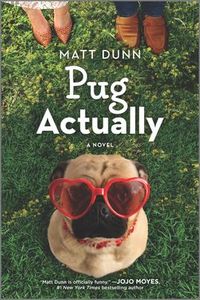
Pug Actually

Pug Actually

by Matt Dunn

Paperback, 313 pg.
Mira Books, 2021

Read: October 5-6, 2021
Grab a copy from your local indie bookstore!

What’s Pug Actually About?

Julie is in a bad relationship, for the last few years she’s been seeing a married man. You know the type—after a few months, he reveals that fact and keeps promising to leave his wife, but… Oh, he’s also her boss. Even if he wasn’t married, he doesn’t treat her well (and is definitely not a dog person). There’s just nothing good to say about Luke.

But Julie really doesn’t see that. Her dad. Jim, and her best friend, Pryia, do—but they can only say so much. But her other best friend, Doug, decides he’s going to do something about it. He starts looking for suitable matches—he doesn’t understand human attractiveness, so he knows he’s at a disadvantage. Early on, he tries to arrange a “meet cute” by knocking over someone’s coffee in the park, but has to abandon that method.

Then Julie is introduced to a recent divorce, Tom. Doug likes him right away (as does Julie’s dad)—even if he is a (gasp) veterinarian. Doug fakes a limp to get taken to Tom’s office, puts up with dog exercise classes in the part, and generally does everything he can to keep the two meeting up. He also steps up his antagonism toward Luke, to try to make it clear to Julie who he prefers.

Doug is a pug who was rescued by Julie and her dad after the death of Julie’s mom. He decides that rescuing can work both ways—and determines that he’s going to find Julie a better guy than Luke.

Without realizing that’s what they’re doing, Jim and Priya help out—discouraging time with Luke and playing up Tom (or anyone else), Jim even is partially responsible for introducing Tom to her.

Slowly something maybe starts between Julie and Tom, and things definitely (and largely independently from the Tom story) get worse between Julie and Luke. And Doug’s along all the while doing his best to help.

The Very Sweet Subplot

When Jim and Doug take their walks, Jim has a habit of stopping by a coffee shop run by a woman named Dot. Dot’s interest in Jim is about as obvious as Doug being a dog. But Jim’s not ready to see anyone after his wife, so is either oblivious or chooses to be. Tom is actually Dot’s son.

About the time that Tom meets Julie, Jim finally opens himself up to the idea of seeing someone. Watching Dot and Jim’s relationship start is possibly the best part of the book (it certainly comes with less drama and more fun).

Doug as Narrator

Going back to Debora and James Howe’s Harold and up through Spencer Quinn’s Chet, I’ve been a sucker for dog narrators. It’s a weakness, and not one I’m in any rush to lose. Doug is one more in a line of dog narrators that has charmed his way into my heart.

Doug’s rather erudite and educated for a canine writer. Sure, there are human things he doesn’t understand, and a few things that a small pug can’t see. But he’s not as easily distracted as Chet, for example. He’s capable of rattling off a Chinese proverb in Chinese—perhaps because he is a pug, because he doesn’t show an affinity for other languages.

He’s also like every dog I’ve ever met, but especially like the pug sitting next to me, and is always hungry—and a little pudgy (hence the need for the exercise class). And while everyone will talk about his need to lose weight, he’s really good at getting them to give him a treat (or finding some on his own).

I really enjoy everyone spelling V-E-T every time they mention Tom’s profession, although as Doug notes, he can spell. The reliable “Big Stretch!” said by everyone who isn’t Luke when Doug stretches brought a grin to my face (and has made me a bit self-conscious when I do the same to my canine companions).

So, what did I think about Pug Actually?

This is a sweet, cute book. Pug Actually is a pretty standard rom-com, you can see most of the story beats coming, but Dunn writes them in an effective way, so who cares? Adding Doug to the mix adds a layer of charm and humor that help make this more than standard.

There’s a moment near the end that really doesn’t seem necessary to add one last hurdle to the Tom and Julie romance. It soured my wife a bit on the book, but me less so. I see where it was necessary—or at least helpful—to give Doug a couple of more shining moments. But the ending was nice enough to make up for whatever stumble that plot point made.

When he was on the Author Stories podcast, Dunn suggested that there might be a sequel in the works. If one appears, I’ll jump on it.

If you’re in the mood for a pleasant, light read, I recommend this. Even better if you’re in the mood for a rom-com. If you’re a dog lover, it’ll help, but even cat people should find plenty to love here.


3.5 Stars

This post contains an affiliate link. If you purchase from it, I will get a small commission at no additional cost to you. As always, opinions are my own.


Abandon All Hope by Scott Spires: A Cynic and an Idealist Stumble Through Life

When I scheduled the A Few Quick Questions with…Scott Spires post and said, I’d get this post up “in a little bit”, I didn’t realize that a transformer was about to blow a couple of blocks away from me, making it pretty difficult to finish/proofread/schedule this post. At least it was the same day. 🙂


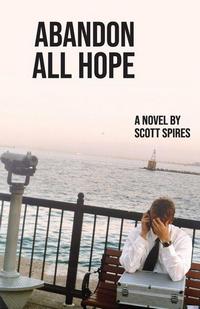
Abandon All Hope

Abandon All Hope

by Scott Spires

eARC, 214 pg.
Auctus Publishers, 2021

Read: October 13-15, 2021
Grab a copy from your local indie bookstore!

What’s Abandon All Hope About?

Set in the 1990s, this novel follows Evan—a cynical writer for an educational software company, Eldritch EduWare (a name that must’ve been the cause of problems for the marketing team—while being fairly apt). He actually commutes to the suburbs to work there, which is a nice twist. Evan doesn’t have a lot of drive or ambition, but he seems to like his life—maybe he could be happier, but he’s comfortable.

One day he encounters Eric, a college dropout. Convinced of his own insight, Eric eschews fiction, music, and the history of philosophy—he doesn’t want anyone else’s ideas. His are pure, new, and will enrich the lives of any who read his book—as soon as he finishes it. To pay the bills, Eric works a succession of temporary jobs, each disastrous in their own way.

Evan is intrigued by Eric, and makes an effort to check in on him from time to time (even trying to hire him for Eldritch at one point), but their storylines are fairly divergent. But common elements are there—we see them socialize (a little bit), muse on art and life, interact with family, colleagues, and supervisors, and so on.

He’s Making a List…

A technique that Spires falls back on often while describing things is the list. For example:

The basic building unit of the bad suburbs was the box. Boxes of various sizes and colors, of concrete, glass, steel and brick, big and small boxes arranged upright and sideways, black, white, gray, brown and transparent boxes, boxes stuck together like Legos or separated by swathes of asphalt, boxes with yards of grass or yards of concrete, could be seen everywhere as you looked out the train window.

Strip malls, mini-malls, and shopping centers alternated with identikit housing developments that bore fanciful names, like Avalon Estates, Balmoral-on-the-Lake, Provence-in-the-Woods, and Renaissance Acres: names that inadvertently highlighted their aesthetic failings.

That’s a lot of dense text that doesn’t say a whole lot—it’s frequently an effective technique. But I think Spires could’ve used a few less and been better for it—a list transitioning to a list transitioning to a list gets a bit mind-numbing. I largely enjoyed the writing, but this was a drawback.

A Scrambled Don Quixote

I typically make a point of not reading anything an author says in our Q&A before I write my post about their book. I’m not sure why I did this time, but if I hadn’t, I wouldn’t have seen his remark about this being a

Don Quixote in reverse – that is, with the somewhat cynical Sancho Panza character being the lead, and the idealistic Don Quixote figure being the secondary protagonist.

There’s part of me that kicked myself for not picking up on that—Spires wasn’t being subtle. At one point, Eric actually equates Evan to Quixote (I was too busy rolling my eyes at the conversation the two characters were having to pick up on it).

Now that I’ve chewed on it a bit now, I can see it to a degree. It’s not one of those insights that opens a fount of meaning to the text—nor is not having it a barrier to understanding the novel*. But it adds some dimension and depth to your understanding.

* He says with only a slightly defensive tone.

So, what did I think about Abandon All Hope?

In the mid-90s, there was a trend of indie movies in the Richard Linklater vein featuring characters who would unburden themselves to each other of their respective philosophical/aesthetic/political takes. This felt a whole lot like those to me. That’s not an evaluation, it’s just an observation.

This novel featured a large cast of unsympathetic and unlikeable characters acting in pretty unsympathetic and unlikeable ways, I’m not sure that there was any growth or development in the primary characters—their circumstances changed, but I think they remained the same (although there are signs that Eric and Evan might be on the verge of growth at the end). But that pretty much describes everyone I know. It might not be what we expect (want?) out of fictional characters, but it’s a pretty solid description of humanity.

This is one of those cases where I think the whole is less than the sum of its parts. A lot of the moments in this book were great–amusing, insightful, interesting—and the same goes for most of the characters. But Spires didn’t combine these moments and characters into a successful overall narrative.

I think overall he might have tried to accomplish too much. If say, Spires cut Evan out entirely (or significantly—just give us his interactions with Eric), in order to spend more time at Eric’s work (maybe requiring more characters there), and I can see my enjoyment of this increasing. Then write another novel about Evan trying to make his way in the world while writing his treatise, I should add. The strength of this book lies in the depictions of these two characters and their career/employment/lack thereof, as the US seems to be in a cultural shift regarding these things at the moment, it’s particularly thought-provoking and relevant on these matters.

Your results may vary, of course. I can think of a couple of people who’d likely disagree (possibly pretty strongly) with me if they picked up the book. I do recommend it for an intriguing experience, and hopefully, in your case something more.

Disclaimer: I received a copy of this novel from the author in exchange for this post and my honest opinion. I thank him for it.


3 Stars
This post contains an affiliate link. If you purchase from it, I will get a small commission at no additional cost to you. As always, opinions are my own.

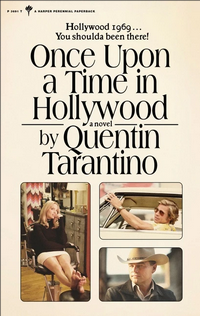
Once Upon a Time in Hollywood by Quentin Tarantino is a thing that I read

Once Upon a Time in Hollywood

Once Upon a Time in Hollywood

by Quentin Tarantino

Mass Market Paperback, 400 pg.
Harper Perennial Paperback, 2021

Read: September 22-23, 2021
Grab a copy from your local indie bookstore!

What’s Once Upon a Time in Hollywood About?

This is novelization—and retooling (as I understand)—of Tarantino’s 2019 movie. It follows two days (with typical Tarantino flashbacks and flashforwards for many of these characters) in the lives of a few people in 1969 Hollywood. A former TV star who had his shot at movie fame, and missed—he’s now a traveling bad guy (“heavy”) guest star on TV shows. His stunt double/gofer/driver, notorious for getting away with murder (and is somehow possibly the most sympathetic character. Also, Sharon Tate, Squeaky Fromme, and Charlie Manson.

The Packaging

I trust whoever put this book together got a nice bonus—or at least a good bonhomie slap on the back—it’s so well done. The whole thing is a throwback—the cover style looks like a movie novelization from the 70s/early 80s, with stills from the film. Inside you get a lot of the full-page advertisements for novels (and novelizations) that were era-appropriate and common in the back of Mass Market Paperbacks at the time.

It was a nice little treat.

So, what did I think about Once Upon a Time in Hollywood?

Eh…I’m not sure. I guess I should say that I didn’t watch the film—outside of the writer/director—there was nothing about it that appealed to me. I only picked this up out of curiosity about Tarantino as a prose-writer. That colored my appreciation of the novel for sure. It’s not surprising at all that a movie that didn’t appeal to me resulted in a novel that left me unmoved.

I’m glad I got to see what Tarantino was like as a novelist. I know what he’s like as a screenplay writer and director. And this was different—but similar. Had this been anyone else writing, I’d have commented on how well they capture the Tarantino-vibe. There are so many (seemingly?) aimless stories shared by characters that can only come from him (or someone trying to rip him off).

There’s also this nice recurring thing where a story is being told—characters introduced, etc.—that turns out to be the characters and story of the pilot episode that the has-been actor is shooting. Sort of a novelization within a novelization. That was neat—and there’s so much more going on in that story and with those characters than is possible for a 1969 TV Western, that I give myself a little slack

But as for the novel itself? Eh, I don’t know. I guess I think I understand the point—I just don’t see where they were stories that need to be told. It wasn’t a bad novel, and I don’t resent the time I spent reading it (as I frequently do with books that don’t work for me)—and I enjoyed bits of it quite a lot. But I’ve got nothing to say good or ill about it. Put this down as the most tepid of 3 stars.


3 Stars

This post contains an affiliate link. If you purchase from it, I will get a small commission at no additional cost to you. As always, opinions are my own.
The Friday 56 for 9/17/21: Headphones and Heartaches by Wesley Parker

The Friday 56This is a weekly bloghop hosted by Freda’s Voice.

RULES:
The Friday 56 Grab a book, any book.
The Friday 56 Turn to Page 56 or 56% on your ereader. If you have to improvise, that is okay.
The Friday 56 Find a snippet, short and sweet.
The Friday 56 Post it

from Page 56 of:
Headphones and Heartaches

Headphones and Heartaches by Wesley Parker

We share a long hug, and I apologize for being so moody lately.

“You’re a teenager. I’d have you committed if you weren’t.” She pecks me on the forehead and all is well in our house again. “I was thinking, you start school and your new job on Tuesday, so what would you say about getting a hotel and spending the weekend in New York City?”

“Are you serious?”

She frowns. “No, I enjoy getting your hopes up and crushing them. Of course I’m serious.”

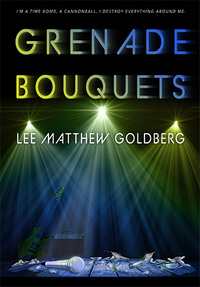
PUB DAY REPOST: Stalker Stalked by Lee Matthew Goldberg: Who Watches the Watchers? Who Stalks the Stalkers?

Stalker Stalked

Stalker Stalked

by Lee Matthew Goldberg

eARC, 245 pg.
All Due Respect, 2021

Read: September 7, 2021

What’s Stalker Stalked About?

Lexi Mazur is a pharmaceutical sales rep who has a habit of sampling her products in addition to drinking pretty heavily. When her boyfriend of about a year breaks up with her, things get worse. Her pill uptake and drinking increase, and she escapes into Reality Shows like The Real Housewives of ______, and her new obsession (literally), Socialites. She’d been heavily invested in those shows before—it was a bone of contention with her ex—but she sunk to pathological levels after the break-up.

Soon, Lexi begins showing up at locations that she knows one or more of the stars of Socialites will be, trying to put herself in a situation where their paths will cross, in the belief that it’s all it will take for them to befriend her. Once they’re friends, her life will improve and she’ll get a bit of the glamorous life they have—maybe even a role in the show.

She has some reason to think that this behavior will work—it has been the foundation (and eventual doom) of her romantic relationships.

Yeah, Lexi is a stalker—she just has a new outlet for these impulses. Her behavior and substance abuse spiral to new depths. We get some details about her prior issues and behaviors, but the novel primarily documents her descent to rock bottom.

That would be enough for most authors, but here’s where Goldberg throws in the plotline that makes Stalker Stalked stand out. In the midst of all the above, Lexi starts to sense that someone is watching her. Stalking her. Is it one of her exes? Is it someone from Socialites? Is it just her imagination, maybe a side-effect of some of the medication she’s abusing?

And then the threats begin…

Low-Hanging Fruit?

Lexi’s story aside (as much as you can do that kind of thing in this book), this book is a sharp satire and critique of TV Reality Shows.

As I read it, I wondered occasionally about Goldberg picking a target that’s too easy. Where’s the challenge in taking shots at Reality Shows?

As easy a target they might be, it’s a target that seems to demand this kind of attention and examination. The cultural impact of this kind of shows—and the social media influencer accounts (and wanna-be social media accounts) that tell the same kind of fictions—is large enough, disturbing enough, that we need as many artists in as many possible media to put them under the microscope.

Looking at this phenomenon through Goldberg’s lens something jumps out at me (and I realize that I’m probably fifteen years behind other people on this insight), this kind of reality shows provide a socially acceptable form of stalking for the masses. How many people think they’re getting a special kind of insight into the lives of these stars? A special, private, view of their day-to-day life? How many unbalanced viewers like Lexi are out there learning that this is an appropriate way to live and take the license to do the same but for people who aren’t on TV?

So, what did I think about Stalker Stalked?

I didn’t like Lexi—at all—for the majority of the novel. I wouldn’t have described myself as terribly invested in what was going on with her or in her well-being. She’s just unsympathetic, unpleasant—the kind of character that most novels would have cast as the villain (one you may ultimately find sympathy for).

As much as I wasn’t able to get invested in her as a character, I couldn’t stop reading. Something about the novel—and I really should be able to put my finger on what it was, but I can’t—gripped me like a Lee Child or Nick Petrie thriller. Compelling doesn’t quite express it—I had to know what was coming next. Lexi was like the proverbial car wreck that you can’t take your eyes off of. Also, I was pretty curious about some of the people around Lexi, how were they going to fare in the face of her problems.

Eventually, however, I started pitying Lexi. I started understanding how she got where she is and how she was tumbling toward rock bottom.

Stalker Stalked is a gripping read, a tragedy that you can’t look away from—that you can’t get enough of. It’s disturbing and thought-provoking. You’re going to want to get your hands on it.


4 Stars

Disclaimer: I received this eARC from Down & Out Press via NetGalley and Lori Hettler of The Next Best Book Club in exchange for this post—thanks to all of them for this.

Headphones and Heartaches by Wesley Parker: Sweet, Honest, Heartbreaking, and Heartwarming

You know how sometimes just the right book comes at just the right time? A book you don’t realize you needed until it had done its job on your psyche? As you’ve probably guessed, that’s what Headphones and Heartaches was for me. So, yeah, this is going to be a rave. It’s also going to be shorter than I want it to be, but that’s only because this won’t ever get posted if I keep tweaking and rewriting it (this was supposed to go up seven days ago).


Headphones and Heartaches

Headphones and Heartaches

by Wesley Parker

Kindle Edition, 324 pg.
2021

Read: September 2-6, 2021
Grab a copy from your local indie bookstore!

“One day you’re gonna look back and realize these are the best days of your life.”

I’m living in a foster home while my mother is getting treatment for a heroin addiction. If these are the best days, maybe I should just give up now.

What’s Headphones and Heartaches About?

Percy Martin is sure that the social worker he meets next to his mother’s hospital bed means well. But Percy’s not interested in what he’s offering, Percy trusts that he can do better on his own than any foster situation that Alex can put him in. When they meet, no one’s sure that Percy’s mother will survive her latest overdose, and Alex’s hands are tied.

So he makes Percy an offer—stick with this foster parent a year, and Alex will do what he can to reunite Percy and his mom. There’s an earnestness about Alex, and (he won’t really admit this to himself) Percy just wants a break from it all—so he accepts the offer.

Alex brings him to Grace Wilson*. A kind, gracious, waitress who has decided the right thing to do is open her heart and home to a teen who needs both. Percy’s life is changed forever immediately.

* I should devote 3-4 paragraphs to her, but I don’t have the time, but she’s a great character.

He has food—and never has to worry about where the next meal is coming from. She helps him get money—and learn to manage it. He learns to sleep on a bed. He makes friends—real friends. He falls for a girl. He—and he says this several times—has a chance to be normal.

And he loves it. How could you not?

But he’s torn—because the cost of all of this change is the relationship with his mother. He feels he’s abandoned her, taken away her motivation to change, removed his support from her when she needs him the most. Is having a better life worth that?

Opium’s Victims

Percy’s mom, Wanda, is never made out to be the villain of the piece. Never. She is deeply flawed, and Percy doesn’t flinch from that. But she’s also the one constant in his life and has clearly done what she can to be a mother and provider to him. She clearly loves him.

But her addiction runs her life, she battles it, but not effectively, and that has consequences for both of them.

One of Parker’s most successful moves is showing that the statistics and reports about the opioid epidemic underreports its victims. It’s not just Wanda—it’s Percy. It’s Grace. It’s Percy’s friends. If Wanda had other family or friends, they would be in that number. And it’s likely that the turmoil, emotional upheaval, and financial impact goes beyond Grace and Percy’s friends to their friends and family…and so on. Percy thinks he can even see the toll this takes on the Judge dealing with his foster care. Yes, Wanda is the primary victim, and addicts like her ought to be the focus of the efforts to combat the epidemic—but not the sole focus.

Headphones, Comedy Albums, and Mixtapes

The 3.5mm jack connects my favorite artists right into my soul like an IV, securing my hopes and dreams that wither under the assault of everyday life. They’ve been there on the nights when the heat wasn’t, at the dinner table when the food wasn’t, reminding me that better times would come, even if they couldn’t give me an estimated arrival date.

Percy finds refuge from his circumstances in movies (VHS tapes he can buy at pawn shops and the like) and music (largely pirated from public library offerings). Music is the one he talks more about, and he has strong opinions about it—while also having very eclectic tastes.

What kind of strong opinions? Aside from Rob Sheffield or Nick Hornby’s creation, I haven’t seen anyone with such detailed specifications for putting together a mixtape—and I loved watching him obsess about things like that. He has much more to say on the subject of wired headphones than I quoted above—and who cares that much about those? I could go on, but you get the idea.

Along the same lines…what he and Grace say about comedy albums? I didn’t realize other people felt that way about them, too. I really would like to see a second edition of the book (or a companion book) containing essays Percy writes for English class about things like comedy albums and their impact on his life, and various topics related to music/music appreciation. Just based on what he says in this book, they’d be fantastic.

It’s things like this that transform Percy from a pitiable kid in hard circumstances to a rounded character that you can develop an emotional bond with. Parker truly nailed this kind of thing.

Categorizing

By and large anymore, it seems that if the book is about a teenager, it must be a Young Adult novel. But it doesn’t seem as if this is being marketed as one. Would it work for a YA audience? Sure. Well, at least I think it would. But really it works for anyone who likes a good coming-of-age tale.

Percy is a teen—and his emotions swing widely and quickly as such. But anyone who is, or who can remember, what that’s like will easily be able to appreciate that. At the same time, thanks to his hard life, he has a certain perspective that gives a layer of maturity to his thinking—so snooty “adult” readers don’t have to sully themselves with something like a book written for teens.

So, what did I think about Headphones and Heartaches?

On Wheel of Fortune there’s always one guy that keeps asking for letters even though it’s clear to everyone else what the answer is. I feel like that guy right now, because in my heart I know the answer, I’m just hoping that it’s the wrong one.

With only a couple of exceptions, the adults that Percy meets after his mother’s overdose are almost too good to be true. I’d be tempted to call them all Mary Sues/Marty Sues. But part of it is that for Percy, these are responsible, caring, adults trying to help him—it’s easy to see why Percy would largely describe them in glowing terms. And even then, the adults aren’t boring—they’re interesting, funny, and inspirational.

But the exceptions? Boy howdy, they are definitely not too good (nor are they too bad to be realistic…). But let’s not focus on them

But Percy and his classmates, playmates in flashbacks, and friends are absolutely well-rounded and developed—as they’re (largely) the focus of the book, that’s the important part. They sound like, think like, and feel like teens (with varying degrees of maturity). They’re some of the better teen characters I remember reading.

You take characters like that and put them out into the world, and you’ve got yourself a good start to a novel. Add in a compelling story—and an emotional depth that fits the characters, and you’ve got a knockout. This is what Parker has delivered.

As the end neared, I jotted a note,”I am going to end up crying.” And while I didn’t technically weep, there were several moments as I finished the book that I came awfully close to it. Those moments were all over the map, I should add—heartbreaking, tragic, heartwarming, and just sweet. Parker just doesn’t get you with human grief and anger, he gets you with the wonderful moments, too.

This is a sweet book, a touching book—an occasionally hilarious book (with some truly cringe-worthy beats)—I guess it’s best summed up as a very human book. Parker got me to feel all sorts of things for these characters, to a degree I didn’t expect or was prepared for.

This is a special one, reader. You’d do yourself a favor if you picked it up.


5 Stars

This post contains an affiliate link. If you purchase from it, I will get a small commission at no additional cost to you. As always, opinions are my own.

Stalker Stalked by Lee Matthew Goldberg: Who Watches the Watchers? Who Stalks the Stalkers?

Stalker Stalked

Stalker Stalked

by Lee Matthew Goldberg

eARC, 245 pg.
All Due Respect, 2021

Read: September 7, 2021

What’s Stalker Stalked About?

Lexi Mazur is a pharmaceutical sales rep who has a habit of sampling her products in addition to drinking pretty heavily. When her boyfriend of about a year breaks up with her, things get worse. Her pill uptake and drinking increase, and she escapes into Reality Shows like The Real Housewives of ______, and her new obsession (literally), Socialites. She’d been heavily invested in those shows before—it was a bone of contention with her ex—but she sunk to pathological levels after the break-up.

Soon, Lexi begins showing up at locations that she knows one or more of the stars of Socialites will be, trying to put herself in a situation where their paths will cross, in the belief that it’s all it will take for them to befriend her. Once they’re friends, her life will improve and she’ll get a bit of the glamorous life they have—maybe even a role in the show.

She has some reason to think that this behavior will work—it has been the foundation (and eventual doom) of her romantic relationships.

Yeah, Lexi is a stalker—she just has a new outlet for these impulses. Her behavior and substance abuse spiral to new depths. We get some details about her prior issues and behaviors, but the novel primarily documents her descent to rock bottom.

That would be enough for most authors, but here’s where Goldberg throws in the plotline that makes Stalker Stalked stand out. In the midst of all the above, Lexi starts to sense that someone is watching her. Stalking her. Is it one of her exes? Is it someone from Socialites? Is it just her imagination, maybe a side-effect of some of the medication she’s abusing?

And then the threats begin…

Low-Hanging Fruit?

Lexi’s story aside (as much as you can do that kind of thing in this book), this book is a sharp satire and critique of TV Reality Shows.

As I read it, I wondered occasionally about Goldberg picking a target that’s too easy. Where’s the challenge in taking shots at Reality Shows?

As easy a target they might be, it’s a target that seems to demand this kind of attention and examination. The cultural impact of this kind of shows—and the social media influencer accounts (and wanna-be social media accounts) that tell the same kind of fictions—is large enough, disturbing enough, that we need as many artists in as many possible media to put them under the microscope.

Looking at this phenomenon through Goldberg’s lens something jumps out at me (and I realize that I’m probably fifteen years behind other people on this insight), this kind of reality shows provide a socially acceptable form of stalking for the masses. How many people think they’re getting a special kind of insight into the lives of these stars? A special, private, view of their day-to-day life? How many unbalanced viewers like Lexi are out there learning that this is an appropriate way to live and take the license to do the same but for people who aren’t on TV?

So, what did I think about Stalker Stalked?

I didn’t like Lexi—at all—for the majority of the novel. I wouldn’t have described myself as terribly invested in what was going on with her or in her well-being. She’s just unsympathetic, unpleasant—the kind of character that most novels would have cast as the villain (one you may ultimately find sympathy for).

As much as I wasn’t able to get invested in her as a character, I couldn’t stop reading. Something about the novel—and I really should be able to put my finger on what it was, but I can’t—gripped me like a Lee Child or Nick Petrie thriller. Compelling doesn’t quite express it—I had to know what was coming next. Lexi was like the proverbial car wreck that you can’t take your eyes off of. Also, I was pretty curious about some of the people around Lexi, how were they going to fare in the face of her problems.

Eventually, however, I started pitying Lexi. I started understanding how she got where she is and how she was tumbling toward rock bottom.

Stalker Stalked is a gripping read, a tragedy that you can’t look away from—that you can’t get enough of. It’s disturbing and thought-provoking. You’re going to want to get your hands on it.


4 Stars

Disclaimer: I received this eARC from Down & Out Press via NetGalley and Lori Hettler of The Next Best Book Club in exchange for this post—thanks to all of them for this.

A Beginner’s Guide to Free Fall by Andy Abramowitz: The best and the worst things in life are sudden

A Beginner's Guide to Free Fall

A Beginner’s Guide to Free Fall

by Andy Abramowitz

Kindle Edition, 396 pg.
Lake Union Publishing, 2020

Read: August 9-11, 2021
Grab a copy from your local indie bookstore!

The Opening

Four months from now, on a secluded beach in Turkey, Davis Winger, who came thousands of miles to start over, will drop his towel and paperback on the sand, wade into the sea, and end up under the tire of a Hyundai that has just come screeching over an embankment. He will be trapped under that car, pinned to the seabed with one final breath crowding his lungs. Time enough to lament that his daughter might now grow up without him; that he might never hear words of forgiveness from the woman he adored, and betrayed; that he might not live to build the roller coaster that his six-year-old had dreamed up from a storybook and that he had spent the summer engineering into reality. Constructing that ride, harnessing his daughter’s giddy vision into a set of blueprints, was his best shot at winning back the people he loved and hurt and lost. The promise of redemption was slipping away. All alone and far from home, he’ll reach for the surface as the sea encloses.

That autumn day was coming. But today it was still spring, a mild Saturday in May, and when Davis awakened next to his wife in the charmingly overgrown Baltimore neighborhood of Mount Washington, he was still gainfully employed and still welcome in his own home.

With an opening like that, how do you follow it up? No really, how do you? How do you get your readers to care about your protagonist and what he’s going through when you know this is what he’s headed for?

Well, enough of that…let’s get on with the post.

What’s A Beginner’s Guide to Free Fall About?

Davis Wagner has one of those jobs that you have a hard time believing people actually have, but clearly, someone does. He designs amusement park rides, like roller coasters. Which is cool enough—but he’s witty, friendly, compassionate, has a great daughter, a wonderful wife, and so on. He’s close with his sister, his father, and his father’s…partner, I guess. (she’s lived with him for years, so girlfriend doesn’t seem to fit…)—Davis’s mother ran off with her therapist when he and Molly were young, leaving them to be raised by their father.

But we know from the opening paragraph above, that this charmed life doesn’t stay charmed—after introducing the reader to this family, Abramowitz starts dismantling Davis’s life—after an accident (that Davis bears no responsibility for), his career is on the line; after something that Davis bears all the responsibility for, his marriage is in shambles and doesn’t look like it’ll recover. The only thing that Davis has left is his relationship with his young daughter in the summer before her first-grade year.

In the (apparently) four months he has left on Earth, can Davis build on the foundation of his relationship with his daughter to save his marriage and career?

There are other plotlines, sure, but this is the focus of the book and the weakness of it drags down the rest.

Molly Winger— Not Pictured

The high school yearbook was basically Davis’s personal photo album, but when Molly graduated three years later, below her photo it read: “Molly Winger—Not Pictured.” And the thing is, she was pictured. Her photo was right there, above the words “Not Pictured.” That was the essence of Molly. Seen yet somehow undetected. There but unaccounted for. Actually, she preferred it that way.

I just loved that idea—well, I mean, it’s depressing as all get out when you think about what that says about Molly—but it’s a great image.

Molly’s still pretty undetected. She writes for an independent newspaper—one limping along financially—as if there weren’t another kind—primarily writing features, but really doing whatever she has to help keep it afloat. She’s dating someone years younger than her, and in no way right for her (or she for him)—she’s smart, literate, cultured. He’s in his mid-twenties, and when he’s not working, he’s playing video games or watching horror movies with his “boys.”

While her brother is trying to put his life back together, Molly stumbles upon a series of articles that will help her confront her own demons, help her readers, and maybe get her detected by people.

I’m glad I read this book if only for the Molly storyline/storylines—Abramowitz was at his strongest here. A character you can sympathize with, chuckle at, and hope for.

Sibling Rivalry

At some point years before we meet them, Davis and Molly started playing this game—Davis would call her out of the blue, and they’d pitch horrible ideas for businesses to each other. For example, a store that sells concert T-shirts for bands that you wouldn’t want to wear in public—Hanson, Sheena Easton, Julian Lennon, Spin Doctors, and so on.

It’s one of those things that makes the most sense in terms of siblings—a running joke that they may not be able to remember the origins of, but it’s something they’ll always do. When you stop and think about it, it’s really sweet.

If you don’t stop and think that much and just read the ideas? They’re hilarious.

Tom Petty

Similarly, Davis amuses himself by working Tom Petty song titles into his conversation around or about one character. It’s a strange way of showing affection, but it works. Sure, I think it’d get annoying in real life—but it’s exactly my kind of humor.

So, what did I think about A Beginner’s Guide to Free Fall?

It took me a long time to be able to care about Davis and his woes, much less his attempts at rehabilitation. I just couldn’t shake the opening paragraph. But I eventually came around and appreciated that part of the novel (which is good, because it’s the majority).

Still, I’d have probably DNFed this if Molly wasn’t around—the character and what she does in the novel are its saving graces.

Abramowitz can write a sentence—I really enjoyed the voice, the way he told the story (well, after the opening), and the themes he explored. I laughed and was moved, and thought a little about life. A Beginner’s Guide to Free Fall is worth the time and effort, you’ll enjoy it.


3 Stars

20 Books of Summer '21

This post contains an affiliate link. If you purchase from it, I will get a small commission at no additional cost to you. As always, opinions are my own.
Love by Roddy Doyle: Pull Up a Stool, Order a Pint, Listen In on This Conversation

Love

Love

by Roddy Doyle

Hardcover, 327 pg.
Viking, 2020

Read: August 19-20, 2021
Grab a copy from your local indie bookstore!

—Well, that was how it felt, he said. —Like we’d never been apart.

—But—.

—I know, he said. —I know. We’d never been much together. But I’m talking about feelings here, not facts. Feelings. The feel of the thing.

It sounded like something he’d said before. More than once.

What’s Love About?

Joe and Davy are men in their 50s—in their 20s, they were drinking buddies, spending every weekend together at as many Dublin pubs as they possibly could. Eventually, they grew out of it. Davy moved to England with his wife. Joe settled down, too.

Now they see each other once or twice a year when Davy comes over to visit his father. It’s really the only time Davy drinks anymore. And, boy howdy, do they drink a lot.

This novel takes place over the course of one night/early morning, starting after dinner when they have a couple of drinks. Joe has a story he wants to tell Davy, he needs to unburden himself. Davy has something he needs to talk about, too, but he won’t let himself.

And that’s the novel—the two going from pub to pub, having a couple of drinks, and moving on. Sometimes out of choice, sometimes because they got a little too loud and are asked to leave. They walk a bit, sober up a touch (while continuing their conversation), and find a new pub to have a pint or two in before being asked to leave.

And if that doesn’t sound that interesting to you, have you ever listened to a couple of Irish people telling stories?

The Title

In the cleverly titled book, The Four Loves, C. S. Lewis posits that there are four different types of love and spends some time describing each.* Others have come up with different numbers, different categories. Which is just to say that the concept of “love” is a tricky one to nail down. To borrow Justice Stewart’s phrase, most of us know it when we see it, and most of us settle for that.

* It’s beside the point, but I feel compelled to list them: Affection (storge), Friendship (philia), Romantic (eros), Charity (agape).

All this is to say, it’s really impossible to know precisely what the title refers to—there are several types of love displayed in this book, and I can see some people trying to argue for which one is most fitting.

After a little thought, I’ve decided that Doyle is referring to them all (and I don’t think that’s a cop-out). It’s about two men struggling—and aided by several of the pints in the cover image—to find ways to talk about love.

Feelings

There is a reason why men don’t talk about their feelings. It’s not just that it’s difficult, or embarrassing. It’s almost impossible. The words aren’t really there

That’s from the beginning of the book, Davy’s narration noting the difficulty that Joe’s having getting his story started. It’s seen a few times after that (I should point out that at least Joe is trying, Davy’s avoiding it entirely).

Which is where beer comes in, I guess. Joe never quite expresses himself the way he wants—Davy doesn’t help that much, really—but he gets asymptotically close. The number of pints they consume to get him to the point where he gets close is enough to make my liver sick. Part of the enjoyment of this novel is watching these two try to get the words right.

—The drink is funny, though, isn’t it? You see things clearly but then you can’t get at the words to express them properly.

—Or somethin’.

—Or somethin’, yeah.

Conventional wisdom suggests that two women wouldn’t need that much alcohol—or any, really—to achieve the same ends, if not do a better job of expressing and understanding the emotions being discussed. I expect that wisdom is right (but wouldn’t die on that hill)—and the ensuing novel might be less entertaining. Still, I’d like to see someone give it a shot.

So, what did I think about Love?

—It’s a thing abou’ gettin’ older, he said. —At least, I suppose it is. So many memories, you know. It become, harder to separate wha’ happened from wha’ might’ye happened an’ wha’ didn’t happen but kind o’ seemed to.

He was looking at me.

—Is it? he asked.

—Is memory reliable? I said. —Is that wha’ you mean?

—I think so, yeah. yeah.

This is a novel about love—obviously—and old friends, memory, nostalgia, the power of reminiscing, aging, dealing with the past (whether it happened or not), family, forgiveness, trust…and a few more things, too. All discussed in the story that Joe’s telling and the stories that Davy isn’t telling.

When I read this in a couple of years, it wouldn’t surprise me if I come up with a different list of subjects.

But in a sense, it really doesn’t matter what you think the novel is about—it can be enjoyed and chewed on just with the surface. A couple of old friends talking.

Doyle’s dialogue is as strong as it ever was. The dialect makes it jump off the page, you don’t so much read this book as hear it with your eyes.* It is funny, it is tragic, it’s heartbreaking, it’s wistful, and occasionally silly. It runs the gamut—both for the characters and the reader.

* Yeah, I know, I know. Roll with it, will you?

If you haven’t read Doyle before—this is a pretty good ice-breaker. If you know his work, this is exactly what you expect (a little closer to the feel of The Barrytown Trilogy than A Star Called Henry or Paddy Clarke Ha Ha Ha). His idiosyncratic punctuation and approach to dialogue tags and paragraphs might cause you to stumble at first—but once you catch on, you won’t even notice it.

It’s like you’re sitting there on a night on the town with these two, just catching up with old friends and enjoying the conversation with them (even if you’re not holding up your end). And who doesn’t think that sounds like a fun time?


4 Stars

20 Books of Summer '21

This post contains an affiliate link. If you purchase from it, I will get a small commission at no additional cost to you. As always, opinions are my own.
The Friday 56 for 8/20/21: In Ten Years by Ian Shane

The Friday 56This is a weekly bloghop hosted by Freda’s Voice.

RULES:
The Friday 56 Grab a book, any book.
The Friday 56 Turn to Page 56 or 56% on your ereader. If you have to improvise, that is okay.
The Friday 56 Find a snippet, short and sweet.
The Friday 56 Post it

from Page 56/ of:
In Ten Years

In Ten Years by Ian Shane

“You turn thirty-nine today.”

“Yeah, I know. It says so on the cake.”

“You turn forty next year.”

“I can also do first-grade math, Max. Is there a point anywhere in our future?”

“Don’t you think it’s time to find a nice girl?”

“I already have one mother, Max. I have no need for a second.”

“Sarah wants a girl to talk to when we get together.”

“I’ve brought girls.”

“None of them stick around long enough for Sarah to get attached to. Besides, you haven’t even had one of those disposable dates in a while.”

Page 13 of 46

Powered by WordPress & Theme by Anders Norén