Tag: Mystery/Detective Fiction/Crime Fiction/Thriller Page 53 of 61

A Few Quick Questions with D. B. Borton

Can you describe your initial path to publication with these books, and why are you reissuing them now?

I had been reading a mystery featuring an older woman detective, and the stereotypical portrayal just made me angrier and angrier. I threw the book against the wall and told myself, “I can do better.”

I wrote the book and signed on with an agent, who told me that she’d found the first chapter so hilarious that she’d read it to her sister over the phone. A year passed and I didn’t hear anything from my agent. Meanwhile, my cherished 18-year-old feline companion died (the book is dedicated to her). The grief opened a hole in my life that swallowed everything, including my writing aspirations, and I asked myself why I’d ever thought anyone would want to read my writing. The day after I hit bottom, I pulled myself together, sniveled my way over to the bookstore, and bought a book called How to Write a Mystery. The next day, my long-lost agent called to say that she was very close to selling the book to Berkley. I think the same first chapter sold the book to my editor at Berkley, who, as it turned out, also edited the series about an older woman detective that had made me so angry to begin with.

The first chapter never appeared in the final book. In it, the 59-year-old protagonist got her period in a department store dressing room, and had an epiphany: if Mother Nature couldn’t provide her with the Change of Life, she would have to make her own change. Some early readers advised Berkley against including it.

As for why I’m reissuing the series now, the economics of independent publishing has a lot to do with it. Series tend to be more profitable than single books. That’s the economic answer. But this series has always inspired a strong loyalty in many readers, who seem to identify with the protagonist. Over the years, I’ve continued to receive the occasional inquiry from a fan (or a fan’s daughter) looking for a complete set.

The community that Cat builds (or finds building around her?) in the apartment that ends up giving assistance and support to her is a frequent feature in female P.I. novels. Is there a particular reason for that, what is it about a female P.I./P.I.-type protagonist that lends itself to that in a way that your typical male P.I. doesn’t? How did you pick your residents of Catatonia Arms?

Interesting question. Women have, of course, traditionally done the cultural work of community building, so I suppose their take on detective fiction reflects that. But when I think of the classic writers, that strong sense of community isn’t there. Miss Marple is strongly identified with St. Mary Mead, and she often finds mystery when she’s off visiting friends, but the recurring characters are few. Girl detectives, on the other hand, have been embedded in communities since the modern girl detective emerged in L. Frank Baum’s Mary Louise series. At first, girls weren’t taken seriously as readers (or purchasers of detective novels), but when they were, publishers wanted to reflect the experiences and interests of their readers. So like Nancy Drew, Bess, and George, girl detectives have always traveled in packs, or at least in pairs.

I’m not really sure how I picked the residents of the Catatonia Arms, except to say that they all bring special knowledge and skills with them. Adding a retired cop at the end of the first book really completed that skill set while giving Cat an older ally against the young people.

There are a number of characters I’d like to ask you about, but I’m going to limit myself to Phyl Stinger, was there a particular historical inspiration for her? If not, just where did she come from?

I guess she’s a composite of several Hollywood screenwriters I’d read about and my imagination — writers like Frances Marion, Anita Loos, and June Mathis. I imagined that they’d have to have been tough as nails to survive in Hollywood.

I loved the way that Cat drew from her reading to guide her through her investigation/expectations of the P.I. job/wardrobe. Unless I’m mistaken, Spenser was the most prominent source of inspiration—is that because of something about the character himself, or given the time period, was he just the easiest to reference? Is there someone you wanted to work in a reference to, but couldn’t quite fit in?

I’d say that Robert B. Parker was a big influence on me.  He’s a male writer who created the kind of community you were talking about around his male P.I. Spenser. The Spenser books have a lot of heart, and they’re very funny. Later books in the series reference other fictional detectives, like Kinsey Millhone, V. I. Warshawski, and Kinky Friedman.

Let’s play “Online Bookstore Algorithm” (a game I’ve recently invented). What are 3-5 books whose readers may like One for the Money?

Oh, I like this game! As someone who’s always looking for comparable authors for advertising purposes, I’d love to hear what other people would say. A recent reviewer said that fans of Dorothy Gilman’s Mrs. Pollifax and Sue Grafton’s Kinsey Millhone would like it, and I’d agree. Also fans of Elizabeth Peters’s Amelia Peabody and, of course, Christie’s Miss Marple. Jana Deleon’s Miss Fortune series features some older women detectives who are a lot of fun.

What’s next for D. B. Borton?

I’ve been working on a standalone about a librarian who inherits a fortune, a valuable library, and a dangerous mission to return a handful of library books. I’m also planning to reissue the rest of the Cat Caliban books. And I’ve started thinking about a new Cat Caliban.

Thanks for your time, and this fun read, I’m looking forward to working my way through the rest of the series

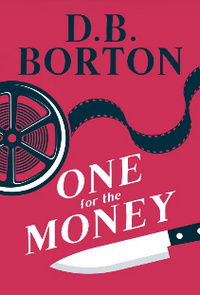
One for the Money by D. B. Borton: This Would-Be Gumshoe Gets By on Her Charm, Wit, Gumption, Friends and a Healthy Dose of Expletives

Later this morning, I’ll be posting a Q&A with the author–be sure to check it out.

One for the Money

One for the Money

by D. B. Borton
Series: Cat Caliban, #1

eARC, 224 pg.
Boomerang Books, 2020

Read: December 1-3, 2020
Grab a copy from your local indie bookstore!

What’s One for the Money About?

Cat Caliban’s a recent widow, who is ready for a change (since she is still waiting on the Change), and takes the bull by the horn and gets herself her change. She buys an apartment complex, moves herself and her cats into one of the apartments there, and pursues a new career—becoming a Private Investigator. Between the suspicious nature and investigative abilities raising three kids has gifted her with and the extensive research she’s done into the P.I. lifestyle (read: reading plenty of P.I. Novels, from Nancy Drew to V. I. Warshawski).

Most of her kids, and most people from her old life, don’t approve of this new stage of her life—and she could not care less. Instead, she assembles a new group of friends who are on board with this change—with one carryover from her old life. And the tenants of her apartments end up being a strong base for those friends.

Of course, there’s a snag there—when showing a vacant apartment to a couple of potential renters, they discover a murdered woman. Almost immediately, Cat begins annoying the investigating officers by trying to look into the death herself. When it’s discovered that the victim is a homeless woman, the priority that the police put on solving the murder drops, but Cat’s drive to find justice for the woman increases.

Sure, she’s still learning the basics of investigating, but she catches a couple of lucky breaks and makes good progress. She also connects with people—friends of the victim, people she worked with, an activist group she was involved with, and someone who probably saw the victim and the killer minutes before the murder—in a way that the police don’t. People respond to this older woman who cares about the woman—not just her death, but the life she led.

One thing leads to another, and Cat’s hot on the trail of both the killer and what could have prompted the killing in the first place.

I’m a Sucker for this Kind of Thing

I am a sucker for fictional PI/PI-types who largely (or entirely) learn their way through detecting via PI novels like Lee Goldberg’s Harvey Mapes (in The Man With The Iron-On Badge, now called Watch Me Die) or Jim Cliff’s Jake Abraham (in The Shoulders of Giants)—Bobby Saxon, from The Blues Don’t Care, took a similar approach with Bogart movies.

Maybe it’s because this is the kind of detective I would be if I had the gumption to try. At the very least I can easily identify with these people, they’ve read the same things I’ve read. We think along the same lines. Watching them draw upon their fictional examples to try to decide how to deal with their cases is just fun.

Naturally, Cat (and Borton), get extra credit from me for the number of times they invoke Spenser. But it works no matter what character she’s referencing.

The Supporting Cast

Cat’s the focus—and she should be—but she wouldn’t be anywhere without the other characters that she bumps up against (we’ll ignore the principles/suspects in the investigation). The book might still be good with just Cat and the suspects, but what frequently makes a book worth reading are the secondary and tertiary characters—and Borton fills the novel with people worth reading about.

The people that fall into her life in this novel almost seem too convenient—wow, Cat makes a friend who happens to be able to help her learn to shoot. One of the first people she rents an apartment to happens to be a lawyer who can help her get through the city’s legal system, what a crazy coincidence! But once you shrug that off (what novel isn’t filled with that kind of thing)

There’s an elderly screenwriter character who is a delight. She adds a crucial detail or two that Cat needs to put everything together, but more than anything else, she’s just fun to read. Borton brings in a few characters like that—they’re around for one or two conversations, but it feels like Borton spent as much time and energy into developing the character for those conversations as she did for the killer or one of the other prime suspects.

I want to talk about the witness to the crime—and his family—but I just don’t think I can do them justice without ruining something. But Borton’s choices in including him, and the way she did so, are a real strength of the novel.

Even the cats are well-written and likable (long-time readers of this site will recognize how odd that is for me to say)

So, what did I think about One for the Money?

Last year, I wrote about Luna Miller’s The Lion’s Tail (apparently now called Looking for Alice), about a sexagenarian rookie P.I. Sure, Gunvor Strom is a little older than Cat, and the novel’s darker—but it’s along the same lines.* I really appreciated the way that neither of these women are allowing themselves to be held back by their age, their sex, their past—their utter lack of experience—they can make a difference, they have something to contribute, and they have the drive.

* I mostly bring it up in case readers are asking themselves, didn’t he talk about this before? Also, because readers of one of these are really going to want to read the other.

Cat and the team she assembles do the one thing the police are unwilling/unable to do: they can focus on the victim and her life to the exclusion of all else. She can get people to talk to her who wouldn’t talk to the police out of principle or intimidation. They open up to her, they tell her things they wouldn’t tell others.

She’s also smart enough and driven enough to keep going until the facts she uncovers fit together in a way that makes sense.

And Borton delivers all this in an engaging, easy style that makes you want to keep turning the pages. It’s a fun story, with a great group of characters that you can’t help but root for, and you not only want to find out what happens but you want to know what happens next. I’ll be back for the rest as soon as I can, but in the meantime, I’m glad I got to read this one and think you will be, too.

Disclaimer: I received a copy of this novel from the author in exchange for my honest opinion and this post.


3.5 Stars

This post contains an affiliate link. If you purchase from it, I will get a small commission at no additional cost to you. As always, opinions are my own.

A Few More Quick Questions with Gray Basnight

Not only do I really appreciate Basnight’s taking the time to do this, but Lisa Weiss, the publicist who got me this book has been very helpful and encouraging. I wanted to thank her, too. This is one of the best sets of Answers I’ve received to my Questions, I hope you enjoy it, too.

The last time we did a Q&A, you said you were finishing a sequel to Flight of the Fox, I assume it was this, what was it about Sam Teagarden that made you want to write a sequel about him (an idea that Sam himself jokes about)? Is there a third book for the professor?

There are two reasons Sam Teagarden puts in this reappearance in Madness of the Q.  The first was reader feedback.  In fact, this sequel is dedicated to those readers who wanted another roller coaster ride with my mathematics professor, who’s dubbed by the media as the “American Prometheus.”

The second reason is the Q Document.  The inspiration for the story came several years ago while listening to a Great Courses audio lecture about the New Testament.  When the professor casually mentioned something called the Quelle Document (German for “Source”) as being a theorized long missing source for parts of Matthew and Luke, I pegged onto it as a potential “what if” fictional scenario.  What if The Quelle Document were discovered in our time.  And an even bigger “what if’ — what if the document said something from the founding days of Christianity that certain groups didn’t want it to say, and what if it said something that certain opposing groups did want it to say?  Well, my guess is that all hell would break loose.  So, in Madness of the Q, it does – fictionally, of course!

As for a third book, we shall see.  If there’s sufficient demand from readers and/or the publisher, I’ll certainly consider it.  I do have a nascent idea.  All I will say is, I like Puerto Rico and perhaps there’s a reason for Teagarden to end up there.  It’s a wonderful and adventurous island filled with good people, good food, and plenty of potential for a fictional thriller.

What kind of research went into this book? What’s the one thing you learned and, try as you might, you just couldn’t bring into the book?

Once I learned about the Q Document, I began reading up on the theory that it might actually have existed but was lost, and may someday be found.  Not all biblical scholars agree, of course.  But those who believe that it is an extant missing source for two of the Synoptic Gospels are both faith based and secular based, which intrigued me.

I also re-read a wonderful book first published in 1841 and still in print today.  Extraordinary Popular Delusions and the Madness of Crowds by Charles Mackay is occasionally called the first pop-psych book to explore crowd think.  It dovetailed nicely with my “all hell breaks loose” theme, so I wove it into the title and quoted Mackay as the epigraph:

Men, it has been well said, think in herds;
it will be seen that they go mad in herds,
while they recover their senses slowly,
and one by one.

As for what was left on the cutting room floor, I felt a need to have Teagarden’s spouse Cynthia, be more of a partner.  They met in Flight of the Fox and she became an important ally in many ways.  Unfortunately, she couldn’t join him in the sequel because he’s on a solo run through Israel and Europe and there was no way around that.  Thus, I invented imaginary conversations between the two to help him get through the roughest days, and justified the technique as a product of his stress.  Thus far, most reader feedback has been positive with this approach.

I think most of us readers can guess some of these, but would you talk about the challenges in featuring someone of Teagarden’s age in a thriller (particularly those you didn’t expect)?

You mean the fact that he’s older than the average thriller protagonist?  Yes, indeed.  He turned 50 in Flight of the Fox which makes him 56 in Madness of the Q.  

The principal challenge is to convince the reader that someone of that age is still sufficiently vigorous to take on dark forces.  This is important to me.  The older I get, the more convinced I am of an age bias built into American culture and our collective way of thinking (to which I was admittedly guilty of in my younger years).

Sam is however highly qualified for the job in both thrillers.  His first gig out of college was a desk job at the CIA as an entry-level code analyst.  It was so boring he quit after one year.  He then became a mathematics professor who is highly skilled in the art of encryption and decryption.

Aside from his age, Teagarden does not have a black belt and knows very little about firearms.  So, both his age and his lack of fighting skills may challenge a reader’s expectation of the formulaic run-for-your-life character.

I intentionally made all these choices to construct a character far less Jason Bourne and more of an Everyman.  If readers are unbothered by his age, I’ve succeeded.  If readers who are a little bothered by his age but stick with the narrative because the momentum carries them to its conclusion, I’ve still succeeded.

There’s a time jump between the two books, putting this one into our near future. How fun was it speculating about 2025 tech—and how hard was it not to go too crazy with it?

It was great fun.  I have no desire to be a sci-fi writer, so there was no difficulty in not getting carried away.  But I really enjoy casting into the near-term future and imagining where foreseeable technology is going based on where it has been.

For example, God Glasses.  In the story, God Glasses allow a type of Superman x-ray vision.  That may not happen anytime soon, but we already have the technology for video cameras to be built into eyeglass frames.

Another is public pop-ups.  Web based pop-up ads annoy me, umm, a whole lot.  It happens because neither the advertiser nor the website proprietor cares about the irritation factor – and for plenty of people, it’s an exasperating reality but one they mostly just accept.  Given that, let’s get ready for the same to happen in public.  In the novel, Sam Teagarden and his wife have researched airfare to the Bahamas.  Later, when he’s on a public sidewalk, the wi-fi gear attached to a giant billboard reads the credit card in his wallet and suddenly Sam’s image and name appear on the billboard as the advertiser stalks his movements in the effort to sell him a trip to the Bahamas.  If this ever happens in reality, pro-privacy forces will naturally object.  I’m certain, however, they’ll lose that fight because the vast majority of people will find it really cool to see their mug on a billboard, even if only for a few seconds.

Let’s play “Online Bookstore Algorithm” (a game I’ve recently invented). What are 3-5 books whose readers may like Madness of the Q?

Well, I’m going to share the books mentioned by several of the early reviewers, and the ones that inspired me to try my hand at thrillers:

  • Robert Ludlum’s Bourne series
  • Dan Brown’s Langdon series
  • Eye of the Needle and The Key to Rebecca, by Ken Follett
  • Name of the Rose, by Umberto Eco 

And I’d be remiss for not giving a humble plug to the prequel:

  • Flight of the Fox, by Gray Basnight (that’s me!)

What’s next for Gray Basnight? Any progress on that YA novel you mentioned before?

Thank you so much for asking about my YA!  I love it and remain committed to its commercial prospects.  Authoritative persons have recently advised me that it likely fits more neatly into Middle Grade, which means substantial rewriting, including the need to adjust the age of Junior Benét, the central character – a schoolgirl with a genius IQ who gets caught up in a dangerous adventure in New York City.

Presently I’m working on a crime novel, though I’m not sure how to classify it with more specificity.  It’s drawn from my appreciation of both Quentin Tarantino and Elmore Leonard and my love for the classic Sergio Leone movie The Good, the Bad, and the Ugly.  When finished, it will likely have emphatic elements of humor and romance.  And, by the way, it too is set about five years into the future.

Thanks for your time — and thanks for some more time with Sam Teagarden, I really enjoyed it, and hope you have plenty of success with it.

Thank you so much for this Q&A.  Great questions and lots of fun to spend time with you again.


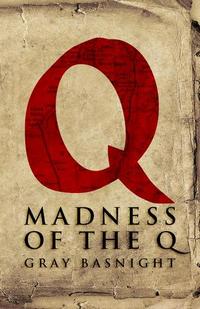
Madness of the Q by Gray Basnight Left Me Ambivalent (I didn’t dislike it, but…)

I’ve got a Q&A with Gray Basnight coming up later this morning—come back to check it out. I haven’t read it yet (didn’t want it to impact what I wrote), but trust that it’ll be interesting in light of what I say below.

Madness of the Q

Madness of the Q

by Gray Basnight
Series: Sam Teagarden, #2

eARC, 368 pg.
Down & Out Books, 2020

Read: November 23-30, 2020
Grab a copy from your local indie bookstore!

What’s Madness of the Q About?

Simply put, it’s the further adventures of professor Sam Teagarden following his uncovering of a large conspiracy within the FBI in 2018’s Flight of the Fox. In the six years since then, a slight mythology has built up around him—he’s got a reputation as one who’ll bring the truth to the world—when all he wants to do is teach math and spend time with his wife.

But it’s his reputation that brings him into the middle of this particular situation. One group wants someone like him to bring information to the forefront of the world, no matter the cost. Another group is afraid of people like him and targets him for assassination before he even knows that there’s something to be exposed to the world. But the FBI catches wind about this before the assassin makes an attempt and saves his life. They also would like him to be involved in a current case, his reputation alone should make things calmer.

What’s the case? Well, the previously theoretical “Q” document (a theoretical source—along with the Gospel of Mark—for the Gospels of Matthew and Luke) has possibly been discovered. Not only that, but there’s a lot of speculation that something big has been discovered in the text itself that wasn’t used by Matthew or Luke and may shake the foundation of religious groups around the world.

It’s been some time since the document was discovered, but now it’s been translated and decoded. The contents are set to be revealed to the world, and on the verge of that, there’s been a rash of mass suicides throughout the world by Christian-ish groups.

Teagarden’s barely gotten involved when his group in Israel are attacked and he goes on the run, trying to get safely to Germany in time for the conference that will feature the unveiling of this document that may be Q.

Will he make it? Will he be able to bring the truths hidden for millennia to light? Are there truths contained at all? These questions and more are dealt with alongside the thrill-ride.

Yeah, that’s a little longer than I usually spend on these sections, but it’s that kind of plot.

What Parts Really Worked for Me?

There’s a lot about this book to commend—for starters, the way that it talks about the “legend” around Teagarden following the events of Flight of the Fox. It felt very real, very authentic—he’s a folk hero to some and a folk villain to others.

Also, there’s the tech from 2025—there’s just a lot of little touches to make the world feel slightly advanced—and slightly annoying. Authentically so, I should add. There are some cool moves forward in technology, and they come with costs to things like privacy. There’s a great temptation to ignore everything else about the book and do a deep dive on this stuff—missing the forest for a few trees, but Basnight did a good enough job with these trees that it’d be fun.

The best part of this book is watching Teagarden at work—instead of making his way down the Eastern seaboard in the States, he’s making his way north from Israel through Italy to Germany. An older math professor, not in the best of health, is just fun to watch in this kind of role. There are a handful of times when it’s not him running, it’s Teagarden going toe-to-toe with someone set on doing him harm, too. I loved them all, his approach (and the way Basnight depicts this approach) are some of the most entertaining passages I’ve read in thrillers this year.

What Didn’t Work For Me?

Everything to do with the Q document and the reactions of various Christian groups, cults, and others to it. I’d have to get into details that are both spoilerific and too detailed for a post like this to adequately describe my problems. But I don’t see a cult caring about the results of textual examination from something found in an archeological dig from Israel. I’m not that sure that a Pentecostal Snake Handling group is going to care that much, either. Nor do I see other Christian groups being driven to suicide because of the initial results of a translation from a very disputed text.

I know people who engage in Biblical textual criticism, and I’ve read a little bit on the serious end of popular works on the subject, and I’m sorry, it just doesn’t work this way. It’s not the kind of field where a bombshell discovery is going to come to light and the entire discipline is instantly changed. It’s going to be debated, dissected, wrangled with, and then maybe, things will shift*. I get that it’s fiction, but I just couldn’t swallow any of this as hard as I tried.

* This assumes that something like Basnight’s Q Document actually exists (or that the actual Q exists and says something like his)

The Big Theme

The one part of the religious aspect of the book that appealed to me was the discussion of faith, of devotion, of commitment on the part of both the religious and the anti-religious (the non-religious among humanity didn’t really factor into things, this was a pro vs. con kind of thing). There’s a group at work in this novel with the aim of eliminating all religion, all theism, throughout the world—and they are devout. Seriously devout. Contrasting these “true believers” with ardent religious people is striking, and deserves some thought. It reminded me of the article “Atheists Are Sometimes More Religious Than Christians” from The Atlantic a couple of years ago, but coming at it from a different angle.

So, what did I think about Madness of the Q as a Whole?

I’m really not sure what to say here. I thought about this a lot while I read it, and have thought about it a lot since I finished—both the details and the themes. And I’m still not sure. I dug the thriller aspects of it, the tech, the character of Sam Teagarden and when the book leaned into those aspects, I was happy. When the foundation—Q and the groups wanting to use the document for their own ends (or those despairing what they thought it might way)—was the focus, I had a hard time pushing on.

I liked (and gave 4 Stars to) the previous Sam Teagarden book. I would absolutely read a third novel featuring him (but I might hesitate if it seems to be in a Robert Langdon-ish vein again). But I just don’t know what to say about this one. It’s going to stay with me longer than books I’ve been very positive about this year—it’s definitely stayed with me longer than books I didn’t like this year. But I’m not sure I can give it a recommendation or a pan. I don’t like just giving a shrug when trying to say what I think about a book, but I think that’s where I am.

Disclaimer: I received a copy of this novel from the author in exchange for my honest opinion and this post.

This post contains an affiliate link. If you purchase from it, I will get a small commission at no additional cost to you. As always, opinions are my own.

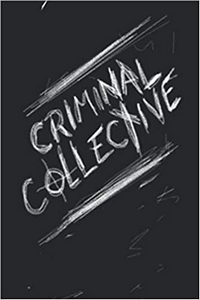
Criminal Collective by Russell Day: Great stories about People at Their Worst

Criminal Collective

Criminal Collective

by Russell Day

Paperback, 268 pg.
2020

Read: November 16-20, 2000

Murder is just another service the nation’s capital has to offer. Like any service industry, you get what you pay for. Less than a grand, in some quarters, will buy you a thug with a baseball bat and a good swing. And at no extra cost they’ll usually tell all their friends about it then spill their guts to the police, once they’re hauled into an interview room.

Creating a dead body is the easy bit. Making it vanish, without questions, now, that’s skilled work. If you pay the extra, someone like me will make the body, the evidence and any troublesome connections melt away, like snow in a heatwave.

What’s Criminal Collective About?

This is a collection of shorter stories from Russell Day, one of my favorites in Crime Fiction. There’s really not much more that I can say, but it seems to brief to move on at this point, so let me just steal from the back of the book:

Do you struggle to know the best place to bury a dead gambler?

Do health care professionals laugh at your attempts to fake a slipped disc?

Do your weapons choices leave you embarrassed at punishment beatings?

If the answer is yes, then Criminal Collective is the book for you! Nineteen stories, each one written to help navigate the tricky etiquette of being a scumbag in the 21st century.

Never again be left nonplussed by the rules of Roadkill Roulette!

Never again mistake your German Virgins for your Automatic Nuns!

Never again leave your fingerprints on a golok!

Criminal Collective! Permanent solutions in an uncertain world.

Doc Slidesmith and Yakky

All the troubles I’ve had over the years have been handed to me by the living not the dead.

There are three Doc Slidesmith stories (one might be novella-length, I’m bad at judging that). For me, these are the highlight of the collection—one of my highlights of the year (have I mentioned how much I love Slidesmith?).

There’s “The Tattooist, The Tarot, and Bang-Bang the Clown,” in which someone ducks into the wrong shop while running from the cops. That was plenty of fun. Then there’s “Not Talking Italics,” which I wrote about two years ago, and loved just as much this time around. Seriously, a short story should not be this good.

The novella (or so) piece is called “Coming Up with a Because (A Game for Three Payers). The three players are A Tattooist, A Nurse and A Solider and we focus on each of these in rotation as the novella tells what happens when a figure from Doc’s past comes looking for a favor. I spent more than a few pages convinced I was a step or two ahead of Doc. That was a mistake. I’m tempted to go on and on here, but it’d just be the ravings of a fanboy…

Doc Slidesmith—you won’t find an amateur sleuth smarter or more enjoyable to read about.

SF Stories

There are two stories that are a SF/Crime Fiction hybrid. Neither of them did much for me. Not that either were bad, I just didn’t connect with them. I’m betting if I tried them again in a couple of months, they’d click with me.

However, both made a reference to the “protein wars.” I’d love to read a story/novel/series about them, the idea intrigues me.

So, what did I think about Criminal Collective?

“I never wanted a different life, Dad,” Liam said. “I was trying to change who I was. I wanted to be someone who wanted the life I had.”

I’ve read that line a few times since I read that story. I think I’m going to have to read it a few more to fully digest it.

There was one other story besides the SF ones that didn’t wow me. All three were okay, though. Not a bad one in the bunch. And the highs more than made up for the not-very lows.

Some of these elicited chuckles, some were disturbing (I mean, put the book down and think about something else for a bit disturbing*), there were a few that had an emotional punch that seemed out of balance compared to the brevity of the story—which speaks to how quickly Day can pull the reader in, and get you invested in some pretty unsavory characters.

* That’s not an exaggeration.

I’d love to talk about some of the stories in detail, but to do so would involve spoiling them—but if you get this book as you should, you’re in for a real treat when it comes to “Click. Size Zero. Delete”, “Reduced to Clear”, and “Colon: Full Stop” in addition to the Doc Slidesmith stories.

As always, Day’s ability with voice and style is at the forefront here—it’d be easy to believe that nineteen authors contributed to this anthology rather than one author creating nineteen distinct voices.

Basically this was a treat from beginning to end, and as always when it comes to Russell Day, I strongly recommend this and encourage you to pick it up.


5 Stars

EXCERPT from The Man in Milan by Vito Racanelli

Earlier this morning, I talked about the book, and now I get to give you a little taste—the opening paragraphs, I hope it hooks you the way it did me.


from Chapter 1 of The Man in Milan by Vito Racanelli (available from Polis Books)

Friday

In the gutter lay a man, face up, between two parked SUVs on Sutton Street. He wore a pale gray suit with impossibly thin pinstripes. It was Zegna, because I’d seen one on my partner, Detective Hamilton P. Turner. The suit was still in good shape, a testament to its workmanship, but the man was not.

I squatted and looked at him in the evening of an April day. I put on my latex and turned him gently. Our fashionable boy wore no tie and his pink shirt had a large red-brown blotch right where his heart used to beat. His suit was ruined in the back, an exit hole right through the trapezius. That’s what the coroner’s report would probably say.

He was about six feet, one inch. Skinny, with fine brown hair, blue- gray eyes. glauco, they say in Italian, which is what the body turned out to be. My grandfather was called Glauco for his eyes. This guy was good looking. Once. No sign of a struggle. Two wounds: a dime-sized hole punched through the back of the head and one more straight into the chest—probably the second shot as he lay prone—to make sure he stayed all the way dead. Below, burrowed halfway into the asphalt, was a slug.

The blues who’d found him already radioed for the NYPD photogs and CSU.

I walked back to my car to call my partner, who’d hadn’t told me why he couldn’t come along to the party. “I’m good,” I said to Turner. “You’re missing a beautiful spring evening in New York City, marred only by one dead body.”

His voice crackled over the radio: “Just the one? Gonna rain later. Meet you back at the precinct, Paolino,” Turner said.

I tossed the receiver back into our Crown Vic’s front seat and walked back to the body. Turner liked to call me little Paul because I was taller than him.


The photogs showed up and cordoned off the area around the body.

“Any other bodies, Detective Rossi?” the photographer asked me.

“I told you, one. Why does everyone think there’s more than one?” I said.

“Yeah, but you know, sometimes you think there’s one and then other bodies just start showing up when you look around. They’re like rabbits.”

I smiled at our photographer, Joe Rinn. He had a nice sideline doing weddings. “You never tell those brides what you do, do you? That you flash dead bodies all day. That your work graces medical school books about fatal wounds?”

“Nah,” he said, smiling back at me, then turning to the job at hand. “I tell ’em I’m an artist.”

I stood back and let the artist work. I tugged my right ear, tilted my head to get another look at this guy, and wondered what this poor fucker had done to deserve a dog’s death.

Rinn circled the body like a vulture. “The geeks’ll be here in a minute. And hey, a Post guy is comin’, too. He asked me to keep the bodies fresh.”

“A body. One body. We’ll try to oblige, but if the fourth estate doesn’t show in time, tough,” I said.

After they took the first set of photos, the CSU geeks began. Hair, blood, and nail samples. They scraped his jacket, pants, and shirts with tape to pick up foreign elements, like someone else’s hair or blood.

I looked around to figure some possible MOs. There was a small service alcove down a few steps and a few feet away. Our hunter knew his rabbit’s habits. Maybe tailed him for a few days. He waited in the alcove and calmly skipped up to the victim as he walked between a Range Rover and an Escalade. That gave the shooter some tall cover, and then he did him. Bang. Bang. Or rather Ping, Ping, with a silencer. The killer had probably taken care after the first shot to lay the body down, so that they were partially obscured, on Sutton near 51st. And that’s when he—or they—popped him a second time. His head, inches from the curb, was near enough that his blood had drained into the sewer nearby. Just when you think you’ve seen it all.

The body came conveniently with docs, a small black address book and an Italian identity card wrapped in a soft, dark brown leather case— Gaitano Muro, forty-six years old and a Milan address, so immediately I thought Mafia. Even the stupidest perp knows not to leave docs in a fixit job. The killer must have been spooked immediately and had to run. This was a botched execution. Two kill shots to rob someone? Not likely.

The address book had names and phone numbers but little else. No addresses. The ID was diplomatic, Capo Servizio something or other, Consolato Generale della Repubblica Italiana, it said, with an embossed little star inside an olive branch and a mechanical gear wheel. My Italian wasn’t bad thanks to my grandfather. Muro was a diplo and Signore Muro from Milan came all the way to New York City and found unexpectedly that this late April evening would be the least lucky night he was ever to have, and he was dropped in the gutter on Sutton St. I suppose there are worse streets to die on.

I’d bet it wasn’t the way he thought it would go. Nobody ever does.

.

Excerpted The Man in Milan Copyright © 2020 by Vito Racanelli Reprinted with permission from the author. All rights reserved


Read the rest in The Man in Milan by Vito Racanelli to see what happens from here.

Thanks to Polis Books, Vito Racanelli and Saichek Publicity for this excerpt!

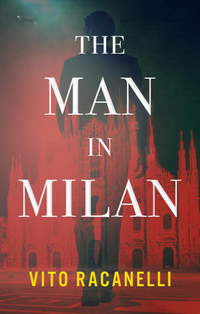
The Man in Milan by Vito Racanelli: A Hunt for the Truth on the Streets of New York and Milan

The Man in Milan

The Man in Milan

by Vito Racanelli

eARC, 336pg.
Polis Books, 2020

Read: November 9-14, 2020
Grab a copy from your local indie bookstore!

What’s The Man in Milan About?

NYPD detective Rossi is called to the scene of a homicide. It looks like a mugging gone bad, but there’s something wrong with the scene that Rossi can’t accept the first impression. Soon, he and his partner discover that this man is attached to the Italian embassy (although it’s initially denied). The deeper they get into the investigation, the murkier things get and the deadlier things get, too.

While they try to deny it, try to avoid the conclusion, the detectives have to admit that the evidence is pointing to a solution in Italy. They’re able to follow the evidence to the victim’s homeland, leading to an explosive conclusion.

The Police

Probably the strongest part of this book—and it’s key to the success of a police procedural are the characters—particularly the police characters*. From practically the instant we meet Detectives Paul Rossi and Hamilton P. Turner, I felt I knew them. Racanelli nailed these characters. They’re at once characters we’ve seen before, and know well—but made them feel fresh.

* There are a few other strong characters that I don’t have the space to talk about, for example: a newspaper journalist who’s almost as strong and developed as Rossi and Turner, that we don’t get quite enough of; and Rossi’s ex-wife and daughter, who I’d like to see again, too.

Rossi is divorced, in AA, more than a little jaded, but driven by the work that’s the only thing he has left in the world aside from the daughter he doesn’t get to see as often as he wants. He has strong ties to his Italian heritage—can speak and read it fluently (which comes in handy)—without being a stereotype. He has a medical condition that crops up to make life inconvenient, if there’s a sequel or two in the future, I’d like to learn more about this.

Turner is a solid cop, but he has ambitions beyond the NYPD, he wants to get into city politics—ultimately that mayor-ship. And he’s open about it. But more, he’s a poet, who regularly presents at events throughout the city, he can’t seem to go anywhere without finding a woman to seduce, dresses better than most detectives (shades of Connelly’s Jerry Edgar?), and has been described as a “black beatnik.” Some authors would take these traits and give us a character that’s just a collection of quirks, but Racanelli uses them to turn Turner into a well-rounded character.

The deceased’s sister, Tenente Laura Muro, is a policewoman from Italy. She arrives to claim the body and return it to be buried. But she’s also interested in helping the investigation and brings a knowledge of both Muro as a person, his past and his home that prove invaluable to Rossi and Turner. That she’s attractive and intelligent just makes her presence all the more welcome to the partners.

Rossi and Turner have a Lieutenant who has no interest in the case until it becomes something the mayor is taking an interest in, and actually wants them to drop it almost immediately. He’s the kind of petty bureaucrat that you hope doesn’t exist outside fictional police departments (but sure seem to show up in all sorts of police procedurals). He’s a solid character, but not one you’ll enjoy (and aren’t supposed to).

What Really Worked

The initial chapters following Rossi and Turner as they look into Muro’s death, talking to the Italian ambassador, Muro’s estranged wife and so on. Once others associated with Muro are killed, there’s a lot of political pressure put on them to make an arrest. Once it becomes clear that someone wants to add their deaths to the list, the external pressures to make an arrest outweigh all the politics.

When the evidence begins to point to an Italian group that seems more Urban Legend than reality, things take off plot-wise and the stakes get higher. Racanelli handles this skillfully, both the reticence of the detectives to follow the evidence and the way they come around when they have to.

What Wasn’t as Strong

Once it became clear to me that the case was going to take the detectives to Italy*, I worried a little about things. And sadly, those worries were valid. But maybe it’s just me.

* It’d been a few weeks since I read the pitch for the book, so I’d forgotten all of it.

Whether it’s Michael Connelly (Nine Dragons) or Neil Lancaster (Tom Novak series)—and probably other examples I can’t think of at the moment, anytime when you take police detectives and put them into a foreign context (especially when it becomes less police procedural and more international thriller), I think the book loses something. This one didn’t lose a lot, but I think it stumbled a little bit—Racanelli handled the switch in flavors as well as anyone, though, I want to stress that this is a me-thing, not a Racanelli-thing.

The Setting

There are plenty of reasons for this to be set in 2002 for the plot to work—beyond that, it’s a great setting for this kind of book. The characters can use cell phones and the internet, but smart phones aren’t ubiquitous and what characters can do with phones/internet is still limited enough that the detectives have to work for their information, not everything is captured on phones, and so on. It may have been a practical choice to set the book when he did, but the benefits make it a great choice.

So, what did I think about The Man in Milan?

From the voice, the style, the characters and the nature of the story—this is a solid, entertaining story. The persons responsible for the murder are dark and mysterious, but it’s not overplayed. The motive behind the (initial) killing, and its method make sense and are just chilling. The escalation in terms of violence and scale feels natural, it felt like this could be based on real events.

Racanelli’s take on Italian culture isn’t one that I think I’ve seen before and it’s one I’d like to learn more about, too.

The more action-thriller parts of the novel are as tense and compelling as you’d want, the procedural material is as good as you’ll find anywhere. The Man in Milan is a great way for Vito Racanelli to introduce himself to Crime Fiction readers, and I look forward to seeing what he produces next.

Disclaimer: I received this book from the author via Saichek Publicity in exchange for this post and my honest opinion—thanks to both for this.


4 Stars

This post contains an affiliate link. If you purchase from it, I will get a small commission at no additional cost to you. As always, opinions are my own.

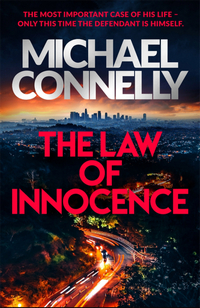
PUB DAY REPOST: The Law of Innocence by Michael Connelly: To Prove He Didn’t Do It, Haller has to Prove Who Did

The Law of Innocence

The Law of Innocence

by Michael Connelly
Series: Mickey Haller, #7

eARC, 416 pg.
Orion, 2020

Read: September 26-27, 2020
Grab a copy from your local indie bookstore!

What’s The Law of Innocence About?

On his way home from celebrating a win in court—a precious finding of “NG” (Not Guilty), Mickey Haller is pulled over in a traffic stop that quickly goes south and Haller finds himself in the back of the patrol car while the officer opens his trunk to discover a dead body—it turns out to be a former client of Haller’s who happens to owe his former defense lawyer a hefty amount of money.

It’s clearly a frame-up. There’s no reader who will buy Haller committing the crime in this way—sure, it’s possible that Haller would be driven to murder by something (for the sake of argument), but he wouldn’t do it this way. He’s too slick, too clever for that. Thinking like that is well and good for readers of Crime Fiction, it’s not how the police think. If you get all the evidence pointing at someone, they’re likely to be guilty, especially if there’s no evidence pointing in another direction.

Which is what happens here. So from his cell in the Twin Towers Correctional Facility, Haller has to plan his own defense. Sure, he knows all the conventional wisdom and jokes about defending yourself, but defending people in court is what has defined Mickey Haller for his adult life and there’s no way he can let someone else take the lead on this. It’s the fight of his life—literally a fight for his life—and Haller has to be the one doing the fighting.

Haller can’t count on a “reasonable doubt” defense. It won’t be enough to get a “Not Guilty” verdict, not if he wants to be a defense lawyer ever again, he can’t go into court with the world thinking he got off on a technicality. Haller has to prove he’s innocent, and the only way he can do that is by finding out who’s guilty, and proving that in court.

The prosecuting attorney is no slouch—frequently in legal fiction, you get someone who’s clearly there to play Washington Generals to the series protagonist’s Harlem Globetrotters, putting up a token case for the defense attorney to use as a way to show off all his tricks. But Dana Berg, star prosecutor for the Major Crimes Unit is hard, smart, and utterly convinced that Haller is guilty. So convinced that she’s not above using as many tricks and sneaky moves as Haller. She’s a worthy opponent which makes it all the better.

Hail, Hail, the Gang’s All Here

Mickey’s friends and family won’t believe this accusation—he’s not a killer. They know this and show up to help—many of them probably would if they had some doubt about his guilt, but we all know that Haller’s half-brother. Harry Bosch, wouldn’t have anything to do with him if Bosch thought there was a chance he was a killer. But Bosch is as involved as Cisco, Haller’s own investigator is. Lorna’s there, as well as Jennifer Aronson. I wasn’t terribly impressed with Aronson the last time we saw her in The Gods of Guilt, but she’s come a long way since then and is key to Haller’s defense.

It keeps going, Maggie “McFirece” McPherson, his ex-wife, and his daughter, Haley, are stalwart supporters, too—and Maddie Bosch even pops in. I’ve always liked Haley and enjoyed her a lot here. You’ll never see me say anything against Maggie’s character, either. Connelly created a great family for Haller back in The Lincoln Lawyer and they continue to pay off here.

While it’s great to see everyone show up to support and help—and Haller needs all that he can get—it’s his novel, it’s his fight, it’s his life in the balance and the novel’s focus is solely on him. With a character like Bosch, he’s a constant threat to steal the reader’s (and likely the writer’s) attention—but he doesn’t even come close. It’s all about Mickey Haller.

Isn’t this just like Fair Warning?

I was slightly afraid of that when I read the blurb for this—do we really need two books from Connelly in 2020 where the protagonist is suspected of a murder that there’s no chance at all that he committed? I figured Connelly would pull it off, but, yeah, there was a degree of trepidation on my part going into it.

Here’s where they were different—in Fair Warning, McEvoy being suspected is just his way into the mystery, and the shadow of suspicion may linger over him, but it’s never really much more than that. But here, Haller being the suspect is the whole novel—he’s only the suspect for a couple of days (which we don’t even see), he’s the accused for all but the first chapter. That makes all the difference, there’s no way to compare the experiences of McEvoy and Haller.

Current Events

This book takes place at the close of 2019 and over the first few months of 2020, and through news reports in the background and some conversations between characters we get glimpses of what’s going on in American culture at the time—specifically, the impeachment and reelection bid of Donald Trump and the early days of the spread of COVID-19. Neither makes a significant impact on the plot, but they act as part of the background, nailing the events of the novel to a specific moment.

I wondered for a while if this would make the novel dated in years to come, making it too “of the moment” to last. But the more I think about it, the more I think adds some flavor, some perspective to the novel, and the way that Connelly uses the current events to ground the novel. I ended up really liking the way he did it. Sure, Haller’s very few and quick comments about the President may put off some readers, if they couldn’t have guessed Haller’s political leanings, they haven’t been paying attention.

So, what did I think about The Law of Innocence?

If I hadn’t been approached to be on this tour, what would’ve likely happened is this: I’d buy The Law of Innocence on release day and had been really excited about it, but would’ve set it aside so I could catch up on some backlog—and it would’ve ended up languishing away on my shelf unnoticed. I’d have probably have made it my last book of 2020 or first of 2021 as a little treat to myself. And I would’ve been mad at myself for that once I got to about the 20% mark (if not earlier). For this to be available and unread would be just wrong.

There’s a one page (or so) introduction/foreward that’s just dynamite, followed by a really strong first chapter, and then starting in chapter 2, we’re off to the races. It’s just unrelentingly good, gripping, fast-paced, smart, and tension-filled from that point through to the jaw-dropping end. Sure, you may be confident that Haller would prevail, but you can never be sure for a moment how that might come to pass—and any time you start to think you know? You quickly discover that was hubris.

Connelly is one of the best in the business, but he’s not satisfied with coasting on his reputation or his laurels, he’s constantly striving to prove that he’s one of the best around—and usually succeeds at it. The Law of Innocence has him doing just that. The prose is lean and tight, the characterizations are spot on, the pacing is perfect and you just can’t put this down. I had a lot going on last week when I read this and several things I needed to accomplish—and I ignored almost every single one of them just so I could finish this. I gave myself five days to read this and finished it in two. Between the story, the characters, and the way Connelly put this together, I had no choice.

A lot of the legal thrillers I’ve read over the last couple of years save some of their best moments for things the lawyers get into outside of the courtroom, The Law of Innocence doesn’t do that. Yes, there are some good moments with Haller and the team investigating things, or while Haller is incarcerated. But the best moments of the novel take place in the arena that Haller comes most to life—in the courtroom, facing off against a good prosecutor, in front of a smart judge and a jury that he can only hope to persuade. Haller’s good at putting the pieces of a puzzle together (especially when Bosch and Cisco give him the right pieces), he can get a witness to give up just the right information, but he shines when he’s using the rules of the court, rules of evidence and the laws of California to further his own ends.

If you’ve been through the wringer with Haller before, you have an idea of what to expect—and you won’t be disappointed. If you’ve never spent time with the Lincoln Lawyer before this, you’re in for a treat. Either way—The Law of Innocence is one of the best thrillers of 2020 and you need to get your hands on it.


4 1/2 Stars

Disclaimer: I received this eARC from Orion via NetGalley and Compulsive Readers in exchange for this post—thanks to all for this, but the opinions offered above are solely mine.

This post contains an affiliate link. If you purchase from it, I will get a small commission at no additional cost to you.


My thanks to Tracy Fenton and Compulsive Readers for the invitation to participate in this tour and the materials (including a copy of the novel) provided.

The City That Barks and Roars by J. T. Bird: It Takes Four Legs to Walk These Mean Streets

The City That Barks and Roars

The City That Barks and Roars

by J. T. Bird

Kindle Edition, 200 pg.
2020

Read: October 30-November 6, 2020

What’s The City That Barks and Roars About?

The book opens with an injured police detective hiding from those who injured him, focused on trying to survive long enough to be rescued while replaying the moments that put him in this situation. This is followed by some of his colleagues beginning the search for the detective, finding only plenty of reasons to assume the worst has happened.

Next, we see a young detective freshly transferred from a small, quiet town to the city to be partnered with the missing detective’s old, jaded partner. The newly matched pair lead the investigation into the missing detective. an apparent kidnapping of some local criminal figures, and the tie between the crimes. Along the way, while some camaraderie builds between the partners, the young detective gets exposed to the worst of the city, underground figures on both extremes of the social ladder, true depravity, and maybe (just maybe) a few upstanding citizens.

What makes this variation on the familiar-feeling story is this: all the characters are anthropomorphic animals who’ve evolved to a 1950’s America-like civilization. The missing detective is a Panda Bear, the kidnapped criminals are beavers, the primary detectives on the hunt are a king penguin and a red howler monkey—other characters are a polar bear, vulture, panther, leopard, lioness, and more.

Is this the Correct Medium for the Story?

I couldn’t stop thinking the entire time that a novel might not be the best way to tell this story, time after time, the visual jokes just didn’t seem to land the way they ought because Bird has to spend so much time describing them.

That’s the major problem of the whole novel—the descriptions chew up too much space, slowing down the movement of the story—and taking away from the impact of the jokes, images, or other moments.

You take this story, these characters, and put them in a graphic novel in a Spiegelman-Maus kind of style? It’d be dynamite.

The jokes are still there, the images are still strong and amusing—I just think this medium dilutes things, makes it less effective. With such a well and richly developed world, I’d just like that to come across better.

So, what did I think about The City That Barks and Roars?

The animal nature of the characters is secondary (or at least seems like it ought to be) to the story and who the characters are aside from that. As such, the book could use a little more depth. Enough space is devoted to the animal setting and characteristics that Bird really can’t give the depth of characterization or subtlety of plot that I’d like to see.

That said, this is some of the best worldbuilding I’ve seen—ever—in a police novel. Bird went well above and beyond on that front, to deliver a unique and entertaining novel. From the original premise to the jaw-dropping final reveals, you won’t find Crime Fiction like this anywhere.

This would serve well as the beginning of a series, and if that’s the case, I’m in for a few more. If it’s strictly a stand-alone? Readers are in for a treat.


3 Stars

My thanks to damppebbles blog tours for the invitation to participate in this tour and the materials (including a copy of the novel) they provided.

The Law of Innocence by Michael Connelly: To Prove He Didn’t Do It, Haller has to Prove Who Did

The Law of Innocence

The Law of Innocence

by Michael Connelly
Series: Mickey Haller, #7

eARC, 416 pg.
Orion, 2020

Read: September 26-27, 2020
Grab a copy from your local indie bookstore!

What’s The Law of Innocence About?

On his way home from celebrating a win in court—a precious finding of “NG” (Not Guilty), Mickey Haller is pulled over in a traffic stop that quickly goes south and Haller finds himself in the back of the patrol car while the officer opens his trunk to discover a dead body—it turns out to be a former client of Haller’s who happens to owe his former defense lawyer a hefty amount of money.

It’s clearly a frame-up. There’s no reader who will buy Haller committing the crime in this way—sure, it’s possible that Haller would be driven to murder by something (for the sake of argument), but he wouldn’t do it this way. He’s too slick, too clever for that. Thinking like that is well and good for readers of Crime Fiction, it’s not how the police think. If you get all the evidence pointing at someone, they’re likely to be guilty, especially if there’s no evidence pointing in another direction.

Which is what happens here. So from his cell in the Twin Towers Correctional Facility, Haller has to plan his own defense. Sure, he knows all the conventional wisdom and jokes about defending yourself, but defending people in court is what has defined Mickey Haller for his adult life and there’s no way he can let someone else take the lead on this. It’s the fight of his life—literally a fight for his life—and Haller has to be the one doing the fighting.

Haller can’t count on a “reasonable doubt” defense. It won’t be enough to get a “Not Guilty” verdict, not if he wants to be a defense lawyer ever again, he can’t go into court with the world thinking he got off on a technicality. Haller has to prove he’s innocent, and the only way he can do that is by finding out who’s guilty, and proving that in court.

The prosecuting attorney is no slouch—frequently in legal fiction, you get someone who’s clearly there to play Washington Generals to the series protagonist’s Harlem Globetrotters, putting up a token case for the defense attorney to use as a way to show off all his tricks. But Dana Berg, star prosecutor for the Major Crimes Unit is hard, smart, and utterly convinced that Haller is guilty. So convinced that she’s not above using as many tricks and sneaky moves as Haller. She’s a worthy opponent which makes it all the better.

Hail, Hail, the Gang’s All Here

Mickey’s friends and family won’t believe this accusation—he’s not a killer. They know this and show up to help—many of them probably would if they had some doubt about his guilt, but we all know that Haller’s half-brother. Harry Bosch, wouldn’t have anything to do with him if Bosch thought there was a chance he was a killer. But Bosch is as involved as Cisco, Haller’s own investigator is. Lorna’s there, as well as Jennifer Aronson. I wasn’t terribly impressed with Aronson the last time we saw her in The Gods of Guilt, but she’s come a long way since then and is key to Haller’s defense.

It keeps going, Maggie “McFirece” McPherson, his ex-wife, and his daughter, Haley, are stalwart supporters, too—and Maddie Bosch even pops in. I’ve always liked Haley and enjoyed her a lot here. You’ll never see me say anything against Maggie’s character, either. Connelly created a great family for Haller back in The Lincoln Lawyer and they continue to pay off here.

While it’s great to see everyone show up to support and help—and Haller needs all that he can get—it’s his novel, it’s his fight, it’s his life in the balance and the novel’s focus is solely on him. With a character like Bosch, he’s a constant threat to steal the reader’s (and likely the writer’s) attention—but he doesn’t even come close. It’s all about Mickey Haller.

Isn’t this just like Fair Warning?

I was slightly afraid of that when I read the blurb for this—do we really need two books from Connelly in 2020 where the protagonist is suspected of a murder that there’s no chance at all that he committed? I figured Connelly would pull it off, but, yeah, there was a degree of trepidation on my part going into it.

Here’s where they were different—in Fair Warning, McEvoy being suspected is just his way into the mystery, and the shadow of suspicion may linger over him, but it’s never really much more than that. But here, Haller being the suspect is the whole novel—he’s only the suspect for a couple of days (which we don’t even see), he’s the accused for all but the first chapter. That makes all the difference, there’s no way to compare the experiences of McEvoy and Haller.

Current Events

This book takes place at the close of 2019 and over the first few months of 2020, and through news reports in the background and some conversations between characters we get glimpses of what’s going on in American culture at the time—specifically, the impeachment and reelection bid of Donald Trump and the early days of the spread of COVID-19. Neither makes a significant impact on the plot, but they act as part of the background, nailing the events of the novel to a specific moment.

I wondered for a while if this would make the novel dated in years to come, making it too “of the moment” to last. But the more I think about it, the more I think adds some flavor, some perspective to the novel, and the way that Connelly uses the current events to ground the novel. I ended up really liking the way he did it. Sure, Haller’s very few and quick comments about the President may put off some readers, if they couldn’t have guessed Haller’s political leanings, they haven’t been paying attention.

So, what did I think about The Law of Innocence?

If I hadn’t been approached to be on this tour, what would’ve likely happened is this: I’d buy The Law of Innocence on release day and had been really excited about it, but would’ve set it aside so I could catch up on some backlog—and it would’ve ended up languishing away on my shelf unnoticed. I’d have probably have made it my last book of 2020 or first of 2021 as a little treat to myself. And I would’ve been mad at myself for that once I got to about the 20% mark (if not earlier). For this to be available and unread would be just wrong.

There’s a one page (or so) introduction/foreward that’s just dynamite, followed by a really strong first chapter, and then starting in chapter 2, we’re off to the races. It’s just unrelentingly good, gripping, fast-paced, smart, and tension-filled from that point through to the jaw-dropping end. Sure, you may be confident that Haller would prevail, but you can never be sure for a moment how that might come to pass—and any time you start to think you know? You quickly discover that was hubris.

Connelly is one of the best in the business, but he’s not satisfied with coasting on his reputation or his laurels, he’s constantly striving to prove that he’s one of the best around—and usually succeeds at it. The Law of Innocence has him doing just that. The prose is lean and tight, the characterizations are spot on, the pacing is perfect and you just can’t put this down. I had a lot going on last week when I read this and several things I needed to accomplish—and I ignored almost every single one of them just so I could finish this. I gave myself five days to read this and finished it in two. Between the story, the characters, and the way Connelly put this together, I had no choice.

A lot of the legal thrillers I’ve read over the last couple of years save some of their best moments for things the lawyers get into outside of the courtroom, The Law of Innocence doesn’t do that. Yes, there are some good moments with Haller and the team investigating things, or while Haller is incarcerated. But the best moments of the novel take place in the arena that Haller comes most to life—in the courtroom, facing off against a good prosecutor, in front of a smart judge and a jury that he can only hope to persuade. Haller’s good at putting the pieces of a puzzle together (especially when Bosch and Cisco give him the right pieces), he can get a witness to give up just the right information, but he shines when he’s using the rules of the court, rules of evidence and the laws of California to further his own ends.

If you’ve been through the wringer with Haller before, you have an idea of what to expect—and you won’t be disappointed. If you’ve never spent time with the Lincoln Lawyer before this, you’re in for a treat. Either way—The Law of Innocence is one of the best thrillers of 2020 and you need to get your hands on it.


4 1/2 Stars

Disclaimer: I received this eARC from Orion via NetGalley and Compulsive Readers in exchange for this post—thanks to all for this, but the opinions offered above are solely mine.

This post contains an affiliate link. If you purchase from it, I will get a small commission at no additional cost to you.


My thanks to Tracy Fenton and Compulsive Readers for the invitation to participate in this tour and the materials (including a copy of the novel) provided.

Page 53 of 61

Powered by WordPress & Theme by Anders Norén