Tag: Non-Fiction Page 14 of 31

The Particulars of Peter by Kelly Conaboy: Adventures of a Woman Obsessed with her Dog

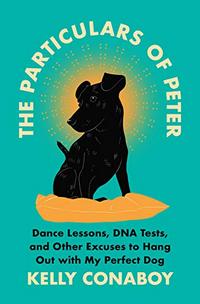
The Particulars of Peter

The Particulars of Peter:
Dance Lessons, DNA Tests,
and Other Excuses to
Hang Out with My Perfect Dog

by Kelly Conaboy

Hardcover, 232 pg.
Grand Central Publishing, 2020

Read: March 30-April 1, 2021
Grab a copy from your local indie bookstore!

I think once a person has a dog the idea of not having one quickly becomes absurd. I know there are other ways a person can fill their time—golf, et cetera. I know you can Hula-Hoop. You can pan for gold, or “do some work at a café.” I know a person can exist without the ability to make a creature they love thrash with uncontrollable joy, wild-eyed and ecstatic, at the mere mention of din—; hush, that’s enough, they’re already excited. I know you can watch TV without a dog resting his paws and head on your leg, breathing quietly, warming you and allowing you to feel like you’re having a real human experience rather than idly ingesting The Sopranos, I know you can go to sleep without a dog in your bed and wake up without a little face staring down at you, whiskers in your eyes, and a nose dripping onto your skin, waiting for you to take him outside so that he might urinate. But… why? Why even wake up at all?

What’s The Particulars of Peter About?

It is, quite simply, about Peter. Well, it’s more about Conaboy’s obsession with Peter and the things she’ll do to foster the relationship between them as well as all the things she’s willing to do with/for him for the sake of her writing.

She begins by talking about how Peter came into her life, going to Woofstock with him, trying to get into agility training, dance classes, and so on. She gets a DNA test, goes ghost hunting, consults a pet psychic, and more.

Each chapter is filled with jokes, amusing anecdotes, and useful information on a particular subject/experience, told with a lot of humor (some-self deprecating).

Some Highlights

It’s probably easier to think of this as a collection of essays rather than a cohesive book, and as such, there are going to be some chapters that stand-out above the others. I think the first two chapters—about adopting Peter and getting a DNA test were the best—with the chapter on where the dog should sleep as a close third.

The chapter on Dog Dancing was, on the whole, not that interesting for me until she dropped the jokes and got to a hard story about Peter and a medical problem. It probably became the strongest chapter in the book at that point.

On the other end of the spectrum

There were a couple of chapters that did nothing for me—training Peter for Ghost Hunting and then trying to communicate with him using pet psychic just bored me. I couldn’t get into them, but I could see where someone would find it interesting.

The rest of the chapters were a good mix of things I thought were great and then a page later made me wonder why I tried the book.

So, what did I think about The Particulars of Peter?

There was something in the preface, that made me wonder if I’d made a mistake and I was going to end up annoyed with this book, but I wasn’t quite sure. Then I got to the paragraph I quoted above—the third in the book, and realized that yeah, this book was for me.

I’m not going to tell you that this is the best book about living with a dog that you’re ever going to read. I’m not saying that every chapter was worth the time. But there’s just so much heart displayed in every chapter, that you can’t help but cut her a lot of slack for whatever shortcomings may appear.

And it’s a funny book. I chuckled and laughed a few times, I enjoyed an eye-rolling smile a few times, a more than a few times I grinned and made not of a fun line. I fell in love with her habit of writing a parenthetical remark to get a punchline into something, and then immediately following it with another parenthetical joke—naturally, I didn’t write down any examples of that, because why should I make it easy for me to explain the quirk.

Basically, this was a fun book about one of my favorite topics—of course, I’m going to recommend it.

2021 Library Love Challenge

This post contains an affiliate link. If you purchase from it, I will get a small commission at no additional cost to you. As always, opinions are my own.

PUB DAY REPOST: Blood and Treasure by Bob Drury, Tom Clavin: A Look at Dream Come Truers

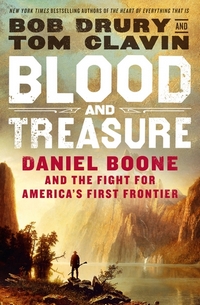
Blood and Treasure

Blood and Treasure: Daniel Boone and the Fight for America’s First Frontier

by Bob Drury, Tom Clavin

eArc, 400 pg.
St. Martin’s Press, 2021

Read: April 5-14, 2021
Grab a copy from your local indie bookstore!

What’s Blood and Treasure About?

It’s pretty much in the subtitle—this book is about 2 things—Daniel Boone and the fight (literal and metaphoric) for America’s first Frontier—with a focus on what we now know as Kentucky, but pretty much everything on the Western edge of the American colonies/states.

It’s not a biography of Boone (I’ll tell you now, I wrongly expected this to be more of one), it’s more like he’s the organizing principle for the book, as we learn about Boone’s roots, early life, and adulthood the authors talk about the conflicts with the Indians on the edge of white civilization’s expanse. We’d get a chunk of a wide-view of history over a period, and then we’d focus on Boone’s life around that time. Then the focus would widen a bit and we’d look at another period of time—and so on.

Two significant ingredients in “the Fight” for the Frontier were what’s called The French and Indian War and the American Revolution. There’s the French and Indian War (and conflicts that led up to it and sprang from it) to begin with, paved the way for the latter conflicts—we see the pressure put on various tribes from the expansion of settlers, the resistance those settlers faced (from shifting alliances of Indians between themselves, and varying alliances between Western powers and the Indians).

As for the Revolution—while most histories/documentaries/etc. about it will acknowledge the fighting in the South and West, few take any time to focus on it. Instead, we casual history readers just get repeated retellings of the stuff we learned in elementary school—Washington*, the Continent Army, Benedict Arnold, Nathan Hale, the Green Mountain Boys, and whatnot—and whatever expansions on some of those topics that Hamilton has taught us in the last few years. This book is a great corrective to that showing how the Indians were largely pawns for the British to use against the colonies, to distract from the larger skirmishes as well as to try to open up another front on the war—another way to steal power and influence from the colonies. You see very clearly how easily the entire War could’ve changed if not for a couple of significant losses suffered by the British and their Indian allies.

* Washington is also featured pretty heavily in the earlier chapters, too—even if he maybe only briefly met Boone on one occasion.

Language Choices

I know this sort of this is pretty customary, but I really appreciated the Note to Readers explaining the authors’ language choices—starting with the tribal designations they used—the standard versions accepted today (there are enough various entities mentioned throughout that if they’d gone with contemporary names and spellings, I—and most readers—would’ve been very confused).

At the same time, they did preserve the varied and non-standard spellings for just about everything else. For example, there were at least three variant spellings for Kentucky: Cantucky, Kanta-ke, and Kentucki (I think there was one more, but I can’t find it).

I was a little surprised that they stuck with the term “Indian” as much as they did—but their explanation for it seemed likely and understandable.

An Image Shattered—or maybe just Corrected

Yes, I know that the Fess Parker TV show I saw after school in syndication was only very loosely based in reality. And that the handful of MG-targeted biographies I read several times around the same time were sanitized and very partial. Still, those are the images and notions about Boone that have filled my mind for decades. So reading all the ways they were wrong and/or incomplete threw me more than I’m comfortable with.

His appearance was particularly jarring—the actual Boone eschewed coonskin caps because they were flat-topped and preferred a high-crowned felt hat to look taller. THat’s wrong on so many levels. “Tall as a mountain was he” is about as far from the truth as you can get.

The fact that he spent most of his life bouncing between comfort and/or wealth and massive debt is both a commentary on his strengths and weaknesses as it is the volatile times he lived in—he lost so much thanks to colonial governments being mercurial. It was reassuring to see the repeated insistence that he was an honest man, who worked to repay his debts even if it took too long.

In the end, Boone seemed to be a good guy trying his best to get by and provide for his family—who accidentally stepped into some degree of celebrity, that magnified some good qualities and replaced the man with a legend.

So, what did I think about Blood and Treasure?

The writing itself? There are moments that were fantastic. On the whole…., but from time to time, when Drury and Clavin wanted to drive an image or description home, they could be stunning. I would have preferred things to be a bit more even—a bit more balanced and consistent on that front. But the topic and scope didn’t really allow for that. So I’ll just enjoy those moments of it that I got.

As for the book as a whole? It was impressive, entertaining (generally), and informative. When it was at its best, it didn’t feel like reading dry history but a compelling look at that portion of US History. At its worst, it was a litany of names, dates, and ideas that didn’t do much for me. Thankfully, those moments were few and far between. It’s not a difficult read at any point, just pretty dry on occasion.

There are so many other things I’d like to have mentioned or discussed—but it would make this post unwieldy. The notes about hunting (both the good and the horrible), Boone’s heroics, his character, and family; various aspects of the Indian customs discussed and so much. There’s just so much in this book to chew on that I can’t sum it up.

I liked this—I liked it enough to look at a few other books by this duo to see what they can do with other topics, people, and eras. I think anyone with a modicum of interest in Boone will enjoy this and be glad for the experience.

Disclaimer: I received this eARC from St. Martin’s Press via NetGalley in exchange for this post—thanks to both for this.


3.5 Stars

This post contains an affiliate link. If you purchase from it, I will get a small commission at no additional cost to you. As always, opinions are my own.

Just a Spoonful of Sugar—Non-Fiction to Smile With and Learn From

(Updated and Revised)
Just a Spoonful of Sugar—Non-Fiction to Smile With and Learn FromI stumbled onto my notes from Funny, You Don’t Look Autistic: A Comedian’s Guide to Life on the Spectrum the other day (and yeah, I forgot almost all of them in my post about the book). But it got me thinking about McCreary’s approach—taking a hard-to-talk about subject and adding a touch of humor (or at least a light-hearted voice) to it to make it palatable. It’s a great way to get someone to look at the subtleties of what the Autism Spectrum Disorder can be, how individuals can fall somewhere on that spectrum (and therefore have many things in common), and yet be very different from one another.

Now, I realized that some would point to our cultural inability to discuss difficult subjects with the sobriety and seriousness they deserve as a significant problem. And there’s something to that. More than something, probably. Still, I don’t like to think I enjoy these books and their approach because I’m shallow, but I guess I shouldn’t rule that out.

Shallowness aside, there’s something to that approach—whether it’s technical issues, trauma, socially awkward topics, disease, disorders, or other things people try to avoid discussing—doing so in a light-hearted manner or with plenty of laughs, tends to make the audience receptive. It takes a lot of skill to blend the difficult topic into an entertaining package. But it’s a great way to gain a new perspective, a deeper understanding, or learn something.

Some of the others that I’ve read/posted about in the last few years that entertain while informing/giving insight:
bullet Wishful Drinking by Carrie Fisher—Fisher addresses her addictions and mental health problems (and the extreme solutions) in this frequently laugh-out-loud memoir
bullet Everything is Normal by Sergey Grechishkin—Grechishkin’s memoir of growing up in 1980’s-era Soviet Russia brings the grins (and a chuckle or two) while not letting us forget how hard and terrifying it could be.
bullet Kasher in the Rye: The True Tale of a White Boy from Oakland Who Became a Drug Addict, Criminal, Mental Patient, and Then Turned 16 by Mose Kasher—Kasher’s account will make you smile, break your heart, and help you understand addiction
bullet Gluten Is My Bitch: Rants, Recipes, and Ridiculousness for the Gluten-Free by April Peveteaux—on the one hand, this seems the slightest of the issues addressed. Ask any person with Celiac Disease how hard it can be to find food that doesn’t make you violently ill—and just how violent that illness can be. But Peveteaux will make you laugh, while offering hope and help.
bullet Henry by Katrina Shawver—even in a Nazi work/death camp, friendship helps, people can find some release.
bullet Funny, You Don’t Look Autistic: A Comedian’s Guide to Life on the Spectrum by Michael McCreary—I realize I started this post talking about the book, but when I revised things, it felt like a bad list if it wasn’t on it. This Comedian talks about growing up with Autism Spectrum Disorder and how he became a comedian—he works to dispel some myths, and offer some real insight while entertaining.
bullet You’ll Never Believe What Happened to Lacey by Amber Ruffin, Lacey Lamar:—Amber Ruffin and her sister, Lacey, recount various racist things that people have said (or done) to Lacy on an almost daily basis in her professional and personal life. It may not sound that funny, but it frequently is.
bullet And Then You’re Dead: What Really Happens If You Get Swallowed by a Whale, Are Shot from a Cannon, or Go Barreling Over Niagara by Cody Cassidy and Paul Doherty—the publisher describes this as, a “gleefully gruesome look at the actual science behind the most outlandish, cartoonish, and impossible deaths you can imagine.”

Help me expand this list—what are some other works along these lines that I should read?

Blood and Treasure by Bob Drury, Tom Clavin: A Look at Dream Come Truers

Blood and Treasure

Blood and Treasure: Daniel Boone and the
Fight for America’s
First Frontier

by Bob Drury, Tom Clavin

eArc, 400 pg.
St. Martin’s Press, 2021

Read: April 5-14, 2021
Grab a copy from your local indie bookstore!

What’s Blood and Treasure About?

It’s pretty much in the subtitle—this book is about 2 things—Daniel Boone and the fight (literal and metaphoric) for America’s first Frontier—with a focus on what we now know as Kentucky, but pretty much everything on the Western edge of the American colonies/states.

It’s not a biography of Boone (I’ll tell you now, I wrongly expected this to be more of one), it’s more like he’s the organizing principle for the book, as we learn about Boone’s roots, early life, and adulthood the authors talk about the conflicts with the Indians on the edge of white civilization’s expanse. We’d get a chunk of a wide-view of history over a period, and then we’d focus on Boone’s life around that time. Then the focus would widen a bit and we’d look at another period of time—and so on.

Two significant ingredients in “the Fight” for the Frontier were what’s called The French and Indian War and the American Revolution. There’s the French and Indian War (and conflicts that led up to it and sprang from it) to begin with, paved the way for the latter conflicts—we see the pressure put on various tribes from the expansion of settlers, the resistance those settlers faced (from shifting alliances of Indians between themselves, and varying alliances between Western powers and the Indians).

As for the Revolution—while most histories/documentaries/etc. about it will acknowledge the fighting in the South and West, few take any time to focus on it. Instead, we casual history readers just get repeated retellings of the stuff we learned in elementary school—Washington*, the Continent Army, Benedict Arnold, Nathan Hale, the Green Mountain Boys, and whatnot—and whatever expansions on some of those topics that Hamilton has taught us in the last few years. This book is a great corrective to that showing how the Indians were largely pawns for the British to use against the colonies, to distract from the larger skirmishes as well as to try to open up another front on the war—another way to steal power and influence from the colonies. You see very clearly how easily the entire War could’ve changed if not for a couple of significant losses suffered by the British and their Indian allies.

* Washington is also featured pretty heavily in the earlier chapters, too—even if he maybe only briefly met Boone on one occasion.

Language Choices

I know this sort of this is pretty customary, but I really appreciated the Note to Readers explaining the authors’ language choices—starting with the tribal designations they used—the standard versions accepted today (there are enough various entities mentioned throughout that if they’d gone with contemporary names and spellings, I—and most readers—would’ve been very confused).

At the same time, they did preserve the varied and non-standard spellings for just about everything else. For example, there were at least three variant spellings for Kentucky: Cantucky, Kanta-ke, and Kentucki (I think there was one more, but I can’t find it).

I was a little surprised that they stuck with the term “Indian” as much as they did—but their explanation for it seemed likely and understandable.

An Image Shattered—or maybe just Corrected

Yes, I know that the Fess Parker TV show I saw after school in syndication was only very loosely based in reality. And that the handful of MG-targeted biographies I read several times around the same time were sanitized and very partial. Still, those are the images and notions about Boone that have filled my mind for decades. So reading all the ways they were wrong and/or incomplete threw me more than I’m comfortable with.

His appearance was particularly jarring—the actual Boone eschewed coonskin caps because they were flat-topped and preferred a high-crowned felt hat to look taller. THat’s wrong on so many levels. “Tall as a mountain was he” is about as far from the truth as you can get.

The fact that he spent most of his life bouncing between comfort and/or wealth and massive debt is both a commentary on his strengths and weaknesses as it is the volatile times he lived in—he lost so much thanks to colonial governments being mercurial. It was reassuring to see the repeated insistence that he was an honest man, who worked to repay his debts even if it took too long.

In the end, Boone seemed to be a good guy trying his best to get by and provide for his family—who accidentally stepped into some degree of celebrity, that magnified some good qualities and replaced the man with a legend.

So, what did I think about Blood and Treasure?

The writing itself? There are moments that were fantastic. On the whole…., but from time to time, when Drury and Clavin wanted to drive an image or description home, they could be stunning. I would have preferred things to be a bit more even—a bit more balanced and consistent on that front. But the topic and scope didn’t really allow for that. So I’ll just enjoy those moments of it that I got.

As for the book as a whole? It was impressive, entertaining (generally), and informative. When it was at its best, it didn’t feel like reading dry history but a compelling look at that portion of US History. At its worst, it was a litany of names, dates, and ideas that didn’t do much for me. Thankfully, those moments were few and far between. It’s not a difficult read at any point, just pretty dry on occasion.

There are so many other things I’d like to have mentioned or discussed—but it would make this post unwieldy. The notes about hunting (both the good and the horrible), Boone’s heroics, his character, and family; various aspects of the Indian customs discussed and so much. There’s just so much in this book to chew on that I can’t sum it up.

I liked this—I liked it enough to look at a few other books by this duo to see what they can do with other topics, people, and eras. I think anyone with a modicum of interest in Boone will enjoy this and be glad for the experience.

Disclaimer: I received this eARC from St. Martin’s Press via NetGalley in exchange for this post—thanks to both for this.


3.5 Stars

This post contains an affiliate link. If you purchase from it, I will get a small commission at no additional cost to you. As always, opinions are my own.
You’ll Never Believe What Happened to Lacey (Audiobook) by Amber Ruffin, Lacey Lamar: You’ll Laugh While You All Lose Hope in Humanity. Fun Times!

You'll Never Believe What Happened to Lacey

You’ll Never Believe What Happened to Lacey: Crazy Stories about Racism

by Amber Ruffin, Lacey Lamar

Unabridged Audiobook, 5 hrs., 21 min.
Grand Central Publishing, 2021

Read: March 11-12, 2021
Grab a copy from your local indie bookstore!

I’m going to lean on quotations from the book pretty heavily for this one, I feel awkward about trying to summarize this—and am afraid I’d come across as too flippant. Which, yeah, is an odd thing to fear for a book that can be rightly shelved under “Humor”

The Authors/Narrators

Amber Ruffin is the host of The Amber Ruffin Show, a writer for and performer on Late Night with Seth Meyers, and is consistently funny and thoughtful. Even when, especially when?, I disagree with her (which happens a lot). She’s the primary author (even when retelling something that happened to her sister) and narrator of the book.

Lacey Lamar is her older sister, who lives in Nebraska and works in the healthcare and human service field. She’s apparently a pretty big geek, too. While her contributions to the book/audiobook are briefer than Ruffin’s, when she pitches in, it’s well worth it.

What’s You’ll Never Believe What Happened to Lacey About?

Early on, we’re told

My sister Lacey is a lightning rod for hilarious racist stories, She’s the perfect mix of polite, beautiful, tiny, and Black that makes people think: I can say whatever I want to this woman. And I guess you can. Hey, knock yourself out—but that doesn’t mean you won’t end up in a book.

She’s such a lightning rod that

Twice a week, I get a text from my sister that says, “Can you talk?” It’s my favorite because I know I’m about to be transported to a place that exists in real life and fantasy: the place where coworkers will put their whole hand in your hair, talking ’bout “It’s fluffy like a dog.” I realize this sounds terrible, but it’s like watching Dateline. You can’t believe it was the GIRLFRIEND who killed the HUSBAND! It’s the edge of reality. Technically, it happens, but it is barely plausible. Excited, I steal away to the elevator banks at work and listen to Lacey tell me a new horror story. It’s fantastic. As I stand there, mouth agape, listening to some new fresh hell, I am always struck by the fact that these stories will only exist in this phone call. Some will go on to become stories once the topic turns to “racist people at work” one night when Lacey is hanging out with her friends, but she’ll forget most of them because of the sheer volume. The. Sheer. Volume.

That’s what this book is, a distillation of that volume. A compilation of the best/worst of those stories. They are tragic. They are sobering. They are frequently pretty funny. But only in the way they’re told. Lamar and Ruffin share these stories with an air of “you have to laugh or you’ll cry.” The kind of resigned laughter when you realize that your situation isn’t going to get better any time soon, so you might as well find the pleasure in it. A lot of this is hard to listen to/read—but it’s usually worth it. There’s also a decent level of “a spoonful of sugar helps the medicine go down” running throughout this.

Some of these stories are old, but a lot of them are post-Obama stories. A lot of folks think things like this don’t happen anymore. But in this climate where people are becoming more brave with their racism, I think things may get worse before they get better. Just kidding, I don’t think things are gonna get better. Just kidding about just kidding. I’m Team Hopeful! My point is: Has anyone ever decided to take a look at one person’s buttload of racist stories? What happens when you do? I don’t know, but here you go.

Audiobook vs. Text Version

So my wife read the hardcover and I read the audiobook (but was able to use the hardcover to grab some quotations). The hardcover features pictures and illustrations, and different typefaces for each author (a feature more books should use). Judging by her responses and just flipping through it, that seems like a great way to go through the book.

The audiobook is primarily read by Ruffin, with some assists by Lamar. Ruffin’s a great performer and the text comes alive with her reading. I think some of the comedy comes through stronger in the way they tell the stories—because a lot of these things are dark and my response leaned to horrified until I heard one/both of them chuckle about it. Also, listening to Ruffin describe the pictures you can’t see is likely as fun as seeing them. I’m not saying that the audiobook is better/worse than the text, but I can say you won’t regret it.

So, what did I think about You’ll Never Believe What Happened to Lacey?

Black readers will read these stories and feel that really good, yet terrible feeling of going through something bad and realizing you’re not alone, and not only that, but that someone else has it worse! And, hopefully, the white reader is gonna read this, feel sad, think a little about it, feel like an ally, come to a greater understanding of the DEPTH of this type of shit, and maybe walk away with a different point of view of what it’s like to be a Black American in the twenty-first century. Hence this book.

For me, I think they succeeded. I’m not a fool, I didn’t think we’d fixed racism or anything—but the casual and blatant racism Lamar encounters at work (or outside of work) is astounding. I can’t count how many times I stopped the recording to say something to my wife to marvel at how blatant the people in this book were. She’d ask where I was, nod, and ask “have you got to X yet?” “Um, no?” “Well, it gets worse…” And it did.

At the same time, I laughed a lot. Those two sensations shouldn’t fit so well together, but they do.

This is a comic-tragedy. A tragic-comedy. Either or both. you won’t soon forget this book. Entertaining and educational. Eye-opening. Frustrating. I strongly recommend this.


4 1/2 Stars

2021 Library Love Challenge 2021 Audiobook Challenge

Rebels and Exiles by Matthew S. Harmon: Sin, Its Consequences, and Restoration Through Redemptive History

Here’s where I start to regret my resolution to write a post about every book in this category that I read this year to make up for the absence of them last year. I really don’t have that much to say about it and am afraid I’m making it look dull. Hope I’m not…


Rebels and Exiles

Rebels and Exiles: A Biblical Theology of Sin and Restoration

by Matthew S. Harmon
Series: Essential Studies in Biblical Theology

Paperback, 145 pg.
IVP Academic, 2020

Read: February 7-21, 2021
Grab a copy from your local indie bookstore!

What’s Rebels and Exiles About?

As with everything in this series, Harmon starts with Genesis and the Fall, and finding the pattern there for human disobedience and restoration that the rest of the Biblical narrative uses time after time (after time after time, sadly). Harmon traces the themes and examples of rebellion, exile, and restoration through The Old Testament and the New alike—with Christ inaugurating the final end of exile in his death and resurrection, which will be culminated in his return and the remaking of the world.

OT and NT Exiles

Personally, I found the chapter on Israel and Judah’s exile from Canaan after the rebellion and the chapter showing how the New Testament Epistles see the Christian life as one of exile—giving both hope and direction for that life—to be the most helpful. Particularly as Western culture becomes increasingly inhospitable to The Church and we’re reminded that we’ve become too comfortable in this world where we are pilgrims and exiles, we need these instructions and examples.

But the chapters describing the Restoration of Israel to the Land—as well as the greater restoration promised to them—and the chapter describing Christ’s Life and Ministry as ending exile were probably the most edifying.

So, what did I think about Rebels and Exiles?

I think I may have read the three books in this series a bit too closely together—it felt a little redundant, the themes and approaches in the various books in this series are so similar. That’s on me, not on Harmon, though.

This isn’t to say that I didn’t like the book or find it helpful. “Now these things happened to them as an example, but they were written down for our instruction,” it’s good to focus on these themes and patterns and Harmon’s little book is a good guide through them.


3.5 Stars


This post contains an affiliate link. If you purchase from it, I will get a small commission at no additional cost to you. As always, opinions are my own.

GUEST POST: 12 Books Every Home Owning Bookworm Needs

It’s been quite a while since I’ve had one of these to share, but long-time readers know that I love a good infographic. The friendly people over at Siege Media dropped by the other day with a post and an infographic for me to share with you that’s timely for me as Mrs. Reader and I are settling into our new digs and taking on a few home improvement/maintenance projects. Check out the nice intro they provided and then follow the links to their longer piece and the full infographic (I’ve provided a snippet of it below).


How many books can you say really changed your life? A handful, maybe? While mysteries and science fiction novels may be a great way to pass the time, they are likely only a few on your bookshelves you’ll return to time and time again.

One genre you can’t really say that about is non-fiction hobby books. Books that break down a complicated topic for you and help you master it, including categories like home improvement projects and organization hacks. And if you are a homeowner, or you’re a renter who doesn’t like your landlord, you may be looking to learn how to fix your home yourself.

The following books are catered to those looking to get into new hobbies at home, to pass the time, or improve their day-to-day lives. You can learn how to garden, become a plant parent, organize your stuffed pantry or decorate your messy bedroom all while getting to participate in your favorite hobby: reading. What can be better than that?

Check out the infographic on best books for the home from the team at Hippo below.

Books for New Homeowners Snippet


Once again, the link to the full graphic.

The Trinity: An Introduction by Scott R. Swain: A Brief but Deep Study

The Trinity

The Trinity: An Introduction

by Scott R. Swain
Series: Short Studies in Systematic Theology

Paperback, 133 pg.
Crossway, 2020

Read: January 17-31, 2020
Grab a copy from your local indie bookstore!

What we find in later Trinitarian creeds, confessions, and doctrinal summaries are not improvements upon a latent or undeveloped biblical Trinitarianism but, rather, the church’s attempt to fathom the depth of the riches of biblical Trinitarianism for the sake of various liturgical, pedagogical, and polemical ends. Some of the church’s creeds, confessions, and doctrinal summaries represent such faithful expressions of scriptural teaching and enjoy such wide-ranging ecclesiastical consensus that we dare not transgress the lines they have drawn. Rather, taking them on our own lips, we gladly join the church’s chorus of Trinitarian praise.

What’s The Trinity: An Introduction About?

It’s kind of there in the title, right? This is an introduction to the classical Christian doctrine of The Trinity. He’s not trying to re-invent the wheel, he’s definitely not trying to innovate, but to provide a concise (it’s a Short Study, after all) jumping-off point into deeper studies by providing a solid foundation.

He spends two chapters looking at the primary Biblical texts demonstrating the Doctrine. Chapter 3 is about the Simplicity of God—something too many overlook in a discussion of The Trinity. The following three chapters each focus on a Person of the Trinity. The final chapters are about the “external works” of the Trinity, the “appropriation” of specific works to particular persons, the beneficiaries of God’s work, and assorted topics.

All of that is a lot to ask of 133 short pages. Swain pulls it off by being concise, but he never seems to be leaving out details or avoiding the complicated ideas (although he obviously has to).

Touching on Controvery

This isn’t a polemical work—Swain is here to inform and educate, not combat. Still, he does talk about some Christological errors, including the contemporary dust-ups over EFS/ERAS—Eternal Functional Subordination/Eternal Relations of Authority and Submission.

Swain briefly (again, it’s a Short Study) addresses this error. He’s calm, he’s fair, yet he’s firm. It’s one of the best short treatments of the controversy I’ve seen, and in the context of the larger discussion of the Person of the Son as well as the larger discussions of each of the Persons, it’s incredibly helpful. It also fits where he put it and doesn’t seem like Swain used the opportunity as a digression just to beat a pet theological peeve.

Helpful Supplemental Material

Maybe it’s just me, but I rarely find the post-text material all that helpful. This book was one of the pleasant exceptions—there’s a brief glossary of some of the technical terms. Also, the “Further Reading” suggestions look great and my “To Buy” list grew a bit.

So, what did I think about The Trinity: An Introduction?

Because the persons of the Trinity are internal to God’s life, not external works of God, we can know the persons of the Trinity, as well as their ultimate plan for creation (Eph. 3:9), only if they stoop down and open up the depths of their inner life to us. Only the persons of the Trinity know the persons of the Trinity. Therefore, only the persons of the Trinity can make known the persons of the Trinity. The revelation of the Trinity is a matter of divine self-revelation, divine self-presentation, divine self-naming.

While this is a theological book, drawing on the teaching of the Church, Swain is careful to never lose sight of the source of this Doctrine, the Word of God. We know this, we understand this (as much as we do) because it is revealed to us. That’s vital to an understanding of the doctrine, and vital to the teaching of it. Swain doesn’t let his readers stray from the text.

This is one of those books where my notes keep saying “Chapter X is likely the highlight of the book,” “the section on X is likely the most valuable in the book.” It appears 60-70% of the book is a highlight—and I may not have written all of those parts down. Which is to say, there’s a lot of gold here, very little (if any) dross.

Helpful, insightful, and useful—it also achieves its end for leading on to further study for me. It’s accessible, but not easy, reading. At the same time, it’s a challenging, but not difficult, text.

Also, I like the looks of this series as a whole, I’ll most likely be grabbing more/all of them if they’re all about this quality.


5 Stars

This post contains an affiliate link. If you purchase from it, I will get a small commission at no additional cost to you. As always, opinions are my own.
GUEST POST: Here are the Worst Words by Curtis Honeycutt

As part of the Tour for Curtis Honeycutt’s Good Grammar Is the Life of the Party: Tips for a Wildly Successful Life, he was kind enough to supply me with this Guest Post to give us all a little taste of his work. Hope you enjoy. For more about the book and the giveaway, see the Spotlight post I put up a bit ago.

No one likes the word moist. I also find the following words to be particularly icky: cyst, pus, dipthong, dongle, ointment, seepage, yeasty, analgesic, succulent, kumquat, and goiter. There’s even a relatively-new word for the disgust of certain words: logomisia. This word is so new that it’s not in moist—I mean, most—dictionaries. Perhaps the pencil-pushers over at the big dictionary companies have logomisia for the word logomisia.

Speaking of hating certain words, I’m afraid you’re not going to like this.

I love to ask people what their least favorite word is (for the record, mine is supple). By far, according to my informal surveying tactics, the word that gets the most votes is irregardless.

I’m sorry to break it to you, but irregardless is technically a word.

Yes, irregardless is a word. Depending on the word processing tool you use, it sometimes gets the red squiggly underline treatment—but not always. And if you look up irregardless in a dictionary, you’ll find it there along with all of the other officially-sanctioned words.

When people jokingly use irregardless, they are doing it wrong. Those who utter it accompanied by an ironic smirk simply use it instead of regardless, to the frustration of word purists.

Many have dismissed the word irregardless because they view it as redundant; regardless is all we need, they argue. Adding ir- in front of regardless downright irritates people.

But that’s the wrong way to use irregardless. You see, irregardless is a way to drop the mic on an argument after someone has already used regardless. Here’s an example:

Robin: Batman, will you let me pick the music on the Bat Radio next time we’re in the Batmobile? I promise not to sing along.

Batman: Absolutely not. Regardless, your taste in music is terrible.

Robin: Holy supple salamanders, Batman! I won’t play any Creed or Nickelback. Can I pick the music, please?

Batman: Irregardless, my answer is “no.” To the Batcave.

In this scene, Batman shuts down the argument by putting extra emphasis on regardless by saying irregardless. Batman knows how to use irregardless properly. Also, he’s the one who wears the pants in the Dynamic Duo (okay, technically they’re tights, but Robin only wears green underwear).

Most of the time irregardless is used, it’s misused, probably in a knowingly tongue-in-cheek manner. And its intent comes through; people either get bothered by their friend’s usage of irregardless or they think it’s funny. Either way, unless you’re using irregardless like Batman, you’re doing it wrong.

Batman once said “It’s not who I am underneath, but what I do that defines me.” I say: leave the defining up to the dictionary; we can all do a better job of improving our grammar and word usage to make our lives more awesome.

—Curtis Honeycutt is a syndicated humor columnist. He is the author of Good Grammar is the Life of the Party: Tips for a Wildly Successful Life. Find more at curtishoneycutt.com.


BOOK SPOTLIGHT: Good Grammar is the Life of the Party by Curtis Honeycutt

Welcome to a Spotlight Tour for Good Grammar Is the Life of the Party: Tips for a Wildly Successful Life by Curtis Honeycutt. After learning a bit about this book, be sure you look into the Giveaway at the bottom of this post and then check back in the next hour for a fun Guest Post from Honeycutt!

Book Details:

Book TitleGood Grammar Is the Life of the Party: Tips for a Wildly Successful Life by Curtis Honeycutt
Category:  Adult Non-Fiction, 18 yrs +, 244 pages
Genre:  How-To, Humor, Grammar and Writing Reference
Publisher:  The County Publishing
Release date:   May, 2020
Content Rating:  PG-13: “I write “hell,” “damn,” and “shit” a few times. Maybe “ass.” .”

Book Description:

Grammar rules! Good Grammar is the Life of the Party: Tips for a Wildly Successful Life will convert grammar goofballs into bonafide word nerds. As the writer of the award-winning humor column “Grammar Guy,” Curtis Honeycutt’s grammar advice appears in dozens of newspapers every week. His debut book—filled with witty word wisdom—is designed to make
your life more awesome by improving your grammar. Do you love language, but sometimes get tripped up by confusing grammar rules? Good Grammar is the Life of the Party is like a cheat code for your social life. Level up your grammar game to become a linguistic legend—from romantic relationships to job promotions to getting invited to fancy roof parties. Climb the corporate ladder, convince people you’re smart, and win at life with dozens of helpful tips on how to master the English language.

Buy the Book:
Amazon
B&N ~ Apple ~ IndieBound ~ Kobo

Add to Goodreads


Meet the Author:Curtis Honeycutt started writing about grammar in his local newspaper. His column, Grammar Guy, has since won multiple awards and now appears in newspapers across the U.S. Originally from Oklahoma, Honeycutt now lives in Indiana with his wife, Carrie, and their two children, Miles and Maeve.

connect with the author:  website ~ twitter ~ facebook ~ instagram ~ goodreads

Enter the Giveaway:

a Rafflecopter giveaway


Page 14 of 31

Powered by WordPress & Theme by Anders Norén