Tag: Non-Fiction Page 24 of 31

The Ten Commandments by Kevin DeYoung: A Warm, Engaging Study of God’s Revealed Will

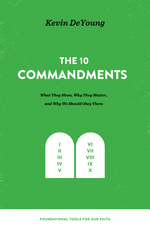
The Ten CommandmentsThe Ten Commandments: What They Mean, Why They Matter, and Why We Should Obey Them

by Kevin DeYoung

eARC, 208 pg.
Crossway, 2018
Read: September 23, 2018

My initial thought when I saw this book was: do we need another popular-level work on The Ten Commandments? We’ve got so many already, like: Ryken’s Written in Stone, Horton’s The Law of Perfect Freedom, Packer’s Growing in Christ. We’ve got Douma’s, Watson’s and Durham’s (newly republished) on the heavier end of the spectrum, too. Why bring out a new book by DeYoung? Still, I was intrigued, so I requested a copy.

Not too surprisingly, I’m glad I did. This is typical DeYoung: a strong, affectionate, orthodox take on the Law delivered in a very accessible and affable manner. He made me think, he made me reconsider a thing or two, and he reminded me of a few things I needed reminding of.

He begins this work against the framework of the secular “anything goes” point of view, where everything certainly does not go — as much as we as a culture might rail against an external source of morality — there are things that simply cannot be said or done. Giving us a choice between humanity’s unwritten, assumed code — or God’s revealed will. DeYoung then goes on to list reasons for the study as well as the following of God’s Law.

The other important groundwork comes from the midst of his very strong chapter on the First Commandment in which he describes the role of the Law for New Covenant believers. It’s still applicable, still binding — just in a different manner. I think this could’ve been developed more — maybe in its own chapter, but what we got here was good. I do particularly appreciate his metaphor of transposition. The Law in the New Covenant is the same for believers as it was in the Old, it’s just in a different key.

Following the introduction where he lays out his framework, DeYoung turns to consider the commandments individually. This is the bulk of — and the heart of — the book, with a chapter devoted to each commandment. If the book has any value, it’ll be found here, and there’s a lot of it to be found. I briefly considered summarizing each chapter, but why steal his thunder. Also, he’s not carving out anything new here, so there’s little need. What’s new is his expression of the timeless truths, his way of explaining and applying them. If you want a quick summary of what he’ll say about each commandment read The Heidelberg Catechism questions 92-115 or the Westminster Shorter Catechism questions 39-85, and you’ll get a pretty good idea.

Instead, I’ll just comment on a few highlights and a couple of problems I had (your mileage may vary). I found his comments regarding the Fourth Commandment to be helpful, but hesitant — in his effort to not be legalistic, or overly dogmatic, he comes across as wishy-washy. I appreciated most of what he had to say about the Second Commandment, but again, he’s hesitant enough in some of his application to stumble a bit. Which is not to say that the bulk of those chapters weren’t good and helpful — they were. I think he could’ve been more consistently so.

Conversely, the chapters on the Eighth and Tenth commandments were incredibly helpful. If you ask me, these two are where the American Church and American Christians stumble more often than we realize (or care about). Publicly, Protestants are expounding so much energy on certain applications of the Sixth and Seventh commandments that one would be tempted to think that 8-10 are concerns of the past. DeYoung doesn’t let the reader think that for an instant, and if you don’t come away from these chapters with a good dose of conviction of your own sin, you probably didn’t read it too closely.

The chapter on the Third Commandment was invaluable also. It’s far too easy for Western Christians to reduce this to “don’t be a potty mouth” and far too hard for us to really get what the importance of “name of the Lord” is. DeYoung does a yeoman’s job on both fronts and does a good job expounding the meaning of this commandment.

You’ll never walk away from any of these chapters thinking that DeYoung is writing a hellfire and brimstone jeremiad against the Church, you, or anyone. He’s sharply critical of a lot of general culture, and individual inclinations, but that’s to be expected. There’s conviction and inspiration both to be found in these pages — all delivered in DeYoung’s warm, almost conversational, style — a strong blend of wit and charm with the steel in his words. I won’t get into it, but his chapter on the Third Commandment contains one of the funniest anecdotes (more in the telling than the story) I’ve read from him. Ignoring his content for a moment, his writing style is what will keep me coming back to DeYoung’s books for years to come.

I think I’ve said before, I’m not a big one for study/discussion questions in books — I like to think the engaged reader doesn’t need them and someone leading a discussion/study of a book will be clever enough to come up with their own. But, I’m obviously swimming against the tide on this because publishers keep printing them. That said, on the whole, this is a pretty good set of questions and would help someone who likes those kind of questions for their own use or for those using the book in Family Worship, Sunday School, or Bible Study.

In the end, my question, do we need another popular-level book on The Ten Commandments? Is answered yes: we need frequent — constant — reminders of the revealed will we’ve been called to obey, so we never stop striving for that perfection and never cease calling on the Spirit’s assistance. We also need to remember how great our sin and misery are so that we constantly live lives of repentance. So bring on DeYoung’s good summary. And others as well — and we need to read them, as well as the older popular-level works. And then we need to push ourselves and read some of the less-popular level ones as well.

This is a good, short set of meditations and reflections on the perfect law, the law of liberty for a contemporary audience. It’s approachable, it’s warm, it’s pointed, and it’s Gospel-centered. It’s not perfect, but it’s good. It functions well as a refresher for those who need one, and a good starting point for their own study of The Ten Commandments. I’m buying a copy (at least one) for my personal library and will be encouraging my household to read it — and anyone else who asks.

Disclaimer: I received this eARC from Crossway via NetGalley in exchange for this post — thanks to both for this.

—–

4 Stars

The Subtle Art of Not Giving a F*ck (Audiobook) by Mark Manson, Roger Wayne: A Mix of Common Sense, Cynicism, Self-Aggrandizement, Clever Writing, and a Great Narrator

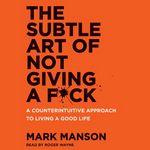
The Subtle Art of Not Giving a F*ck (Audiobook)The Subtle Art of Not Giving a F*ck: A Counterintuitive Approach to Living a Good Life

by Mark Manson, Roger Wayne (Narrator)

Unabridged Audiobook, 5 hrs., 17 min.
HarperAudio, 2016

Read: October 1, 2018

I’d seen this book around, and let my eyes slide right off given the title. Clearly, it wasn’t for me. Then a couple of months ago, I heard it referenced in a couple of podcast interviews (no, I don’t remember who talked about it — but at least one of them said something thoughtful about it) and my cubicle-mate listened to it at the same time and seemed to enjoy it. So I figured I’d give it a shot. I’m very glad I did, really.

I’m also glad that HarperCollins’ website gives such a thorough blurb about the book, which will save me so much time — so let’s take a moment to read what they said:

           In this generation-defining self-help guide, a superstar blogger cuts through the crap to show us how to stop trying to be “positive” all the time so that we can truly become better, happier people.

For decades, we’ve been told that positive thinking is the key to a happy, rich life. “F**k positivity,” Mark Manson says. “Let’s be honest, shit is f**ked and we have to live with it.” In his wildly popular Internet blog, Manson doesn’t sugarcoat or equivocate. He tells it like it is—a dose of raw, refreshing, honest truth that is sorely lacking today. The Subtle Art of Not Giving a F**k is his antidote to the coddling, let’s-all-feel-good mindset that has infected modern society and spoiled a generation, rewarding them with gold medals just for showing up.

Manson makes the argument, backed both by academic research and well-timed poop jokes, that improving our lives hinges not on our ability to turn lemons into lemonade, but on learning to stomach lemons better. Human beings are flawed and limited—”not everybody can be extraordinary, there are winners and losers in society, and some of it is not fair or your fault.” Manson advises us to get to know our limitations and accept them. Once we embrace our fears, faults, and uncertainties, once we stop running and avoiding and start confronting painful truths, we can begin to find the courage, perseverance, honesty, responsibility, curiosity, and forgiveness we seek.

There are only so many things we can give a f**k about so we need to figure out which ones really matter, Manson makes clear. While money is nice, caring about what you do with your life is better, because true wealth is about experience. A much-needed grab-you-by-the-shoulders-and-look-you-in-the-eye moment of real-talk, filled with entertaining stories and profane, ruthless humor, The Subtle Art of Not Giving a F**k is a refreshing slap for a generation to help them lead contented, grounded lives.

Sure, some of that is overblown — its point is to sell you the book, right? But, by and large, that’s a good summary of the book’s highlights. Manson’s point isn’t to stop giving a f*ck period, it’s to give fewer f*cks in general and to make sure the f*cks you give are for the right/important stuff in life. That’s pretty basic, but pretty easily ignored advice: everything seems important, but not everything is. Focus on the important stuff, care about that, and let the rest go — if it works out, great. I’m not sure if this is different from Carlson’s book Don’t Sweat the Small Stuff — but it probably has more laughs and profanity.

Manson is entirely too impressed with himself (or at least he comes across that way), and he never convinces me that there’s a reason to heed his advice over anyone else’s. But on the whole, what he says makes a lot of sense. Do I think that ultimately, this is all a house of cards that won’t stand intense scrutiny? Yup. But I think that of every bit of man-made advice — Manson’s is more amusingly delivered than most, and won’t get the devotee into too much trouble if they apply this recklessly.

Roger Wayne’s narration elevates the entire thing — there’s not a moment that I don’t confuse his voice for Manson’s. It felt like I was attending one of the most intense self-help seminars in history and that Manson got going and just wouldn’t stop (not that anyone tried to make him). Wayne added voices (his Disappointment Panda voice is the best character I’ve heard in an audiobook since Luke Daniel’s take on Hearne’s Oberon), flair and a sense of passion to the text. When Manson approached poignancy, Wayne made it all the more so. Fantastic work.

I’d probably give this 3-stars if I’d read the text — amusing, thought-provoking, with some good advice. But, you add in Wayne’s narration? I’ve got to bump it up to 4. Seriously, he’s just that good. This isn’t a book for everyone (I know several readers of this blog that should avoid it just for the language), but for those who are capable of sorting out the wheat from the chaff — this is a fun and potentially helpful read.

—–

4 Stars2018 Library Love Challenge

Looking for Calvin and Hobbes (Audiobook) by Nevin Martell, Jeremy Arthur: A close-up look at the Cartoonist and His Creation

I’ve spent 20 minutes trying to get this header to look decent — and I give up. It’s just going to look awkward given the length of the title.

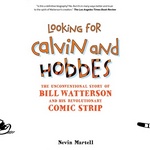
Looking for Calvin and Hobbes (Audiobook)Looking for Calvin and Hobbes: The Unconventional Story of Bill Watterson and His Revolutionary Comic Strip

by Nevin Martell, Jeremy Arthur (Narrator)
Unabridged Audiobook, 7 hrs., 9 min.
ListenUp Production, 2014
Read: September 25 – 27, 2018
Nevin Martell, like just about everyone who ever read him, is a Calvin and Hobbes fan — what’s more, he discovered the strip at the right age and was able to appreciate it as only a child can — without being self-conscious about reading a comic strip and with devotion. Years later, when trying to write something more meaningful to him than another book about a pop star, he decides to write about that strip and its reclusive creator.

The reclusive part of that sentence is the key — Watterson had (and has) pretty much dropped off the face of the earth as far as your typical person is concerned. A few select friends, business acquaintances and family members can get in touch with him, but no one else can. This isn’t crippling to a book about his comic strips or himself, but it sure hampers it (especially because those people who can get in touch with him are just about as reticent as he is to talk about him or his work). Unencumbered by access to Watterson himself, and his perspective on his life and career was like, what his influences were, what made him make the creative decisions, etc. Martell dove into research — things written about and by Watterson, archives of his previous work (when and where available) and interviews with colleagues, editors and the like.

In the kind of detail only a scholar or a fan can appreciate, Martell describes Watteron’s childhood, college, and pre-Calvin and Hobbes career; then he discusses that comic strip — major themes — and its publishing history; Watterson’s battle to keep control of the strip, its merchandising/licensing; then he describes Watterson’s retirement. As much of that as he can, which isn’t much. Following that, Martell focuses on things like the impact of Watterson on the industry, his relationships with other cartoonists and is influence on those who followed.

I wish he’d given us more (and maybe he gave us all he could, but I don’t think so) from Watterson’s contemporaries/those he influenced in the field of comics (or related fields — he spoke with a novelist and Dave Barry, too). Martell spoke to many and gave us a lot of what he was told — but I’d have appreciated more coming from professionals about Watterson’s strengths, technique, stories — whatever. Sure, it might have gotten a little redundant, but something tells me that it wouldn’t have been too bad. These were my favorite parts of the book, and I could’ve listened to another hour of them easily.

I’m not convinced that I was ever as invested in Martell’s journey as he seemed to think his readers would (should?) be — and I’m okay with that. I know I tend to overshare here a tad myself — so I understand the impulse. Or maybe I’m just callous, and everyone else got into it.

As far as Arthur’s work narrating — there’s not a lot to say. This isn’t a work of fiction where he can play with characters, pacing, and whatnot. It’s a straightforward text and he does a capable job of reading it in a straightforward manner. I did have to remind myself a couple of times that I was listening to someone Martell’s words rather than listening to him — which I guess is a good thing.

It was a pleasant book, nothing too challenging — and it reinvigorated an impulse to go read a collection or two of Watterson again on my part (and some of Larson’s The Far Side, too — I’m sure there’s an interesting book to be written there, too). It’s not a must-read, but it’ll scratch an itch for those who have an interest in the subject.

—–

3 Stars

2018 Library Love Challenge

Pub Day Repost: Dear Mr Pop Star by Derek & Dave Philpott: Hilarious, Unique, Addictive are some Adjectives I use to describe this Incredibly Entertaining Book

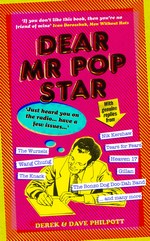
Dear Mr Pop StarDear Mr Pop Star

by Derek & Dave Philpott
eARC, 412 pg.
Unbound, 2018
Read: July 24 – August 7, 2018<br/

In my intro post for this Tour Stop, I said that this book was “almost indescribable” and I really mean that — the blurb for the book says, “deliberately deranged letters to pop stars from the 1960s to the 90s to take issue with the lyrics of some of their best-known songs.” And that’s right, but it doesn’t seem to get to the heart of it. The answer to the first question in the Q&A is a pretty good description, though. But if you don’t want to read that (which I get, you’re wrong — but I get it), I should probably try to convey what you’ll find here.

Let’s take a look at the letter they wrote to Starship. I don’t feel too bad about talking about this letter in detail because their take on their song “We Built this City” is common (I used to own, for example, a t-shirt that made the same joke, just in briefer form). Now, their letter goes into a great amount of detail about the nature of foundations, different types of them, etc. and how this makes their “design project” the “most ludicrous” in the history of architecture. This kind of thing is funny, and a collection of these sort of letters — as well-written as these are — would be worth the time to read and would make you laugh — I’d give it a pretty high rating, encourage you to get it, etc.

But what separates this book from similar tomes, what makes it special is that on the very next page, you get to read a response from Martin Page, who co-wrote the song. Page mounts an impassioned defense of the song — full of references to Rock classics as proof. I’ll spare the details so you can appreciate Page’s inspired choise in response. Each letter printed in this collection is answered by a songwriter, musician, or other representative of a musical act. Some of these responses debate the premise of the Philpott’s letter, some answer in the same vein, others take the premise and run with it in their own way — some appear to be in on the joke, others appears to be flummoxed that anyone would take their lyrics in this insane manner.

In particular, Tears for Fears, The Knack, and NuShooz/J. Smith had great responses — Kimberly Rew (of Katrina and the Waves) is my current favorite. EMF must have either absolutely loved or utterly hated writing their response, I cackled at it. The Human League and Wang Chung composed very long responses — some are as short as a paragraph or three. I really could keep listing some other distinctives about the responses, and great ones to look for — but this is already getting pretty long.

They also include some lIttle notes or postcards like the one to ELO, talking about the impossibility of their name; to “Mr. John” about the unacceptability of violence on any night; or to John Parr (involving canonization of a particular Muppet, and the danger of exposing him to flame) — I just reread that one and cracked up, again. These probably couldn’t support being stretched into a letter of any length, and there are no responses printed — but are very likely the most funny parts of the book.

There’s an elevated vocabulary used by the Philpotts — this isn’t an uneducated reaction to lyrics. The letters are frequently erudite and earnest. The letters don’t come across as something written for comedic effect — yes, they’re funny. But that’s not the intention. Somehow, that happens without turning the joke back on them for misunderstanding the lyrics, either. They’re a strange kind of tribute, but this kind of close reading of a lyric is a form of flattery.

Many of the acts haven’t made much of an impact in the States, and I clearly don’t know enough about British Pop Music to understand each of these — but thanks to youtube and lyrics websites, I was able to get the gist of what I was supposed to be reading about (and I was able to enjoy those I was feeling too lazy to look up). But by and large these are acts and songs that are well-known enough that this book is accessible to readers from around the English-speaking world (and maybe larger, I’m not an expert on music listening habits). The acts run the gamut from Herman’s Hermits to Judas Priest and many, many points in between.

I cannot stress enough how much fun I had with this book — I read whole letters or notes aloud to family members, and/or forced them to read one for themselves. These are the perfect literary equivalent of potato chips, you can eat a handful at a time and then leave the bag for later (along those lines, it’s possible to read too many at once). The letters are short enough that you can just dip in and out of the book. And, I can assure you, these are the kind of thing you can return to later and still enjoy — not unlike a good pop song (huh, wonder where I got that imagery?) A combination of satire, analysis, tribute and comedy — without any meanness or cruelty — Dear Mr Pop Star will appeal to music lovers from all sorts of eras. Do yourself a favor and grab this today.

Disclaimer: I received a copy of this book from the authors in exchange for my participation in this tour stop.

—–

5 Stars

Dear Mr Pop Star by Derek & Dave Philpott: Hilarious, Unique, Addictive are some Adjectives I use to describe this Incredibly Entertaining Book

Dear Mr Pop StarDear Mr Pop Star

by Derek & Dave Philpott

eARC, 412 pg.
Unbound, 2018
Read: July 24 – August 7, 2018<br/

In my intro post for this Tour Stop, I said that this book was “almost indescribable” and I really mean that — the blurb for the book says, “deliberately deranged letters to pop stars from the 1960s to the 90s to take issue with the lyrics of some of their best-known songs.” And that’s right, but it doesn’t seem to get to the heart of it. The answer to the first question in the Q&A is a pretty good description, though. But if you don’t want to read that (which I get, you’re wrong — but I get it), I should probably try to convey what you’ll find here.

Let’s take a look at the letter they wrote to Starship. I don’t feel too bad about talking about this letter in detail because their take on their song “We Built this City” is common (I used to own, for example, a t-shirt that made the same joke, just in briefer form). Now, their letter goes into a great amount of detail about the nature of foundations, different types of them, etc. and how this makes their “design project” the “most ludicrous” in the history of architecture. This kind of thing is funny, and a collection of these sort of letters — as well-written as these are — would be worth the time to read and would make you laugh — I’d give it a pretty high rating, encourage you to get it, etc.

But what separates this book from similar tomes, what makes it special is that on the very next page, you get to read a response from Martin Page, who co-wrote the song. Page mounts an impassioned defense of the song — full of references to Rock classics as proof. I’ll spare the details so you can appreciate Page’s inspired choice in response. Each letter printed in this collection is answered by a songwriter, musician, or other representative of a musical act. Some of these responses debate the premise of the Philpott’s letter, some answer in the same vein, others take the premise and run with it in their own way — some appear to be in on the joke, others appears to be flummoxed that anyone would take their lyrics in this insane manner.

In particular, Tears for Fears, The Knack, and NuShooz/J. Smith had great responses — Kimberly Rew (of Katrina and the Waves) is my current favorite. EMF must have either absolutely loved or utterly hated writing their response, I cackled at it. The Human League and Wang Chung composed very long responses — some are as short as a paragraph or three. I really could keep listing some other distinctives about the responses, and great ones to look for — but this is already getting pretty long.

They also include some little notes or postcards like the one to ELO, talking about the impossibility of their name; to “Mr. John” about the unacceptability of violence on any night; or to John Parr (involving canonization of a particular Muppet, and the danger of exposing him to flame) — I just reread that one and cracked up, again. These probably couldn’t support being stretched into a letter of any length, and there are no responses printed — but are very likely the most funny parts of the book.

There’s an elevated vocabulary used by the Philpotts — this isn’t an uneducated reaction to lyrics. The letters are frequently erudite and earnest. The letters don’t come across as something written for comedic effect — yes, they’re funny. But that’s not the intention. Somehow, that happens without turning the joke back on them for misunderstanding the lyrics, either. They’re a strange kind of tribute, but this kind of close reading of a lyric is a form of flattery.

Many of the acts haven’t made much of an impact in the States, and I clearly don’t know enough about British Pop Music to understand each of these — but thanks to youtube and lyrics websites, I was able to get the gist of what I was supposed to be reading about (and I was able to enjoy those I was feeling too lazy to look up). But by and large these are acts and songs that are well-known enough that this book is accessible to readers from around the English-speaking world (and maybe larger, I’m not an expert on music listening habits). The acts run the gamut from Herman’s Hermits to Judas Priest and many, many points in between.

I cannot stress enough how much fun I had with this book — I read whole letters or notes aloud to family members, and/or forced them to read one for themselves. These are the perfect literary equivalent of potato chips, you can eat a handful at a time and then leave the bag for later (along those lines, it’s possible to read too many at once). The letters are short enough that you can just dip in and out of the book. And, I can assure you, these are the kind of thing you can return to later and still enjoy — not unlike a good pop song (huh, wonder where I got that imagery?) A combination of satire, analysis, tribute and comedy — without any meanness or cruelty — Dear Mr Pop Star will appeal to music lovers from all sorts of eras. Do yourself a favor and grab this today.

Disclaimer: I received a copy of this book from the authors in exchange for my participation in this tour stop.

—–

5 Stars

A Few Quick Questions about Dear Mr. Pop Star


I had the great privilege of asking a few questions of Mr. Dave Philpott regarding this great book. It was tough to come up with the questions, the temptation to get into some of the particular letters/responses was great — I also had a song or two I thought about trying to get their take on. But I restrained myself — at great personal cost. But it was worth it — these are some of the best answers I’ve received in one of these. . .

This seems to be largely a UK-based endeavor — for the sake of my largely US audience, could you introduce Derek & Dave Philpott and the background for this project?
To be totally frank with you we are just two ordinary blokes. I’m obsessed with music, am extremely knowledgeable about it and it’s my day job, So I revere and view artists and songs from a skewed perspective. My father though knows nothing about music, is completely detached from it and doesn’t know or care if a tune is by a world famous artist or a band in a garage down the road. Hence, when Mick Jagger sees a red door and wants to paint it black, I marvel at an angst-ridden motif of despair and the hopelessness of the human condition from the pen that bought us ‘Sympathy For The Devil’. My dad though, oblivious to Mr. Jagger’s pedigree, will say:

‘’What a fool! If he doesn’t put a strong undercoat on there it’s going to turn up purple. Your Uncle Len did that once and..’’

…and then he’s off on a diatribe about bad D.I.Y. or, as I believe our American friends call it, Home Improvements. How it would always work is that I would play him a song, or perhaps even give him a copy of the lyrics to a famous tune, let him digest it for a while and then wait for the gold, which would normally just be him wittering on for a while about the record interspersed with details of how his day would pan out and what the neighbours were up to. I would note this all down, edit it and it would form the body of a letter to the artist. In 2008 we put together a website of about 50 or 60 letters, which we would add to regularly, and then we set up our Facebook page. We thought it was funny enough that these unanswered missives were sitting there in the misty ether. We found ourselves with a fierce fan base and then one day, about two years into the project, we got a reply from one of the artists themselves. Crucially this contact was secured not through official channels but from a mutual fan who knew the pop star personally. We then realised that this could be an interactive dialogue with the rock and pop stars and that, importantly, we could get to these artists through ‘the back door of the industry’. This could be through friends of friends, roadies and crew, the bass player’s cousin or any indirect route. This made the process a lot more personable, as we were being recommended by people who knew who we were and what we did and that it was all a bit harmless and daft. Eventually we got to the point where the rock stars were telling each other. I wrote to a pop star last year, asking if they would like to get involved and if they knew who we were, then the immortal reply “Oh god, I’ve been dreading and looking forward to being asked one day!” came back and we were absolutely thrilled.

We made sure that we got the full consent of the artists to use their replies and that they were happy for us to share them. Every single one of them told us that they were more than happy and they all got behind us and some even supported us by telling their own fans about us.

Owen Paul told us, in not so many words, that he felt that this is so obviously an organic project which he’d seen this grow over years and if we had been a couple of journalists then he just wouldn’t have got involved because it would be contrived rubbish.

It took us a long time, nearly an entire decade in fact, but we ended up with enough material for a book which we self published after an amazingly successful campaign on Kickstarter, through which we were able to raise £18,000. The success of that volume bought us to the attention of our now publisher, Unbound, who encouraged us to do a second.

Is there an artist/group or song that you’ve tried to write about but just haven’t gotten things just right?
Yes, indeed, the one that springs to mind first is Stiff Little Fingers. Many of their songs are based around The Troubles in Ireland which started in the late 1960s, an era that my Dad lived through and, due to being that bit older, knows more about than I. He was quite rightly very uncomfortable about deriding the subject matter and lyrics, so we decided that we would poke fun at ourselves by writing a letter to them where we deliberately got the wrong end of the stick by misunderstanding the song for comedic effect. Looking back I think that that letter completely changed the project for the better – we realised that we could turn the joke on ourselves and this allows the artist to hit back at us. For the new book Dr Hook and Tears for Fears both informed us that they couldn’t find the inspiration to reply to our first efforts because they weren’t up to our usual standards, probably because of the fact that at the time we were compiling the whole project, and had our eye off the ball. So we screwed up the first letters and started again, thought it through and came up with completely new letters which they lapped up and their responses were magical. They were absolutely right.
Of the responses you’ve received from artists/groups, which has been the most surprisingly good? Either you didn’t expect a response quite along the lines of their letter, and/or theirs was better than you expected? (I’m sure you have some on the other end of the spectrum, as well, but we’ll ignore them)
From the new book it’s Geoff Deane from Modern Romance, Chris from The Waitresses, Mott the Hoople, Wang Chung and Nik Kershaw. They absolutely slaughtered us with their wit and inventiveness. Although I have to say that we are always impressed at the answers that we get back, the effort that the stars put into their replies is astounding and we’re flattered that they give us so much time and attention. Each letter is a wonderful surprise.
You’re obviously enjoying a measure of success from artists and readers (otherwise this book wouldn’t exist), what’s the most interesting criticism you’ve received — either from a reader, critic or musician? Has it changed your approach to anything?
Feedback from our friends online is vital to us and this is why we’ve always tried to be as interactive as we can on our Facebook page, which dad does try to be a part of as much as he can, but he is obviously from a era where things were a little less ‘immediate’ and a lot more polite. Sometimes when we send messages via Messenger and there’s a ‘seen tick’ but no reply, Dad feels that this is incredibly rude, but it’s just the way things are now in the world. He like so many pensioners comes from a more courteous past.

There is a certain luxury of this real time interaction with the people who follow you though, in that you can bounce ideas out there via status updates and see how new material is received in general. If it chimes and makes people laugh then you can integrate it into letters. Also when we first began our letters were fairly flowery – we would spend sometimes weeks perfecting them, making sure that we never repeated words, writing very elaborate scenarios to tie in with the different songs. Perhaps we were trying to be a bit too clever to impress the artists. But the feedback we got told us that we could actually lose a lot of the purple prose and just get straight to the point and this has crucially changed how we write now. Being succinct actually means that the focus is more on the replies and probably makes our missives easier to respond to, as they not bogged down in unnecessary language.

Also a lot of anoraks on the prog forums were incensed, claiming that we’d invented the responses from some of their heroes as ‘there is no way that Mr. XXXX would respond to this outrage’. I loved that – it meant that we really were getting somewhere.

Of all your letters in this particular volume what are the one or two that you’re most proud of?
Bruce Woolley’s is a masterpiece. Also as fan of Gong, getting Daevid was a massive deal for me. It was one of the last things the great man did before he left us, and he absolutely loved it. I was going to include it in the first book but felt it was too soon after his passing. Then I was dithering about putting him in this one and I had a vivid dream, in which he visited my house, knocked on the door and said,

“I am ready to speak”

Thank you very much for your time — and for this book. I had such a great time reading it, I hope you have great success with it!
Bless and thanks, Mr. Newton

BOOK SPOTLIGHT: Dear Mr Pop Star by Derek & Dave Philpott

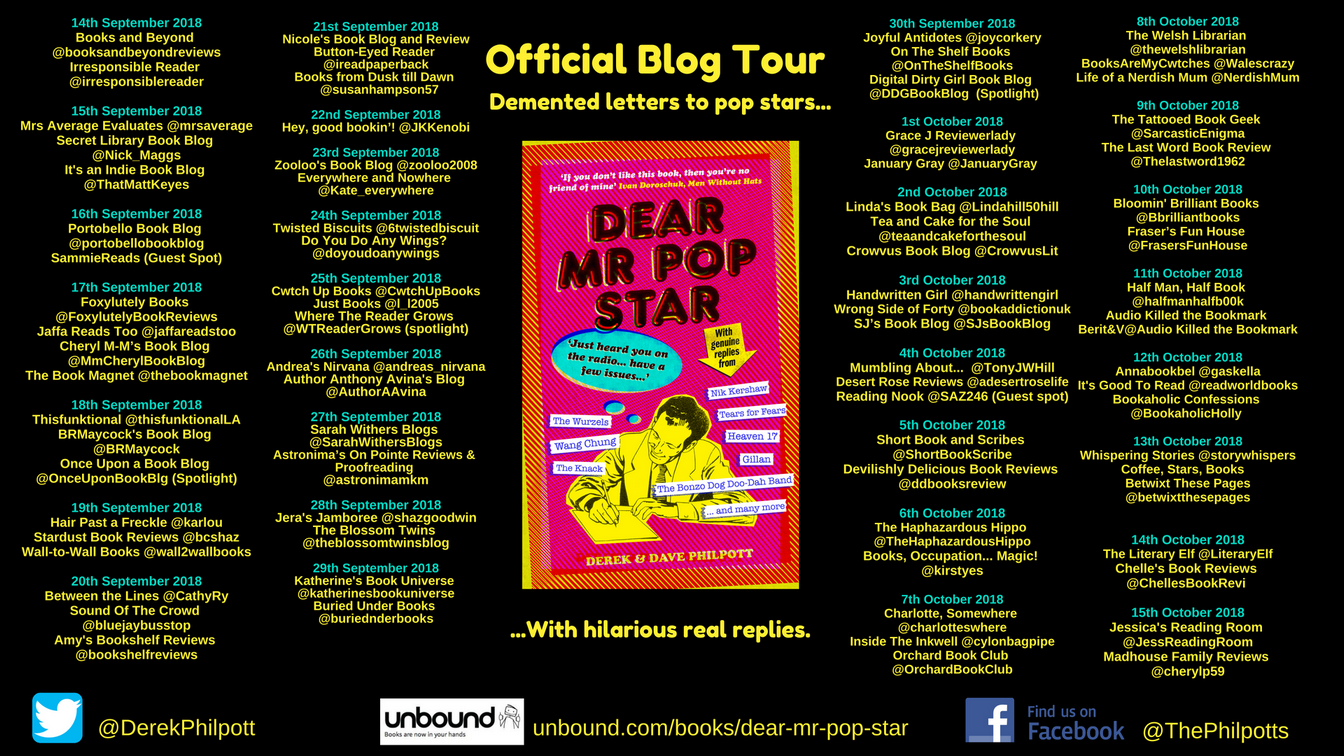
Today we welcome the Book Tour for the almost indescribable Dear Mr Pop Star by Derek & Dave Philpott — hopefully that “almost” is accurate, or I’m going to have trouble when it comes to my post about it (as if being one of this massive group isn’t bad enough — seriously, check out that graphic!). Along with this spotlight post, I have a Q&A about the book, and then I’ll be giving my take on the novel here in a bit. (those links’ll work once the posts are live)

(click to embiggen)

Book Details:

Book Title: Dear Mr Pop Star by Derek & Dave Philpott
Publisher: Unbound
Release date: September 20, 2018
Format: Hardcover/ebook
Length: 416 pages

Book Description:

“If you don’t like this book, then you’re no friend of mine.” Ivan Doroschuk, Men Without Hats

A collection of hilarious letters to iconic pop and rock stars with fantastic in-on-the-joke replies from the artists themselves: Eurythmics, Heaven 17, Deep Purple, Devo, Dr. Hook and many, many more…

For more than a decade, Derek Philpott and his son, Dave, have been writing deliberately deranged letters to pop stars from the 1960s to the 90s to take issue with the lyrics of some of their best-known songs. They miss the point as often as they hit it.

But then, to their great surprise, the pop stars started writing back…

Dear Mr Pop Star contains 100 of Derek and Dave’s greatest hits, including correspondence with Katrina and the Waves, Tears for Fears, Squeeze, The Housemartins, Suzi Quatro, Devo, Deep Purple, Nik Kershaw, T’Pau, Human League, Eurythmics, Wang Chung, EMF, Mott the Hoople, Heaven 17, Jesus Jones, Johnny Hates Jazz, Carter the Unstoppable Sex Machine, Chesney Hawkes and many, many more.

About the Authors:

Derek and Dave Philpott are the noms de plume of two ordinary members of the public, working with help from a worldwide social networking community.

For More Information:

Goodreads ~ Unbound ~ Twitter ~ Facebook

Planet Funny by Ken Jennings: Chortling Towards Bethlehem? or We Are Amusing Ourselves to Death

Planet FunnyPlanet Funny: How Comedy Took Over Our Culture

by Ken Jennings

Hardcover, 320 pg.
Scribner, 2018
Read: June 21 – July 6, 2018
This is going to be much shorter — and much more vague –than it should have been, because I was in a rush to get out the door on the day I took this back to the library and therefore forgot to take my notes out of the book. Which is a crying shame because I can’t cite some of my favorite lines (on the other hand, I don’t have to pick from my favorites). I’m actually pretty annoyed with myself because of this — I spent time on those notes.

I’m going to try to save a little time here and just copy the Publisher’s synopsis:

           From the brilliantly witty and exuberant New York Times bestselling author Ken Jennings, a history of humor—from fart jokes on clay Sumerian tablets all the way up to the latest Twitter gags and Facebook memes—that tells the story of how comedy came to rule the modern world.

For millennia of human history, the future belonged to the strong. To the parent who could kill the most animals with sticks and to the child who could survive the winter or the epidemic. When the Industrial Revolution came, masters of business efficiency prospered instead, and after that we placed our hope in scientific visionaries. Today, in a clear sign of evolution totally sliding off the rails, our most coveted trait is not strength or productivity or even innovation, but being funny. Yes, funniness.

Consider: presidential candidates now have to prepare funny “zingers” for debates. Newspaper headlines and church marquees, once fairly staid affairs, must now be “clever,” stuffed with puns and winks. Airline safety tutorials—those terrifying laminated cards about the possibilities of fire, explosion, depressurization, and drowning—have been replaced by joke-filled videos with multimillion-dollar budgets and dance routines.

In Planet Funny, Ken Jennings explores this brave new comedic world and what it means—or doesn’t—to be funny in it now. Tracing the evolution of humor from the caveman days to the bawdy middle-class antics of Chaucer to Monty Python’s game-changing silliness to the fast-paced meta-humor of The Simpsons, Jennings explains how we built our humor-saturated modern age, where lots of us get our news from comedy shows and a comic figure can even be elected President of the United States purely on showmanship. Entertaining, astounding, and completely head-scratching, Planet Funny is a full taxonomy of what spawned and defines the modern sense of humor.

In short, Jennings is writing about the way that humor — the entertainment culture in general, really, but largely through humor — has taken over the cultural discourse in this country, so much so that you can’t make a serious point about anything anymore without injecting a smile or a laugh. This could be subtitled, Neil Postman was right. Jennings looks at this phenomenon through a historical lens (mostly over the last century) and a contemporary lens — analyzing and commenting on both.

The initial chapters on defining humor, the history of humor and academic humor studies are probably the best part of the book — not just because of their scope and subject matter, but because how Jennings is able to be amusing and insightful while informing. (although the amusing part is problematic given the thesis of the book). I enjoyed learning about the use of humor in the 20th Century — who doesn’t associate the two? I don’t remember a time when the best advertisements/commercials weren’t the funniest (other than things like the crying Native American anti-litter AdCouncil stuff). But there was actually a time when that was looked down on? Who knew?

I also particularly liked the history of Mystery Science Theater 3000 and then pivoting that into a look on the way even entertainment changed in the last few decades because of the funny-ification of all things. Jennings gives a pretty decent defense of Alanis’ “Ironic” (while enjoying a few shots at it, too) — and the ensuing discussion of Irony the cultural waves embracing and shying away from Irony, Enjoying things Ironically, and a need for sincerity was excellent.

Politics, obviously, has fallen prey to this comedy-take over as well. From Nixon shocking everyone by showing up on Laugh-In to Clinton (pre-presidential candidate) on The Tonight Show to then-candidate on The Arsenio Hall show to every political player doing Late Night shows. Obama appearing on Maron’s podcast and Between Two Ferns (crediting that appearance with saving ObamaCare?) and onto the entire Trump campaign. At this point, the book got derailed — I think — by getting too political. If Jennings had kept it to Trump’s embracing/exploiting the comedy takeover, I probably would have enjoyed it — but he spent too much on Trump’s politics (while having ignored Nixon’s, Clinton’s, Obama’s), enough to turn off even Never-Trump types.

I’m pretty sure that the book was almost complete about the time that Louis CK’s career was felled by allegations of sexual misconduct — which is a shame, because Jennings had to go back and water-down a lot of insightful comments from Louis CK by saying something about the allegations while quoting the comedian. At the same time, it’s good that the book wasn’t completed and/or released without the chance to distance the man from the points used — otherwise I think Jennings would’ve had to spend too much time defending the use of those quotations.

I think Jennings lost his way in the last chapter and a half or so — and I lost a lot of my appreciation for the book as a whole at that point. On the whole, it’s insightful writing, peppered with a good amount of analysis, research, interviews, and laughs — outside of his weekly trivia newsletters, I haven’t read Jennings and he really impressed me here. In short, it’s a fun book, a thought-provoking book, and one that should get more attention and discussion than it is. I may quibble a bit with some of the details, but I think on the whole Jennings is on to something here — and I fear that it’s something that not enough people are going to take seriously until it’s too late.

—–

3.5 Stars2018 Library Love Challenge

BOOK BLITZ: Outfoxing the Gaming Club Blitz by Pascale Batieufaye

Biography, Business
Date Published: May 2018
CLAIM INSANITY OR BE FIRED!
Ex-Casino Employee Spills All of the Unseen Corruption
Running Rampant in the Business!
Ideas flow freely through the work environment, and the good ones are scooped up and put into action. But what happens when your ideas are suddenly being claimed by someone else? What if you found out that your employer was hiding secrets from the public? A job is supposed to secure one’s finances, but what if it was actually the cause of your financial troubles?
All of these questions – and more! – are addressed in Pascale Batieufaye’s tell-all memoir, Outfoxing the Gaming Club: A Former Worker Reveals All. From the kitchen to guest services, Batieufaye exposes the corruption and exploitation present in one of the world’s biggest casinos, Resort Casino, where he worked from 1996 to 2004
Through the book’s pages, Batieufaye details how corporate executives undermine their employees and use their ideas as their own, as he found was done with his own ideas when he shared them with leadership at the gambling powerhouse. He also details the mistreatment of the Native Americans he witnessed, who built the very grounds that now contribute to their injustice.
“I have centered Outfoxing the Gaming Club on the emotional suffering I faced while working for my previous employer,”shares Batieufaye. “The book outlines guiding principles for those who have experienced maltreatment and anxiety in their own workplace. Readers will discover the crookedness that occurs right under the noses of the patrons, and unearth the oppression that the employees had to deal with on a daily basis.”
An exposé for both gamblers and those opposed to it,this book details:
· How his own ideas were stolen from right under Batieufaye’s feet
 
· The mistreatment of Native Americans involved with the company
 
· Corruption’s role in the mental health of himself and other employees at the company
 
· Gambles employees took when attempting to contribute, knowing all too well they may not receive proper credit for those ideas
 
· The emotional suffering that workers had to deal with on a daily basis
 
· And so much more!
About the Author

Pascale Batieufaye attended Johnson & Wales University, where he studied travel and tourism. He is technically an animal rights activist and aspires to open an animal rehabilitation center for rescue animals. His principal occupation has been a part time school bus driver since the end of 2012, which allowed him to write five unpublished manuscripts in his spare time. Before that, Batieufaye ran a video store which closed up at the hype of Netflix’s driven internet power. He has also held some backbreaking jobs, such as courier driver (independent contractor) and Skycap/baggage handler, although nothing seems to take as much of a toll as his work with a major, corrupt casino corporation did, as detailed in his book Outfoxing the Gaming Club.
Contact Links
Purchase Links
RABT Book Tours & PR

The War Outside My Window: The Civil War Diary of LeRoy Wiley Gresham, 1860-1865 edited by Janet E. Croon: A sick and dying teen witnesses history

There’s so much more I want to say, but I ran out of time — and went on pretty long already. It’s really bugging me all the things I wanted to talk about, but didn’t. There may be a follow-up. I updated this slightly after posting thanks to a comment from the publisher.

 The War Outside My Window The War Outside My Window: The Civil War Diary of LeRoy Wiley Gresham, 1860-1865

by Janet E. Croon, ed.

Hardcover, 480 pg. (includes an 8-page photo insert)
Savas Beatie, 2018
Read: May 1 – 28, 2018

When he was twelve, LeRoy Wiley Gresham, of Macon, Georgia starts keeping a daily journal (well, as close to it as anyone really ever does). The year is 1860 and he and his father are headed to Philadelphia to consult with leading doctors about LeRoy’s medical condition, which local physicians have been unsuccessful in dealing with — the book contains a medical foreword and afterword that will explain these circumstances better than LeRoy ever does (partially because he doesn’t have the whole story). From Philadelphia they return home and to talk of succession — it’s not long before the Confederacy is born and Fort Sumter is fired upon. This is the setting for these journals — published for the first time this year.

LeRoy was born to be a Southern Gentleman and was raised as such — and between the War, his age and disease, he never really had an opportunity to examine his upbringing. As such, he is incredibly partisan, shows nothing but contempt for the Union, Lincoln, the Union Army, etc. The language and attitudes he uses toward his family’s slaves (and pretty much everyone’s slaves) is par for the course during the Civil War, readers need to remember this going on. He is also a pretty astute observer and realist — when the tide begins to turn for the Confederacy, he’s aware and his upfront about it (there are even traces of “I told you so” to his writing when it comes to certain strategies).

Meanwhile, life continues — people go to school, crops are grown and harvested, babies are born, people die and are married, kids get pets. LeRoy’s family were staunch Presbyterians, his father a leader in the local church — presbytery and synod meetings are also reported on.

For LeRoy, the years after his return from Philadelphia (and those leading up to it, really) are also years of deteriorating health, bouts of pain, and ineffective treatments. Those who put this book together have determined (and it seems only likely) that there are two major health problems going on here — a horrific leg injury sustained when he was 8 and tuberculosis. Neither did him any favors — his life wasn’t going to be easy just with the injury, but TB made it short. Tracing the worsening of each is tragic — and LeRoy dies not long after the end of the War.

All of these topics are detailed and recorded — almost every day — in a few brief sentences. Sometimes it can be jarring the way he’ll go from casualty numbers, to talk about his coughing, to a comment on peach harvests and the book he’s reading in a paragraph a little briefer than some of the longer ones in this post. But that’s just what was on his mind that day. Sometimes there are strange doodles or other things recorded, lists of Bible questions, practice trials of his own developing signature and other things like that (often with photos included).

The War reporting is going to get the bulk of each reader’s attention. Which is completely understandable — and it gets about half of the space of the book, the other topics compete for the other half of the space. His information (as the wonderful footnotes demonstrate) is frequently mistaken — and he knows his, and will often speculate about as he reports what the newspapers say. We’re used to news stories developing over minutes and hours, LeRoy had to be content with learning about something days after the event, and then still learning details weeks later. His frustration about that is seen occasionally — especially as te War grinds on and it’s harder for newspapers to be printed and delivered (paper itself becomes scarce). At one point there’s such an outbreak of smallpox that there’s no one available to bring his family their newspaper, so they have to send someone to retrieve it — LeRoy’s utter disgust at that is both hard to believe and completely human. “Fascinating” doesn’t come close to reading his perceptions and understanding the events that are history to us – talking about famous battles as they’re happening and news is getting out. His account of Sherman’s March is incredible – and adds so much perspective to the contemporary reader’s own understanding.

Normally, this writing would be something I’d pan and complain about. But this was never intended for publication — that’s clear — it’s a young man’s private journal and reads like it. You see a growth in his style, his way of thinking — and reading. But it isn’t an easy read with a strong narrative pulling you along. It’s repetitive, full of details that mean only something to him, stupid humor written for an audience of one (which isn’t to say that I don’t appreciate his wit). Don’t expect to enjoy this read, to find a style that will grab you (or really, any style at all). It’s authentic — and not authentic in a “so well researched and told that it might as well be the real thing” way, but in a this is what this person thought and recorded about others’ thoughts in the 1860s to himself — it’s completely honest (well, there might be some self-deception/self-aggrandizement at work, but not much).

I grew to really like LeRoy — his attitude, his quiet faith, his patience, his stupid jokes, his intelligence. You watch someone’s life day-to-day for a few years and you almost can’t help it. His death — which I knew was coming before I opened the book, and knew was nigh given the date (and lack of pages left in the book) — struck me hard. I couldn’t believe it, really, but I got emotional in the last couple of entries.

His last entries are followed by the text of his obituary from the Macon Telegraph and a letter that his mother sent to her sister which filled in some details about his last days and condition. That letter is a great touch and helps you see that a lot of what you had learned about LeRoy from his writing was also seen by his family — it wasn’t just LeRoy’s self-image. You also see that LeRoy’s critical gaze, which is displayed frequently, was a family trait (but pretty understandable in the context)

The effort putting this book together — transcribing, deciphering, tracing the family members and friends — the medical research to diagnose LeRoy all these years later) — I can’t fathom. Croon deserves so much more reward than she’ll likely ever receive for this. Really, I’m in awe of her work. The Publisher’s Preface, Introduction, and Postscript (and aforementioned Medical Foreword/Afterword) are must-reads and will help the reader appreciate LeRoy’s own writing and Croon’s efforts.

Every so often, reading my email can be surreal — getting a request to read and post about this book was one of those times. The same form has led me to read a book about a P.I. with a talking (and sentient!) arm, a crime solving frog, and a werewolf rock star — and now, this literally unique book?* I’ve rarely felt so inadequate to the task. What do I know from historic diaries? Here’s what I can say — you have never read anything like this — it will appeal to the armchair historian in you (particularly if you’ve ever dabbled in being a Civil War buff); it’ll appeal to want an idea what everyday life was like 150 years ago; there’s a medical case study, too — this combination of themes is impossible to find anywhere else. This won’t be the easiest read you come across this year (whatever year it is that you come across it), but it’ll be one of the most compelling.

It feels stupid putting a star rating on this — but, hey, that’s the convention, so…no doubt about it:

—–

5 Stars

Disclaimer: I received an ARC of this book from the publisher in exchange for this post and my honest opinions.


* Which is not to say that there weren’t merit to these books or that there weren’t others — of comparable quality to this. I could provide lists.

✔ Read a book about a historical event you’re interested in (fiction or non).

Page 24 of 31

Powered by WordPress & Theme by Anders Norén