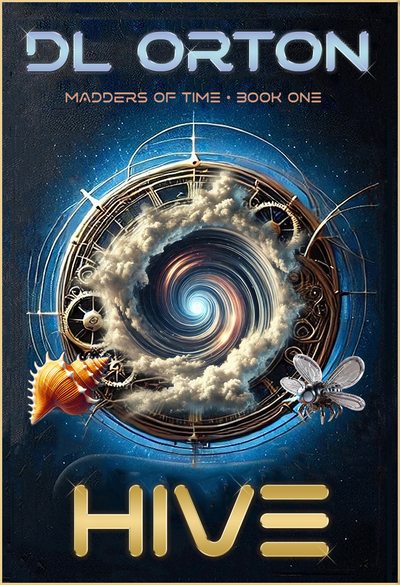
by D. L. Orton
DETAILS:
Series: Madders of Time, Book One
Publisher: Rocky Mountain Press
Publication Date: May 6, 2025
Format: ARC
Length: 350 pg.
Read Date: May 8-9, 2025


What’s Hive About?
We open on a semi-functional (less so by the day) biodome some 30 years in the future (it’s vague, but safe to put it in the 2040s-2060s largely depending from when the reader picks this up)—there are two living humans, and an AI of sorts trying to keep going. There are some other biodomes out there, and hopefully, they’re doing better. The land outside the biodome is not fit to sustain human life—or much in the way of animal or vegetable life, either.
They have enough energy to use a spacetime bridge one more time as a last-ditch effort to go back and stop things from getting to this point. The target day was a fateful day for the two of them as individuals, and apparently one for the timeline as well (probably for different reasons, I’m not suggesting history pivots on them). They can send one person back with the sole idea of preventing their present.
I’m being as vague on details as the characters are here—you’ll get an idea about the particulars later.
We spend the rest of the book watching how this plays out from the point of view of some pivotal individuals (earlier versions of these characters in one way or another), with some observations from that AI about how well it’s working and the chances their mission holds of success.
A Quick Look at the Characters
Our primary characters (in the 2010s-2030s) are Matthew, Diego, and Isabel. Matthew and Diego did some work together in the past, and have some loose connections in the book’s “present”—but they’re not great pals or anything, and their stories don’t intertwine much (in Hive, anyway—I expect that to change). Matthew is a physicist of some repute and his expertise will be important.
When we meet Isabel, her divorce has just been finalized and she is excited and free from her husband (well, as free as you can be from an egomanical technocrat that you happen to work for and who owns your research). Diego is the would-be do-gooder scientist/entrepreneur who’s trying to do his part to help poorer countries with their water supply. Diego is also the one who got away, for Isabel. Through some unlikely coincidences (probably shaped by their future selves), they reconnect and try to start over/make up for lost time.
Also, they’ve received prompting from future-Isabel to stop Dave. It’s unclear what they’re supposed to stop him from doing, but they’re all in.
Dave is the kind of character that the reader is primed and ready to hate, or at least really dislike, from his first line of dialogue—and your impression of him goes downhill from there. There are a few sycophants in his company that we don’t get to know too well, but their devotion to him really solidifies your impression of them.
Meanwhile, Matthew is pretty much kidnapped by a couple of representatives of the U.S. government to work on a mysterious artifact, presumably (to the reader) something sent back to the past from the biodome. The senior member of this pair is easily as dislikable as Dave—almost irrationally so. And while he might be one of the “good guys,” or at least is working to help people, he’s definitely one of those envisioned by the coiners of the phrase, “Who needs enemies with friends like this?”
I’m focusing on these two here to be efficient—other than these two jackwagons, 99% of the rest of the characters (from very minor on up) are kind, pleasant, smart (if not brilliant), and are working to improve things. They’re the kinds of characters you want to spend time with—they’ve got good senses of humor, are optimistic and determined to keep going. Reading about them while there’s some sort of apocalypse around them is actually pleasant. Even if only you and the AI knew how bad things were going to get for them, you would like their chances and be pleased every time the AI mentioned their chances of improving their chances of success.
A Focused Armageddon
It’s hard to judge the scope of this/these calamity/calamities—our view is of Denver and the surrounding area. We get some hints that conditions are the same in other parts of the country as things get worse. But we really don’t know what things are like outside the U.S.
Given how bad it is 30+ years into the future when we first see things, it makes sense to think this happened globally. But it’s also possible that the devastation was limited to North America (or just the U.S.) and the rest of the world was able to protect itself, or weren’t exposed to the effects. During the bulk of our time with Diego and Isabel, some forms of communication work and some don’t for them, so it’s believable that they just have no clue what’s happening outside of Colorado. Communications around Matthew seem a lot more reliable, but he’s kept so much in the dark that it really doesn’t get the reader anywhere.
I’m not sure how much it matters for the story—particularly at this point. But I think it’s fun to speculate about while you’re reading and afterwards. Has the rest of the world moved on, fairly intact, waiting for things to calm down in North America so they can come over and try to rebuild? Or are they, so far removed from the three events, suffering just as much?
Crossing in Time
Feel free to skip this part and move on—I’m not sure this adds much to the overall post, but I can’t stop thinking about this.
This is a reworked version of Orton’s novel Crossing in Time. I listened to that book back in 2021 and enjoyed it—try as I might not to, I inevitably kept what was different about this version. The little voice in the back of my head just wouldn’t shut up. To make things worse—I think I have some details of Crossing in Time conflated with one or more other time travel books involving a strong love story.*
What I think she did here was lop off some later chapters, I assume to move them to Book Two. And introduce and/or beef up some of the chapters and subplots. I’m more sure about the former than the latter, if I’m right, that makes the ending more of a cliff-hanger that will springboard you into wanting Book Two in your hands straightaway.
I also think Orton removed what could be described as convolutions—making the novel more streamlined and fast-paced. Overall, I get her choices, and I do think it makes the book a stronger read.
But again, I could be wrong—but I couldn’t stop thinking about it as I read the book, or as I think about it now—so I had to get this out.
* With apologies to the author, there have been 800 or so books between now and then, details get fuzzy.
So, what did I think about Hive?
This is a fast-paced, propulsive read filled with amiable characters who aren’t afraid to joke around even when things are tense or confusing. The hook gets set pretty early, and the pages melt away as you plunge ahead to follow the events. It’s exactly the kind of popcorn read that helps you escape after a long day.
The tech is very cool—both the stuff that Isabel developed and the items that Matthew talks about and develops. Orton gives you enough to understand how it all works and to visualize it clearly without bogging down the pace with paragraphs and paragraphs of details. The plausibility of it all? Eh, it’s SF, it’s plausible enough if you come with a standard level of suspension of disbelief needed for time travel (especially, in this case, when the time travel comes with a side order of multiverse story).
Because of the pacing, Orton’s able to get away with a few things that maybe she couldn’t in a slower-moving book. I don’t actually see the grounding of the romance between Diego and Isabel—he’s carried a torch for years, she regrets making the choice years ago to walk away. But…that’s it. We don’t see many sparks, just have to take it because we’re told that. There’s no reason for the senior agent involved with Matthew to be such an ass to everyone, all the time, especially when just a sentence from him now and then would be enough to get people to work with him instead of his threats (and I don’t care how instinctive and characteristic his brusqueness is, you don’t move up in an organization simply be being mule-headed, there has to be at least an insincere level of cooperativeness expressed occasionally). All the depth of the characters that could be brought out are merely nodded to, or you have to assume them.
Actually, this all might be necessary because of her pacing. If so, I understand the choice (as much as I disagree with it).
I want to stress, however, in the moment, you don’t think about this (and if you do, you brush it off because you don’t want to step out of the movement). Everything works, everything clicks while you’re reading and speeding off to the next twist/revelation. It’s only after you get to the ending that leaves you holding onto the cliff’s edge with your fingers that this might occur to you if you stop and think about it. Mostly, you’re going to be thinking about how long it will be until you can get your hands on Book Two.
It’s easily enjoyable, engrossing, and entertaining. You should give it a try.
This post contains an affiliate link. If you purchase from it, I will get a small commission at no additional cost to you. As always, the opinions expressed are my own.
My thanks to The Write Reads for the invitation to participate in this tour and the materials they provided, including the ARC.



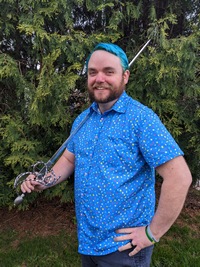 Adam Holcombe daylights as a programmer and moonlights as an author. After spending years toying with the idea of writing, he decided to commit and work toward releasing his first novel. Then Gam Gam got in the way, and now he’s writing too many stories to count.






 The World Savers