Tag: YA/MG Page 10 of 24

Revenge of the Beast by Jack Meggitt-Phillips, Isabelle Follath (Illustrator): A Tale of Vengeance and Do-Goodery

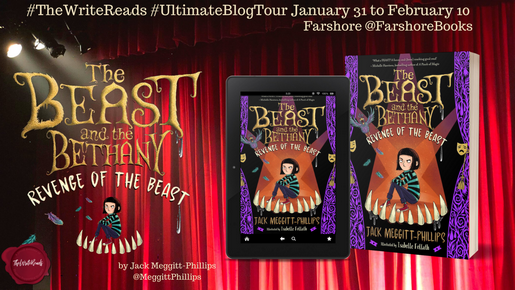
Revenge of the Beast Tour Banner

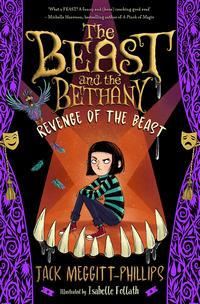
Revenge of the BeastRevenge of the Beast

by Jack Meggitt Phillips, Isabelle Follath (Illustrator)

DETAILS:
Series: The Beast and the Bethany, #2
Publisher: Aladdin (US); Farshore (UK)
Publication Date: March 22, 2022 (US); September 30, 2021 (UK)
Format: eARC
Length: 272 pg.
Read Date: February 1-2, 2022

Support Independent Bookstores - Visit IndieBound.org

What’s Revenge of the Beast About?

At the end of The Beast and The Bethany, Bethany, Ebenezer, and Claudette (the Wintlorian purple-breasted parrot) were sure that The Beast was vanquished and they could start living their lives in a new direction.

They’re de-Beasting their lives—getting rid of just about everything that The Beast magicked into existence for Ebenezer over the centuries—and they’re devoting their energies to do-gooding. Bethany needs to make up to people for all her pranks, and Ebenezer has a lot of karmic debt to pay off (and Bethany’s pushing him). He also is doing what he can to stay off the radar of the organization that’s been chasing the Beast for more centuries than Ebenezer’s been alive. That’ll be easier to do without magic items laying around.

But as the title of this book suggests, they were wrong. The Beast isn’t done yet, and he’s out to get back at those three—and anyone else who happens to be in the general vicinity while he’s at it.

Their do-gooding efforts stumble, the items they tried to divest themselves of start to behave strangely—and dangerously—for their new owners. No matter what they attempt to do, something goes wrong. It’s time for some drastic measures.

Comparatively Speaking, are We Sure The Beast is the Worst?

There are a handful of new characters introduced in this book, which helps in a few ways—it shows how much Bethany has changed Ebenezer’s life by expanding his social world, and it adds a little flavor to the series. But there are three new characters* in particular I want to single out: The Cussocks. Mr. and Mrs. Cussock run the theater that plays a significant role in the novel and their daughter, Gloria. Gloria reminds me of the TV version of Nellie Oleson, without the redeeming characteristics. Nellie knew how she should act and just didn’t care. I don’t think Gloria knows how she should act, she’s pure id. Once you get to know her parents, a bit, you start to see why. I’m not going to get into it, but just know that Gloria lives in the same orphanage that Bethany used to live in, because they just can’t stand her (and have no problem letting everyone—including her—know that).

* I’m pretty sure they’re new, they may have played minor roles in the first book. But I don’t think so, and I’m too lazy to check..

It’d be easy in a book like this to make The Beast the epitome of all evil, and every human and animal nothing more than a potential victim. Bethany and Ebenezer have some restitution to do and need to reform, but they’re trying. But as long as people like the Cussocks are around, the reader has to remember that people are capable of the same kind of evil as The Beast is. They don’t have magic to help, and they don’t get their sustenance from eating humans—which almost makes it worse, you could make a pragmatic argument for a lot of what The Beast does. But the Cussocks don’t have that going for them.

(but to be clear, all four of them are truly reprehensible characters)

True Horror: The Food

Sure, there’s a magic being eating people, producing magical items, and inflicting all sorts of psychological damage; a possibly sociopathic little girl inflicting pain on her peers; and a centuries-old man wandering around in this book. But the true horror? The food designed by Bethany and others.

Bethany considers herself a sandwich artist. No, she’d probably be inclined to add the “e,” she’s a sandwich artiste. Some of the flavor combinations she comes up with would make me run start swallowing Bertie Bott’s Every Flavour Beans by the handful without wondering/caring what flavors they’d be. They’re fully at the intersection of incredibly imaginative and incredibly unappealing.

It’s the kind of humor that an MG reader is practically guaranteed to enjoy.

Illustrations

I’m pretty sure neither of these books would be as successful without the contributions of Isabelle Follath. Her illustrations—sort of a mash-up of Eugene Yelchin, Quentin Blake, and Jules Feiffer—are attractive, eye-catching, and augment the text without being a distraction. I made more notes than usual about liking the artwork in this novel. Rather than further demonstrate how poorly I describe art, I’ll just say that her stuff is great and leave it at that.

So, what did I think about Revenge of the Beast?

I know when I posted about The Beast and The Bethany, I was aware that it was the first of a series, but I have to tell you, I thought it made a great stand-alone book. So much so that I forgot there were more books to come, I got this one primarily out of curiosity about how Meggitt-Phillips would approach this, rather than a curiosity about the characters or story. I was satisfied with where the first book left things.

That said, if you’re going to write an unnecessary sequel, this is the way you want to do it. Give some good backstory about the antagonist and one of the protagonists, and help the reader understand how they got started five centuries ago. Then while you’re doing that, show how everything you thought happened at the end of the first book wasn’t at all what was going on—so we need to read the sequel. It was really well-conceived in that way. But given the two that exist, we definitely need a third (which is, thankfully, on the way)

I think it’s best if I think of this in two different ways, it’s a creative way to tell this story, the morals are there for those who want to see them (again), but are easily ignored if that’s what the reader prefers. The humor is a bit subtler this time out, but it’s just as funny if you’re looking for it. I was honestly surprised by a couple of plot developments, too. But…it just didn’t work as well for me as its predecessor. Like I said with And Your Enemies Closer, a lot of that is likely just the way second novels in a trilogy strike me. But I don’t think it’s all of the reason why. I think it’s probably a function of separating (for good and understandable reasons of plot) Ebenezer and Bethany for so much of the book. The series is stronger when they’re together.

On the other hand, if I got this book when I was in Fifth Grade? I’d really dig it, and it would earn a spot in my Roald Dahl-Daniel M. Pinkwater-Norton Juster re-read cycle, right alongside The Beast and The Bethany, and I’d get it read at least four more times before the third volume is released. Since that guy is the one that Meggitt-Phillips is writing for, not the guy with four adult children—I figure that’s good enough.

At least three of my four kids would’ve loved this when they were the right age (and it’s possible that the fourth one would’ve, too)—and I’m willing to bet that whatever parents are reading this would find similar results in their homes. They should pick this up and see.


3.5 Stars

This post contains an affiliate link. If you purchase from it, I will get a small commission at no additional cost to you. As always, opinions are my own.

My thanks to The Write Reads for the invitation to participate in this tour and the materials they provided, via Netgalley and Farshore.
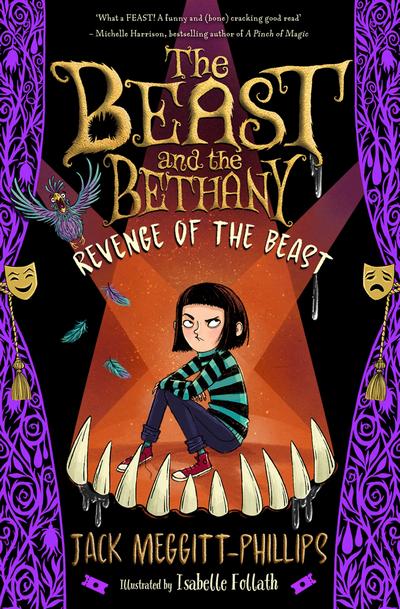
BOOK SPOTLIGHT: Revenge of the Beast by Jack Meggitt-Phillips, Isabelle Follath (Illustrator)

I’m very pleased and excited today to welcome The Write Reads Ultimate Blog Tour for Revenge of the Beast Jack Meggitt-Phillips and illustrated by Isabelle Follath. It’s the follow up to their delightful The Beast and The Bethany, which you really should read if you haven’t. I’ll be posting my take on the novel in a bit here, but for now, let’s learn a bit about it.

Revenge of the Beast Tour Banner

Book Details:

Book Title: Revenge of the Beast by Jack Meggitt-Phillips, Isabelle Follath (Illustrator)
Release date: March 22, 2022 (US); September 30, 2021 (UK)
Publisher: Aladdin (US); Farshore (UK)
Format: Hardcover/Paperback/Ebook/Audiobook
Length: 288 pages

Revenge of the Beast

Book Blurb:

Lemony Snicket meets Roald Dahl in this riotously funny, deliciously macabre, and highly illustrated sequel to The Beast and the Bethany in which Bethany and Ebenezer try to turn over a new leaf, only to have someone—or something—thwart them at every turn.

Once upon a very badly behaved time, 511-year-old Ebenezer kept a beast in his attic. He would feed the beast all manner of objects and creatures and in return the beast would vomit him up expensive presents. But then the Bethany arrived.

Now notorious prankster Bethany, along with her new feathery friend Claudette, is determined that she and Ebenezer are going to de-beast their lives and Do Good. But Bethany finds that being a former prankster makes it hard to get taken on for voluntary work. And Ebenezer secretly misses the beast’s vomity gifts. And neither of them are all that sure what “good people” do anyway.

Then there’s Claudette, who’s not been feeling herself recently. Has she eaten something that has disagreed with her?

Book Links:

Amazon US ~ Amazon UK ~ Goodreads

About the Author:

Jack Meggitt-PhillipsJack Meggitt-Phillips is an author, scriptwriter, and playwright whose work has been performed at The Roundhouse and featured on Radio 4. He is scriptwriter and presenter of The History of Advertising podcast. In his mind, Jack is an enormously talented ballroom dancer, however his enthusiasm far surpasses his actual talent. Jack lives in north London where he spends most of his time drinking peculiar teas and reading P.G. Wodehouse novels.


My thanks to The Write Reads for the invitation to participate in this tour and the materials they provided.

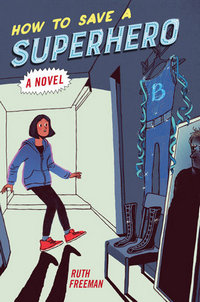
How to Save a Superhero by Ruth Freeman: A Cute MG Adventure

How to Save a SuperheroHow to Save a Superhero

by Ruth Freeman

DETAILS:
Publisher: Holiday House
Publication Date:  October 18, 2021
Format: Hardcover
Length:264
Read Date: January 26-27, 2022
Support Independent Bookstores - Visit IndieBound.org

“Adelaide. Now that’s a name you don’t hear very often. I think it’s old German by way of French. How do you do, Adelaide? My name is Minerva, after the Roman goddess of wisdom. I have a theory that interesting people have interesting names. Are you interesting?”

After taking a moment to think about it, Addie said, “I’m kind of working on it.”

“Good answer,” said Minerva Swift. “I’m working on it too.”

What’s How to Save a Superhero About?

Ten-year-old Addie and her mom have one of those relationships where you’re not sure who the parent is a lot of the time. While it’s clear that Tish is devoted to her daughter, she’s not really devoted to anything else—especially her frequently changing employers in frequently changing towns. Since her mother died, she just hasn’t been able to hang on to anything, and Addie’s been emotionally untethered since then, too.

Now they’re staying with another one of Addie’s aunts and Tish is working at the Happy Valley Village Retirement Community on a one-month trial. After school, Addie joins a couple of other children of employees and spends time with some of the residents.

One resident, in particular, is a favorite of Addie’s—and her mother seems to be the only employee that he seems to tolerate. Mr. Norris has been having trouble with falling, so he’s in the HVV until he can regain his stability.

One of Addie’s friends becomes convinced that Mr. Norris is a super-hero—and there have been some strange things happening around him—Addie can’t believe it. Another friend is convinced that he’s a retired Professional Wrestler. Addie’s not so sure about that one, either.

The three friends do what they can to get to the bottom of Mr. Norris’ identity (over his strident and cantankerous objections), and find themselves in the middle of other adventures with some of the other residents while they’re at it.

So, what did I think about How to Save a Superhero?

This was an okay book. It did everything it needed to do and was well told. I never really connected to any of the characters, or any of the rest of it. I can’t tell you what it was missing, but it seemed to be missing that spark.

It was enjoyable enough—just enough—and it’s likely that the target audience will find it more entertaining than I did. So, sure, I’d recommend it for a middle-grade reader, but I wouldn’t necessarily tell anyone older they’d enjoy it.*

* That sounds harsh to me, I’m not trying to be…


3 Stars

This post contains an affiliate link. If you purchase from it, I will get a small commission at no additional cost to you. As always, opinions are my own.

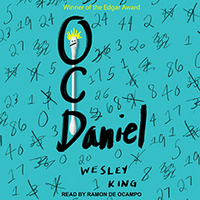
OCDaniel (Audiobook) by Wesley King, Ramón De Ocampo: An Uplifting MG Mystery/Coming of Age Story

OCDaniel

OCDaniel

by Wesley King, Ramón De Ocampo (Narrator)

Unabridged Audiobook, 7 hrs., 4 min.
Tantor Audio, 2018

Read: June 29-30, 2021
Grab a copy from your local indie bookstore!

What’s OCDaniel About?

I found myself saying way too much about this book—I’ve taken two attempts at this part of the post, and each gets too detailed. It’s hard to stop talking about this, apparently.

So let me fall back on the tried-but-true (albeit lazy) method of borrowing the description from the Publisher’s website:

Daniel is the back-up punter for the Erie Hills Elephants. Which really means he’s the water boy. He spends football practice perfectly arranging water cups—and hoping no one notices. Actually, he spends most of his time hoping no one notices his strange habits—he calls them Zaps: avoiding writing the number four, for example, or flipping a light switch on and off dozens of times over. He hopes no one notices that he’s crazy, especially his best friend Max, and Raya, the prettiest girl in school. His life gets weirder when another girl at school, who is unkindly nicknamed Psycho Sara, notices him for the first time. She doesn’t just notice him: she seems to peer through him.

Then Daniel gets a note: “I need your help,” it says, signed, Fellow Star Child—whatever that means. And suddenly Daniel, a total no one at school, is swept up in a mystery that might change everything for him.

OCD Portrayal

I didn’t note how far into the novel we are before someone uses either “OCD” or “Obsessive-Compulsive Disorder,” but I’d be willing to guess it’s the latter third. Obviously, for anyone who even glanced at the title, they know what’s going on—but this novel isn’t about OCD per se.

It’s a novel about a kid who doesn’t understand himself, who doesn’t realize what’s going on with his brain, and who’s scared to talk to anyone about it. He loves his parents—and there’s no reason to think they wouldn’t be supportive and would help him to find the tools he needs. But he doesn’t want to be “weird,” he doesn’t really want to admit to it to anyone other than himself.

Sarah has her own struggles and isn’t afraid to let Daniel see them—and she sees his at least as clearly as Daniel’s. So he can open up to her.

This is based on King’s own experiences, his own OCD, practically ensuring that it’s a sensitive and sympathetic portrayal. At the same time, it does as good a job as any that I’ve come across in communicating what it’s like to those who’ve never experienced it. I’d recommend it to anyone in whatever age range just for that alone.

That doesn’t mean that King doesn’t have some fun with it, he takes opportunities for small and large comedic moments brought on by Daniel’s OCD. But it’s never mean-spirited, and the reader laughs while feeling sympathy (maybe even empathy).

A Few Thoughts on the Narration

De Ocampo is a pretty versatile narrator—I’ve previously listened to his work on Diary of a Wimpy Kid and Tropper’s This is Where I Leave You. He’s able to hit all the right notes here—the comedy, the uncertainty, the tension—Daniel’s “zap”s—the whole kit and caboodle.

I was pretty impressed—moreso when I looked him up and saw that I’d heard his work before. He did a good job here and did so in a way that didn’t make me think of the others I’d heard.

So, what did I think about OCDaniel?

I thought the whole mystery thing was a bit far-fetched, especially the way it resolved. But that didn’t mean it wasn’t fun—and the rest of the novel more than made up for the bits of the story that induced a bit of eye-rolling.

It was an entertaining and enlightening novel—great for the upper MG/lower YA crowd, but a solid enough work for older audiences, too.

Give this a read, or a listen—you’ll be glad you did.


3.5 Stars

2021 Library Love Challenge 2021 Audiobook Challenge

This post contains an affiliate link. If you purchase from it, I will get a small commission at no additional cost to you. As always, opinions are my own.

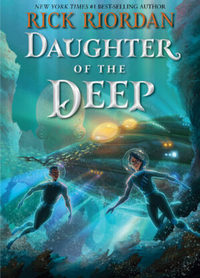
Daughter of the Deep by Rick Riordan: An Overdue Sequel to Verne’s Nemo Stories

Daughter of the Deep

Daughter of the Deep

by Rick Riordan

Hardcover, 336 pg.
Disney-Hyperion, 2021

Read: November 18-22, 2021
Grab a copy from your local indie bookstore!

What’s Daughter of the Deep About?

So here’s the thing—the events and characters of 20,000 Leagues Under the Sea and The Mysterious Island are based on actual events and people—but Verne was given a few skewed details. One hundred-fifty years later, descendants of these people are running rival schools their ancestors founded, the Land Institute and the Harding-Pencroft Academy.

Students at HP are only told about their origins at a certain point, and their mission is to graduate future leaders in a variety of disciplines to guard the science that Nemo developed and slowly, carefully introduce it to the world.

Land Institute students are told their origins earlier and their mission is to rush that science out into the world—even if by doing so, it’ll unleash societal upheaval, economic trouble, and will upend established science for years.

The two schools are in sort of a cold war until the Land Institute launches an attack on HP, and the freshman class has to head to sea to try to survive. While on the run, the class is told about HP’s origins and our central character, Ana Dakkar, learns about her family history, forcing her to take a leadership position and more.

Can Ana and the rest of the freshman survive the Land Institute*? Can they utilize Nemo’s technology in ways no one else has? Who will control Nemo’s heritage?

* It is unfortunate that the ocean-going HP Academy is rivaled by the “Land Institute.” It feels a little too-on-the-nose, even though it’s named for Ned Land.

Plausibility

Because this is aimed at the MG crowd, I can buy the whole “a bunch of preteens/teens outsmart and outperform dangerous and super-smart older teens” nature of the plot—it’s pretty much a given in the genre.

Also, the whole Land Institute teachers/administrators allowing students to start killing people is a pretty hard pill to swallow. For some reason, I had an easier time buying competing mythological figures setting teens against teens.

But hey…if it’s in a universe where everything in 20,000 Leagues Under the Sea is based on reality, and that Nemo’s tech worked (and still does!)? Well, hey, I can buy a little less-than-plausible High School actions.

So, what did I think about Daughter of the Deep?

I had a lot of fun with this. A goofy premise, but well-executed. I dug the characters, the action was solid and the pacing was good—enough to keep the reader engaged and entertained, while giving enough breathing room for a little character development.

And there’s a giant cephalopod—every undersea adventure needs one of them.

If this is the beginning of a series (and it feels like it), there’s a good chance I’ll come back for more. But honestly? I think it’d be better as a stand-alone.

Either way, this is a fun ride—and one that’ll hopefully spur the target audience into giving Jules Verne himself a try.


3.5 Stars

2021 Library Love Challenge

This post contains an affiliate link. If you purchase from it, I will get a small commission at no additional cost to you. As always, opinions are my own.

The Friday 56 for 11/19/21: Daughter of the Deep by Rick Riordan

The Friday 56This is a weekly bloghop hosted by Freda’s Voice.

RULES:
The Friday 56 Grab a book, any book.
The Friday 56 Turn to Page 56 or 56% on your ereader. If you have to improvise, that is okay.
The Friday 56 Find a snippet, short and sweet.
The Friday 56 Post it

from Page 56 of:
Daughter of the Deep

Daughter of the Deep by Rick Riordan

The world is quiet except for the slosh of waves against the hull and my captor’s ragged breathing in my ear. It must be hard work pulling me along, using me as a human shield while swimming backward toward his pontoon. I hope he drowns.

Above us, Gem says grimly, “I’ve got the shot, sir.”

I don’t think he meant for us to hear this comment, but voices carry at sea. The idea of him firing makes my stomach twist. With the ocean swells, and the movements of the ship and my captor, it would be a tough shot even for Gem. Besides, I assume my captor still has his little hypodermic needle somewhere at hand. I hope he sticks himself with it.

“Stand down, Mr. Twain,” Hewett orders.

Really? I think. That’s all you’ve got, Hewett?

“That’s right,” my captor mocks, “stand down, Mr. Twain.”

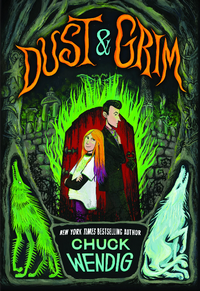
Dust & Grim by Chuck Wendig: Fairies and Foxfolk and Florgs, Oh My

Dust & Grim

Dust & Grim

by Chuck Wendig

Hardcover, 368 pg.
Little, Brown Books for Young Readers, 2021

Read: October 28-29, 2021
Grab a copy from your local indie bookstore!

“We’re a funeral home for monsters,” Vivacia said

“Viv!” Dustin said, scandalized.

“Fine. The supernatural,” the woman corrected. To Molly, in a lower voice, she said: “Monster is a bit of no-no word. We prefer not to use it, and they certainly prefer us not to use it. But we need common ground here, and I hope it helps you to understand.”
“Monsters,” Molly said, repeating the no-no word.

“The supernatural,” Viv corrected again.

“The nonstandard citizens,” Dustin said sharply.

What’s Dust & Grim About?

After thirteen-year-old Molly’s father died, her uncle comes to her and tells her about her (late) mother and older brother—Molly’s parents split right after she was born and she’d never known anything about them. Her father had never been a good provider—or much of a parent in any other way. She needs money for costuming school (and room and board, too) and her long-lost family has an ongoing business of some sort.

So Molly introduces herself to her brother, Dustin, and makes an ultimatum: she wants half of everything or to take part in the business. Dustin and his mother’s friend, Vivian (who has taken on the role of mentor/guardian) aren’t keen on either option (or on Molly in general, if truth be told).

Through sheer pluck, determination, and a happy accident or two, Molly learns that the family business is as a funeral home/cemetery caretakers for supernatural creatures. Not only that, but a malevolent magic-user is running around the cemetery ruining the eternal rest of those interred there (which could have cataclysmic effects).

With the help of a band of non-standard citizens—as delightfully creepy and goofy as you could want—the siblings have to figure out how to get along and stop this threat.

The Non-Standard World

“Mollllllly,” the forest whispered in return.

She shuddered. “That’s weird. You should stop that!”

“Sorrrrry,” the forest answered.

Well, at least it’s a polite menacing voice.

It’s hard to describe briefly the non-standard world we’re introduced to—through the cemetery, the group helping Molly and Dustin, and others that they interact with. It’s sort of like Gaiman’s Neverwhere or Aaronovitch’s demi-monde. But the Pixar version.

Just a few examples: there’s a Foxperson shapeshifter, which is pretty much what it sounds like; the above talking forest (at least, that’s her theory at the time); a vampire that can compete with Fred, the Vampire Accountant for the Most Milquetoast Vampire in Literature; and a Florg, a childlike extra-dimensional being, who is probably the most dangerous being in the book, who is pacified with cheese crackers and by attempting to be funny (think Dave Bautista’s Drax, but not at all).

I hope there’s a sequel just to spend more time in this world.

So, what did I think about Dust & Grim?

“What kind of poison?” Dustin asked.

Marsha chimed in: “Mucus-thorn and mire-berry.”

“Is that, like, some kind of alt-folk band?” Molly asked.

“Not as bad as that,” Ember said, grinning like, well, a fox. “But as poisons go? Pretty flappin’ bad.”

Dust & Grim was just silly, creepy, wholesome fun. You’ve got some great creatures. You’ve got a nice sibling-dynamic. Some genuinely funny lines. Molly’s cosplaying is great, I love the choice to ground her character in that. And a creative story.

But most of all, you get to young characters who learn who they are, find ways of fulfilling their dreams that they didn’t expect to find, and a strong sense of family—and what that means. Not in some “we have to find a wholesome message for MG readers” kind of way, but in a way that would work for these characters no matter the intended audience.

I don’t want to spend too much time trying to talk about this, it’s just a fun read that should be enjoyed that way.

3 Stars

2021 Library Love Challenge

This post contains an affiliate link. If you purchase from it, I will get a small commission at no additional cost to you. As always, opinions are my own.

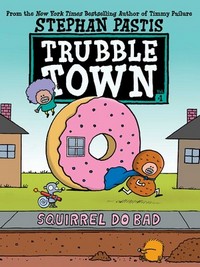
Squirrel Do Bad by Stephen Pastis: The Misadventures of Butterfly Girl

Squirrel Do Bad

Squirrel Do Bad

by Stephan Pastis
Series: Trubble Town, #1

Paperback, 287 pg.
Aladdin, 2021

Read: October 25-26, 2021
Grab a copy from your local indie bookstore!

Always remember—even the smallest thing you do can have big consequences.

What’s Squirrel Do Bad About?

Wendy the Wanderer is a little girl who desperately wants to travel the world, but her over-protective father has other ideas. He’s so focused on safety and caution, he carries an umbrella at all times (for example). But when Dad has to leave town for a while on business, Wendy just might get to do a little exploring, if she can get around her babysitter.

This isn’t a challenge, as the sitter is too focused on her phone to notice pretty much anything. So, Wendy heads out to explore her hometown, Trubble Town. A fitting name, for her at least.

She tries to befriend a squirrel, Squirrely McSquirrel, but is out of nuts. So gives him a little bit of a Mooshy. A Mooshy is a dangerous concoction for a human, much less a squirrel, it’s a “steaming cup o’hot chocolate shoved chock-full with forty marshmallows.” The levels of hyperactivity that this induces in Squirrely can’t really be described, it can only be depicted in graphic terms, really. He also becomes pretty addicted to them—but the destruction wreaked was so great that no one is permitted to give him any.

It’s at this point that things get out of control. The chaos that ensues features a police officer driven by hatred of squirrels, a mayor who refuses to work, a strange town obsession with statues, a would-be nut-themed superhero, a vegetarian squid, civic-minded moles, a lot of dynamite, and too many other things to enumerate. It’s the kind of mad-cap pandemonium that appeals to the little kid in us all (especially the middle-grade target audience).

The big questions addressed are: will Squirrely stay out of trouble? Will Wendy be able to keep all this from her father? Will anyone learn anything?

Pearls Before Swine-Verse

On page 56, Larry the Crocodile appears as Squirrely’s lawyer. Planting this firmly in the same world as Pastis’s comic strip, Pearls Before Swine. But Larry’s the only character that I recognized, it’s not Pearls. The humor’s different than the comic—it’s suited for kids, with a different tone, and a different aim.

Art Style

If you’ve read Pearls, you’ll have noticed the slightly sloppier style, with bolder lines that Pastis uses when one of his characters is drawing—the art’s a lot like that (except for a panel or two at the end). But essentially, it looks a lot like Pearls without Pig and Rat, etc.

So, what did I think about Squirrel Do Bad?

Wendy learns a little about chaos theory and begins to see herself as the butterfly that starts the storm. Which is helpful and maybe a little unhealthy, too. Still, she learns the meaning of her father’s words before he left (see the opening quotation).

The storytelling reminds me of the kind of stories my kids would write/tell when they were little—something that starts off kind of fun and then gets stranger and stranger and stranger. This is both an observation and a warning for people who want structure and logic to their stories—that’s not going to be around.

It’s silly. There is some real sweetness to it. It’s weird. It’s a lot of fun. Pretty much what you’d expect. Give it a shot, or let your kid give it a shot.


3 Stars

2021 Library Love Challenge

This post contains an affiliate link. If you purchase from it, I will get a small commission at no additional cost to you. As always, opinions are my own.

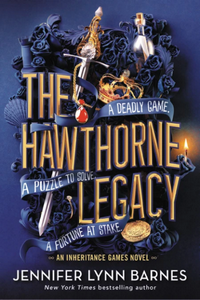
The Hawthorne Legacy by Jennifer Lynn Barnes: Second Verse, Pretty Much Same as the First (and that’s okay)

https://www.hachettebookgroup.com/titles/jennifer-lynn-barnes/the-hawthorne-legacy/9780759557642/

The Hawthorne Legacy

by Jennifer Lynn Barnes
Series: The Inheritance Games, #2

Hardcover, 352 pg.
Little, Brown Books for Young Readers, 2021

Read: September 27-28, 2021
Grab a copy from your local indie bookstore!

What’s The Hawthorne Legacy About?

Almost all the puzzles in The Inheritance Games were resolved by the end, just in time for it to introduce a new one in the closing paragraphs. Which is where we pick this up—and it casts a little doubt on some of what we thought was resolved before.

Essentially the core of this book focuses on Avery. Why was she chosen to be Tobias Hawthorne’s heir? What is her connection to the family?

Avery and the brothers (with some assistance from her sister, best friend, and her staff) plunge into this mystery and end up unearthing—and shedding a lot of new light on—Hawthorne family secrets and history.

Also, someone is pretty determined to kill Avery. Somewhere along the way, that should be dealt with, too, right?

Beyond that, it’s pretty near-impossible to talk about the book’s plot without giving everything past page 3 away.

Max

Avery’s best friend, Max, was one of the brightest points in the previous novel—despite her minimal appearance, and I’d hoped that we’d get to see her more in this book.

My wish was granted and we got plenty of Max. It’s the one improvement to The Inheritance Games. She’s just a lot of fun. Thanks to her particular brand of minced oaths and personality—and being one of the few people who don’t assume that their position, money, and privilege will get them what they want in the book—she shines brightly against the rest of the characters.

Also, whatever is going on between her and one of the Hawthorne brothers? I’m digging it. No matter what the next section may indicate.

Young Love

In The Inheritance Games there was a romantic subplot or two right underneath the surface—well, one or two involving Avery, anyway, plus some others. They’re not under the surface anymore. And I frankly couldn’t care less about them.

The novel doesn’t need them, the characters aren’t made more interesting because of them, and the almost-triangle nature of it seems overly stereotypical.

But I know that I’m the statistical outlier for the reader of this book, it wasn’t written for me and my typical tastes. So…take this griping with a giant rock of salt.

So, what did I think about The Hawthorne Legacy?

Bottom Line: If you enjoyed The Inheritance Games, you’re going to like this—it’s more of the same. The two could’ve been one really long book. But thinking of it as “one really long book,” it sounds dull, and it’s anything but that. I guess it’s better to think of it as Season 2 of the series, adding layers or dimensions to the ideas from The Inheritance Games and carrying the storylines forward. It might have been easier to just repost what I said about it with a minor tweak or two than to write something new.

I’m not sure I appreciated it as much as the first book—and a couple of times I sort of rolled my eyes at it, but…there’s something about Barnes’ storytelling that gets under your skin and keeps you turning the pages as fast as you can, you just need to find out what twist is coming next and what will be revealed as a result of it. Compelling feels like a slight understatement.

I think my lack of enthusiasm comes from the way that Barnes showed off all the same tricks in the previous book that she does in this one, so the “discovery” factor isn’t there. So the problem* I have with the book is that I was wowed so much already. She lived up to expectations rather than surpassing them is a really lousy complaint.

* Other than the YA Romance/kind-of-triangle. But that’s just me being a guy way outside the target audience and my inherent immunity to that.


3.5 Stars

2021 Library Love Challenge

This post contains an affiliate link. If you purchase from it, I will get a small commission at no additional cost to you. As always, opinions are my own.

I Have Mostly Good Things to Say about The Mostly Invisible Boy by A.J. Vanderhorst

For the first part of this Tour Stop, we looked at the novel, The Mostly Invisible Boy from a distance, now it’s time to dive in.
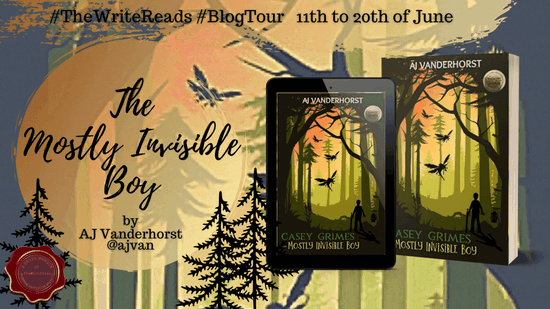
The Mostly Invisible Boy Tour Banner

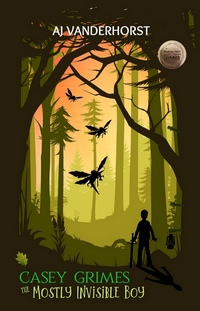
The Mostly Invisible Boy

The Mostly Invisible Boy

by A.J. Vanderhorst
Series: Casey Grimes, #1

Kindle Edition, 298 pg.
Lion & Co, 2021

Read: June 14-16, 2021
Grab a copy from your local indie bookstore!


This is one of those posts, I’m afraid, that I end up sounding less positive about than I am. So let me start off with this: I liked The Mostly Invisible Boy, I think your average Middle Grade Fantasy reader will, too. Sure, I have some issues with it, but that just means its in the same company as works by Brandon Mull, Christopher Healy, and Rick Riordan.

What’s The Mostly Invisible Boy About?

What if you find yourself in a magic kingdom only to find out that no one there believes in magic? That’s just what happens to Casey Grimes.

But I’m getting ahead of myself. Casey Grimes is an eleven-year-old who transferred into a new Middle School at the beginning of the year. As far as Casey can tell, no one at the school is aware that he exists—no one seems to see him for more than a few seconds at a time, and even people he’s spent a lot of time with don’t remember him for longer than a few seconds. To say this is getting to him would be an understatement.

When he gets home from the last day of school he learns that his parents are leaving for a surprise vacation, leaving Casey and his sister, Gloria, with a babysitter for a week. This is just not what he needs after the worst last day of school he can imagine, so he heads out to the woods behind his house to blow off some steam by climbing trees. He comes across an impossibly large oak tree he’d never noticed before.

Driven by its uniqueness, novelty, and a desire for something that he probably can’t name, Casey climbs the tree and makes several discoveries that change his life. Casey and Gloria will be brought into a new, heightened reality, a world of magic, monsters, honor, adventure, and danger. A world where he is seen, he is noticed—and he finds purpose.

Now, he just has to make sure the two of them survive it.

The Worldbuilding

The Sylvan Woods is a world hidden from regular mortals (they’re dubbed “Civilians”—not as fun to say as “Muggles,” but it gets the message across a bit more clearly). The residents of the Sylvan Woods serve as a defense against the creatures who would destroy humanity, they hold back that which overrun the world.

There’s a history of conflict, of triumphs, victories, of developing prejudices—and a loss of the sense of wonder and magic behind the duties. Many Sylvans resent Civilians, looking upon them with disdain. They’re soft and useless, taking the sacrifices of the Sylvans for granted (never realizing or even considering the possibility that we just don’t know they exist).

Worse, many of these Sylvans don’t believe in magic. Thinking it’s all stuff of fiction, legend—Dark Age belief. This is very understandable, but when the greatest defenses of the Sylvan are magical…well, that doesn’t bode well for their efforts, does it?

Some dynamite worldbuilding and it should be a great world to explore in the volumes to come.

Ms. Jones

The Grimes parents leave the children in the care of “an extremely well-qualified traveling babysitter” (her words), who are part of the vacation package the parents receive. She is the character I think we really needed more of to strengthen the book (although, more of every adult would’ve been helpful). She’s some sort of strange hybrid of the P. L. Travers version of Mary Poppins, Mrs. Piggle-Wiggle, and Professor Savant. She blithely accepts whatever weirdness that Casey and Gloria talk about, talks about even stranger things than them, has some agenda that has nothing to do with babysitting, and seems to know more about what’s going on with the Grimes family than any of the Grimes do.

And every time she’s mentioned or is in a scene, whatever she is doing, saying, or not doing or saying is more interesting than anything that Casey or Gloria is up to. Not because they’re uninteresting, it’s just she’s that interesting. A little more of her would’ve helped—too much more and she’d have overshadowed the whole thing (which wouldn’t necessarily be bad, it’d just be a different kind of book).

My Issues

My problems with the book boil down to this—too often it feels undercooked. All the flavor is there, all the ingredients are present—it just was taken out of the oven too soon.

It’s clear that Vanderhorst has a well-thought-out plan, he knows what the world is about, he has a story he’s wanting to tell—and that he thinks he told. He hits all the plot points, shows us the various monsters and geographic elements, but doesn’t give the reader everything we need to understand the importance of them.

It’s hard to explain without giving you a couple of pages and going through them line by line. But, to use an example most people reading this should get—it’s as if we see Harry and Hagrid on Diagon Alley, going into Ollivanders, Flourish and Blotts, and the Gringotts and maybe see what they get, without knowing where Diagon Alley is, how you get to it, who shops there and why. The essentials are there—we see the coins, the books, and the wand—we may even see some of the odd characters around there. But without all the context, details, and flavors that The Sorcerer’s/Philosopher’s Stone gives us, it’s not as cool (for lack of a better word to sum up the experience).

This happens several times throughout the book—including the last chapter. That felt incredibly rushed—like it was the highlight reel of a major sporting event, which might be okay for a casual viewer, but not for a fan who wants to understand what happened during the game/match.

None of this ever ruins the novel, it’s still enjoyable, you always know what happens. But…it certainly dampens my enthusiasm.

So, what did I think about The Mostly Invisible Boy?

It was…pretty okay. I liked the book and had plenty of fun watching Casey and Gloria learn about the Sylvan Woods and get into (and out of) scrapes. I thought many of the other children they encountered were interesting and can see how the relationships will develop over the coming books into the kind of thing that makes addicts of Middle Grade Fantasy readers. I also appreciated all the adult characters—not something that can be said for almost every MG Fantasy I can think of.

My issues keep me from being effusive with praise and restrain my enthusiasm about this book—but I do think it’s something you should pick up for your favorite member of the target audience. Particularly, I think, if they’re fans of Mull’s Fablehaven/Dragonwatch series.

This post contains an affiliate link. If you purchase from it, I will get a small commission at no additional cost to you. As always, opinions are my own.

My thanks to The Write Reads for the invitation to participate in this tour and the materials (including the novel) they provided.

Page 10 of 24

Powered by WordPress & Theme by Anders Norén