Month: May 2017 Page 1 of 4

Fox Hunter by Zoë Sharp

Fox HunterFox Hunter

by Zoë Sharp
Series: Charlie Fox, #11

eARC, 400 pg.
Pegasus Books, 2017

Read: May 22 -24, 2017


I honestly had given up on seeing another Charlie Fox novel — which was a cryin’ shame, but I get that authors have to move on sometimes. But then a couple of weeks ago, when I logged onto NetGalley to take care of something, there it was on the front page — and I jumped to request it (despite promising myself I was taking a NetGalley break to catch up on other things).

“You were a soldier, Miss Fox , and you are now a bodyguard. There is an old saying that is true in both cases : To survive—to protect a life— you have to be lucky every day. But your enemies, they have to be lucky only once.”

Following his near-miraculous recovery from the injuries no one expected him to survive, Charlie Fox’s love/boss, Sean, hasn’t been the same. Now, it looks like he’s settling old debts — not necessarily his own. The fact that he’s doing that is bad enough — it’s not quite de rigueur for someone in his position to go around exacting vengeance. But the way these debts are being settled (if that’s what’s happening) speaks to someone not in full control. Charlie fights for the opportunity to do the boots-on-the-ground investigation to prove that it’s not Sean’s handiwork.

This ground is Kuwait and Iraq, and before she knows it, Charlie is dealing with soldiers/mercs that she’s annoyed in the past, Russians with a grudge, Iraqis trying to defend cultural artifacts and certain three-letter agencies mucking around in it all — and every sign is that Sean’s up to exactly what Charlie is convinced he’s not doing. Before the book ends, she’ll come face to face with multiple faces from her past (none of which she ever wanted to encounter again) and will be forced to reassess some of the most formative events of her past and career.

For those new to Charlie Fox — this would make a pretty good entry point, by the way — she’s former British Army, who received some special forces training, before her career was derailed. Since then she’s done plenty of work as a bodyguard and worked other types of security. She’s stubborn, loyal, inventive and tenacious. And deadly — it eats away at her, but when push comes to shove, Charlie’s as lethal as you can find.

Killing because your life—or that of another—is in immediate danger is one thing. I’d been trained to accept that possibility right from the start of my army career. But appointing yourself judge, jury, and executioner is quite another. As is doing it anyway, only to discover that it doesn’t trouble your conscience nearly as much as it should.

Sharp has given Charlie a strong voice — one you can believe can accomplish all she needs to, yet one that’s entirely human.

The new characters are well developed — and we see plenty of old faces, too. One unexpected antagonist is almost too evil to be believable (but, sadly, I imagine that plenty of Armed Forces have people just like him). There’s one death that was a real gut-punch for the reader (or at least this one) — that’s a testimony to Sharp’s skill that she can create someone like that in a brief period.

I don’t remember any of the previous novels being all that tied to current events, but Fox Hunter clearly took place post-Brexit and during the Trump administration. I’m not saying that’s bad, but oddly specific — and changes when the rest of the books happened as well, because this didn’t take place long after Die Easy despite the 5 years between the novels — I’d have had an easier time swallowing the book without that specificity, but not much — I note it because I found it strange.

That aside, this is exactly what Charlie Fox readers have come to expect from her — she takes the proverbial licking and keeps on ticking, and kicking, swinging and everything else. Best of all, she thinks — she plots, she improvises, she keeps on trying. Not to sound cliché, but this damsel finds herself in plenty of distress — and gets herself out of it (occasionally with help — but not in a Nell Fenwick sort of way; more like Lt. Templeton Peck way). Plenty of action, plenty of violence, plenty of suspense — all with some character development, moving ongoing story arcs forward (while re-evaluating everything before).

Not much else to ask for — except another volume soon.

Disclaimer: I received this eARC from W. W. Norton & Company via NetGalley in exchange for this post — thanks to both for this.
N.B.: As this was an ARC, any quotations above may be changed in the published work — I will endeavor to verify them as soon as possible.

—–

4 Stars

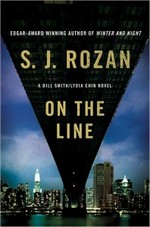
On the Line by SJ Rozan

On the LineOn the Line

by SJ Rozan
Series: Lydia Chin & Bill Smith, #10

Hardcover, 309 pg.
Minotaur Books, 2010

Read: May 25 – 26, 2017


Okay, it’s Bill Smith’s turn as the POV character — and that’s a good thing, because this would be a very short book if it wasn’t. A figure from Bill’s past is back, looking for revenge. The electronically altered voice on the phone belongs to someone that was sent to prison, in part due to Bill’s work, and now he’s out and is ready for Bill to pay what he’s due. He’s demanding that Bill play this game he’s devised in order to keep his hostage alive for the next 12 hours (or so).

The hostage, of course, is Lydia Chin. This is what makes this book different from all the other books where the hero is racing against the clock to play the twisted game of the psychopath in order to save the hostage. The hostage isn’t someone created just to be in peril, this is someone we’ve become attached to over the last 9 books (half the time being in her brain, I should add) — and Bill’s got a lot more history with and affection for her than any of us readers do. Again, this is stuff we know, not something manufactured for the purposes of this plot. So the stakes are higher for Bill than most heroes in this plot, and we believe it, too.

Without Lydia to work with, Bill has to get help from others — there’s just no way that he can do this on his own. Enter Lydia’s friend Mary, the NYPD detective; and her cousin Linus, the hacker/computer guru. Even with these two replacing Lydia, Bill spends a lot of the time seemingly over-matched. Now that I think about it, he’s so distracted by worry that a lot of the thinking is left to others, Bill mostly reacts to things in anger and fear. All believably, I should add.

The kidnapper/tormentor isn’t some psychopathic genius, some criminal mastermind — he’s a smart, committed criminal who has spent a lot of time planning. This means that the reader can see why he’d go off the bend like he does, why Bill can defeat him — and yet spend so many pages clueless. He is clever, I shouldn’t downplay that — the game he’s set up, the clues (and what he does with them) show that this is no slouch that Bill’s up against. Thankfully, neither are Bill’s allies — for 2010, one of the solutions involves a ingenious use of social media (actually, it’d be a pretty sly use in 2017, too).

The conversations between Lydia and Bill are what I’m always saying are the highlight of these books — in this book, their chats are brief proof of life kind of things. This means that every word, every nuance counts — and it’s primarily in what these two don’t have to say to communicate that is the winning element.

I enjoyed this one so much — even if Bill wasn’t as sharp as he should’ve been, even if Lydia is practically a non-factor throughout (but when she gets involved, it counts). Rozan knows these two, their world, so well that this story seems effortless (which it just couldn’t be).

It seems effortless for her, I should say, the reader is left hanging on every development, every twist, every detail, just hoping that Bill can save the day. One of Rozan’s best.

—–

4 Stars
2017 Library Love Challenge

RELEASE DAY: DEJA YOU

RELEASE DAY: DEJA YOU

E-books 99¢ RELEASE DAY SPECIAL
Paperbacks $10.99

deja you jpeg image

TITLE: Déjà You
PUBLISHER: Emerald Lily Publishing
RELEASE DATE: May 30, 2017
PURCHASE LINKS
Amazon | B&N Paperback | Create Space Paperback

In Déjà You, five authors share stories of second chances, as varied in telling as the writers themselves.

Kelly Cain’s We’ll Always Have Oahu takes us on a whirlwind New Adult romance set in the 80s between a young woman on a high school graduation trip and a handsome Navy sailor.

Bianca M. Schwarz transports us to 1760 in The Pearl with the story of Marcus Landover, who attends a card party and ends up with more than he bargained for in the beautiful Sophia Chelmsford.

Amanda Linsmeier’s Joy and Sorrow reunites lovers separated by death in a Women’s Fiction tinged with the unusual.

The Eyes of the Heart by Jamie McLachlan gives us Rosalina, who is forced to confront her attraction and the truth about her blindness when a new gardener is hired at the Greystone house.

Finally, C.H. Armstrong brings us Mr. Midnight, where tragedy reunites two star-crossed lovers, but misunderstandings soon rip them apart. Now, six years later, the stars are realigning with the help of the smooth voice of a late night radio DJ.

Some of the stories are sweet, some sad, some steamy, but all carry the same theme. Déjà You is a collection of stories for those who believe in love, but most of all, second chances.


The Birth of Déjà You

About two years ago, a group of five novice writers signed with the same small publisher, each inexperienced in the publishing world yet committed to understanding the process and finding success. Through their mutual dive into unchartered territory, Amanda Linsmeier, Bianca M. Schwarz, C.H. Armstrong, Kelly Cain, and Jamie McLachlan reached out to one another and became instant friends, sharing laughs, tears, and the struggles of life and writing. We soon dubbed ourselves “Book Besties.”

During the fall of 2016, we decided to write a book of short stories together. As friends, we wanted to combine our talents to create a collection that would inspire hope and happiness. After much deliberation, we chose the theme “Second Chances” and decided to title this anthology, “Déjà You.” Though each story contains the same theme, they all are as unique as the author who wrote it. Including New Adult, Women’s Fiction, Fantasy, Historical, and Contemporary Romance, each short offers a different take on the theme and involves varying heat levels, from sweet to steamy.


About the Authors

kellycain200x200Kelly Cain has published a multicultural adult and new adult romance, but she writes across genres and age groups, currently penning book one of a young adult urban fantasy series. Most of her stories are set in Texas with frequent travels to her home state of California, and all of her stories have an excess of food weaved throughout.

If she’s not writing, she’s probably reading. Or maybe cooking. Check out her website for recipes for dishes featured in her books, and some other fun stuff. She has two adult daughters and lives in a suburb of Houston, Texas.

Kelly is the author of Altered, a new adult multicultural romance and Connections, a steamy short story exclusively available on Amazon. Visit her on her Facebook, Twitter, Pinterest, Instagram or Tumbler.

authorphotoweb

Bianca M Schwarz was born in Germany, spent her formative years in London, and has a US passport, but she considers herself a world citizen. She lives in Los Angeles because that’s where they make movies and she used to work on them. She writes novels because that’s kind of like making a movie in people’s heads and because she just loves books. Bianca has one son, because that’s all she can handle and she tolerates her husband because, well, she loves him and there is no help for that. Visit her on her website, Twitter, Facebook, and Pinterest.

10254015_492271840927359_9159417025130441003_nAmanda Linsmeier is the author of Ditch Flowers and Beach Glass & Other Broken Things. Her writing has been featured in Portage Magazine, Literary Mama, and Brain, Child Magazine. Besides writing Women’s Fiction, she loves reading and writing fables, fairytales, and fantasy, and sometimes she pretends her Hogwarts letter is still coming. She can be found blogging about writing and books at amandalinsmeier.com. When she’s not writing, she works part-time at her local library and brings home more books than she has time to read. Amanda lives in the countryside, surrounded by trees, with her family, two dogs, and two half-wild cats. You can Amanda’s blog for book reviews and random musings, or check her out on Twitter or Facebook for more information.

5b26cd_c6727b40380f424a9a8f337501ca0160~mv2

Jamie McLachlan is the Canadian author of Mind of the Phoenix, an Amazon Bestseller in Dark Fantasy and the first novel in the Memory Collector Series. The third, Rise of the Phoenix, is set for release in summer of 2017. When not writing, Jamie reads, dabbles in various crafts, and spends time with her family. Find her on Twitter, Facebook, and her website.

blogging

C.H. Armstrong is an Oklahoma-native transplanted in the Midwest. A life-long lover of books, she made her author debut with the 2016 release of her historical fiction novel, The Edge of Nowhere, which was inspired by her own family’s struggles during the one-two punch that was The Great Depression and The Dust Bowl. Armstrong is currently working on two young adult novels and is a regular contributor to the Minnesota-based women’s magazine, Rochester Women. Visit her on Twitter, Facebook, and her website.


For more information on Déjà You or the Book Besties, visit their website, or find them on Twitter or Facebook.

Memorial Day

There’s just no way (no crassless way) to tie today’s U. S. Holiday into books/reading. Well, there’s no way that I can think of — more power to you if you pull it off (and I’ll likely steal it next year).

You non-U. S. people have a good day. U. S. readers, I won’t say “Happy Memorial Day,” because, that’s just missing the point, but I hope you find the time to observe the day as it ought to be observed and enjoy the time off work (if you get any).

We’ll be back tomorrow.

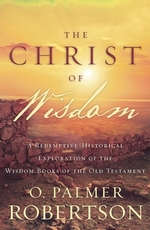
The Christ of Wisdom by O. Palmer Robertson

The Christ of WisdomThe Christ of Wisdom: A Redemptive-Historical Exploration of the Wisdom Books of the Old Testament

by O. Palmer Robertson

eARC, 432 pg.
P&R Publishing, 2017

Read: May 7 – 21, 2017


Robertson’s preface laments the way that the Wisdom Literature of the Old Testament is usually ignored in Redemptive-Historical studies —

…how do you fit these wisdom books into the flow of redemptive history that consummates in the Christ? By letting them be what they are in their own distinctiveness. They are, it should be remembered, canonical, divinely revealed, and authoritative writings that tell the world how and what to think about the deeper mysteries of human life. Rather than submitting to the moldings and bendings of modernity, these books broaden our understanding of the nature of redemptive history. Divine progress in the complete restoration of reality does not merely move in a purely linear fashion like the flight of an arrow moving across time and space without deviation until it reaches its target. This “third dimension” of redemptive history moves in a cyclical pattern. For certain aspects of God’s salvation perform according to a pattern of regulated repetition.

To ignore this dimension of redemptive history is to exclude a major portion of the old covenant canon—and that you do not want to do.

So how do you discuss these books from a RH point of view? This is what Robertson seeks to do in this book — not as a final answer, but as the beginning of a search for wisdom along these paths.

In one sense, Robertson could’ve made this easier to talk about this book — there’s not one central argument developed throughout. There’s a general discussion (brief) of wisdom, wisdom Biblically defined, that is. And then using that discussion, Robertson looks at the Wisdom Literature of the Old Testament (and Lamentations, which is not usually considered Wisdom Literature, but can function as such), summarizing each book, looking at the various forms of wisdom described and passed on through it.

Simply,

Wisdom is the ability to understand the basic principles inherent in God’s created order, and to live by those principles. Wisdom enables a person to summarize these basic principles in a succinct and memorable fashion. Wisdom is living out the whole of life with a constant awareness of accountability before a loving, gracious, and just Creator and Redeemer.

The work he does to get to this summary is well worth the time and effort to work through. Actually, that goes for everything in the book, but I’ll hold off on saying that kind of thing for a few paragraphs.

The chapter on Proverbs is, fittingly, the longest and most developed. He discusses various approaches to the book, to understanding its construction and from there trying to understand it:

A much more accurate view of the theology of Proverbs may be gained from a covenantal perspective. The wise sayings of the book are not presented in a vacuum. They are not purely moralistic aphorisms. Instead, they are steeped in theistic assumptions. These wise observations about how the world works assume that God the Creator is none other than Yahweh, the Lord of the Covenant.

This, right here, would help so much of what I’ve read about Proverbs over the last few decades. To get into everything that Robertson says about the pursuit of Wisdom, passing it on and living by it from this book would make this post unbearably long — but it builds the foundation for everything that comes. Proverbs covers Wisdom as a whole — the rest of the book deals with it in specific areas.

While dealing with the personification of Wisdom in Proverbs 8, Robertson gives an excursus, “Athanasius as the Champion of the opponents of Arianism,” that is just gold. I’d love to see this developed into something longer.

Following Proverbs, he moves on to Job. Job doesn’t give us the answers to the puzzling circumstances of life, but for those who understand the book, they learn how to puzzle through the circumstances, how to think about them — how to ask God about them. Yes, there are answers given in the book — not easy answers, not the answers anyone necessarily wants, but answers — answers tied to the hope of the Resurrection. But wisdom knows to look for those answers in the difficulties of life, with a sure faith that is willing to look at dark circumstances and say, “I don’t know why this is happening, but I trust in Him Who does.”

Ecclesiastes, is, naturally, a tricky chapter — Robertson threw me a curveball when setting aside the usual discussion of authorship of the book to note

But a related question of some significance for understanding the book has been generally neglected. This neglected question is the identity of the “target audience”of Ecclesiastes.

Chewing on this a little helps get through some of the discussion of authorship. There are so many divergent readings of Ecclesiastes that your head can swim just trying to get a sense of them, Robertson is a pretty sure guide through them before landing on his conclusion that Ecclesiastes presents a “realistic picture of life” — one that is a precursor to Paul’s discussion in Romans 8, where creation is subjected to frustration, but that this is being renewed. I do think this chapter could’ve been organized in a more straight-forward way, but I appreciate the way that Robertson makes you work through various considerations and themes before leading to his conclusions — which are all very helpful.

His discussion of Lamentations, summed up in the subtitle “How to Weep,” was one of the best things I’ve read on the book (an admittedly too-short list). You may think that’s a pretty easy thing to learn — but there’s a wise way, a godly way to weep over the tragedies that will come into our lives. The book of Lamentations teaches us that — and, here’s the RH emphasis coming through — there’s a hope tied to the wise weeping. A hope tied to faith in God’s commitment to preserving a repentant people to Himself.

Lastly, we get to the wisdom of “How to Love” (in a marital sense) in the Song of Songs. The way he reads the book is a “Redemptive-Historical” way, in

terms of the redemptive work of God in restoring humanity to the situation prevailing at the time of creation . . . a restoration of the initial blessing of man and woman in their relation to each other, just as when they first stood in each other’s presence “both naked” but feeling “no shame” (Gen. 2:25). This Song rejoices in the fullness of God’s redemption of the marriage relationship.

He concludes this chapter uniquely, with a script for a Dramatic Reading of the Song of Songs — I think there could’ve been a bit more instruction on how to approach such a Reading — and why — than he gave. But I really appreciated that part.

He could’ve used a conclusion to wrap things up — returning to the closing admonition of the opening chapter. But that’s probably just a taste thing on my part.

There’s a focus on the literary/poetic forms in each book tying in the themes and teachings of them to the way the author presents them. This kind of discussion — no matter the type of literature (inspired or not) always stretches me. I imagine I’m not alone in that — in fact, I bet many people will skip those parts. This is to their own detriment. Robertson discusses these matters in a way that takes some effort to understand, but it’s effort that pays off.

This is a truly helpful book — not full-fledged commentaries on any of the books, but helpful summaries pointed towards seeing the wisdom passed down in each book, and tied into the Redemptive work going on in history all around us. I found it interesting that the recent A Biblical-Theological Introduction to the Old Testament doesn’t approach some of these books the same way as Robertson — in some ways flatly contradicting him. I’d hoped for more overlap between the two works approaching this material from the same framework — but none of the contradictions or differences change the overall message of the Biblical material, just shadings. Honestly, in each case, I think Robertson’s readings are easier to square with the texts in consideration (and not just because he has more pages to develop his points, either).

Robertson, as always, delivers the goods with this book. The reader has to think about what he says, has to drag out their Bible and use the two books together, but will ultimately come out the better for it. I found this book to be incredibly helpful, insightful and something that drove me back to the fullness and fulfillment of all the wisdom of God — Jesus the Messiah. Just where Robertson wants his readers to focus.

Disclaimer: I received this eARC from P&R Publishing via NetGalley in exchange for this post — thanks to both for this.
N.B.: As this was an ARC, any quotations above may be changed in the published work — I will endeavor to verify them as soon as possible.

—–
4 Stars

Saturday Miscellany – 5/27/2017

Odds ‘n ends over the week about books and reading that caught my eye. You’ve probably seen some/most/all of them, but just in case:

    I ididn’t see any New Releases that were up my alley this week — which means I probably missed some — and next week doesn’t look much better. You guys see anything?


The Mail I Get . . .

(with apologies to Lee Goldberg for stealing his title for blog posts to describe the strange, the obnoxious, the puzzling emails that he gets.)

Have myself a nasty case of eyestrain today — which makes this whole thing interesting — I got about half of a post written, but I can’t read it, so who knows how good it is. Thankfully, I can still make out graphics enough to black out revealing information, so I can tell a little story and still get a post up today. My eldest assures me that I got the graphics right — and he even fixed a typo that I couldn’t see.

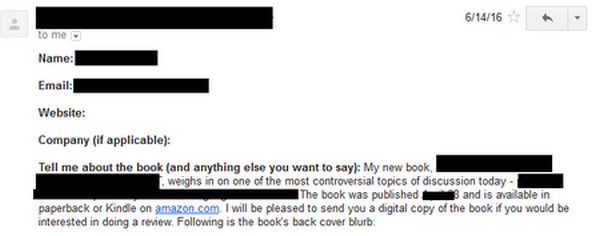
Last year I got this email:

I responded (I seem to have sent several emails that day, most of which were overdue, so I didn’t realize that this one wasn’t):

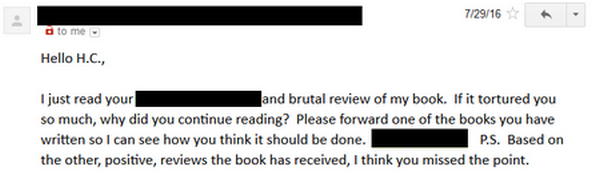
I got the book, didn’t like it at all, posted about it, and then a couple of weeks later, I got this email:

I chose not to reply.

Fast-forward to this week, when I got this from the same author:

Believe it or not, I said I’d be happy to read it — I think there’s a really good chance that I’ll like this one. I really hope I do — I prefer liking things to any alternatives. (and, yeah, it’d be a better ending to the story).

Towel Day ’17: Some of my favorite Adams lines . . .

There’s a great temptation here for me to go crazy. I’ll refrain from that and just list some of his best lines . . .

The Hitchhiker’s Guide to the Galaxy

  • Time is an illusion. Lunchtime doubly so.”
  • This must be Thursday. . . I never could get the hang of Thursdays.”
  • “You’d better be prepared for the jump into hyperspace. It’s unpleasantly like being drunk.”
    “What’s so unpleasant about being drunk?”
    “You ask a glass of water.”
    (I’m not sure why, but this has always made me chuckle, if not actually laugh out loud. It’s just never not funny)
  • He had found a Nutri-Matic machine which had provided im with a plastic cup filled with a liquid that was almost, but not quite, entirely unlike tea.
  • In those days spirits were brave, the stakes were high, men were real men, women were real women and small furry creatures from Alpha Centauri were real small furry creatures from Alpha Centuari. And all dared to brave unknown terrors, to do mighty deeds, to boldly split infinitives that no man had split before . . .
  • “Look,” said Arthur, “would it save you a lot of time if I just gave up and went mad now?”
  • The Restaurant at the End of the Universe

  • It is a curious fact, and one to which no one knows quite how much importance to attach, that something like 85 percent of all known worlds in the Galaxy, be they primitive or highly advanced, have invented a drink called jynnan tonnyx, or gee-N-N-T’Nix, or jinond-o-nicks, or any one of a thousand or more variations on the same phonetic theme. The drinks themselves are not the same, and vary between the Sivolvian “chinanto/mnigs” which is ordinary water served at slightly above room temperature, and the Gagrakackan “tzjin-anthony-ks” which kills cows at a hundred paces; and in fact the one common factor between all of them, beyond the fact that the names sound the same, is that they were all invented and named before the worlds concerned made contact with any other worlds.
  • Life, the Universe, and Everything

  • The Hitchhiker’s Guide to the Galaxy has this to say on the subject of flying.

    There is an art, it says, or rather, a knack to flying.

    The knack lies in learning how to throw yourself at the ground and miss.

  • (It goes on for quite a while after this — and I love every bit of it.)

  • “One of the interesting things about space,” Arthur heard Slartibartfast saying . . . “is how dull it is?”

    “Dull?” . . .

    “Yes,” said Slartibartfast, “staggeringly dull. Bewilderingly so. You see, there’s so much of it and so little in it.”

  • So Long, and Thanks for All the Fish

  • Of course, one never has the slightest notion what size or shape different species are going to turn out to be, but if you were to take the findings of the latest Mid-Galactic Census report as any kind of accurate guide to statistical averages you would probably guess that the craft would hold about six people, and you would be right.

    You’d probably guessed that anyway. The Census report, like most such surveys, had cost an awful lot of money and told nobody anything they didn’t already know — except that every single person in the Galaxy had 2.4 legs and owned a hyena. Since this was clearly not true the whole thing eventually had to be scrapped.

  • Here was something that Ford felt he could speak about with authority.

    “Life,” he said, “is like a grapefruit.”

    “Er, how so?”

    Well, it’s sort of orangy-yellow and dimpled on the outside, wet and squidgy the middle. It’s got pips inside, too. Oh, and some people have half a one for breakfast.”

    “Is there anyone else out there I can talk to?”

  • Arthur had a swordfish steak and said it made him angry. He grabbed a passing waitress by the arm and berated her.

    “Why’s this fish so bloody good?” he demanded, angrily.

    “Please excuse my friend,” said Fenchurch to the startled waitress. “I think he’s having a nice day at last.”

  • Mostly Harmless

  • A common mistake that people make when trying to design something completely foolproof is to underestimate the ingenuity of complete fools.
  • Dirk Gently’s Holistic Detective Agency

  • Let’s think the unthinkable, let’s do the undoable. Let us prepare to grapple with the ineffable itself, and see if we may not eff it after all.
  • (I’ve often been tempted to get a tattoo of this)

    The Last Chance to See

  • “So what do we do if we get bitten by something deadly?” I asked.

    He looked at me as if I were stupid.

    “You die, of course. That’s what deadly means.”

  • I’ve never understood all this fuss people make about the dawn. I’ve seen a few and they’re never as good as the photographs, which have the additional advantage of being things you can look at when you’re in the right frame of mind, which is usually around lunchtime.
  • I have the instinctive reaction of a Western man when confronted with sublimely incomprehensible. I grab my camera and start to photograph it.
  • And a couple of lines I’ve seen in assorted places, articles, books and whatnot

  • I love deadlines. I love the whooshing noise they make as they go by.
  • A learning experience is one of those things that says, “You know that thing you just did? Don’t do that.”
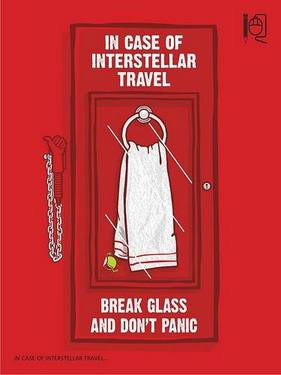
  • Towel Day ’17: Do You Know Where Your Towel Is?

    The Hitchhiker’s Guide to the Galaxy has a few things to say on the subject of towels.

    A towel, it says, is about the most massively useful thing an interstellar hitchhiker can have. Partly it has great practical value. You can wrap it around you for warmth as you bound across the cold moons of Jaglan Beta; you can lie on it on the brilliant marble-sanded beaches of Santraginus V, inhaling the heady sea vapors; you can sleep under it beneath the stars which shine so redly on the desert world of Kakrafoon; use it to sail a miniraft down the slow heavy River Moth; wet it for use in hand-to-hand-combat; wrap it round your head to ward off noxious fumes or avoid the gaze of the Ravenous Bugblatter Beast of Traal (such a mind-bogglingly stupid animal, it assumes that if you can’t see it, it can’t see you); you can wave your towel in emergencies as a distress signal, and of course dry yourself off with it if it still seems to be clean enough.

    More importantly, a towel has immense psychological value. For some reason, if a strag (strag: non-hitch hiker) discovers that a hitch hiker has his towel with him, he will automatically assume that he is also in possession of a toothbrush, face flannel, soap, tin of biscuits, flask, compass, map, ball of string, gnat spray, wet weather gear, space suit etc., etc. Furthermore, the strag will then happily lend the hitch hiker any of these or a dozen other items that the hitch hiker might accidentally have “lost”. What the strag will think is that any man who can hitch the length and breadth of the galaxy, rough it, slum it, struggle against terrible odds, win through, and still knows where his towel is is clearly a man to be reckoned with.

    Hence a phrase that has passed into hitchhiking slang, as in “Hey, you sass that hoopy Ford Prefect? There’s a frood who really knows where his towel is.” (Sass: know, be aware of, meet, have sex with; hoopy: really together guy; frood: really amazingly together guy.)

    One of my long-delayed goals is to write up a good all-purpose Tribute to Douglas Adams post, and another Towel Day has come without me doing so. Belgium.

    Next year . . . or later.

    Adams is one of those handful of authors that I can’t imagine I’d be the same without having encountered/read/re-read/re-re-re-re-read, and so I do my best to pay a little tribute to him each year, even if it’s just carrying around a towel (I’ve only been able to get one of my sons into Adams, he’s the taller, thinner one in the picture from a couple of years ago below).

    TowelDay.org is the best collection of resources on the day, recently posted this pretty cool video, shot on the ISS by astronaut Samantha Cristoforetti.

    Even better — Here’s an appearance by Douglas Adams himself from the old Letterman show — so glad someone preserved this:

    Love the anecdote (Also, I want this tie.)

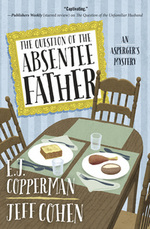
    The Question of the Absentee Father by E. J. Copperman, Jeff Cohen

    The Question of the Absentee FatherThe Question of the Absentee Father

    by E.J. Copperman, Jeff Cohen
    Series: Asperger’s Mysteries, #4

    eARC, 288 pg.
    Midnight Ink, 2017

    Read: May 19 – 22, 2017


    So after reading #3 in this series, The Question of the Felonious Friend last year, I was going to read the first two before the next one came out but you know what they say about the The best-laid schemes o’ mice an ‘men, right? Gang aft agley . . . So, here it is, a few months later and the next book is out. Picking up soon after the last ended — this time the case is a bit more personal. Not case, of course, Samuel isn’t a detective, he answers questions. To be accurate (as Samuel would want), this time the question is a bit more personal. Not that Samuel cares about it, but people in his life do.

    (actually, I technically can still read the first two before the book comes out — I’ve got a few months, now that I think about it)

    I should back up a bit, for those who didn’t read what I thought of book 3 (I’ll get over the slight) — Samuel Hoenig isn’t your typical mystery protagonist. He runs a business called Questions Answered — basically, he researches things for you. A human Boolean Search. From the looks of it, this occasionally results in him playing amateur detective. As is indicated by the name of the series, Samuel finds himself on one end of the Autism Spectrum, which helps him focus on his questions, but leads to challenges on the interpersonal level.

    Which is where is mother and his associate, Ms. Washburn, come in to play — Ms. Washburn helps him through the challenges presented by the world around him (as well as helping research his answers). His mother is . . . well, his mother — she still cooks for him, , still cares for him, pushes him to do new things, while providing a safe environment at home. He has a friend, Mike (no known last name), a taxi driver with some military experience that he relies on when things get sticky. And things get pretty sticky this time around.

    Samuel’s father left home when Samuel was a kid, he always assumed it was because he was such a difficult child. He never let this define him — or affect him at all (as far as he’s aware). But now, his mother receives a letter from him, and it distresses her. So she asks Samuel the question that she’s probably been wanting to ask for a while, “Where is your father living now?” The question is not emotionally wrought for Samuel, but he can tell it is for his mother (and Ms. Washburn keeps trying to make it into something that matters to Samuel).

    What Samuel does get emotional about is what this question makes him do — leave home. Get on an airplane, travel to California, sleep on a strangers bed, ride in a car that he is unfamiliar with, eat at restaurants he’s never heard of, deal with LA traffic — and much more. In the midst of all that, Samuel and Ms. Washburn begin to suspect that his father is mixed up in something nefarious, and potentially dangerous.

    The story is really strong, and more complex than I’d assumed it would be. In the last book, Samuel was dealing with other people on the Spectrum or their families. This time, there’s none of that — just strangers who are unused to interacting with people like him and who have no patience. Which serves as a good challenge for Samuel to overcome. There is real character growth evident in this book — it’s not the same kind of growth you expect to see in most books — because Samuel isn’t like most protagonists. But it is there — and really, he makes some pretty big strides here. It’s nice to see him not be treated as static, but someone who can make choices, can evolve.

    Once again, Samuel isn’t treated as a bag of symptoms or tics, he isn’t made a paragon of anything. He’s an individual who has to do some things the rest of the populace don’t consider. There are some lighter moments in the book, but none of them are at Samuel’s expense, just human foibles.

    The Question of the Absentee Father is another strong outing for Samuel and his team — as well as for E.J. Copperman. For those who like a mystery on on the cozy side, with some strong characters, this is the one for you.

    Disclaimer: I received this eARC from Midnight Ink via NetGalley in exchange for this post — thanks to both for this.

    —–

    3.5 Stars

    Page 1 of 4

    Powered by WordPress & Theme by Anders Norén