Month: July 2023 Page 4 of 8

The Inside Scoop—A Q&A with Ian Shane About Self-Publishing

Inside Scoop logo
Ian Shane has become one of my favorite authors over the last couple of years—I’ve given copies of his books away and recommended them to people in real life and online. I’m very glad that he agreed to take part in this series. I hope you enjoy this—and click on the links below, there are some solid recommendations here.


Before we get into things, why don’t you give the reader a brief introduction to you and your work?
Hi, I’m Ian Shane! I’m the author of three novels (Radio Radio, Postgraduate, and In Ten Years). I’m finishing up an “almost memoir” (Sundry Notes of Music) which should be ready for publication in November. If you want to put a label on my work, my genre is “Lad Lit,” in the great tradition of Nick Hornby.

My website is currently down, but you can find my books at viewauthor.at/ishane, and I’m on Twitter @ThatIanShane.

What are some of the biggest misconceptions you find that readers have about self-published books?
That they are less than published books. I will take the works of Matthew Hanover (@MatthewHanover), N.J. Cartner (@njcartner), Wesley Parker (@weswritesforfun), and Adam Shaw (and so many others) over many other “traditionally published” authors. Indie authors’ voices are important and, many times, infinitely more interesting.

What kind of costs are associated with self-publishing a book? Do you hire one or more editors, or one editor for a couple of passes? Cover artist? Anyone to help with layout, design, etc.? Beta readers? Or do you take it all on yourself? Are you actually making any money at this, or are you still focused on breaking-even while building an audience?
There is a lot of investing. The lion’s share of the cost is for editing. But it’s sooooo worth it. Melissa Gray (@ProofreaderMG) is the best editor in the business. Editors are a prerequisite to publishing a book, not an option. I have paid for the covers of my previous three books; however, I designed the cover of my next book. I’ve also paid for a website, but I am reevaluating that, as it seems that it only attracts unsolicited messages from web designers offering to redo my website. I’ve also tried some promotional campaigns, which did very little to move the needle when it comes to sales.

I’m not making money off of this. Writing is my passion project, and I’m more interested in building an audience than making money.

Are there tools, mentors, websites you’ve found to help you through this process? Or did you stumble through blindly on your own?
A little bit of both. My first novel was done blindly. However, after I finished my first draft, I joined a writer’s group in St. Paul. It was nice to have a group of beta readers I got to check in with every two weeks. When I started writing Postgraduate, I found some writers on Twitter who had different approaches to promotion and distribution, which I was able to adopt.

How do you juggle marketing/PR/etc. with writing new work? (along with day jobs, family, hobbies, etc., etc.)
It’s the biggest obstacle. I am a writer, not a publicist, and indie authors are forced to be both. It also doesn’t help that my schedule for the day job isn’t exactly consistent, so I don’t have a set time to market the book. The job is the highest priority because I like the finer things in life, such as food and shelter. Writing is next. Especially when I’m in the final stages of a book, I have very little time for spreading the word. I really need to get better at it.

How do you promote your book—what things have worked best for you? What kind of lessons have you learned for things not to do (at least for you)? Do you do any in-person marketing, or are you all online?
I’ve tried a couple of promotional campaigns that didn’t really seem to do anything for sales. I also tried Amazon Ads and have had mixed results on it. Believe it or not, the thing that seems to work the best is Twitter. There is a correlation between when I spend a bit of time on Twitter and sales spikes. I’m not constantly tweeting links to my book, although I take advantage of #WritersLift tweets from time to time.

On a whim, I tagged Jake Ruhd, an on-air personality on The Current in Minneapolis, in a tweet. He hosts a classic alternative show on Sundays, and my second book was about the same kind of music. I wrote that I was waiting for him to discover the book organically, and I just decided to be shameless in getting his attention this way. He retweeted my post, and it got a lot of traction. To this day, that was my best-selling month. (I love this story)

That has started to become a little trickier now that Twitter is so divisive and there is a fracture of social media feeds, I’m trying to find time to devote to other platforms, but it’s exhausting starting all over again to build an audience.

What made you decide that self-publishing was the direction you wanted to go? How often do you question that choice? How do you get through the self-doubt?
When I first started writing Radio Radio, there was no such thing as CreateSpace, and I didn’t know any print-on-demand options. I felt that my book catered to a limited audience, and I didn’t believe a traditional publisher would be interested in inside jokes between me and a few people I worked with. There was an indie publishing house in Bloomington, Indiana (where I was living at the time), and I thought it would be my best option. Having a publishing house like that locally was an advantage of living in a college town. However, the “basic option” was a bit out of my price range, so I started to scrimp as much spare change out of my embarrassingly low paycheck while I wrote the first draft.

I moved to Minnesota and lost my connection to AuthorHouse, so I was trying to find a home for my book. I found SmashWords and CreateSpace and never looked back. I’ve never thought about “what could have been” if I tried to sell the book to a traditional publisher, and if I had the chance to do it all over again, I would do the exact same thing when it comes to publishing.

Have you thought about trying to get a deal with major (or indie) publishers for upcoming works, or are you planning on sticking with self-publishing?
I plan on sticking with self-publishing.

Self-publishing tends to have fewer external deadlines keeping one accountable. How do you maintain your work process or work ethic?
While writing Postgraduate and In Ten Years, I started posting word totals on my day-to-day writing on Facebook. It was a very public way to keep myself accountable, and the fear of failing in front of my friends was a huge incentive to keep my but in the chair and typing. I’m certain that it annoyed most of my friends; however, some kept me accountable and mentioned it any time I was slacking.

What is your favorite and least favorite thing about being self-published?
The great thing about self-publishing is that anybody can publish a book. What isn’t great about self-publishing is that anybody can publish a book.

I love that I don’t have a deadline that anybody else has set and that I don’t have to change my writing to draw in as many people as possible. I love that I get to tell my story on my terms. Writing is art, not a commodity. Picasso and Jackson Pollock never had to submit themselves to a focus group.

The downside is that in 2021, there were 2.3 million new independently published books. And while I love that others have taken advantage of the same system I have, it just makes it harder to market my book. As a writer, I really have to stand out, and that’s not always easy.
2.3 million? I’m feeling better about my TBR List’s size.

How do you decide a book is finally finished and ready? (or how do you avoid “perfection as the enemy of good”?)
I may be the wrong person to ask this. I have rewritten Radio Radio post-publications many, many times. I used to make fun of George Lucas for continuing to “update” the Star Wars trilogy, but I get it now. But, that was my first book and I wanted to get it out as soon as I could.

However, I have honed my process. I have found an amazing editor and the right people to review the writing. But in the end, it’s a feeling I have. I have an inner peace that lets me know that I have expressed what I wanted.

Thanks for your time and participation! Hope you enjoyed it! And do know that there are many of us out here who appreciate and applaud what you do (and our number is growing)!
Thank you for asking me!

Be sure to check out all of Ian Shane’s work—you’ll laugh, you’ll smile, your heart will get warmed all the way down to the cockles!

Self-Published Authors Appreciation Week Footer

Clker-Free-Vector-Images from Pixabay
The 2023 Self-Published Authors Appreciation Week Logo was made by Witty and Sarcastic Book Club
The Inside Scoop—A Q&A with Jeremy Billups About Self-Publishing

Inside Scoop logo
I met Jeremy Billups a few years ago at a local Comic Con and was instantly drawn to his art—it helped that he’s a super-nice guy, too. Since then, I’ve talked about all of his books and he’s been very generous with his time and participated in several things around here. Those of you who’ve seen the cartoon pilcrow I use here and on Social Media know a little of his work, too. Let’s hear a little about self-publishing for the Picture Book/Children’s Market.


Before we get into things, why don’t you give the reader a brief introduction to you and your work.
Thanks so much H.C. for the opportunity to chat! My name is Jeremy Billups and I make attempts at writing and illustrating children’s books. I’ve self-published three so far. Bearded, Bearded Too, and Sea This and Sea That. I’m very close to wrapping up the manuscript for the third Bearded book. I’m also chipping away at a Christmas book and a book about being a dad.

I’ve also been working on some comics, Squirrel E. Jones and Tales of the Incredible. Both comics are very different from each other and the children’s books, but good creative outlets for me.

If so inclined, you can find all my books, comics, and other fun things at caffeinatedbeverages.com.

What kind of costs are associated with self-publishing a book? Do you hire one or more editors, or one editor for a couple of passes? Cover artist? Anyone to help with layout, design, etc.? Beta readers? Or do you take it all on yourself? Are you actually making any money at this, or are you still focused on breaking-even while building an audience?
The self-publishing money talk, huh? I actually think these are good questions to bring up. We could have a whole discussion on this alone.

I’m very thankful to have enough design experience from my day job that I’m able to handle the design and artwork for my projects. In fact, that was a big reason why I chose to go with self-publishing. Having the skills and knowledge with the design side of things gives me a lot more control over my projects and saves me a lot of money.

The biggest cost for me is printing. It took a while, but I was finally able to find a U.S.-based printer that does print-on-demand at a cost that works for me. I’m now able to put out new books without nearly as much financial risk. Saying this though, it makes me realize that I need to take advantage and put out more books!

I do work with one editor. With each project we go back and forth with each manuscript until I think it’s ready. I’m fortunate here as well because my word count is so low that she only charges me a very reasonable flat rate.

Though, nothing to live on yet, I am making money at this. It’s just enough to keep me motivated to continue growing my catalog and audience. I would love for this to be all that I do one day.

Your comment about word count will tie-in very well with what a Fantasy author says about that (and how he’s considered other genres because of it)
Yeah, I’m very thankful that word count is something I don’t have to take into consideration while telling my stories.

How do you promote your book—what things have worked best for you? What kind of lessons have you learned for things not to do (at least for you)? Do you do any in-person marketing, or are you all on-line (I assume predominately online)
So I started out on Amazon and only produced a digital version of my book, Bearded. Seemed like a good way to see if anyone would be interested. I was all in on Kindle Direct Publishing. At the time, it was exactly what I was looking for. I did all the things they recommended, took advantage of their promotional offers and saw some traction. The big download numbers always came when I offered the book for free. So I decided to lean into that and make the digital version of Bearded permanently free. And, then I offered a second book, Bearded Too as a paid follow up to the free book. With the change of Bearded to “perma-free” I saw significant downloads and good ratings for the free book, but those downloads never really translated to people buying the second book.

I have a few theories as to why I didn’t see the sales I was hoping for, but it doesn’t matter anymore. I decided to change things up and focus on in-person. There are a few local events that I participate in every year and it’s been so much better. I’ve made some great connections, sold some books, and get to see repeat customers face-to-face each year.

I didn’t give up on the internet entirely. I’ve recently updated my website with a shop so that I can keep selling online and I’m currently exploring Etsy as a option to sell online as well.

I don’t know that I’d have thought about Etsy for self-published books—but it make sense—what got you thinking in this direction? Have you considered other non-Amazon options?
I decided to give Etsy a try after noticing that a lot of the artists/creators that I follow on social media were using it to sell their creations. After exploring the site and buying some super cool things, I thought it would be worth trying out. At the very least, I think it’s a good way to expand the reach of my products beyond what I’m currently doing with my website.

As for other non-Amazon options, I haven’t really considered anything other than Etsy. But, I am a little curious about selling directly through Instagram and/or Twitter. If Etsy doesn’t work very well, that may be what I try next.

What made you decide that self-publishing was the direction you wanted to go? How often do you question that choice? How do you get through the self-doubt?
It really came down to my lack of patience, and a bit of naivety. I didn’t want to sit around waiting for approval to tell my stories. I just wanted to tell them. Self-publishing gave me that capability immediately and so I dove right in. I definitely questioned the decision early on. But now, after all that I’ve learned and experienced, I know it was the right decision, and I’m excited and proud to continue telling my stories this way.

The self-doubt comes in on whether or not to go all in or not. Today I have a day job that pays the bills and supports my family. When to take a leap of faith and devote my career to more books, I’m just not sure about yet.

Have you thought about trying to get a deal with major (or indie) publishers for upcoming works, or are you planning on sticking with self-publishing?
I have thought about this. Especially since it may be the quickest path to getting to do this full-time. If it was a partnership that worked well for both parties then I’d definitely be open to it. There is a bit of self-doubt here too. Am I good enough? Can I meet their deadlines? Can I continue to produce as much as I think I can?

At the very least, I’m open to entertaining the idea if someone were to reach out.

Thanks for your time and participation! Hope you enjoyed it! And do know that there are many of us out here who appreciate and applaud what you do (and our number is growing)!
Thank you for the opportunity to meet with you and all the great questions! I enjoyed the discussion and look forward to the next one. I also appreciate all that you do and the love and attention you give self-publishers like me. It really means a lot!

Your kids/grandkids/nieces/nephews/etc. are going to love Billups’ work! Be sure to check out all of it!


Self-Published Authors Appreciation Week Footer

Clker-Free-Vector-Images from Pixabay
The 2023 Self-Published Authors Appreciation Week Logo was made by Witty and Sarcastic Book Club
The Inside Scoop—A Q&A with Shannon Knight About Self-Publishing

Inside Scoop logo

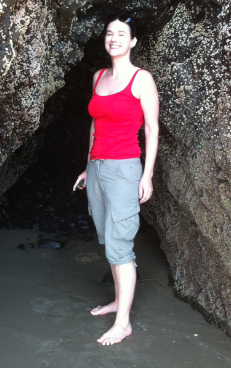
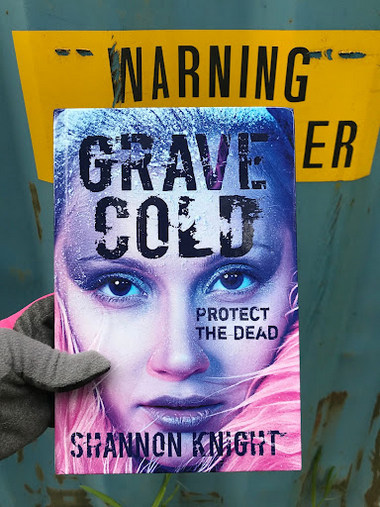
We’re starting this series with Shannon Knight—she’s one of those authors who came to me from JCM Berne. I’ve yet to read any of her books, but she’s popping up on the blog all over. She’s contributed a Guest Post (as she mentions below) about the cover design for her novel, Grave Cold, and we’re working on something else now, too—stay tuned for that. But today we’re talking about the self-publishing, when she sent me her replies she explained why she replied to so few questions: “I wrote long answers to the questions. I guess I want to turn everything into a story.” I loved the her stories and thought they made a great launching point for this week.


Before we get into things, why don’t you give the reader a brief introduction to you and your work.
Shannon KnightMy name is Shannon Knight. I live in the Pacific Northwest. I’ve published three novels this year, all science fiction and fantasy. The first is Wish Givers, a fantasy set on a tropical island with tattoo magic where the hero must save her people and destroy her enemy by granting his every wish. Next is Insiders, a great, big space opera. With the help of a sentient plant, the crew of a small spaceship must each overcome their personal demons and lend their unique strengths in order to save the universe. Finally, I published Grave Cold, a biopunk novel set in the near future. When the dead are being used as an energy source, a reaper and a necromancer work together to save the dead from the living. You can find full blurbs for each book at your favorite online bookstore.

Buy Wish Givers here: https://books2read.com/WishGivers
Buy Insiders here: https://books2read.com/Insiders
Buy Grave Cold here: https://books2read.com/GraveCold

What made you decide that self-publishing was the direction you wanted to go? How often do you question that choice? How do you get through the self-doubt?
I caught COVID-19 in the Spring of 2020. None of it went the way I’d expected. I’d run a mountain marathon the month before, I had a robust immune system, and I was medically young. Nonetheless, it seemed I was going to die. Weeks passed, months passed, and I did not improve. In fact, new symptoms kept appearing, so that the random, extreme malfunctioning of my body became my norm. I strove to breathe, to haul my bones to the toilet, and to endure constant pain. In an allusion to The Princess Bride, COVID was my Dread Pirate Roberts. “Good night, Shannon. Good work. I’ll most likely kill you in the morning.”
Shannon Knight 2
During the first two and a half years, I had passing access to my own thoughts. See, even self-reflection was no longer readily accessible. In my moments of clarity, I accepted death. I accepted the life I had lived up to this point. I also really wished I’d put those books out. I decided that if the mental capacity to pull it off returned to me, I would self-publish. It was roughly around the two and a half year mark that my life changed. One of the many medical tests yielded results and a treatment. Suddenly, I could sit up. Out of bed. For many hours! My mind opened. I could think again! I started studying Korean. I could do it! I could simply stand up! I wanted to run. I wanted to build my body back up.

My new limitations clarified themselves, but I began work on self-publication. I could study Korean, but for some reason, I couldn’t understand my own novel. That was bad. My daily reserve of expendable energy was quite small. I minimized my steps, ate instant food, and focused on self-pub. I reached out to editors, to cover artists. I created spreadsheets of prices and timelines. Some of the waits were extensive. I worked as long as I coherently could each day, with my body wilting and vision blurring as I hit my cut-off point. Unfortunately, my symptoms were increasing, my functionality decreasing. It wasn’t long before I could only sit up for two hours per day. I emailed my doctor. He said, “Oh, yes. It’s common for this medication to fail. We’ll take you off of it for a reset. We can also keep doubling the doses as it successively fails. Each time, there’s a fifty-fifty chance these methods will work.” Confused, I emailed the artist and editor I had been planning with and put the project on hold. Off the meds, I returned to that no-person space.

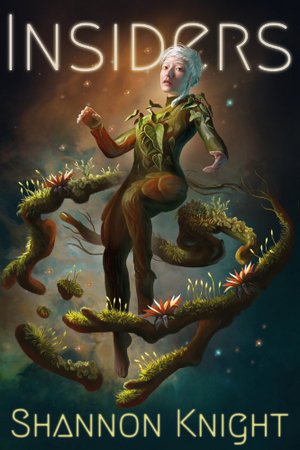
On round two of the meds, I threw away all notions of exercise or cooking. Everything was about my books. I hired the editor. I confirmed that the artists would not be available before my next expected round of med failure. I had long pursued art as a hobby, but never anything digital. I decided to do the best with what I could accomplish myself in a race against my failing body. But I was improving! I was much more capable than during round one. I completed the Insiders revisions with ease, perfectly understanding my story, and feeling frustrated at the number of errors my copy editor had not caught. I gave the manuscript multiple extra sweeps myself to make sure I was satisfied with it. I published both Wish Givers and Insiders in January 2023. The green Insiders cover was completed in a deep blur of confusion as my capacity waned, but the book inside was everything I wanted. Back off the meds, I told myself, it’s okay now—you’ve got two books out.

Then my doctor said some very frustrating things to me. That guy. He said I should plan to never get better. That I should expect complete failure of the meds that let me think and stand and occasionally go to the grocery store. At first, I was upset, but then I decided that none of it was true. I’ve got Long COVID. It’s a novel disease. There are no treatments, they don’t fully understand the mechanisms behind it, and, therefore, they don’t know what’s going to happen to me. I have so many doctors, and only one of them made this statement.

I hired the artist that I wanted to do the Wish Givers cover. I found and hired an artist for the Insiders cover. It would be a few months. Was that okay? Would I make it? Hell, yes. (I paid early, though, just in case.) Grave Cold needed serious revisions. Also, it has a death theme, and I had lots of new thoughts on the matter. I dove into all of it. And I’m holding steady. WAY steady. I published Grave Cold in May. The artwork for Insiders was completed in early June, and the art for Wish Givers will be finished at the end of June. (I’m writing this in June.) Then I’ll re-release those books properly.
A Photo of the Grave Cold cover
So why did I decide to self-publish? COVID-19 is why. Do I question that choice? No, I do not. Do I have self doubt? I doubt plenty of things in this world, but I do not question sending my stories out so that people can read them. Do you know what comforts a person who is lonely? What distracts a person from pain? What brings someone hope? What allows a person to consider the many emotions and relationships in this world when everything has fallen down around them? Stories do that. Stories are a light in the darkness. Let me turn on the light.

Do you do your own cover design, or have you found people to help with that? It seems almost as difficult as writing the novel itself—talk about the process a bit.

I designed my own. Cover design has been a unique challenge for each of my books. I spoke with you once before, in detail, about my cover creation process for Grave Cold. In some ways, the design for Grave Cold was the easiest of my three books because I chose the cover art from existing photographs. While I needed to consider many possibilities via different search terms and scrolling through endless photos, there were also built-in limitations regarding what was available. Then the details of the typography were chosen based on genre and on what the art didn’t already convey.

For Insiders and Wish Givers, I commissioned paintings. Therefore, I needed to decide everything. The price tag on commercial paintings also meant that I needed to make them count. I may not earn back the cost I spent on the covers, but in indie, if your cover isn’t good enough, readers are unlikely to even consider giving your story a chance. After the years I’d put into writing these books, the least I could do was invest in the best covers I could get.

Insiders created a distinct challenge. At first, I thought I had an easy solution because Insiders is a space opera, and NASA and ESA/Hubble have made all their space images free for public use. However, an image of space or spaceships in Insiders Coverspace would not drive home that Insiders is a character-driven, ensemble piece. Thematically, teamwork is crucial. I needed to show characters on the cover, but I couldn’t cram six characters and a plant on the cover and make it look good. (Or could I? I spent some time on that, too. I’ve seen movie posters do it well.) I considered which character or characters I could select from the group for the cover. One character has a special role in that she is a teen wearing the sentient plant suit, but a teen photo on the cover is code young adult, and Insiders is an adult novel. It took me longer than I care to admit before I realized that the plant suit covering her face and body, which would be straightforward in a painting, would eliminate the young adult classification and look wonderfully sci-fi. (Ironically, my cover artist, Isa Backhaus, chose to show her face anyway, but the result don’t look young adult in the painting. Of course, I also made this concern clear to my artist, so I’m sure it wasn’t accidental.) For Insiders, the final cover design also didn’t feature a scene directly from the book. Instead, the design was decided in order to portray enough elements to show the heart of the story. I believe the cover is beautiful, represents the story well, and will attract the right readers.

I spent months on designs for Wish Givers. It’s a fantasy novel, but my agent had found interest for it outside of standard fantasy circles, so initially, I was thinking of breaking the standard fantasy cover expectations by choosing an art style not normally used on fantasy novels. I’m afraid I spent too much time on that before realizing that my limitations as an indie writer meant that I shouldn’t be trying to break the mold. When I returned to the traditional fantasy style of covers, I realized I had a new problem. My Polynesian characters already wouldn’t look like traditional fantasy characters. The magic within the book involves elaborately drawn tattoos that make wishes happen. Showing a tattoo in progress or a completed tattoo would not convey a sense of magic or fantasy. I needed magic on the cover so that Wish Givers would be immediately identifiable as fantasy. I realized the wish that would best show this, but I was still worried about creating a design that was genuinely captivating. Plus the generative AI debacle was creating its own massive mess, reproducing the most common denominators of everything. I wanted something very human made. I decided one of the least common denominators was a truly dramatic perspective. And, eureka, I had it! I created a design for Wish Givers from an extreme angle above my character so that she was strikingly foreshortened. The angle alone causes the human eye to pause and reflect. It also offered the bonus of hiding many of the protagonist’s tattoos, which are story spoilers, and allowing for an eye-catching placement of the wish-come-to-life. After all my design work, I was amused and delighted to find that my cover artist, Eli Peiró, offered three designs to choose from, even if an author arrives with a design in hand. I could have saved myself some trouble and let her do that heavy lifting! I chose the design I had initially suggested. As I write this, the new cover for Wish Givers is being painted, the drafts are absolutely lovely, and the new cover will be available in early August. You should check it out!

Thank you, thank you, thank you for all your time and effort—and openness—for this. Thanks for your participation! Hope you enjoyed it! And do know that there are many of us out here who appreciate and applaud what you do (and our number is growing)!

Readers, be sure to check out all of Shannon Knight’s work!


Self-Published Authors Appreciation Week Footer

Clker-Free-Vector-Images from Pixabay
The 2023 Self-Published Authors Appreciation Week Logo was made by Witty and Sarcastic Book Club

SPAAW ’23: The Inside Scoop—Self-Published Authors Talk About Self-Publishing

The Inside Scoop
It’s once again Self-Published Author Appreciation Week, a celebration of those brave souls who take all the publishing responsibilities and risks on themselves*. I regretted not being on the ball to participate too much in this last year, so put it on my calendar in May to start planning something. But what? I could just post review-y posts about a bunch of Self-Published works, but I always seem to struggle when I try to save up a bunch of posts to do at a certain time. Also, it would look pretty much like every week here already, and I wanted to do something more.

* Although you’ll see this week (if you’re not aware already), no one really does this alone.

So I decided to try to do some Q&As with self-published authors, to see what it’s like for them. Or to ask for some Guest Posts about some aspect of it. It’s one thing to say we appreciate them, but learning more about what it takes from those who’ve been there should add to our appreciation, right? So I sent requests out to some that I’ve interacted with a bit and thought would be open to it. One of the first to respond was JCM Berne, who added, “I’m on a discord server with a ton of self published authors, I can spread the word.” I said sure, that’d be great—and within minutes I start hearing from people I’d never heard of (and some I had, but had never interacted with).

Before I knew it, I had more people interested in this than I knew what to do with.

When I told Berne about the response he’d generated he replied, “Actually, that should be your theme for the week. ‘I offered to publicize some self-published writers and they swamped me.’ It says so much about what there is to say about the communities.” It does indeed, as he put it, “Part of self-pub is we all think of marketing as our job and we’re all eager to find ways to do it.” This is particularly borne out in those who had to drop out due to time constraints—they clearly regretted doing so and asked me to be sure to hit them up for something like this in the future. No one I approach said no, some couldn’t squeeze it in, but they clearly regretted it.

I think that’s the biggest takeaway from all this, all authors—even those who have a marketing arm behind them—but particularly those on the self-publishing front need eyeballs and will jump through a lot of hoops to get it. Particularly with the way the social media landscape has shifted so much in the last few months, it’s harder now more than ever to get attention.

So this week, we’re going to be hearing from 17 different self-published authors in a series of Q&As—all of which ended up looking very different from each other and covering different aspects of self-publishing—plus a couple of Guest Posts about it. You’ll see some seemingly contradictory answers, but will find some common threads throughout. There’s a variety of genres represented, and a variety of levels of success, too (however you want to define success). Some of these authors are still trying to find their audience, some are having great success. Each and every one of these is well-worth your time (I think—and I’ve read them multiple times at this point). I’m beyond grateful to each of these authors.

So by all means, appreciate the self-published authors you know and/or read. Show this appreciation by buying their stuff, buying gift copies, talking about the books online and in real life, making a mortgage/rent payment for them, and so on. In the meantime, I hope you enjoy and learn a little from this series.

Self-Published Authors Appreciation Week Footer

Clker-Free-Vector-Images from Pixabay
The 2023 Self-Published Authors Appreciation Week Logo was made by Witty and Sarcastic Book Club
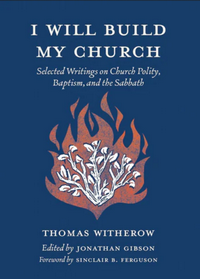
I Will Build My Church: Selected Writings on Church Polity, Baptism, and the Sabbath by Thomas Witherow, Edited by Jonathan Gibson: Presbyterianism 101

I Will Build My ChurchI Will Build My Church:
Selected Writings on
Church Polity, Baptism, and
the Sabbath

by Thomas Witherow, Edited by Jonathan Gibson

DETAILS:
Publisher: Westminster Seminary Press
Publication Date: January 29, 2022
Format: Hardcover
Length: 251 pg.
Read Date: July 2-16, 2023

What’s I Will Build My Church About?

Thomas Witherow was an Irish Presbyterian pastor in the mid-Nineteenth Century, who later became a professor. Over the course of his ministry–in part thanks to the revivals of the time–he saw more competition in Ireland to the Presbyterian Church from a variety of Protestant groups. He also saw that too many Presbyterian members or ministers couldn’t define or defend the distinctives–many seeing them as a tradition more than a conviction.

One of Witherow’s driving missions was to help the Presbyterians he taught amongst to see that their distinctives were serious and defensible. He also wanted to explain them to the other Protestants and possibly convince them to at least consider them.

This is a collection of three of his works along those lines–about ecclesiology, sacraments, and the Sabbath–slightly edited for modern standards. Long sentences turned in to multiple, spelling updates, and so on–and the Bible citations modified to be the ESV. That sort of thing.

A Prince of Irish Presbyterianism

Before we get into the works, the editor, Jonathan Gibson, provides an almost 80-page biography of Witherow–sketching his education, family life, pastoral work, writing, and professorial work.

I just picked this up to read Witherow, and hadn’t counted on learning anything about him and it was a great bonus for me to get more context for his work both in terms of his own life and the Church situation he found himself in.

The Apostolic Church

Odds are, if you know anything that Witherow wrote, it’s this short book (in this edition, it’s about seventy pages long). The subtitle to this is “Which is it? – An Inquiry at the Oracles of God as to Whether Any Existing Form of Church Government is of Divine Right.” Which is a pretty good summary of the work.

Witherow’s convinced that too many people (no matter their preferred ecclesiology) see it as a matter of convenience, taste, and traition. He cannot abide by that kind of thinking–convinced that if the Church cannot find Scriptural endorsement of a way of doing something, it ought to be abandonded.

Witherow starts this work by listing and explaining six principles he sees in the Apostolic Church then he looks at the three forms of church government–prelacy (whether in Roman Catholic or Anglican form), congregational, and presbyterian–to see which, if any, does the best job of embodying those principles.

Scriptural Baptism

This is a slightly shorter book on the subject of Baptism–tackling (in turn) the mode of baptism and the subjects of it.

He deals with the question of mode pretty quickly–first by Scriptural evidence and then moving to practical considerations.

Then he moves on to the issue of the subjects of baptism–from the outset, he’s careful not to let prominent Irish Baptists set the terms of the debate, instead he reframes the typical way these conversations went in his circles. Rather than starting with the positions of the baptists and then responding to them, he sets out a few points he wants baptists to answer–and then shows how (from his vantage point, anyway) they cannot.

The Sabbath

The book on the Lord’s Day/Sabbath is more pointed than the others. Witherow takes a pretty traditional path–defining moral and ceremonial law at the outset. Then he addresses Christ’s attitude toward and teaching about the Sabbath before getting into the abrogation of the ceremonial law and the practice of the New Testament church.

Then Witherow addresses a move to adjust the equivalent of the Blue Laws there to make Sunday a day for amusement (I’m a little vague on the details and it’d take to long to explain my guesses). Basically, where you could go pay for theaters and shopping and the like. Witherow follows his explanation for the Christian observance of the Lord’s Day with a warning about what will happen if the laws are changed–how it will negatively impact workers, businesses, and the economy–in addition to the church.

Say what you will about Blue Laws (and I have plenty to say in other contexts), Witherow was spot-on with his predictions.

So, what did I think about I Will Build My Church?

I spent a lot of time with The Apostolic Church almost twenty years ago–I used it and a paper by him to compare with some contemporary American ecclesiologies. I haven’t read it since for a variety of reasons (mostly overkill), but man, it was fun to come back to it.

I appreciate the footnotes Gibson added, but I’m not so sure that we needed the ESV update. I don’t know what it gained, outside of maybe making it more accessible for contemporary readers. But those who are going to need an ESV rather than the AV for translation are really going to be put off by Witherow’s insistence to call the baptists Anabaptists throughout the second book. He’s definitely not a 21st century writer🙂

I enjoyed all these books–and Gibson’s biography was a great bonus. The photographs of Witherow and his family were unexpected, too.

Sharp, concise writing, with a little bit of punch (but not quarrelsome). This is a great introduction/tutorial on Presbyterian Church distinctives. Highly recommended.


5 Stars

Saturday Miscellany—7/22/23

I come across as a little grumpy in my comments this morning–and maybe I am (probably a good thing that I’m not trying to write posts about books today). Don’t let my demeanor put you off, I enjoyed all of the things I linked to.

Odds ‘n ends about books and reading that caught my eye this week. You’ve probably seen some/most/all of them, but just in case:
bullet The Rise of Tech Worker Fiction: Novels about Big Tech’s working class are popping up like push notifications. What can they tell us about the labor movement and late-stage capitalism?—I’ve apparently missed all these “popping up” lately, that’s on me, I guess. But Copeland’s Microserfs told us this stuff in 1995, didn’t it? These new ones still look pretty good…
bullet After robbery, ‘Mrs. Plansky’s Revenge’ involves getting on a motorcycle and taking action—Didn’t read much of this, because I want to dive in with it fresh. Good to see Quinn getting some attention.
bullet Michael Connelly on His Path to the Top of the Crime Fiction World—the last thing that Connelly needs is more attention, but I’m always down for more from him.
bullet A Typical Day for a Protagonist in a Young Adult Fantasy Book—Yeah, it’s a little like picking low-hanging fruit, but Augusta Chapman’s piece made me grin.
bullet Step-by-Step Tutorial For Recovering from a Book Hangover—I’ve linked to a few Book Hangover Recovery posts over the years, this contains a few things most don’t.
bullet Can you guess these famous writers by their childhood nicknames?

A Book-ish Related Podcast episode (or two) you might want to give a listen to:
bullet The Thriller Zone Bruce Borgos, author of The Bitter Past—a fun chat with Borgos about his writing and this book. David Temple sounds every bit the fanboy as I would’ve in his shoes.
bullet Speaking of Mysteries Episode 251: S.A. Cosby—I was already champing at the bit to read his newest, but that’s gone into overdrive now. I’ve heard a few interviews with Cosby and each one makes me want to sit down and have a beer or two with him and talk fiction.

This Week’s New Releases that I’m Excited About and/or You’ll Probably See Here Soon:
bullet The Bitter Past by Bruce Borgos—Longmire meets The Americans in this great series debut about a Nevada Sheriff. I had few things to say about it recently (and several things I didn’t say because I didn’t want to ruin it for anyone).
bullet Mrs. Plansky’s Revenge by Spencer Quinn—A septuagenarian heads to Romania to get her money back from phone scammers. That premise and Quinn’s knack for writing has to make this a winner.

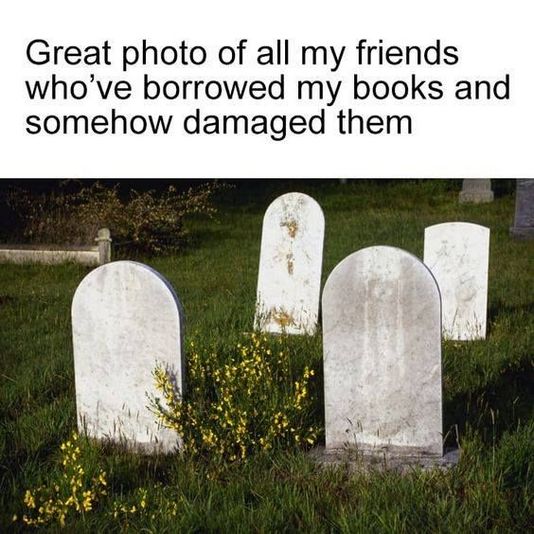
Caption says Great photo of all my friends who've borrowed my books and somehow damaged them over picture of gravestones

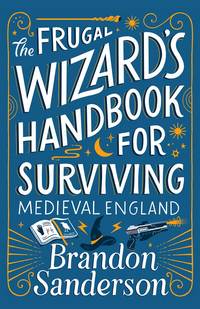
The Frugal Wizard’s Handbook for Surviving Medieval England by Brandon Sanderson: Is Plenty of Fun, but Not What It Should’ve Been

The Frugal Wizard's Handbook for Surviving Medieval EnglandThe Frugal Wizard’s Handbook for Surviving Medieval England

by Brandon Sanderson

DETAILS:
Publisher: Tor Books
Publication Date: June 27, 2023
Format: Hardcover
Length: 364 pg.
Read Date: July 17-19, 2023
Buy from Bookshop.org Support Indie Bookstores

What’s The Frugal Wizard’s Handbook for Surviving Medieval England About?

At some point in the future, scientists discover the ability to move between parallel dimensions, and even find a group of them capable of sustaining human life—and buy/license exclusive access to some of them with histories and developments similar to our own, but delayed somewhat, so that visitors from “our” world look advanced. And then you “sell” these universes to people who are looking for the ultimate getaway.

Sure, sometimes you temporarily lose your memory when you travel to your new dimension. So you need to write everything you need to know in a book that you carry with you. But if things get bumpy in your entry, that book might catch on fire, removing a lot of your information—so it takes a bit to recover your memory. Which is what happens to John West when he wakes up in a version of medieval England.

I know that Sanderson keeps saying that John West is inspired by Jason Bourne—but that suggests that he’s competent on multiple/several levels and that’s not John. He’s not even a Samantha Caine. He’s more like a Myfanwy Thomas. But for the sake of discussion, let’s go with Bourne okay?

Imagine Bourne wakes up in Terry Brooks’ Landover, and tries to pull off a Hank Morgan-con to convince the locals that he’s a wizard with great power. Throw in a little bit of Wizard in Rhyme‘s mixing of math/quantum physics into fantasy and a Douglas Adams-ish book-within-the-book (heavy on the “ish”) and you’ve got this book.

Oh, and mobsters from his time are wandering around, as is at least one undercover policeman. And they all know John West—and he’s not on anyone’s good side.

So, what did I think about The Frugal Wizard’s Handbook for Surviving Medieval England?

I recognize—and want to remind everyone—that this is a completely subjective thing, and if I’d read this two months ago or two months from now, I’d react differently. But…this was good. Not great. Certainly not bad. Good—but somehow underwhelming.

But I couldn’t shake the feeling the whole time that I should be enjoying it more than I was. I like the tone (although it felt like Sanderson was holding back and wouldn’t let this get as funny, snarky, or whatever as it should’ve been). I love the premise, the characters, the twists, etc., etc., etc. But…it felt restrained? Like he’s trying to assure everyone that no matter what he’s still Brandon Sanderson—he’s not going full-comedy (or whatever). I couldn’t help but wonder if he’d put this out under a pen name if he’d been able to let loose a bit more. If Scalzi, Cline, or Meyer had done this? Absolutely would’ve worked.

It’s been bugging me for days—I absolutely should’ve been raving about this, or at least enthusiastically talking about it. But I’m not. There’s utterly nothing I can point to that explains it, either. All the elements are there for the kind of book that I love, and they were combined to just become something that I liked. Explain that one, Gestalt.

I absolutely recommend this—and think that many readers will find it as enjoyable as I thought I should. And even if you walk away with the same whelmed-level as I did, you’ll have had a good time. But I’m not sure you should rush to it.


3 Stars

This post contains an affiliate link. If you purchase from it, I will get a small commission at no additional cost to you. As always, the opinions expressed are my own.

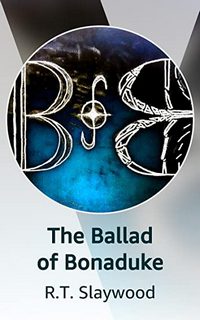
The Ballad of Bonaduke—Episode 29: All Talk by R. T. Slaywood: What a Small World

The Ballad of BonadukeThe Ballad of Bonaduke—
Episode Episode 29: All Talk

by R.T. Slaywood

DETAILS:
Series: The Ballad of Bonaduke, #29
Format: Kindle Vella Story
Read Date: July 20, 2023

Just once I would like to wake up on something warm and soft.

The Story So Far…

A drunken Michael Bonaduke decides to use a grift (with maybe some sort of magic/magic-like “help”) to win on a scratch-off lottery ticket so he has money to buy more to drink. He pulls off whatever he did, gets his money and some booze and stumbles off into the darkness to drink himself into oblivion so he can start again the next day. He’s hit by dark memories (probably what’s driving him to the drinking) of fire, pleading, and screaming. There’s going to be a price to pay for his grift, and he’s trying to be ready.

He’s abducted by some representatives of a mysterious group who subject him to a test—if he passes, everything will be explained to him (and hopefully the reader, too). He passes—and is brought somewhere for answers, or maybe training, or maybe another test. Time will tell (or things are going to get really annoying). Answers aren’t quick to come—but the mysteries and questions keep piling up.

Things get hairy and Bonaduke leaves and finds himself back in the neighborhood he started from. He takes refuge in a homeless encampment shortly before a police raid. He’s apprehended and finds himself an interrogation room and shortly escapes after using his grift (but with results he didn’t quite intend). He finds himself by a group of squatters who seem to have strapped a woman to a chair for reasons that can’t be good. He attempts to rescue her before he even realizes what he’s doing, and seems to have succeeded—well, the two of them got away from the group anyway—breathing but bruised.

What’s All Talk About?

Desperate for something to eat to help him keep going, Bonaduke walks up to a drive-thru restaurant and places an order. Now, unless things are different where Slaywood or Bonaduke reside, he shouldn’t get served there—but he does. Well, almost. The employee at the window is someone the reader and Bonaduke know. So things go downhill fast (that conjunction might not be the best to use, but who do we know that Bonaduke does where things would go well after running into them?).

Without intending to, Bonduke uses his grift. He and the (still) unconscious woman find themselves a place to wait in relative security while waiting for the next shoe to drop and/or he decides what his next move will be.

So, what did I think about All Talk?

It’s not all talk—but it largely was. It’s one of the more dialogue-heavy episodes thus far—maybe the heaviest. But Slaywood’s kept the forward momentum going—and that’s what’s important.

I can think of nothing I didn’t like about this episode, Bonaduke keeps trying to help this woman, and while not enjoying it, successfully pushes this kid around to do just that. And maybe because he enjoys it a bit.

I really don’t have anything else to say. Good job, and I’m eager to see what happens next.


4 Stars

The Friday 56 for 7/21/23: The Frugal Wizard’s Handbook for Surviving Medieval England by Brandon Sanderson

The Friday 56This is a weekly bloghop hosted by Freda’s Voice.

RULES:
The Friday 56 Grab a book, any book.
The Friday 56 Turn to Page 56 or 56% on your ereader. If you have to improvise, that is okay.
The Friday 56 Find a snippet, short and sweet.
The Friday 56 Post it.

from Page 56 of:
The Frugal Wizard's Handbook for Surviving Medieval England

The Frugal Wizard’s Handbook for Surviving Medieval England by Brandon Sanderson<

GUARANTEE ONE
Your dimension will have an island of Great Britain populated by a society of humans who work steel, but have not yet discovered gunpowder. They will have a functional society and culture that roughly equates to the Late Classical, Early Medieval, or Late Medieval (pre-gunpowder) Earth time period.

GUARANTEE TWO
The people of Great Britain will speak a language that is intelligible to modern English speakers. We chose our dimensional band specifically for this reason!

Reposting Just ‘Cuz: Classically Cool—Let’s Talk Classics!

I’m having one of those weeks, and was struggling to get something posted today. Then Witty & Sarcastic Book Club retweeted this old post, Classically Cool- Let’s Talk Classics!. Which reminded me of this one that I haven’t posted in a while. I’ve brushed it up a bit, but not much because again…one of those weeks.


Last week, Witty and Sarcastic Bookclub posted Classically Cool- Let’s Talk Classics!, and it got me a-thinkin’, what Classics would I mention as faves?

Dickens doesn’t do anything for me, ditto for the overwhelming amount of Shakespeare I’ve read, Hawthorne makes me angry, I don’t get Melville’s appeal (but I also kind of do…I just don’t want to put in the effort)…but by and large “The Classics” (aka the Canon) are Classics for a reason (not because some nameless, faceless group of (now-)Dead, White Males exercised hegemonic powers to impose their tastes, either).

Still, there are some favorites:

Starting with The Oresteia (for chronology’s sake), this is the only existing example we have of a Greek dramatic trilogy. This series showing the fall-out of the Trojan War for Agamemnon and his family/kingdom and is pretty impressive.

Call me silly, but Beowulf has always really worked for me. I don’t know how to rank the various translations, I’ve read a handful and don’t think I ever knew a single translator’s name. I’ve meant to try the Haney translation since it came out, but haven’t gotten to it yet—the same goes for Tolkein’s. From about the same time (a little later, I believe, but I’m not going to check because if I start researching this post, it’ll never get finished) is The Dream of the Rood, a handly evangelistic tool (one of the better-written ones) in Old English.

Moving ahead a couple of centuries (I’ll pick up the pace, don’t worry, the post won’t be that long) and we get Gawain and the Green Knight, which is fun, exciting and teaches a great lesson. Similarly, we have that poet’s Pearl, Patience, and Purity. I don’t remember much about the latter two, beyond that I liked them, but the Pearl—a tale of a father mourning a dead child and being comforted/challenged in a dream to devotion—is one of the more moving works I can remember ever reading.

Unlike the last couple of times I posted this, I’ve actually now read The History of Tom Jones, a Foundling by Henry Fielding, and narrated my way through the book over a year + (I broke it into small chunks and then posted about every chapter or two as I read through it to keep it after several aborted attempts since 1995). It’s funny and tense, (entirely too long), the satire and commentary (both straight on and obliquely) are fantastic. I really wish I’d read it 3 or 4 times by this point in my life.

I can’t remember the titles for most of the Robert Burns poems I’ve read—”A Red, Red Rose” and “To a Mouse, on Turning Her Up in Her Nest With the Plough, November, 1785” (one of the best titles in history) are the exceptions—but most of them were pretty good. And I’m not a poetry guy.

Skipping a few centuries and we get to Alexandre Dumas’ The Three Musketeers. If all you know is the story from movies, you’re in for a treat when you actually read this thing. I’ve read it a few times, and each time, I’m caught off-guard at how fast-moving it really is, how entertaining and exciting it can be. It’s not a classic by any stretch of the imagination, but I feel compelled at this point to mention that the book about Dumas’ father, The Black Count: Glory, Revolution, Betrayal, and the Real Count of Monte Cristo by Tom Reiss is a must-read for any fan of Dumas.

I don’t remember how Ivanhoe by Sir Walter Scott ended up on my bookshelf (I think whatever relative took me to the bookstore said I could get something silly and trashy (in their view) if I got a Classic, too). But a few years later, I finally got around to reading it at about the same time that another kid in my class (we were High School sophomores) was reading it—both of us talked about how it was pretty good, but too much work. Until we got to a point somewhere in the middle (he got there a day before I did, I think) and something clicked—maybe we’d read enough of it that we could really get what was going on, maybe Scott got into a different gear, I’m not sure—and it became just about the most satisfying thing I’d read up to that point in my life.

Jane Eyre by Charlotte Brontë is one of my favorite books, probably belonging in the Top 3. Go ahead and roll your eyes at the idea of me saying that about a romance novel, that just means you’ve misread the book. This tale about integrity, about staying true to what one holds dear, what one believes, and to what is right despite everything and everyone around you is exciting, inspiring, fantastically written, and so-memorable. And, yeah, there’s a nice love story to go along with that 🙂

Speaking of love stories, we now get to my favorite, Edmond Rostand’s Cyrano de Bergerac. I steadfastly refuse to learn anything about the actual figure, because I don’t want anything to ruin this for me. When I first read the play in junior high, I considered the best parts the lead-up to the duel in Act I, and Christian’s trying to pick a fight with Cyrano the next day. Now I know the best parts are Christian’s realization in Act IV and Cyrano’s reaction to it and then, of course, Cyrano’s death (I’m fighting the impulse to go read that now instead of finishing this post). And don’t get me started about how this play’s balcony scene leaves any other romantic balcony scene in the dust. Something I’ve noticed, though, as I age, is that I’m appreciating different Scenes and Acts than I used to .

I can’t pass up an opportunity to praise, The Adventures of Huckleberry Finn, Mark Twain’s tour de force. Satire, social commentary, general goofiness, and some real heart. This book has it all.

I’m not sure that Ambrose Bierce’s The Devil’s Dictionary is technically a “Classic.” But I’m counting it as one. It’s hilarious, it’s incisive, it’s a great time for those who like to subtly (and not-so-subtly) play with words. Yeah, it’s cynical—but it’s idealistic, too (as the best cynics are). If you haven’t sampled it yet, what’s wrong with you? I just bought a new, pretty-looking hardcover of it that I cannot wait to read.

I feel strange dubbing anything from the Twentieth Century as a Classic, so I won’t talk much about The Old Man and the Sea, The Great Gatsby, Winesburg, Ohio, or Our Town (the best way short of having a dog die to make me cry is get me to read/watch Act III). But I do feel safe mentioning To Kill a Mockingbird by Harper Lee, the ground-breaking, thought-shaping, moving, inspiring, and (frequently) just plain fun look at a childhood in the South.

When I started this, I figured I’d get 4-5 paragraphs out of the idea. I guess I overshot a little. Anyway, that’s what came to mind when I read W&S’ post—maybe other works would come to mind if I did this another time, but for now, those are my favorite Classics. What about you?

Page 4 of 8

Powered by WordPress & Theme by Anders Norén