Category: Blog Series Page 199 of 232

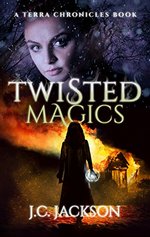
Twisted Magics by J.C. Jackson: A Great Spin on Contemporary Fantasy Kicks Off a Promising Series

Twisted MagicsTwisted Magics

by J.C. Jackson
Series: Terra Chronicles, #1

Paperback, 220 pg.
Shadow Phoenix Publishing LLC, 2016

Read: August 30 – 31, 2018


I had a brief conversation a couple of weeks ago with J.C. Jackson and she described the book as “Science Fantasy” and told us a little about the series. Something about fantasy characters but with modern technology, but phrased better. Not really getting what she said, I asked why not just call it Urban Fantasy, and she gave a decent answer — basically that she didn’t have enough vampires or werewolves in the books so readers told her she couldn’t. I was a chapter or two in to the book when I figured out what she was saying.

In your mainstream Urban Fantasy, you have fantasy creatures — wizards, druids, werewolves, fae — popping up in our world. On the other end of the spectrum (or an other end, anyway) you have things like the Eddie LaCrosse novels or the Dragon Precinct books that have modern ideas (police squads, private investigators) used in a fantasy series. Jackson takes a different tack — it’s a typical fantasy novel in that there’s a lot of magic, elves, halflings, Dark Elves, living next to humans — very standard kind of thing, but their technology matches ours (actually, it’s slightly more advanced). I loved this approach and there’s a good chance that I’d have had nice things to say about the book just because of this idea.

I do have more reasons to say nice things, though.

Ketayl is an Elven mage who works as a a CSI-like lab tech for the Terran Intelligence Organization (a FBI-like organization). Her strength is in finding ways to use devices to do forensic investigation of magical elements of particular crimes. She’s not the most socially adept of people, clearly more secure in her lab and with clearly drawn rules governing her interaction with others.

Then there’s an explosion in the Elven Territories, seemingly magical in origin — definitely devastating. The TIO director sends Ketayl, along with the rural tracker, Retanei; and Artemis, Retanei’s wolf companion to investigate. Along with the local TIO team — which does their best to bring these agents into their community — they dive into finding those responsible. It’s a kind of magic that doesn’t play by the rules that Ketayl is used to, and powerful enough to make her nervous.

While they look for what could have caused this destruction, we learn more about the world, the magic system and Ketayl. I still have a few questions about all of those and I think some of them should’ve been addressed in the first book — but I never felt lost in this world as I waited for the details to be given. This is a pretty decent thriller when you strip away the fantastic elements, or a pretty decent fantasy tale if you take out the criminal investigation elements. Keep them combined and the whole thing is stronger.

Eventually, the TIO hires a consultant from the Paladins — their kind of music is very different from Ketayl’s. The Paladins are also very prejudiced toward other magic users, and other species. Thankfully, the Paladin sent to help the team (Silver) is pretty open-minded and doesn’t get driven right into a religious conflict (which doesn’t preclude other kinds of conflict). Silver joining the team — primarily partnering with Ketayl — brings her out of her shell a bit.

Ketayl frequently reminded me of Tilly Bradshaw, the analyst from M. W. Craven’s The Puppet Show (one of those books that I somehow haven’t had time to blog about, but you should read, if only for the Ketayl-like character). She’s a complex character that I look forward to learning more about. The rest of the characters — with Silver pretty much being the exception — aren’t as developed as you might like, but you get enough of to satisfy just about every itch you might have.

There were a few too many typos for me, and the misspellings/unfortunate slips like homonym confusion. It wasn’t horrible, but it was bad enough to stick with me.

The novel does a good job of introducing us to the characters and world while telling a compelling story. Jackson’s particular spin on merging fantasy and a 10-minutes-into-the-future world is refreshingly original. I liked the characters, the world and everything — I’ve already gone out and purchased the sequel and am trying to find time on the schedule to get it read.

—–

3.5 Stars

✔ Read a book written by an author from the state where you grew up.

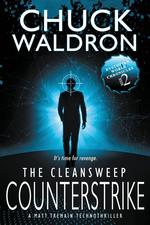
The Cleansweep Counterstrike by Chuck Waldron: An entertaining thriller follow-up that almost lives up to its predecessor.

The Cleansweep CounterstrikeThe Cleansweep Counterstrike

by Chuck Waldron
Series: Matt Tremain Technothriller, #2

eARC, 312 pg.
Bublish, 2018

Read: August 7, 2018


Let me preface all this by saying that I enjoyed The Cleansweep Counterstrike, I thought it was a fun return to the characters of the first book. I had some problems with it — that weren’t so bad that they kept me from enjoying this book, but they diminished my appreciation. I do talk about them below, and to adequately express them takes some space — so much so that it dominates my post. This isn’t because I didn’t like the book — it’s just that I wanted to be sure I explained my thinking. So I’m stressing at the outset — I recommend this book, I liked it and I think that other readers will, too.

Ahab had his whale, Coyote has his Road Runner and Charles Claussen has Matt Tremain (and the others that helped him out in The Cleansweep Conspiracy). Claussen lost a lot — not just in terms of influence of money, either — when Tremain’s investigations helped bring his Cleansweep project down. Now on the run from his former bank-rollers and trying to keep under the radar of law enforcement, Claussen risks everything to get his revenge.

Tremain and his friends have moved on in their lives and careers — but you get the impression that they haven’t stopped looking over their shoulder for something to come at them for their role in Cleansweeps failure — not just Claussen, either. He may have been the front man, but no one thinks that he’s the only one that might bear a grudge.

After he gets his revenge, Claussen does plan on trying to get some mercy from his benefactors — and maybe see if he can demonstrate that Cleansweep can work in another country. But first things first.

I am so glad that Waldron took this approach to things — I went in apprehensive that this would be Conspiracy Redux — somehow the people behind Claussen were trying it in a new city/country (or worse, they were trying again in Toronoto under a different name) and that Tremain and company had taken it upon themselves to head off to the new location to do the same thing they’d done at home. I just wasn’t ready for the tortured logic that would make it possible. Instead, it’s all about the fallout from Conspiracy — good and bad for all involved, and all parties trying to go on with their lives, obsessions, and whatnot. Everyone except Claussen, that is. He’s still stuck in the moment, making him the proverbial fly in the ointment for everyone.

Like in Conspiracy, there’s some issues with time — how much time went by before Claussen starts his efforts at revenge, how long before Tremain and Carling go hunting for Claussen, for example — there’s a couple other spoiler-y items that I’m confused on the timing about, too. Yes, Waldron gives plenty of clues about the time, but some of them are pretty vague and some of them come so late into the game that by the time he says anything about it, it’s too late and the reader is already a bit muddled on details. That could just be me, but I don’t think so. On the flip side, there’s some things in Tremain’s personal life that move so quickly (I think) that they’re hard to believe. The key there is to not fight it, not insist that everything’s crystal clear — and the book will sweep you up in the hunt and you’ll stop caring. And, when it comes to the things that are important — he doesn’t miss a step. It’s only in the setup, the subplots, the background, etc. that things get muddled.

Once Claussen starts to move in and really gets the four worried about what he’s up to and what might happen to them, the book comes together and all the little quibbles vanish. There’s danger afoot, hazards everywhere and they all will have to be ready to adapt to any strange circumstance if they’re going to get out of this alive and intact.

We spent plenty of time with Claussen in Conspiracy — and we get even more here. Early on, almost every line of dialogue, every thought of his that’s recorded is as diabolically evil as it could be — which made it so hard to swallow. But after a while, that goes away. And you can almost reach the point where you want to see Claussen escape a little longer so that when he does come for Tremain, the whole thing will be a tinge more exciting.

My main problem with this novel is that we don’t get nearly enough time with Tremain and his allies — so much of that part of the story feels rushed and under-cooked. I’d like more time with Carling, Remy and Susan. Yes, Tremain is the focus — and should be — but we get almost nothing about the other three when they’re not playing backup to Tremain. Carling is the most neglected (which I don’t think will be a problem in the next book), keeping him the one I want to learn most about — Tremain’s Russian hacker benefactor would be a close second.

Angela Vaughn, Claussen’s former security chief, was one of the highlights of Conspiracy for me — and she has a great moment or two here. But sadly, just a moment or two. I’m glad that Waldron brought her back for this book, I just wish he’d done more with her.

The criminals and mercenaries that Claussen surrounds himself with and/or is surrounded with (it’s a fine, but important, distinction you can learn about yourself) aren’t as compelling. Those that are competent vacillate between almost too capable to believe and have they ever done anything more complicated than hold up a liquor store?

Conspiracy felt plausible, maybe some of it was a stretch, but it still struck me as something not too far-fetched, and the stakes felt real. On the whole, Counterstrike is probably closer to plausible, but the stakes didn’t — maybe because it felt so unlikely that someone like Claussen could be so focused on his revenge — so short-sighted about the dangers inherent in pursuing it (from the government, his backers, other enemies he’s made). But it’s that Ahab-like focus that drives the novel, so you have to accept it. Once you do — the rest is easy to buy into.

Once again, this novel is close to be a great thriller, but it misses by an inch or two on many fronts — some are minor quibbles, some are more than that — but you get enough of those and it’s hard to be enthusiastic about the book as you could’ve been. Maybe I’m wrong, but it feels like this is a draft or two away from being at that point (would a Toronto police detective call the FBI “the Feds”?). For every thing that I grumbled about above (or put in my notes and didn’t bring up because I was starting to feel like I was being negative), Waldron nails 3-4 other things. The story is there, I simply don’t think that Waldron told it as effectively as he could’ve.

I don’t want this post to come across as negative, I’m just underwhelmed. I enjoyed it — I don’t think it’s as good as Conspiracy, but it’s a worthwhile continuation, and should make the reader keen to get their hands on Book 3. Given where Waldron leaves things, it has the makings of a pretty strong installment.

Disclaimer: This book was provided to me by the author in exchange for my honest thoughts.

—–

3 Stars

A Few More Quick Questions With…Chuck Waldron

Here’s Part 2 of the Book Tour stop for The Cleansweep Counterstrike — a follow-up to the Q & A from last time.

Could you tell us a little about your “path to publication”? What got you into writing and what did you do to take it from an aspiration to a reality?
It started innocently enough when I joined a class on writing short stories. Years of professional writing was transformed into story-telling. Fifty-five short stories later I went back to my first short story, wondering if I could turn it into a novel. Now, working on novel number six, the journey continues. I’m a proud indie author and haven’t looked back.
Back when we talked about The CleanSweep Conspiracy, you said, “I like Matt Tremain, the protagonist in The CleanSweep Conspiracy. He just might hang around for another story.” Of all the various things you could’ve done with Matt — what was it about the premise for Counterstrike that made you say, “That’s the one”?
Matt’s story wasn’t finished. He still had his evil nemesis lurking, waiting to do Matt harm. I decided to follow Charles Claussen after his escape and weave his story of revenge with Matt’s desire to be left in peace. Matt, realizing that “peace” wasn’t going to happen as long as Claussen was in the picture, had to act. That’s when I knew, “that’s the one.”
thing they did in the prior book, or conversely, something they said in a “throwaway line” in the first b
For me, it was trying to walk a tightrope. How could I create a stand-alone book in the sequel and yet have it be part of a continuing story? I already knew my main characters and how they acted, but how to keep their voices fresh. Stieg Larsson did it brilliantly in his series, setting a high standard.
We seemed to spend plenty of time with Charles Claussen in this volume (not that we didn’t in the preceding one), seeing things from his point of view — what’s the hardest part of writing him?
For me, creating villains has always meant digging into some dark corners of my imagination. In just about every way Claussen represents my polar opposite. I chose to create a composite of evil people I know. The hardest part writing him was to give his character something likable.
I’ve often heard that writers (or artists in general) will forget hundreds of positive reviews but always remember the negative — what’s the worst thing that someone’s said about one of your books, and has it altered your approach to future books?
I wrote a quirky fantasy Remington and the Mysterious Fedora. From all the words, a reader chose a paragraph that had some mild sexual context. She said, “I can’t believe this book. It’s not about a hat or a typewriter. It’s about sex.” It’s my only one-star review. I don’t see that as a demand bid to change my writing.
Is there a book 3 in the works, or is this the end of the road (at least for those that survive)?
This hint is the sample chapter of book three at the end of The Cleansweep Counterstrike. There’s still enough conspiracy theories to go around.
Thanks for your time, and I hope The Cleansweep Counterstrike is met with plenty of success!
Thanks for having me, and your good wishes.

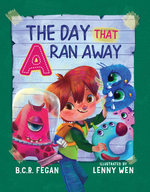
The Day That A Ran Away by B.C.R. Fegan, Lenny Wen: The Best Reasons (Excuses?) Schoolwork wasn’t Done that I’ve Ever Read

The Day That A Ran AwayThe Day That A Ran Away

by B.C.R. Fegan, Lenny Wen (Illustrator)

Kindle Edition, 32 pg.
TaleBlade Press, 2018
Read: July 9, 2018

Things are going bad for poor Jet — his teacher has noticed that he hasn’t finished his assignment of writing out the Alphabet. So he explains to Mrs. May that he did, in fact, do it, but . . . well, did you read the title? A ran away.

From there, Jet goes on to explain why each letter isn’t on his paper. D was scared, I just didn’t want to, something nefarious might have gone on with L, and so on. Each letter gets its own page with a fantastic picture personification and a line or two describing (in rhyme) why that letter didn’t make it onto the work.

Wen’s art is never not delightful, but I really enjoyed this one and have flipped through it a couple of times just to look at the drawings — I love the T and O characters in particular. I’m not sure I can describe it, it might take away from the value if I could — but T’s teeth are about the best bit of art I’ve seen this month. The details he fills the pages with are wonderful, eye-catching and will entertain adults as much as kids.

I’m a little surprised that I’ve become, at this stage in my life (my kids are teenagers or older) to become a fan of picture book creators — but these two have turned me into one. This book demonstrates why. Typical of Fegan and Wen, The Day A Ran Away this is imaginative, fun, and well-written. I cannot imagine a child of picture book age (and maybe a little older) not being entranced by the art, there’s plenty going on for parents/others to point out, and a story that’s fun enough to read that someone wouldn’t mind repeating a few dozen times — which is more important than non-parents can realize.

Disclaimer: I received a copy of this book from the publisher in exchange for my honest opinions about this book.

—–

4 Stars

Finding Felix by Jo Platt: A Charming Rom Com that brought a smile to my face

Finding FelixFinding Felix

by Jo Platt

Kindle Edition, 258 pg.
Canelo, 2018
Read: August 28 – 29, 2018

‘Head buried in the sand,’ she said. ‘Typical Dot.’

I frowned but didn’t feel able to challenge the statement. I knew she had a point. My tendency to refuse to confront personal challenges and consider their consequences until my nose was pressed up against them was undeniable. In my defence, it was an approach that on the whole seemed to work reasonably well. It cut down considerably on the amount of time spent worrying and stressing about things, and, nine times out of ten, a last-minute fix was just as good as a lengthy, considered and, in my opinion, tortured approach.

However, like it or not, I had to admit that this was not one of those times. This was definitely the one in ten.

This is all thanks to Ian Patrick — if he hadn’t tweeted about this book on Saturday, I wouldn’t have heard about — much less read — Jo Platt’s book (or Jo Platt, come to think of it). The term “romcom” just didn’t seem like the kind of thing I should see coming from him. So I clicked the link, read about the blurb and decided to give it a whirl. There seemed very little chance that anyone would find a dead body, kill anyone or have to defend their lives — which seemed like a good change of pace.

I’m glad I took the shot on this — as you can see from the above, Dot Riley doesn’t think things through too often. And it probably seemed like a good idea to assure her dying grandmother (Nanny Flo) that, no, she’s not single; there’s no reason to worry about her at this time — in fact, she’s dating that old friend from childhood that the whole family loved so much. But faster than you can say Norah Ephron, Nanny Flo makes a miraculous recovery — and she credits the news about Felix for saving her life. Before she realizes it, months have slipped away and it’s time for Dot’s sister’s wedding. Which, naturally, her boyfriend will be attending with her.

Dot has a couple of choices here: come up with a lame excuse for Felix’s absence; telling her family the truth, which let’s be honest, would possibly kill Nanny Flo; or . . . she could track down the man she hasn’t seen since they left for university and get him to go along with the story. Because of the genre, it’s easy to guess which she’ll go for.

She tracks him down and he agrees to go to the wedding with her. You halfway expect them to hit it off immediately, or at least think about it — but Felix doesn’t seem that interested in anything about Dot as a person; and Dot is so thrown by the ridiculousness of her request and how Felix changed (as people do) in the decade or so since she’s seen him that she isn’t really that capable of getting past any of that.

You can pretty much plot out the rest of the book for yourself — but that doesn’t mean that Platt doesn’t have a curveball or two to throw at the reader. And even the parts you do see coming are handled with such aplomb, wit and charm that you’re not sitting there rolling your eyes and saying “yeah, knew that was going to happen.” Rather, you grin and admire how she did it.

The key, obviously, to all this are the characters, in particular, Dot. Platt gives us a great group of characters — whether around for a few paragraphs or for the entire book. Dot’s a mess of a character. But in a good way — she’s tardy, she’s impulsive, she’s frequently unintentionally thoughtless, and she has an uncanny ability to ruin any encouragement she tries to give anyone by poor word choice. But she’s got a big heart and great taste in friends. Thankfully, she’s got a good sister and an equally good best friend/business partner who can keep her from mucking everything up too badly.

Felix is . . . Felix is a good character, too. I don’t think I can say much more without spoiling some of the work Platt did in revealing him. So we’ll move on to . . . Dot’s mother? She tries really, really, really hard not to meddle in her daughter’s lives. Well, she thinks she does, anyway. She loves them, and wants the best for them — and will do everything she can to make sure that her daughter’s do what they need to do get their lives to work out for the best (whether or not that’s what her daughters actually want).

Dot’s father is a hidden gem — possibly the most valuable player here. He’s funny, he’s put-upon, he’s the voice of reason (and humor) working to prevent her mother’s emotional excesses from steamrolling their daughters and their daughter’s significant others.

The relationships that Dot has with her sister and partner — and their husbands — are just great. I’d have easily enjoyed another 80-100 pages of filler conversations between any of them and Dot just to enjoy their interactions. They are cozy, fun, and honest in the way you only can be with those closest to you.

This was silly, it was earnest, it was sweet, it was fun — I laughed out loud a couple of times, and even when I didn’t do that, I appreciated the humor. If you’re willing to buy into the conceit and genre (and I know some of you who wouldn’t be), I can assure you — you’ll have a good time.

Oh, yeah, and there are no killings, attempted killings or lesser crimes committed at all. It’s good to remember that you don’t need any of that to get a good story.

—–

3.5 Stars

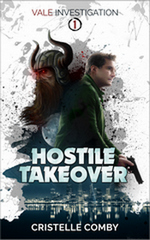
Hostile Takeover by Cristelle Comby: Death’s PI is on the Case in this Strong and Original UF Debut

Hostile TakeoverHostile Takeover

by Cristelle Comby
Series: Vale Investigation, #1

Kindle Edition, 355 pg.
2018
Read: August 23 – 24, 2018

On the one hand, I’m annoyed that something about Bellamy Vale, our P. I. protagonist, is revealed in the book blurb for Hostile Takeover. On the other hand, I don’t know how I could’ve written much without slipping myself (but I appreciated the reveal when I got to it, having forgotten everything I read about the book before starting it). Bell works for Lady McDeath, the daughter of Hades. We’re not given many details of the arrangement (which I honestly enjoy — something I’ll get back to in a minute), but it involves her saying “Jump” and him leaping.

Being her emissary on Earth comes with some real benefits — namely, he survives things, events, situations that he shouldn’t. Which is a real plus for a P. I. who annoys mobsters and supernatural beings on a regular basis.

In this particular case, Lady McDeath wants Bell to investigate a couple of deaths that have been officially attributed to a wolf, but it takes Bell a few seconds to realize weren’t caused by anything from this world. The detective in charge of the investigation (naturally) isn’t wild about P. I.s in general, but has a special kind of distaste for Bell. This makes anything Bell does near the scenes, bodies, or anything else a sticky situation. Stickier yet, things that could do what was done to those bodies aren’t supposed to be in our world. While dying is off the table for Bell, he’s not impervious to pain or injury, and the state of those bodies suggests that there’s a lot of pain and injury waiting for anyone who gets between the creature and his/her/its next victim.

To help him along the way, Bell calls upon a hacker friend, Zian, who is not entirely human; a nosy, ambitious, and fierce reporter; a police detective that he’s in an on-again/off-again relationship with (currently, it’s an off); and a few other local contacts/friends who are aware that not everything is as mundane as most people think it is. Overall, this was an entertaining cast of characters — I think we need a little more to the police detective that can’t stand Bell, because right now, he’s too one-dimensional. But otherwise, this is a good group to start a series with, there’s not one of them I don’t want to see again.

Bell himself is pretty much your typical P. I. character — a loner with a tragic past, dedicated to the work he does, willing to take risks for himself (particularly since he knows no mistake is fatal) — but not willing to put others in the line of fire, he has a hero complex for sure. He’s got a decent sense of humor, a good moral code, and a loyal strike obvious to everyone. The added abilities that come from his supernatural patron are pretty neat and I don’t think I’ve seen much like it before.

You can tell that Comby has worked out a lot of behind the scenes stuff she hasn’t shared with us — exactly what drove Bell to make a deal with Lady McDeath (we get hints, and they aren’t pleasant), what he had to do in order to seal the deal, exactly what deities are active in the world (or what pantheons are), what’s the source of the rules governing interaction between the worlds, etc. Comby had to feel a lot of pressure to spill those beans and she resisted — giving us just enough to ground ourselves in this world, but not boring the reader by drowning him in world-building (also giving her time and room to work out some details to make later books easier to pull off). Recently, I’ve complained about fantasy novels withholding too much world-building so that it’s too confusing for the reader to understand what they’re reading. Comby avoided both extremes and therefore succeeded in giving us a world that intrigues, and makes you want to know more about, without feeling utterly stranded.

I had a quibble or two with the book, nothing major. I do think that the motivation for the Big Bad was too sketchy, and the reveal of their identity was tipped far too soon. Bell was just handed a lot of information without having to pound the pavement too much, which isn’t something that really commends a P. I. to me. But only guessing the identity of the Big Bad far too early bugged me while I was reading it — it’s only when I stopped to reflect on the book as a whole that the rest occurred to me. In the moment, the momentum of the storytelling and the strong voice kept me going. Also, I liked the characters enough that I was (and am) more than willing to overlook a few hiccups.

This is a solidly built and solidly entertaining entry to this series — there’s a lot she can do with Bell and the others (depending which others come along), and it’s a world that would be easy to drop new/different deities/monsters/creatures into. The characters are well-developed and the kind that you want to spend more time with so you can see them develop more — I could just watch Zian (and his dad) talk to Bell for a bit and have a good ol’ time, too. I’m definitely interested in more from this series, and I bet most UF readers who give this a chance will be waiting for book two with me.

Disclaimer: I received a copy of this novel in exchange for my honest opinion, the only impact that transaction had on my opinion was providing me something upon which to opine.

—–

3.5 Stars

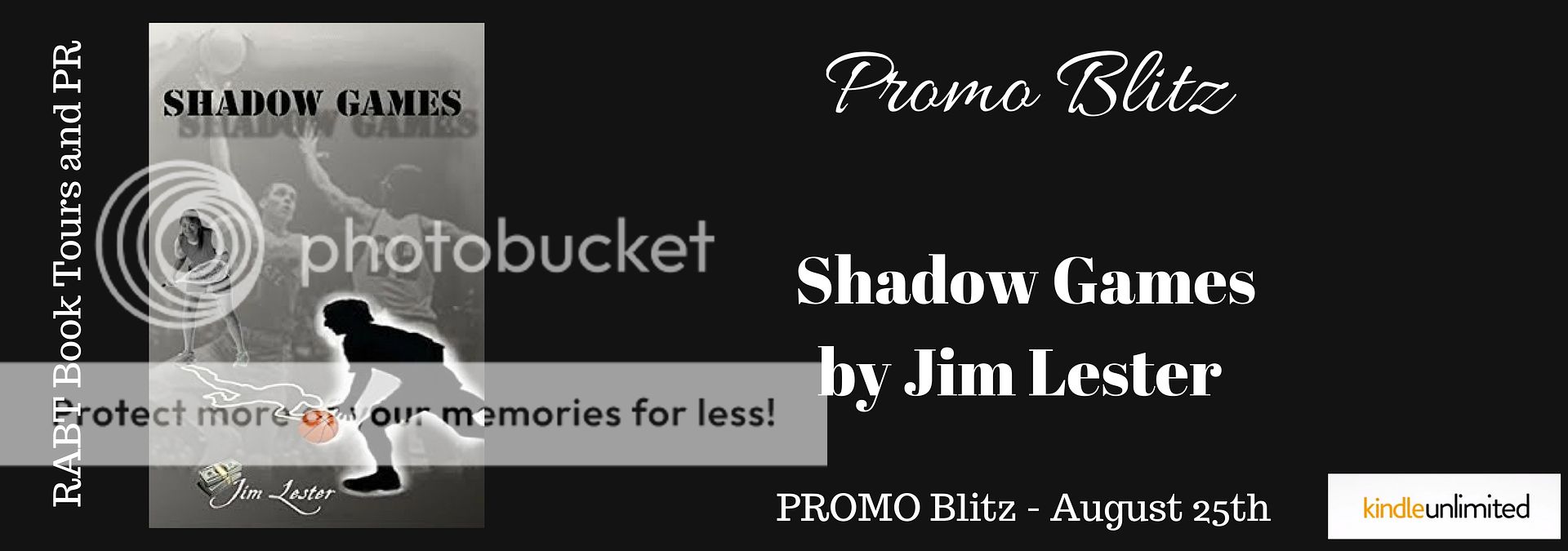
BOOK BLITZ: Shadow Games by Jim Lester

 photo Shadow Games_zpsutlxortm.jpg

Coming of Age
Date Published: June 2018
 photo add-to-goodreads-button_zpsc7b3c634.png
Danny McCall loves basketball more than anything in the world. So why would he risk his basketball scholarship, the love of his life and his entire future to fix the point spread in a series of college basketball games?
Set in the early 1990s, Shadow Games is an exciting page-turner, filled with fast-paced hoops action. A topical novel for readers of all ages, the book is a powerful portrayal of the loss of youthful innocence.


About the Author

 photo Shadow Games Author Jim Lester_zps3ykf5nop.jpeg

Jim Lester is the author of three successful young adult novels: Fallout, The Great Pretender and Till the Rivers All Run Dry. He has a Ph.d in history and is the author of a non-fiction book entitled Hoop Crazy: College Basketball in the 1950s.
Contact Links
Purchase Link


RABT Book Tours & PR

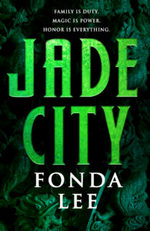
Jade City by Fonda Lee: Immerse yourself in this world of Magic, Crime and Family

Jade CityJade City

by Fonda Lee
Series: The Green Bone Saga, #1

ARC, 444 pg.
Orbit, 2017

Read: August 15 – 16, 2018

So Fonda Lee has a great idea — others have employed it as well, don’t get me wrong, but the way she does it is great — instead of setting an Urban Fantasy in this world, just a version of it with some magic; you set it in a world a whole lot like this one — but you infuse the world with some sort of magic. A world where technology/science and magic co-exist. It’s enough like this world that you can get your hands around cultural mores and norms.

There’s this stone, a mineral, called jade. It looks a lot like our jade (from what I can tell, Hank Schrader, I’m not). Certain people are sensitive to it, and it enables them to channel magic, some become addicted to the mineral and what it does to them — others (“stone eyes”) are completely insensitive to it and are therefore the ideal candidates to shape it, transport it, and mine it. Only people from Kekon have this relationship with jade (not that unexpectedly, they’re also the world’s source for it).

There are other countries that want jade and what it can do to a person — military uses, primarily. But their people aren’t natively sensitive, so they’re working on ways to engineer the sensitivity. There’s a lot of money to be made controlling the Jade. Years ago — a generation or so — a group of “Green Bone” warriors drove foreign powers from Kekon and assumed control of the Jade trade. Working with the legitimate government, these Green Bones rule Kekon.

They are, for all intents and purposes, a criminal organization — or would’ve been were it not for a divergence of vision — they’re now two rival criminal organizations — with their own rules, laws, rituals, educational systems and cultures. There’s a Cold War between them — a perilous truce, with the citizens of Kekon stuck in the middle (paying tribute, currying favor, and occasionally serving as cannon fodder).

But then something shifts the balance of power — plans that have been brewing for years start to come to fruition and conflict erupts.

We focus on the Kaul family, their soldiers, their leadership, their friends and fortunes. There’s the aged warrior struggling with the weight of glory and past success in the face of the end of their life, there’s the new generation of leadership, trying to live up to the glories of the past and finding it more difficult than they expected. Some have tried to forge new paths in a new world, others are trying to recreate the past.

This is one of those that I can’t think how to describe without ruining everything — so that’s about as much as I’m going to say. The back cover blurb describes this as “The Godfather with Magic.” It’s easy to see why. It’s also incredibly easy to start casting various characters ___ is Michael (clearly), ___ is Tom, and if ____ isn’t Sonny, I’ll eat my hat. I do have real answers for those blanks, but I thought I’d better not give everything away. It is more than just The Godfather with Magic — but you can’t get away from that (unless you’re not that familiar with that particular work — and then you’re not missing a thing).

There’s magic, there’s a mob story, there’s family, love, loyalty . . . you name it, this book has it. Better yet, at the helm of this world you have Fonda Lee who does a great job building this world and populating it with people that the reader can relate to.

This is a rich world full of intrigue, danger, family and magic. It’s a fantastic piece of worldbuilding and you can tell that Lee has great plans in store for these characters, and I can tell that they have no clue what’s coming — and frankly, the readers have less of a clue. I’m looking forward to seeing just what it is.

Note that’s close to a disclaimer, yeah, I said ARC for a book that was published last year. How’d I manage that? Time travel? Well, no. I won the ARC at Indie Bookstore Day (or something like that). So, there be a couple of changes between what I read and the final product, but probably nothing major.

—–

3 Stars

The Drifter by Nicholas Petrie: A Near-Perfect Thriller Debut that You Won’t Want to Miss

The DrifterThe Drifter

by Nicholas Petrie
Series: Peter Ash, #1

Trade Paperback, 371 pg.
G. P. Putnam’s Sons, 2015

Read: August 16 – 17, 2018

Peter pushed the truck hard toward downtown, the city roads rough with potholes, trying to get to Lake Capital begot they closed the doors for the day.

One eye on the rearview, watching for the black Ford. But it would be easy to miss in heavy traffic. And Peter’s truck would be easy to follow. Unless he was willing to rent a beige sedan, he couldn’t do anything about it.

He didn’t have a plan for Lake Capital. But the principle wasn’t complicated. It was the same principle he’d operated under for years.

Poke a stick into something and see what happened.

This approach to problem solving isn’t new — Philip Marlowe employed it, Spenser loves it, Harry Dresden has invoked it — and I’m pretty sure a certain homeless former MP has mentioned it a time or two. It may be tried and true — but that’s only because it works really well (at least in fiction). Peter Ash is one of the leading candidates for “the next Jack Reacher,” so he might as well employ it, too. It’s a very effective stick in this instance, I should add.

Now Reacher, as you probably know, was a career Army MP, the son of a career Marine officer — he’d spent his entire life living on military bases until his discharge following the Army’s downsizing after the fall of the Berlin Wall. In reaction to that kind of living, he’s taken to walking all over the US, getting to know the country. Peter Ash is a recently discharged Marine Lieutenant, with a couple of degrees in economics, who is wandering around the country a little bit. His reason for it differs from Reacher’s, since coming back to the States after tours in Iraq and Afghanistan, Peter has panic attacks anytime he’s indoors — he calls it “white static.”

This has led to him essentially living in the woods for the past few months, until he heard that his former sergeant and friend, Jimmy Johnson, has killed himself. Peter quickly came to Milwaukee to visit Jimmy’s wife, Dinah. He wasn’t around to help his friend, but maybe he can assuage his guilt by helping out with some much needed home repairs on his behalf.

He starts with the front porch — and while he’s working on it, discovers a hidden suitcase filled with money, and four bricks of plastic explosive. This seems strange, Peter hides the bricks, and gives the money to Dinah. Around the same time, a mysterious figure comes by looking for something (probably the suitcase, but he never mentions is). The two of these together gets Peter’s curiosity piqued — and he sets out to find out what his friend was up to before he died. He barely beings this before someone tries to kill him.

Peter survives, and becomes even more certain that something is going on — Jimmy was on to something just before he died. Peter has to find out what — to honor Jimmy’s memory, protect Dinah and her two sons, and maybe get a little peace for himself — maybe find some forgiveness for failing to help Jimmy.

This isn’t just guy wanders into town, finds trouble and starts hitting/shooting things and people until the problem is solved. Peter has to think, he has to investigate, he takes wrong paths, he really needs to find a shower and a way to clean a very large dog — which isn’t saying anything about the investigation, it’s just another thing he has to do along the way (still, harder problems than you might expect when you throw in his white static). There’s plenty of hitting and shooting, but it’s not the focus.

Yes, Peter is very much in the Reacher mold — but he’s different in very significant ways. The ways in which he’s not Reacher make him a fascinating character on his own. He has a sense of humor, he’s lonely, he’s a bit more self-reflective — he knows that he didn’t come back from the wars whole and intact, and is seeking to fix that. Maybe. He’s got a different kind of education, and a different way of looking at the world. The ways he’s similar to Reacher (good with weapons, devastating to hand-to-hand combat opponents, fast thinking, strategic, etc.) simply ensure that he’s fun to read about. Both of these sides together give us a Thriller protagonist that’s a sheer pleasure to read.

So Peter has “White Static”, Jimmy clearly had problems adjusting to being back home, but they’re not treated as the only ones — there are many others seen and talked about in this book. It’s not done exploitatively, it’s done to highlight the problems and the many, various ways they can be addressed successfully. Nor are they talked about in a way that suggests everyone who comes back from combat service comes back damaged. Nothing is universalized or generalized. I’m certainly not speaking from any kind of first, or even second-hand, experience here — but it appears to me that Petrie dealt with these psyches in just the right way — compassionate, understanding, and accepting.

As there is an element of mystery to the story, I’m not going to talk about the villains much. But they are just as good as the rest of the book — wide-ranging motivations, differing levels of commitment to the enterprise, they’re not all cookie-cutter types. They are not cartoonish, they are not super-villains. They are straight-from-the-headlines evil though. I could absolutely see something like this happening and it working.

I could have spent more time with just about every other supporting character — not in a “hey, you could’ve developed them better” way, but in a “I liked them and enjoyed Peter’s interactions with them” kind of way. Sure, that would’ve involved more character development, but not because they were lacking anything, it just would have worked out that way. Dinah’s an ER nurse with a lot of grit, and isn’t sure what to think of her late husband — but is dedicated to being the best mom she can to their kids. Charlie, their oldest, has learned a lot from his dad and is trying his pre-teen best to live like he should and be “the man of the house.” There’s a woman from the Veteran’s group that tried to help Jimmy who is a wonderful character, too. I could say more about her and the other supporting characters, but you should meet them yourself.

The last advantage that this one has over any of the Jack Reacher novels — and frankly, most Thrillers, is Mingus. He’s a very large dog that Ash finds living under the porch at his friend’s house (that porch led to the discovery of a lot) — he’s a bigger, nastier version of Walt Longmire’s Dog. Just as friendly, too — toward people not being threatening, anyway.

Okay, I obviously found this fantastic. The tension was high throughout; the pacing was fantastic; the actions scenes were fast, furious and believable; the story was clever and yet sensitive to current events, and the people represented by the characters; the stakes were real and believable; Peter’s code and the code(s) of those around him are wonderful to think about, examine and possibly try to adopt. They don’t get much closer to perfect than this — I’m definitely picking up the next two in the series as soon as I can, and I can’t wait to talk about them without nearly so many references to Jack Whatshisname.

—–

4 1/2 Stars

Anaconda Vice by James Stansfield: A Fast, Fun Thriller

Anaconda ViceAnaconda Vice

by James Stansfield
Kindle Edition, 245 pg.
Manatee Books Ltd, 2018
Read: August 3 – 4, 2016
Retired professional wrestler (of no great fame, but some notoriety), Lucas Winter, runs out of gas on his way back from a personal appearance and finds himself in a very small, very insular town. He gets taken advantage of by a local gas station owner/mechanic, leaving him stranded for a day in a town that seems untouched by the outside world (or maybe that’s just because Winter can’t get even get one bar on his cell phone).

One apparently common problem for a professional wrestler, are small town tough guys wanting to pick a fight with you — to prove that you’re not that tough, or that they really are. Winter finds himself on the business end of one of those altercations, and defends himself well. So well, that he’s kicked out of the only dining establishment in town — even before he can finish his breakfast.

It’s not long before the entire Sheriff’s Department (all 3 deputies and the Sheriff himself) come to take Winter into custody. The man he fought with is dead, and there aren’t a whole lot of suspects.Winter finds himself embroiled in small town politics, a frame job that’s both sloppy and seemingly inescapable — in between the Scylla of impotent cops and the Charybdis a powerful and rich family. He needs to rely on his wits, his charm and a whole lotta luck to clear his name and maybe, just maybe, get out of Anaconda alive.

I wasn’t that crazy about many of the characters — well, actually, just the various family members of the dead man, at least one of them could’ve used a little more depth. The various other townspeople were great, both the people who were around for a page or two or the Law Enforcement types who were with Winter throughout the book.

Lucas Winter himself was a fun protagonist, he’s just funny enough to entertain without turning this into a comedy, and human enough to keep this from being a Jack Reacher clone.

This is a very familiar story, really. But Stansfield puts a couple of very interesting twists on it — I won’t tell you most of them, because that’d spoil the fun. One that I’ve already mentioned is our protagonist’s former life — a middling former Pro Wrestler? That right there is a stroke of genius. He can take some physical punishment — but not a Herculean amount. He can dish out the physical punishment — but not in a Jack Reacher/Evan Smoak way. He’s tenacious, he’s tough, and best of all, he’s desperate.

One teeny-tiny little gripe — if you’re going to write about an American in the middle of the US, don’t talk about kilometers out of town. Manatee Books is a British publisher, so we Yanks can forgive a “tyre” or two, or using “mobile” instead of “cell” — put come on, get lose the kilometers, please.

The book doesn’t hold a lot of surprises — but the ones that it does hold? Wow — I’m pretty sure I yelled at one point. The rest is told by someone very assured and quite skilled at his craft. I’ve said it before, I’ll say it again: A familiar tune sung well is just as entertaining to listen to as a new song — same applies to stories. You tell me a story like one I’ve heard before in a way that I an appreciate, I’ll still like it today as much as I did the first time.

A thriller that’ll press all the right buttons, will throw a shock or two at you, and keep you riveted throughout it’s very fast pace — sounds like a pretty good read to me. Check Stansfield and Anaconda Vice out.

—–

3 Stars

Page 199 of 232

Powered by WordPress & Theme by Anders Norén