Category: Mystery/Detective Fiction/Crime Fiction/Thriller Page 99 of 153

Book Blitz: A Time to Burnish by Radhika Nathan​

~ Book Blitz ~
A Time to Burnish by Radhika Nathan
About the Book:

“Not too long before we can get as many of them 3-D printed.”

That pretty much sums up Josh Winslow’s feelings about classic artifacts. As a man of science and technology, he couldn’t care less about old bronze idols. Unfortunately, his brother Tom has just made one such idol his problem.

Vidya Thyagarajan, a young banker from Chennai, didn’t expect to chase the origins of old idols either. But her friend Tom has just entangled her in one such chase.

Along with Vidya, Josh reluctantly embarks on a journey to India to track the origins of a Chola bronze idol. Through the urban maze of Chennai, dusty roads of small towns in deep Chola territory, they discover clues that confounds them every step of the way.

During a short span of a week, the quest quickly becomes personal as the shadow of the past challenges their outlook toward life and love.

Book Links:
Goodreads * Amazon

Read an Excerpt:

“What is my area of expertise, Josh?”
Recognizing the question for what it was—an opener—Josh bit back a groan. Tom reminded him of an old modem in a slow network; the connection light had to get steady before the data light started blinking in a measured pace.
He replied, “You know I can answer that question in my sleep! Growing up, it was all that residue hippie stuff, all that ghastly sitar music, thanks to Mom and Dad. Then you had to go pick India as your area of interest.”
There was no answering smile on Tom’s face, just an abrupt headshake of a refusal to rise to the bait.
“What specifically in India?”
“South India.”
“Your brilliant grasp of the specifics never ceases to amaze me,” Tom said with the same maddened note that crept into his voice when dealing with Josh’s indifference toward his profession.
He poured out the warm saké from the flask and took a delicate sip from the cup.
“For the zillionth time, my area of specialization is the Chola Empire, covering roughly the ninth to the thirteenth century.”
“I know,” acknowledged Josh, sensing this was not the time to say “whatever.” He made an effort instead. “The rise and fall of the Cholas, with special focus on that dude who was a great warrior and visionary—Maharajah Chola.”
“You mean Rajaraja Chola.”
“Yes, of course, what was that paper you wrote? ‘The social order under Rajaraja and the later Cholas’,” Josh said with pretentious nonchalance. Tom produced many such papers and was either a member or a fellow or some such on various societies.
Tom laughed for the first time that evening. “There may be some hope for you after all.”
Josh grinned.
Tom rubbed his eyes slightly and then, leaning forward, started talking about the Cholas with the passion and intensity that usually marked him.
“At its peak, the Chola Empire covered the bulk of South India, parts of Sri Lanka, touched Maldives, and even Malacca. The medieval Chola kings were great patrons of art and literature, they made major strides in governance and foreign relations, and they were builders of magnificent architecture… Let’s just say, the height of the Chola Empire, especially the time of Rajaraja, can be thought of as a golden age. Think Italy during the Renaissance.”
“Must I?” Josh muttered, fidgeting a little. Tom ignored it.
“You know, as part of my job, I work on acquisitions of relics of rare value?”
Yes,” Josh nodded. What was it that Tom had acquired the previous summer? Wasn’t it a manuscript of some sort? He wished he could surreptitiously pull his iPad out and do a quick search on his email.
He needn’t have troubled himself. Tom continued, almost ignoring his answer, his brows furrowed.
“My limited budget hardly allows for anything major. A piece of an intricately carved wooden door, an old silk sari, a palm leaf book, those are the kind of things I usually go for. A Chola bronze icon is in a whole different league. You could even say it’s the top artifact of the period. These bronzes are typically delicate, sensual icons of the gods and the saints or occasionally royals. They still make bronze icons in south India, but the Chola bronzes are Yes,” Josh nodded. What was it that Tom had acquired the previous summer? Wasn’t it a manuscript of some sort? He wished he could surreptitiously pull his iPad out and do a quick search on his email.
He needn’t have troubled himself. Tom continued, almost ignoring his answer, his brows furrowed.
“My limited budget hardly allows for anything major. A piece of an intricately carved wooden door, an old silk sari, a palm leaf book, those are the kind of things I usually go for. A Chola bronze icon is in a whole different league. You could even say it’s the top artifact of the period. These bronzes are typically delicate, sensual icons of the gods and the saints or occasionally royals. They still make bronze icons in south India, but the Chola bronzes are antiques—they could be millions of dollars’ worth.” Tom paused for a moment, his face troubled, full of worry.
Josh raised his brows and whistled lightly. “Millions, huh?”
“Yes, millions. Josh, in my enthusiasm, I have made a grave mistake. You have got to help me. I have no one else to turn to.” Tom’s voice took on a strained, and nervous quality.
Josh raised a hand.
“Hang on! What are you talking about?”
Tom sat back, grimaced, and then enunciated slowly. “I need you to help me track a Chola bronze.”
“What do you mean track?”
“Find all the information there is about a particular Chola bronze. I believe I have in my possession an antique bronze that has come into the UK likely through illicit art trafficking. My gut says there has been a major art theft, and if I don’t act now, I am going to be an accessory.”

About the Author:
Radhika Nathan is a juggler, a meanderer and a rolling stone. She believes in the miracle of words and the rain. Her favourite pastimes include reading, listening to podcasts and gazing at monsoon clouds. Her taste in books is eclectic ranging from anthropology to old fashioned murder mysteries, and if pushed she would name Jane Austen as her favourite author for her believable, eternal characters. Travel is something she enjoys and has been to more than a dozen countries — for the love of meeting new people and discovering new cultures.
Radhika writes for her fascination of human beings, intrigued by their archetypal & atypical behaviour and the differences & similarities in all of us. Writing is a means that forces her to think and re-examine a point of view or a preconceived notion. ‘I grow as a person as I write’, she says and quotes ‘A well written sentence [a rare occurrence] is like soul chocolate.’
Radhika, believes in a spiritual approach to life that welcomes science. She believes in liberty, equality, personal responsibility and fair play.
Author Links:

Robert B. Parker’s Old Black Magic by Ace Atkins: Atkins delivers a solid dose of Old Boston Magic

Old Black MagicRobert B. Parker’s Old Black Magic

by Ace Atkins
Series: Spenser, #46

Hardcover, 319 pg.
G.P. Putnam’s Sons, 2018
Read: May 2 – 3, 2018

Wow. The Forty-Sixth Spenser novel. Atkins’ seventh, too — it’s hard to believe. I can still remember some of these as clearly as if I read them yesterday — I’m a little vague on some of them, I have to admit (sorry Bad Business and Painted Ladies), but by and large, this is one of those series that’s defined me as a reader. This is one of those that in years to come that I’m going to remember pretty clearly, too, I’m glad to report.

Also, I’m pretty sure that 46 books in, nothing I say here is going to get the series a new reader. Still, I want to talk about it some.

So here’s the pitch: Locke, an older P.I. and friend/associate of Spenser, comes to him for help — he’d like Spenser to take over one of his cases, as she’s fighting a losing battle with a medical problem. Twenty years ago, a Boston museum was robbed — two paintings and one Picasso sketch were stolen. The Boston Police, the FBI and he have turned over every rock they can think of, he’s traveled the word just to find them. But he’s gotten no where — but there’s some new information coming to light — and with the statute of limitations about to kick in, there’s probably no better time to find the painting then now. Spenser agree and plunges right into the hunt.

Whether you’re Spenser or Nero Wolfe, the worst type of client has to be a committee or board* — a committee that’s not entirely sure they want you to work for them is even worse. The museum committee is led by a classic stuffed shirt, Spenser’s always fun to read when he’s antagonizing the pompous. We’ve also got another Spenser trope — a tough, no-nonsense, hard-to-impress client that Spenser slowly wins over — in the museum director. Putting the two of those together is a good combination. The committee has their own replacement for Locke — an anti-Spenser. British, polished, cultured (he’s probably forgotten more about art than Spenser has ever known), not obviously prone to violence, with an approach to this case that’s very different from Spenser’s. As much as I disliked him, I wish we’d gotten a little more time with him.

This is a novel largely dependent on the non-regular characters — clients, witnesses, sources, suspects. There’s no Hawk, no Sixkill, limited Susan, not enough Pearl — so who does Spenser talk to? Henry (a little more than usual), Frank, Quirk, and Rita — and a couple of chats with Vinnie Morris. Things are still not good with Vinnie, but there might be room in that direction — and common enemies can help a lot. Given the Gino Fish connection, of course we have to have a lot of Vinnie.

Spenser’s approach to this case is classic — he goes around talking to every witness, suspect that he can — annoying some, charming some, learning a very little. Then he moves on to the next and the next, and then circles back to the first. Prying a little more, and a little more. This is a very talk-y book. There’s the threat of violence — and even some actual violence — but most of the actual violence was associated with the original burglars, so we hear about it, but don’t see it. Atkin’s solid take on Parker-dialgoue means that this is a fast, fun read. And that’s fine with me.

Back when Robert B. Parker was writing multiple series, one of the fun aspects was watching characters from one series (typically the longer-running, Spenser books) show up in one of the others. Watching Capt. Healy’s interactions with Jesse Stone, for example, provided an interesting counter-point to the way Healy and Spenser got along. Now that there are three authors actively writing the Spenser-verse series, there’s an added twist to that. Recently (long enough ago that I don’t feel too bad saying it), Reed Farrel Coleman killed off Gino Fish. There are huge chunks of this book that are little else than seeing the effects of that death in Boston’s criminal society (for lack of a better term).

How do we get to Gino Fish? When it comes to Art Crimes — especially higher-end stuff — and the resulting fencing, at that time in Boston everything came through Gino’s fingers. Between the references to the late Gino and the fact that the crime in question took place two decades ago, there’s a lot of history covered here as Spenser talks to various criminals/criminal associates while hunting for these paintings. I do mean a lot of history — going back to events in Mortal Stakes (my first encounter with the series) and characters from The Godwulf Manuscript (the first in the series). Yes, there’s a certain element of this being fan-service-y nostalgia on Atkins part. As a serviced-fan, I’m not complaining. But I think it’s more, it’s the kind of series that Parker and Atkins have given us — one that is very aware of its past and draws on it always. (there’s an interesting contrast to be made with the Jesse Stone series on this front).

If you’re looking at this as a mystery novel, or focusing on the plot — I’m not sure how successful it is (better than many, but I’m not sure it’s up to Atkins’ typical standards). But, if you look at it as some time with old friends — Spenser primarily, but even Quirk, Belson, Henry, etc. — it gets better, especially if you’ve got as much history with these characters as many readers do. Throw in the atmosphere, the perfect voice, the longer-term character moves, and you’ve got yourself a heckuva read. Spenser #46 is as entertaining as you could ask for and I’m already looking forward to #47.


* Yes, it bothers me that I can only come up with two names for this truncated list. I can’t imagine that other P. I.’s are immune to this kind of client, but I can’t think of another example. I’ll probably lose sleep over this memory failure.

—–

4 Stars

Batman: Nightwalker (Audiobook) by Marie Lu, Will Damron: aka Gotham Season 9, just didn’t work for me. DNF’d.

 Batman: NightwalkerBatman: Nightwalker

by Marie Lu, Will Damron (Narrator)
Series: DC Icons, #2

Unabridged Audiobook, 8 hrs, 39 min.
Listening Library, 2018
Read: April 27 – 30, 2018

Let me get the Audiobook portion out of the way quickly — Damron does a capable job. He didn’t particularly wow me, but I had no complaints about his work. I could see myself really getting into a book he narrated.

This is essentially Gotham, season 9. Bruce is on the eve of graduation, turning 18 (yet his guardian, Alfred, is still treated as if he has any standing in his life), and finds himself on the wrong end of the law and serving probation by doing community service at Arkham Asylum. While there, he becomes fascinated by an accused murderer — she’s part of a criminal/political (technically a terrorist group, but the label was never used) group targeting Gotham’s one percenters.

The line between the Bruce Wayne of this book and the Dark Knight we all know is pretty weak. You’ve got Alfred, Lucius Fox, Bruce’s dead parents, Gotham City — sure — but there’s nothing that distinctively Batman about them (as used here). Even when you throw in Harvey Dent as a troubled youth with a strong trust in the legal system as one of Bruce’s best friend and numerous references to bats, and you’re supposed to thing that you’ve got yourself the building blocks of the Caped Crusader. But it’d have been incredibly easy for this to be any other rich youth with a knack for electronics. This doesn’t have to be a Batman story, it could be almost any generic YA hero.

If you want to read an inexperienced, fallible, Batman (as seems to be the case here), read Miller’s Batman: Year One or Barr’s Batman: Year Two — they treat the character the way he should be treated. This book just wasn’t. I got about halfway through (maybe a little over halfway) before I just couldn’t take it anymore and decided to move on.

I liked the Wonder Woman installment in this series just fine — why didn’t this one work for me? Well, while Diana wasn’t the hero we all know — she was still clear in her purpose, driven to do right and capable. Bruce is none of those things — which is odd, because he’s typically been depicted as driven and single-minded since childhood. That’s the Bruce we all know, and should’ve seen here.

I can see why some people will enjoy this, but I just can’t bother to finish.

A Question of Blood by Ian Rankin: Rebus Deals with Gun Violence on Multiple Fronts

A Question of BloodA Question of Blood

by Ian Rankin
Series: John Rebus, #14

Hardcover, 406 pg.
Little, Brown and Company, 2003

Read: April 19 – 21, 2018


I’m torn between quotations to open with, on the one hand, you have this one which captures the environment this novel takes place in — it’s a perfect encapsulation of the frustration of so many civilians. Particularly the ones in the town near the focal crime.

Fear: the crucial word. Most people would live their whole lives untouched by crime, yet they still feared it, and that fear was real and smothering. The police force existed to allay such fears, yet too often was shown to be fallible, powerless, on hand only after the event, clearing up the mess rather than preventing it.

On the other hand, this seems to be the perfect encapsulation of the sentiments of Rebus, Clarke, Hogan and so many (most?) of the police in this novel (and most police novels in general):

He checked the radio to see if anything bearable was being broadcast, but all he could find were rap and dance. There was a tape in the player, but it was Rory Gallagher, Jinx, and he wasn’t in the mood. Seemed to remember one of the tracks was called “The Devil Made Me Do It.” Not much of a defense these days, but plenty of others had come along in Old Nick‘s place. No such thing as an inexplicable crime, not now that there were scientists and psychologists who’d talk about genes and abuse, brain damage and peer pressure. Always a reason . . . always, it seemed, an excuse.

So the story is, an ex-SAS soldier walks in to a school, shoots three students and then kills himself. One of the students — the son of a local politician — survives. His dad sees this crime as an opportunity to get himself out of some PR trouble and some prominence — so he keeps popping up in inopportune places to grandstand and shine a negative light on the police. Which goes a long way to make a complicated situation worse for Bobby Hogan — the detective running the investigation. There’s not much to investigate, the only surviving witness has told his story, the culprit is dead — but there’s a lot of why questions floating around, Hogan’s got to try to answer some of them. Hogan knows two things: 1. His friend John Rebus was almost an SAS soldier, so he might understand the mindset of this man better than the rest, and 2. Rebus could use an excuse to get out of Edinburgh for a few days. The Army’s in town, doing what it can to shape the narrative — i.e. “this isn’t the way we train our men to be, maybe there’s something else going on.” Hogan’s having trouble getting anywhere, the press isn’t helping, and the evidence isn’t doing wonders for anyone at all.

I liked the fact that we’re dealing with Rebus’s military past again — it’s largely been untouched (at least to any real depth) since Knots & Crosses, and conversations between Rebus and Clarke show that he hasn’t talked to her about it at all. As much as the first book might have helped Rebus deal with some of what happened to him, it’s clear that there’s more t do. Hopefully, this is the start of it — at least to help him.

The more this crime is investigated, the less it looks as cut-and-dry as it was at the beginning. This was all wonderfully constructed, a strong multi-layered story that’ll keep the reader glued to the action to find out what happened (or why it happened). And it’s really not the best part of the novel — it could’ve been, easily. But no.

The reason that Rebus could use a few days away from home base is that he has a mysterious injury. One that could have a completely innocent explanation — or one that puts him at the center of a suspicious death investigation. There’s this creep who’s been stalking Clarke, threatening her. Rebus is seen at a bar with him one night, and the next day, he’s dead and Rebus is getting medical care that suggests he could have been present at the time of death. Clarke and Hogan believe him because he says he didn’t do it. Good ol’ Gill Templar isn’t sure (raising the question: who knows him best? Siobhan or Gill?), and frankly, none of Rebus’ legion of enemies in the police or press are less sure than Templar. There’s a little question about letting Siobhan fight her own battles rather than take the avuncular and/or misogynistic approach of helping her. The two get past that pretty quickly, but Clarke harbors a doubt or two about Rebus’ involvement.

Rebus, actually, wasn’t that concerned with protecting Clarke — he just used that situation to help him with another investigation. Which is typical of him. It’s this last story that’s really — in a way — the center of the whole novel. The events investigated, the motives for a lot of it, and the emotional core are all tied (at the very least) to this story. Rankin’s structuring of the novel in this way shows him at his best. And that’s really all I can say without ruining the experience for anyone (in fact, I arguably said too much).

Then there’s the last chapter == which is all I’m going to say about it — I’m torn. On the one hand, it seems to undercut a lot of the emotional weight of the climactic moments. But that doesn’t mean it wasn’t believable. It’s probably more believable than the alternative. Still .. . it left me dissatisfied. On the other hand, Rankin seems to be setting us up to revisit many of these characters in the future. I bet that’ll be worth it.

It’s hard to come up with things to talk about in a series that’s 14 books-old. It’s got to be hard to come up with things to talk about with a character that’s 14 books-old. Which might be part of the reason that Rankin circled back for another look at the end of Rebus’ time with the SAS, which definitely could use another look. How he did it — and the situations the characters found themselves in regarding that case,and all the others going on — is what makes Ian Rankin the modern legend that he is. A Question of Blood is one of those books that improves, the more you think about it.

—–

4 1/2 Stars

2018 Library Love Challenge

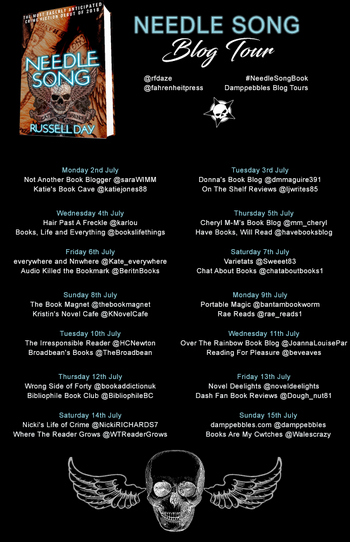
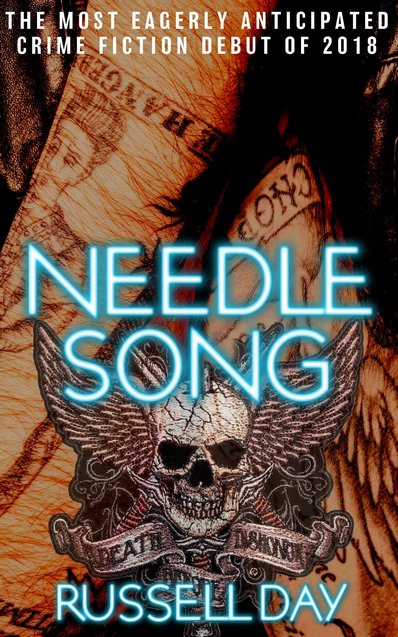
COVER REVEAL (and a little more): Needle Song by Russell Day

I’m very excited to be a part of the crew revealing the cover for Russell Day’s Needle Song — after you rest your peepers on the cover, read on to learn more about this great looking book.


Is that not the textbook definition of arresting?

Book Blurb:

Spending the night with a beautiful woman would be a good alibi, if the body in the next room
wasn’t her husband.

Doc Slidesmith has a habit of knowing things he shouldn’t. He knows the woman Chris Rudjer meets online is married. He knows the adult fun she’s looking for is likely to be short lived. And when her husband’s killed, he knows Chris Rudjer didn’t do it.

Only trouble is the police disagree and no one wants to waste time investigating an open and shut case.

No one except Doc.

Using lies, blackmail and a loaded pack of Tarot cards, Doc sets about looking for the truth – but the more truth he finds, the less he thinks his friend is going to like it.

I’m sold. I’m not just saying that as part of this cover reveal, that blurb did it’s job when I read it.

Last minute addition to the post, added without nuance: Fahrenheit Press just dropped a pre-order link. Click and buy!

FREE RUSSELL DAY SHORT STORY IN EXCHANGE FOR A TWEET:

Russell Day came to Fahrenheit Presses attention when they asked for submissions for their NOIRVILLE short story competition. A panel of judges placed Day’s stories in first AND SECOND place! Only one of the stories features in the NOIRVILLE anthology which means we’re giving the second story away for FREE, you lucky people!…….(well, free in exchange for a tweet!).

To receive a copy of Russell Day’s award-winning story, make sure you’re following @damppebbles (so you can receive the DM with the download links) and then tweet the following:

NEEDLE SONG by Russell Day (@rfdaze) published by @fahrenheitpress in eBook on Monday 30th April! #NeedleSongBook | @damppebbles.
http://www.fahrenheit-press.com/books_fahrenheit.html

No retweets, it has to be a shiny new tweet otherwise it won’t count! Any problems then please contact @damppebbles.

About Russell Day:

Russell DayRussell Day was born in 1966 and grew up in Harlesden, NW10 – a geographic region searching for an alibi. From an early age it was clear the only things he cared about were motorcycles, tattoos and writing. At a later stage he added family life to his list of interests and now lives with his wife and two children. He’s still in London, but has moved south of the river for the milder climate.

Although he only writes crime fiction Russ doesn’t consider his work restricted. ‘As long as there have been people there has been crime, as long as there are people there will be crime.’ That attitude leaves a lot of scope for settings and characters. One of the first short stories he had published, The Second Rat and the Automatic Nun, was a double-cross story set in a world where the church had taken over policing. In his first novel, Needle Song, an amateur detective employs logic, psychology and a loaded pack of tarot cards to investigate a death.

Russ often tells people he seldom smiles due to nerve damage, sustained when his jaw was broken. In fact, this is a total fabrication and his family will tell you he’s has always been a miserable bastard.

The Bone Keeper by Luca Veste: When an Urban Legend becomes Urban News

The Bone KeeperThe Bone Keeper

by Luca Veste

Paperback, 421 pg.
Simon & Schuster, 2018

Read: April 17 – 19, 2018

One, two, Freddy’s coming for you
Three, four, better lock your door
Five, six, grab your crucifix
Seven, eight, gonna stay up late
Nine, ten, never sleep again

(that’s not from this book, it’s from The Nightmare on Elm Street movies — but you’re so clever, you probably didn’t need me to say that)

I’ve never been a horror movie guy — but I watched a couple of the Elm Street movies as a kid, mostly because my younger sister was obsessed by them. Still, if I sang this song, played a bit of either The Fat Boys or DJ Jazzy Jeff and the Fresh Prince’s songs about the movies (the musical bit), she would get freaked out. Something about that song immediately tapped into the fear of that movie for her (and made it very easy for her older brother to torment her).

I mention that because the Bone Keeper — an Urban Legend, a bogeyman story — has his own song that kids throughout all of Liverpool know and have known for decades/generations. He’s a supernatural being, living in the woods near/around the city who captures kids and adults, kills them and keeps their bones (hence the name). Clearly just a story to be told around campfires, etc. Right? One more way for older brothers, cousins, etc. to torment their younger friends and relations.

But when an injured, bleeding, and disoriented woman comes stumbling out of the woods singing that song, everyone (police, media, social media users) starts wondering — is the Bone Keeper real after all?

DC Louise Henderson and DS Paul Slater are officially skeptical (okay, more than skeptical) about the Bone Keeper’s involvement in the attack on the woman as they begin their investigation. Finding bodies in the area near where she was probably attacked (and inexplicably escaped), with strange symbols carved into nearby trees only fuels the speculation — and perhaps gets at least one of the detectives thinking that maybe they were too quick to write off the “out of the box” suspect.

As the investigation continues, the options are (at least for the reader, even if Henderson and Slater can’t think this way): there’s a deranged serial killer out there taking advantage of the Bone Keeper legend to mask his crimes; there’s a deranged serial killer out there that thinks he’s a supernatural creature, killing people; or there’s a supernatural being out there killing people. Veste writes this in such a way that every option is a valid conclusion up until the moment he has to make it clear just what’s been going on.

Like the Elm Street movies, The Bone Keeper isn’t my kind of book — but I gave it a shot anyway. I’m so glad I did. It was gripping, it was addictive, there are many other adjectives I could use here, but they don’t seem to be adequate. Let’s say that it’s the kind of book you read in the waiting room of your doctor’s office and hope that he’s running late (I was able to read enough to get to an acceptable stopping point so I didn’t resent him being pretty much on time).

I cannot talk about this book the way I want to — I’d ruin everything. I’ve deleted several sentences (or at least the beginnings of several sentences) already — and I’ve not typed a few others. Take the premise above and imagine the best way to tell that story — that’s precisely what Veste has given us.

The opening chapter is one of the creepiest that I can remember reading — and things only move quickly from there until the action-packed conclusion and almost-as-creepy coda. Haunted characters, haunted families, haunted woods — in at least one sense. The Bone Keeper‘s characters and setting are rife with opportunity and material for Veste to use to tell his story of a literal walking nightmare. A police procedural that brushes up against the horror genre — this is a thriller that’ll stay with you for a while (I’m not sure how long it’ll stay with me, but I can tell you I’m avoiding places rich with trees for the foreseeable future).

—–

4 Stars

The Plea by Steve Cavanagh is a dynamite legal thriller

The PleaThe Plea

by Steve Cavanagh
Series: Eddie Flynn, #2

Hardcover, 358 pg.
Flatiron Books, 2016 (2018 for US Edition)
Read: April 10 – 12, 2017

Lawyers don’t usually question whether or not a client is telling truth. That way lies madness. You do what you have to and trust the system. So, the guilty plead guilty. The innocent fight their case and the jury decides. If a by-product of that process is the emergence of the truth, then so be it, but the truth is not the aim of the process. The verdict is the aim. Truth has no place in the trial because no one is concerned with finding it, least of all the lawyers or the judge.

If that’s not cynical enough for you, try this:

I saw through Dell’s game. It was a familiar one. It’s a game the justice system plays every single day in America–because sometimes it simply doesn’t matter if you’re really innocent of the crime; the only smart move is to plead guilty and make a deal for a lesser sentence.

“You want me to read the new evidence and tell David that irrespective of his innocence, he will definitely be convicted and his only choice is to plead guilty and make a deal to cut his sentence.”

“Bingo,” said Dell.

Happens all the time. I’ve done it myself. Innocent people often don’t want to take the chance of losing and doing fifteen or twenty years when they could make a deal and be out in two. It’s mathematics–not justice, but that’s the reality.

Don’t worry — this book is not a diatribe about the shortcomings of the American judicial system (as appropriate as one might be), little comments like that are just a little bit of flavoring accenting the story, grounding it in the real world despite the craziness filling the book.

Eddie Flynn, for those new to the character, is a con man who went straight and then went to Law School. Following that, he made a couple big mistakes — one cost him the career he had built, the other cost him his family. He’s in the process of rebuilding both — no easy task — but you have to root for the guy trying to recover.

Eddie’s approached (okay, ambushed) by the FBI, who wants Eddie to take on a new client, David Child. Child’s a tech billionaire accused of murdering his girlfriend, and the FBI wants Eddie to convince him to plead to the charges. Then he needs to convince Eddie to help the FBI take down the law firm that currently represents him — and is laundering money on a mind-boggling scale. If Eddie refuses? The FBI has enough evidence to put Eddie’s ex away for a long time (did I mention that she works for the aforementioned firm, totally unaware that she’s incriminated in the laundering?).

So, somehow Eddie has to separate Child from his current counsel, replace them, and then persuade Child to work with the FBI — within a couple of days. No easy task. Then Eddie becomes convinced that Child is innocent. Which complicates things tremendously. So how does Eddie clear Child, keep his wife out of jail and help the FBI take down the laundering lawyers? Well, it’ll take every bit of his old tricks, and maybe a few new ones.

I’m not a huge legal thriller guy — never read a Grisham — but when you give me a compelling character (particularly a defense attorney) like Eddie Flynn, I’m in. Watching Eddie navigate through the tricky waters of the system — including jail guards, court staff, judges, prosecutors — is a blast. This was like a serious version of the Andy Carpenter books. I would like to see Eddie take on a client he because he wanted to for a change, but that’s not a complaint about this book, it’d just be nice to see.

Sure, it’s your appreciation for Eddie Flynn that’ll determine if you like this book or not, but he’s not the only character to focus on — there’s David Child himself, who is interestingly drawn — he’s a fairly typical computer-genius character, socially awkward, etc. Typical, yes, but used well. My only complaint about Child’s associate, Holly, is that we didn’t get more of her (not that Cavanagh could’ve easily fit more of her in). The villains? Nasty, vile people — believable (with one possible exception, but I liked him enough I don’t care) — all of them were well used, well drawn and just what the doctor ordered.

The Plea isn’t perfect: I figured out the whodunit almost instantly, but it took a little while to get the details of the howdunit right — and Cavanagh fooled me a little bit on that one. But that didn’t detract from the book at all — the fun is in watching Eddie and the rest scramble to survive this horrible situation and figure things out. The plot moves at a relentless pace — which is a cliché, I realize, but I challenge you to come up with another way to describe this plot. Eddie can barely get a moment to rest and think, and when you’re reading this, you feel like you can’t either.

Characters you can’t help but root for (or, in some cases, against), a fast-moving plot, with just enough twists, turns and hurdles. This one’ll grab you by the collar and drag you along as it rushes to the dramatic conclusion (not that you’ll be fighting against it, but the dragging will help you keep up). Keep yours eyes peeled for Steve Cavanagh and Eddie Flynn, they’re something to watch.

—–

4 Stars

The Secret of the Lost Pharaoh by Carolyn Arnold: A would-be Indiana Jones-esque adventure in Egypt

The Secret of the Lost PharaohThe Secret of the Lost Pharaoh

by Carolyn Arnold
Series: Matthew Connor Adventure, #2

eARC, 436 pg.
Hibbert & Stiles Publishing, Inc., 2018
Read: April 6 – 7, 2018

Noted thrill-seeker, adventurer and archaeologist in the Indiana Jones mold, Matt Connor, is contacted by a former colleague with a more-than-tempting offer: she’s pretty sure that she’s on the trail of a fascination of Matt’s — the Emerald Tablets — and would he like to help look for them? Matt jumps at the chance and persuades Dr. Alexandria Leonard to let him bring his two friends along — they’ve come along on many of his previous escapades and will be a helpful addition to this one, too.

He just has to convince them to come. Following the three of them being compelled to find the lost City of Gold, they’ve plunged themselves into their very tame careers and personal lives and away from excitement. Matt convinces them to come along (or the book would’ve been much shorter), and they head to Egypt a couple of days later. Keeping things very secret from just about everyone, of course, because these Emerald Tablets have great power — we’re not told anything about this power, just that no one wants it to fall into the wrong hands. When people first started talking about them in those terms, I rolled my eyes, until I realized that this was a world in which that was a thing — tablets have power, the Ark of the Covenant probably took out a bunch of Nazis and Bobby probably found an ancient tiki that carried a curse. Once I figured out that was the kind of book I was reading, things made a little more sense. We are told almost nothing else about the Tablets, but from the way everyone acts about them (at least everyone that believes in them), you can tell they’re a pretty big deal.

Once they arrive, things start to good poorly for the expedition — and not in small ways, but they struggle through it all (mostly). The Tablets are not easily found — if they even exist, that is. But there’s plenty of other archeological finds to focus on — and some real dangers. Like, say, snakes. Arnold does a great job depicting how snakes can really creep a person out — even a person safely reading about them on their Kindle thousands of miles away from a single asp. Although at a certain point, they just disappear — like Hamlin’s Pied Piper sauntered through Egypt and every asp left with him. It was a bit disconcerting once they stopped being a concern — especially in the last chapters where they really could’ve been a looming presence — after being everywhere for a while.

This was a fun little adventure story, nothing too intense, nothing too serious, just a nice little diversion (which is good thing). But it could’ve been better, too.

Early on, when the characters are getting to know each other and get comfortable in Egypt, I really had some trouble with the conversation. Matt’s friend and photographer (ugh, don’t get me started on the drama surrounding bringing along a photographer), Cal, can serve a great role for the reader. Cal’s only a hobbiest when it comes to this stuff from hanging out with his friend — so he can ask a lot of questions that Arnold can use to plug the reader into the world. It’s a thankless task that characters in books and TV shows have to play letting the “stars” show off their expertise. That’s all well and good, but man, Cal asked some pretty dumb questions — and what’s worse, characters in and around the field of archeology were way too impressed with others answering simple questions — questions I could’ve answered. That was hard to swallow, but easy to get past.

But was really hard to get past — if only because she kept throwing it in your face — was the unsubtle emotional stories. Alex’s other friend, Robyn, is clearly the love of his life — and vice versa. But they broke up years ago, while neither has let go. And one or the other of them (and occasionally, Cal) is thinking about this every few pages, without doing anything about it. And when another romance is kindled in Egypt, the melodrama gets hard to swallow — seriously, in an early draft of Twilight, Stephanie Meyer would’ve cut this kind of stuff for being “too high school.” Unless I’m remembering incorrectly, Arnold can do subtle emotions, this didn’t seem to be the same author who wrote Remnants — and that’s a shame.

The pacing of this was disappointing — we got too much set-up, far too much time establishing the various storylines in Egypt, and then we rushed through the conclusion. I think the heart of the adventure took the last 20 percent of the book! It needed to be longer just to give it the necessary dramatic weight — and to make the last challenges these characters faced seem more difficult and fraught than a run down to Tim Horton’s for donuts and coffee.

The mystery component (for lack of a better word), was far too easy to figure out — but it wasn’t framed as a whodunit, so that’s not a slight on Arnold. But it does make you wonder about the powers of observation displayed by Matt, Cal, Alex and the rest. But the villainous characters did their overall job, keeping things moving and providing a way for Matt and the rest to have the adventure the book they needed.

I’ve given a lot of space here to my relatively minor complaints — but it takes a bit of space to express them. I did have a good time reading the book. Matt’s a fun character — ditto for Cal. I enjoyed the chemistry between the central characters and could’ve easily read another hundred pages or more with them and not really noticed or minded. As long as the high school stuff was downplayed — when that wasn’t a focus, I wanted more time with all the characters.

This is the second in a series, but would be a find jumping-on point. I do recommend this for people looking for a light adventure, and can see myself coming back for another go-round with these characters — I know Arnold can do better than this (and this wasn’t bad, it just wasn’t as good as it could’ve been).

Disclaimer: I received a copy of this book from Hibbert & Stiles Publishing in exchange for this post. I appreciate the opportunity to read this book.

—–

3 Stars

Quotation of the Day

“A man condemning the income tax because of the annoyance it gives him or the expense it puts him to is merely a dog baring its teeth, and he forfeits the privileges of civilized discourse. But it is permissible to criticize it on other and impersonal grounds. A government, like an individual, spends money for any or all of three reasons: because it needs to, because it wants to, or simply because it has it to spend. The last is much the shabbiest. It is arguable, if not manifest, that a substantial proportion of this great spring flood of billions pouring into the Treasury will in effect get spent for that last shabby reason.”

–Nero Wolfe

Pub Day Repost: Madam Tulip and the Bones of Chance by David Ahern

Madam Tulip and the Bones of ChanceMadam Tulip and the Bones of Chance

by David Ahern
Series: Madam Tulip, #3Kindle Edition, 368 pg.
Malin Press, 2018
Read: March 5 – 6, 2018

Many people doubt psychic powers exist, but the doubters do not include actors. Everyone in showbusiness knows that as soon as one actor learns of a casting, actors of all ages, ethnicities, creeds and genders are instantly aware of every detail. Einstein claimed that faster-than-light communication is impossible. Einstein was not an actor.

But not even the actors that Derry, Bruce and Bella knew had an inkling of the dash of good fortune heading toward Derry and Bruce — they were given roles in a movie without the need to audition, if they could get themselves to Northern Scotland and Derry might have to give a reading or two. For readers new to this, Derry played the role of Madam Tulip on occasion — giving psychic readings at parties and the like. Derry was initially reluctant to take the role, but she needed the work — and Bruce only got his job if she took hers.

So they find themselves in Scotland — a land not necessarily ready for or welcoming toward people making a film. Which almost describes the director, too. He’s clearly nuts — and not in the genius filmmaker kind of way. Many of the other professionals on set did seem to know what they’re doing, which went a long way to keeping the production running. But mostly, the antics on the set made for good comedy. Derry is given a set of bones on set to add to her gypsy character’s fortune telling routine in the historical drama.

While practicing with the bones, Derry starts to have visions, we’ll get into that later, but it’s clear that she’s gotten herself into more than meets the eye (again).

The most striking and interesting people in the book aren’t on the film set — believe it or not. As the blurb on the back says,

A millionaire banker, a film producer with a mysterious past, a gun-loving wife, a PA with her eyes on Hollywood, a handsome and charming estate manager—each has a secret to share and a request for Madam Tulip.

As usual, Derry’s desire to help people and natural nosiness gets her involved in these people’s lives (okay, she might have less altruistic motives about the estate manager). And that’s before someone tries to kill her and/or one of her new friends. Once that happens, Derry can’t help but dive into finding out what’s going on. Madam Tulip may be able to guide the direction she goes, but it’s Derry’s on cleverness that will carry the day.

In Madam Tulip, her father seems to actually believe that she had some psychic ability, otherwise it seems like a lark, something she does for giggles. But in book 2, it seemed possible that she might actually have some abilities, but there wasn’t much in the novel that was more than a hint or suggestion that she did. But here? That hint, that suggestion is gone — she sees things when she rolls the bones, her Tarot readings do say a lot that’s true (and future) about the person she’s reading the cards for. I think I liked it better when the reader wasn’t sure if she had gifts or not, honestly — but only a little bit.

I’ve been a fan of this series since chapter two or three of the first book, so you’re not getting anything really objective here (not that you ever do). But this is the best that Ahern’s done yet — there’s plenty of good comedic writing (there are lines I tried to shoehorn into this, but couldn’t, that made me laugh out loud), a mystery you can’t really guess the solution to, a little peril, a dash of romance and some fun characters. That’s not even counting Derry and Bruce. Bones of Chance is a strong entry in the series that will please fans, but it’s also a decent jumping on point for new readers. Basically anyone who enjoys light mysteries with a touch of something extra should have fun with this book.

There are times that I fear my enthusiasm towards a book doesn’t come through, and I usually don’t know how to achieve that better — this is one such time. I found myself grinning frequently while reading this — I chuckled, I even laughed out loud. I had a few theories about the trouble that Derry was getting herself into, and failed with almost all of them (a sign of a good mystery/thriller, if you ask me). If you’re not picking up my enthusiasm, that’s on me, just trust me that it’s there.
Disclaimer: I received this eARC from the author in exchange for my honest opinion..

—–

4 Stars

Page 99 of 153

Powered by WordPress & Theme by Anders Norén