Category: Non-Fiction Page 25 of 63

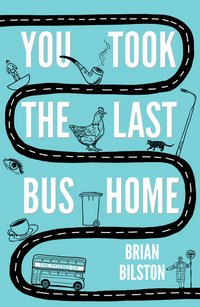
You Took the Last Bus Home by Brian Bilston: Do I Dare Eat Some Kale?

You Took the Last Bus HomeYou Took the Last Bus Home:
The Poems of Brian Bilston

by Brian Bilston

DETAILS:
Publisher: Unbound
Publication Date: April 13, 2021
Format: Paperback
Length: 226 pgs.
Read Date: March 1-29, 2023

Do I need my usual disclaimer about not being a poetry reader here?

Probably not, but I’ll throw it up anyway. This is the fourth time in about 10 years of blogging on this site that I’ve posed about a book of poetry. There’s a reason for that. I typically don’t like them.

There’s also a reason that I had to buy, read, and post about this one—after Facebook’s algorithm inexplicably started showing me his poems for a stretch back in January, I had to read more of them. So I bought this book, and now I have to talk about it. Because I try to do that about every book I read, but primarily because I want more people to have the opportunity to have fun with him.

What’s You Took the Last Bus Home About?

This a lengthy collection of poems (well, maybe not—it’s the lengthiest I own outside of textbooks, anyway) about love, loss, politics, and “everyday places and situations” (as he describes them in the Introduction—which I somehow skipped over until just now). Everyday situations like—someone wanting to borrow a phone charger (and being denied), beards, search engines, playing with a dog, and so on.

Bilston closes the Introduction by saying

I suppose these are not traditionally regarded as being teh stuff of poetry. But there is poetry to be found in anything if you look hard enough.

And Bilston looks that hard.

Playing with Form

One of the best things about poetry is the ability to use form to communicate. To play with the placement of the words on a page, and how they’re presented to get the meaning across—sometimes more effectively than the words used.

Bilston is a master of this.

From decreasing the type size in “Unforseen Consequences” to rotating the text in “Ode to a USB Stick” or something as simple as embracing the traditional shape of a Christmas tree in “Needles” (and then tweaking it), the visual impression of each page got you in the right frame of mind before you started reading.

See also his use of Flow Charts, Org Charts, Excel worksheets, etc.

So, what did I think about You Took the Last Bus Home?

I remember in college classes about poetry there’d be a certain tone of voice used with the phrase, “light verse.” It was eerily similar to the audible sneer used for the term “genre fiction.” And I get that—it’s the same reason that comedies are almost never nominated for an Oscar. It’s not right, but I get it.

But to brush this collection off because Bilston frequently brings the funny is a mistake. This is some really clever work–when he’s funny and when he’s not. The fact that he’s so frequently amusing (to one degree or another) means that when he drops that and goes for serious, earnest, or thoughtful—those are even more powerful (for example, “Refugees”). It shouldn’t be overlooked that he frequently is thoughtful and humorous in the same poem.

I like the creativity, I adore the wordplay, and—as always—I’m a sucker for anyone who makes me laugh/chortle/giggle/smile on the majority of the pages. I audibly laughed at the ninth poem—and several after that. My favorite haiku ever is to be found in these pages (and probably most of the top ten of that list, too*)

* A list that I didn’t realize I’d need/want/have until I started this book.

Did I love every poem? No. Did I skim a few? Yup. But in a collection this size, that’s to be expected, right? Particularly when it comes to someone who isn’t particularly a fan of poetry in the first place. The overwhelming majority of them absolutely worked.

This is a book to spend time with—open it up randomly, or read from cover to cover—whatever. Don’t do it all in one sitting, obviously—although I think it’d be easy to do, I typically read at least two more poems than I intended to per session (usually more than two). But it’s hard to appreciate them if you gorge yourself.

You’re not just going to want to read these yourself—you’re going to want to share these. I also couldn’t help but read a poem to whoever happened to be in the room with me—or make someone else read one that I really appreciated (especially if you needed to see it for full impact). My daughter received several messages from me that consisted of a quick photo of a page or two almost every time I sat down to read this volume.

I can’t say enough good things about this. I’ll be buying more of his work soon.


4 1/2 Stars

This post contains an affiliate link. If you purchase from it, I will get a small commission at no additional cost to you. As always, the opinions expressed are my own.

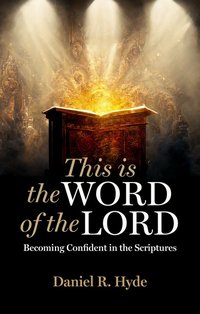
This Is the Word of the Lord: Becoming Confident in the Scriptures by Daniel R. Hyde: A Sound and Basic Defense of Scripture

This Is the Word of the LordThis Is the Word of the Lord: Becoming Confident in the Scriptures

by Daniel R. Hyde

DETAILS:
Publisher: Christian Focus Publications
Publication Date: January 17, 2023
Format: Paperback
Length: 121 pg.
Read Date: February 26, 2023

As yearly surveys and our own experience shows, we are living in a time of famine of the true Word of God. The ancient prophet Amos spoke of such a coming famine in his day: “Behold, the days are coming, declares the Lord God, when I will send a famine on the land—not a famine of bread, nor a thirst for water, but of hearing the words of the Lord’ (Amos 8:11). How true is this still? We are living in that day. This is why when we find the Word, we need to mine it for its riches, cultivate it for its food, and drink from it like a well in the desert. Sadly, Amos says in those days that ‘they shall wander from sea to sea, and from north to east; they shall run to and fro, to seek the word of the Lord, but they shall not find it’ (Amos 8:12). This describes our time. The apostate church blindly wanders from the sentimentality of Protestant Liberalism to the so-called authoritative and immovable word of Rome or Orthodoxy, to the relativistic Emerging Church, to the skeptical Bart Ehrman, to the happy Joel Osteen, and the list goes on. There is a lot of searching but no finding. Yet in the Word written, our searching turns to resting as the silence of our hearts is filled with His living voice.

What’s This Is the Word of the Lord About?

Very simply, the book is Hyde’s response to that quotation—that’s the book’s thesis—everything else is the details. The primary concern of the work is to build and establish the reader’s confidence in the Scriptures—and that from that confidence the reader would build their life, faith, and sanctification on those Scriptures.

He covers topics like the revelation, inspiration, authority, canonicity, sufficiency, and perspicuity of Scripture—largely the typical points focused on in books about the Doctrine of Scripture. His last chapter, “Experiencing the Word,” tackles something I haven’t often seen in this kind of book, however. He calls his reader to “consider how the presence and power of the Spirit works causing us to experience the Word.” This is done particularly “to effect my recognition of in my life,” “to effect my reception of the Savior,” and “to effect my realization of sanctification.” Knowing everything in the previous nine chapters is all well and good—but if it remains an intellectual exercise, it’s pointless—the element of the Scriptures impacting your life—causing you to see your sin, need of a Savior, and resulting in sanctification (roughly the outline of the Heidelberg Catechism, to the surprise of no one), is essential.

So, what did I think about This Is the Word of the Lord?

As much as I appreciated the tone and urgency Hyde displays through the book, his obvious earnestness, the much-needed emphasis in the last chapter, and the overall soundness of every point he makes…I found the book to be adequate. But not much more than that.

Perhaps I’ve just read too many books written on this level for this general purpose, so it feels like so much of a retread for me.

I liked it but wanted and expected more. Hyde generally delivers that for me, but here he didn’t. Would I recommend this to anyone wanting a good foundation in the doctrine of Scripture? Absolutely. But for me, it fell a little flat.


3 Stars

This post contains an affiliate link. If you purchase from it, I will get a small commission at no additional cost to you. As always, the opinions expressed are my own.

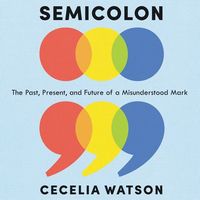
Semicolon (Audiobook) by Cecelia Watson, Pam Ward: No, Really—I Assure You, It’s Interesting

SemicolonSemicolon:
The Past, Present, and Future
of a Misunderstood Mark

by Cecelia Watson, Pam Ward (Narrator)

DETAILS:
Publisher:HarperAudio
Publication Date: July 30, 2019
Format: Unabridged Audiobook
Length: 3 hrs., 47 min.
Read Date: March 13, 2023

Grammar, in our mythical narrative, is part of the good old days. People used to know grammar properly, we think, the same way they used to walk three miles to school uphill in the snow, and everyone was polite, and better looking and thin, and well dressed.*

* I want to stress that the above represents my guesswork on punctuation, Watson’s is probably superior)

What’s Semicolon About?

I’m going to go the lazy route and just lift from the Publisher’s Website:

A page-turning, existential romp through the life and times of the world’s most polarizing punctuation mark
The semicolon. Stephen King, Hemingway, Vonnegut, and Orwell detest it. Herman Melville, Henry James, and Rebecca Solnit love it. But why? When is it effective? Have we been misusing it? Should we even care?

In Semicolon, Cecelia Watson charts the rise and fall of this infamous punctuation mark, which for years was the trendiest one in the world of letters. But in the nineteenth century, as grammar books became all the rage, the rules of how we use language became both stricter and more confusing, with the semicolon a prime victim. Taking us on a breezy journey through a range of examples—from Milton’s manuscripts to Martin Luther King Jr.’s “Letters from Birmingham Jail” to Raymond Chandler’s The Big Sleep—Watson reveals how traditional grammar rules make us less successful at communicating with each other than we’d think. Even the most die-hard grammar fanatics would be better served by tossing the rule books and learning a better way to engage with language.

Through her rollicking biography of the semicolon, Watson writes a guide to grammar that explains why we don’t need guides at all, and refocuses our attention on the deepest, most primary value of language: true communication.

Pam Ward’s Narration

Wow…just wow. Ward throws more emotion, dynamic changes, dramatic changes, and overall oomph! into this narration than several novels I can name. It was so striking, so entertaining, and engaging that most of what I liked and noticed about this book can be attributed to her.

Seriously, immediately before this, I’d listened to a book with multiple murders, other violent crimes, and a natural disaster threatening homes and livelihoods—Ward filled a book about a punctuation mark with more pathos and excitement than that.

At least half the stars down there belong to her.

So, what did I think about Semicolon?

A grammar attack is, quite simply, an ad hominem attack that looks more legitimate becuase it’s dressed up in a cap and gown.

The fact that this ends up being about more than the semicolon is both a strength and a weakness.

It’s a strength because Watson simply doesn’t have enough material to just talk about the semicolon for 200 pages (in the hardcover). The material was so wanting that she really had to spend a lot of time on the case about sales of alcohol in early 20th century Boson than it was worth.

I thought her material on Raymond Chandler and Martin Luther King, Jr. was fantastic. The origins of the semicolon and the ups and downs of its usage pre-grammar textbooks were fascinating.

But when she went off on grammar rules, how they get in the way of communication, can help shut down discourse, etc. The book suffered. Now, she was insightful, helpful, and persuasive on these points (and I say this as someone who reflexively comes down on the “prescriptivist” side in grammar debates). But when she did that, she walked away from “The Past, Present, and Future of a Misunderstood Mark,” and it bugged me. If Watson was going to write something like Emmy J. Favilla’s A World Without “Whom” or Gretchen McCulloch Because Internet, I’d be there in a heartbeat. (also, if she wanted to tackle punctuation beyond the semicolon like Shady Characters by Keith Houston, I’d be all for that) But for this book, she went too far afield for this reader’s taste and lost a lot.

At the end of the day—if you want a rousing celebration and examination of the winking half of an emoticon—or the mark’s more illustrious use and history, this is the book to grab. I almost never recommend a particular format of a book, but you need to listen to at least a sample of Ward’s narration.

This post contains an affiliate link. If you purchase from it, I will get a small commission at no additional cost to you. As always, the opinions expressed are my own.

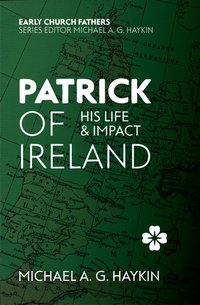
Patrick of Ireland: His Life and Impact by Michael A.G. Haykin: A Little Light on Info, but Does a Lot With It

Patrick of IrelandPatrick of Ireland:
His Life and Impact

by Michael A.G. Haykin
Series: The Early Church Fathers
Publisher: Christian Focus Publications
Publication Date: February 02, 2018
Format: eBook
Length: 112 pgs.
Read Date: February 19, 2023

I came to the people of Ireland to preach the Gospel, and to suffer insult from the unbelievers, bearing the reproach of my going abroad and many persecutions even unto bonds, and to give my free birth for the benefit of others; and, should I be worthy, I am prepared to give even my life without hesitation and most gladly for his name, and it is there that I wish to spend it until I die, if the Lord would grant it to me.

The Series

In case you hadn’t read what I thought of the other books I’ve read in this series, let me start with the thumbnail description of the series I came up with:

I literally stumbled on this series, The Early Church Fathers, a few weeks ago and thought it sounded like a great idea. It looked kind of like a mix of Crossway’s Theologians on the Christian Life and Oxford’s Very Short Introductions (incidentally, that’s what it ended up being).

What’s Patrick of Ireland About?

Like the other books in this series, Haykin starts with a biographical sketch of Patrick—noting the difficulties around that due to the small bibliography we have from him and the large number of myths and hagiography surrounding him. He then moves into considering Patrick’s Trinitarianism, his vision for evangelism/missions. Finally, he looks at “the balance of the Word and Spirit in Patrick’s thinking and experience.”

His Life

…there are a number of aspects about his life that are not at all clear- cut. There is no agreement, for example, about the date of his birth or the location of his childhood home, or about the place of his captivity in Ireland or whether or not he had formal theological education; nor is there any agreement about the dates of his ministry in Ireland.

We do know some things—mostly from his own hand—but scholars have to wade through a lot of chaff. R.P.C. Hanson is cited as summarizing it as: “Patrick’s life has become subject to a large amount of hagiographical embroidery and fictitious enhancement.”

That fictitious enhancement is where a lot of what I grew up “knowing” about Patrick, and I’d wager it’s the same for a lot of you.

…from the Middle Ages onwards, his mission to Ireland was depicted as one astounding miracle after another. For example, Jocelin of Furness (fl.1175–1214), the English Cistercian hagiographer, explained the absence of snakes in Ireland to be the result of Patrick’s destruction of them all on the peak of Croagh Patrick (St Patrick’s Mountain) in County Mayo. Jocelin also tells us that Patrick as an infant was baptized by a blind priest who got the water for the baptism by causing Patrick to make the sign of the cross over some earth, from which a well of water immediately issued. The water cured the priest of his blindness and enabled him, though illiterate, to read the rite of baptism. According to other miracles ascribed to Patrick, he was able to pass through doors, like the risen Christ, and could turn butter into honey.

At the end of the day, however,

Unlike the otherworldly miracle worker depicted by later biographies of Patrick, the two authentic writings from Patrick reveal a typical fifth- century bishop who was involved in preaching, baptizing, celebrating the Lord’s Supper, confirming new converts, and ordaining ministers.

Because of—or maybe despite—the dearth of information we have about him, what can be established is all the more interesting.

His Theology

Haykin focuses on two primary areas—Patrick’s Trinitarianism and his Missiology. Thankfully, we have his two written works to learn from here.

Without any references to the shamrock (thankfully), Patrick’s full-orbed Trinitarianism shines through his writings. After the last couple of entries in this series were so filled with controversy over the doctrine, it’s so refreshing to read one absent it.

I also appreciated the simple and straightforward nature of Patrick’s missiology and doctrine of the Church. He lived the kind of life he described and called others to. The fact that, in his mind, evangelizing the Irish was bringing the gospel to the literal end of the earth and thereby he was helping to bring in the Last Days, makes his work all the more remarkable. He didn’t call people to a temporary faith, he actually established believers and churches that lasted.

So, what did I think about Patrick of Ireland?

This is the best one of these books since the Augustine volume (maybe even better than it).

I enjoyed it—it helped increase my understanding and appreciation of the subject, and I learned a little bit about how little we know. (I read his Confessions more than a decade ago, and need to dig it out again)

I don’t think I got as much from this as I did from some of the others in this series—but that’s a quirk of the source material, and that has its own charm. Seeing what others have established, and what Haykin has synthesized here is the impressive bit.


3.5 Stars

This post contains an affiliate link. If you purchase from it, I will get a small commission at no additional cost to you. As always, the opinions expressed are my own.

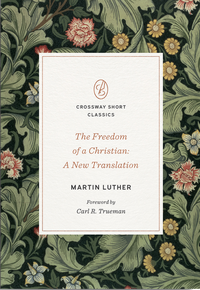
The Freedom of a Christian by Martin Luther, Translated by Robert Kolb: A Pastoral Gem from the Reformer

The Freedom of a ChristianThe Freedom of a Christian: A New Translation

by Martin Luther, Translated by Robert Kolb Carl R. Trueman (Foreward)

DETAILS:
Series: Crossway Short Classics Series
Publisher: Crossway
Publication Date: February 21, 2023
Format: Paperback
Length: 86 pg.
Read Date: February 26, 2023


Some Thoughts on the Series as a Whole

The point of this series is to take classic short works—sermons, tracts, articles—package them attractively, edit a bit (modernize language, eliminate footnotes, tweak grammar, etc.), and make them widely available. Each is given a short introduction to help the reader get the context and a bit of information about the author.

They published seven books in this series last year, and I discussed them here. Two have come out this year (so far), but I’m hoping for more.

What’s The Freedom of a Christian About?

A Christian is a free lord of everything and subject to no one.

A Christian is a willing servant of everything and subject to everyone.

This is Luther (early in the Reformation) laying out his vision for good works for the believer–how they are to be performed, why they are to be performed, and their place in the life of the believer. I’m sure there’s more to say, but that’s basically it.

That quotation gives his two theses–the rest of the book is his working out the thinking behind them. It’s penetrating, it’s convicting, and it’s inspiring to watch him work. Whoops, I seem to have stumbled into the next section.

So, what did I think about The Freedom of a Christian?

From all of this comes the conclusion that a Christian lives not in himself but in Christ and in his neighbor, in Christ through faith, in the neighbor through love. Through faith he rises above himself in God, from God he descends under himself through love, and remains always in God and in divine love. It is as Christ said in John 1[:51]: “You will see heaven standing open and the angels ascending and descending over the Son of Man.” Behold, that is the proper, spiritual Christian freedom, which liberates the heart from all sins, laws, and commands. This freedom exceeds all other freedoms, as high as heaven is over the earth. May God grant us that we truly understand that and retain it.

I wasn’t sure about reading this–it’s one of those works I’ve read so much about. I’ve seen it cited, heard descriptions of it in lectures, and read about it, but I haven’t gotten around to reading it. A lot of the times I read something that I know about like this, it doesn’t work out (I’ve never been able to get past page 40 of Postman’s Amusing Ourselves to Death, for example). But this is exactly what it should’ve been.

Martin Luther being pastoral is just great. Luther coming alongside those believers so often neglected in the Church and saying, here’s what to do–free of burden, free of guilt, free to live and love as they ought, as they’ve been called to.

This little read is a gem. I’m glad I took the chance on it and so glad that Crossway’s series brought it to us.

4 Stars

This post contains an affiliate link. If you purchase from it, I will get a small commission at no additional cost to you. As always, the opinions expressed are my own.

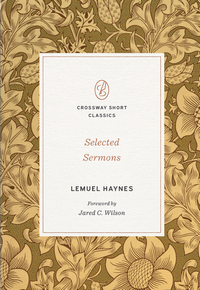
Crossway Short Classics: Selected Sermons by Lemuel Haynes: A Great Collection

Selected SermonsSelected Sermons

by Lemuel Haynes, Jared C. Wilson (Foreword)

DETAILS:
Series: Crossway Short Classics Series
Publisher: Crossway
Publication Date: February 21, 2023
Format: Paperback
Length: 139 pg.
Read Date: February 26, 2023

Some Thoughts on the Series as a Whole

The point of this series is to take classic short works—sermons, tracts, articles—package them attractively, edit a bit (modernize language, eliminate footnotes, tweak grammar, etc.), and make them widely available. Each is given a short introduction to help the reader get the context and a bit of information about the author.

They published seven books in this series last year, and I discussed them here. Two have come out this year (so far), but I’m hoping for more.

What’s Selected Sermons About?

As is obvious from the title, this is a collection of sermons by Lemuel Haynes. Born in 1753, Haynes is known as the first African-American ordained to the ministry.

The foreword serves as an introduction to Haynes as well as the included sermons, and we also get a quick biography of him before diving in.

The four sermons cover the idea of Universal Salvation, a sermon on John 3:3, a description of ministers, and a sermon against slavery.

So, what did I think about Selected Sermons?

The middle sermons—on the necessity of being born again and ministers were good examples of latter-Puritan-ish sermons, along the lines of Edwards and Whitfield. They were good, and solid, but not necessarily the kind of thing I’m coming back to.

The other two, however? Wow.

Sure, it’s easy from our vantage point to shake our heads and wonder how so many Christians could be comfortable with American slavery—it’s good to remember that it wasn’t true of them all. With “Liberty Further Extended,” Haynes delivered a powerful sermon against the practice, and you can only wish that more people were exposed to it—there’s a lot to be appreciated from this sermon, even if it’s not as timely as it once is (thank God).

“Universal Salvation,” the first sermon in the collection, blew me away (and may have set my expectations too high for the rest). The rhetoric was dynamite (there’s probably a better way to put it, but this is the most appropriate), the doctrine sound, and the conclusions were important. When you take the comments by Wilson into account, this must’ve created quite a stir when he preached it. I’d have paid the purchase price for the volume for this sermon alone.

I don’t know that everyone will agree with my evaluation—actually, I’m pretty sure many won’t—but I don’t see that anyone with an affinity toward Puritan-ish sermons, (First) Great Awakening sermons, or just good sermons not appreciating this little gem of a book.


4 Stars

This post contains an affiliate link. If you purchase from it, I will get a small commission at no additional cost to you. As always, the opinions expressed are my own.

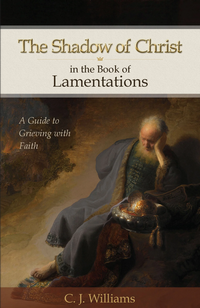
The Shadow of Christ in the Book of Lamentations by C.J. Williams: Finding the Hope of the Gospel in the Laments

The Shadow of Christ in the Book of LamentationsThe Shadow of Christ in the Book of Lamentations:
A Guide to Grieving with Faith

by C.J. Williams

DETAILS:
Publisher: Crown & Covenant Publications
Publication Date: November 25, 2022
Format: Paperback
Length: 172 pg.
Read Date: February 5-12, 2023

The people had been warned about this day of judgement for centuries, but as God pleaded with them through the prophets, they became more stubborn in their sin. Now the day had come. If there was ever an “I told you so” moment, this was it. But the speaker does not stand aloof; he gives a voice to the sorrow and suffering of the people. He wept with them and for them with sympathy that arose from the depth of his soul. Although the people had brought this terrible day upon themselves, they were met with compassion and “a spirit of gentleness” with which we are to minister to those who are overtaken in any trespass (Gal. 6:1).

What’s The Shadow of Christ in the Book of Lamentations About?

Based on a series of sermons, Williams walks the reader through the book of Lamentations—in a careful manner. He doesn’t avoid technical points, nor does he dwell on them, moving the book in an esoteric direction. At the same time, he doesn’t keep it so simple that there’s not a lot to learn, to think about, or to meditate on.

As the back of the book says,

The book of Lamentations counsels us on how to:

  • respond to hardships with faith,
  • grieve with hope,
  • and find the renewal of grace during the trials of life.

and Williams is careful to draw out each of these points more than once.

But that’s not the focus of his book—and, Williams would argue, it’s not the focus of Lamentations. The focus is on how Christ is displayed and revealed through this short Old Testament book. This comes through loud and clear and proves comforting and inspiring.

Christ-Centered Perspective

When seen in this light, a book that technically has no direct speech from God comes alive with the voice of the Son whom he would send.

Starting in the introduction and carrying on through the end, Williams makes it clear that this is going to be a Christ-centered book because the role of this book is to reveal Christ to his people. There is a speaker throughout the book, referring to himself as “I.” Williams argues that this is the voice of Christ—he is the lamenting one alongside the other voices in the book.

I’m not going to try to echo his arguments—I don’t have that kind of space. But when he started to enfold it, I was captivated—and as he returned to it throughout the book, I kept being captivated and wanted to spend more time examining these points.

So, what did I think about The Shadow of Christ in the Book of Lamentations?

When believers experience hardship or the chastening of God, asking this blunt question awakens us to the truth: Has God utterly rejected us? To ask the question is to answer it. You may not know how any hardship will end, but as a child of God, you know how it will not end. Nothing can Separate us from the love of God that is in Christ Jesus our Lord (Rom. 8:39).

The conclusion of Lamentations shows us that there js always a path forward when we walk with faith.

Of all the prophetic books, Lamentations is the one that has always resonated with me the most—but I always knew I was missing something about it. Starting in Chapter 2 (where he begins his argument for the Voice of Christ in this book), so many lightbulbs turned on—I know Christ was revealed in this book (as he is everywhere), but I didn’t understand how thoroughly the book did that.

I’m not for one second suggesting that this is an exhaustive treatment of the book, nor that Williams is the final answer when it comes to this idea—but it’s a fantastic place to start.

The rest of the book was just as good—I walked away from every chapter with a better understanding of or refreshed appreciation for the text.

If you’re looking for a trustworthy guide to this dark portion of Scripture (that is also full of light and hope), you’d do well to look to C.J. Williams.


4 Stars

Grandpappy’s Corner: Geeky Baby’s Guide to Colors by Ruenna Jones, Josh Lewis (Illustrator): Starting a Geek Off Right

Grandpappy's Corner Logo

Geeky Baby’s Guide to Colors

by Ruenna Jones, Josh Lewis (Illustrator)

DETAILS:
Publisher: Running Press Kids
Publication Date: September 21, 2023
Format: Board Book
Length: 26 pg.
Read Date: January 16, 2023
Support Independent Bookstores - Visit IndieBound.org

What’s Geeky Baby’s Guide to Colors About?

This is a book about colors illustrated with Geeky/Pop Culture illustrations (or inspired by pop culture things—for example, I don’t think some of the orange-masked faces are real superheroes).

There are pages about a White Wolf, a Gray Wizard, a Black Car (a ’67 Impala with a couple of men in the front seats), a Yellow (not golden) Lasso, and so on.

Let’s Talk about the Art for a Minute

This art is cute—in case you ever wondered if Legolas or T-Rex could look dangerous and “awww” worthy at the same time, Josh Lewis can answer that for you. All the colors pop—not just the color focused on in the drawing. All the illustrations are eye-catching and will bring a smile to the adult reading with a kid (or likely will entertain a kid flipping through the book solo).

There are a few images from the book on the Illustrator’s website.

How is it to Read Aloud?

So the reading part isn’t that engaging. It’s two words per page—color + item. But this isn’t a book about reading, it’s a book about exposing a child to colors, and helping them identify them. So the words are more prompts about what to talk about rather than reading.

So, I guess this question should be re-rephrased as “what’s this like to go through with a child?” And that answer would be it’s a lot of fun for a geeky adult who will enjoy the pictures for what they represent in Pop Culture.

Timing Is Important

If you ask me, this is a book to go through before a child is at the asking questions stage of life. As I was preparing to write this post, I started thinking about some of the conversations that could go really wrong with an inquisitive child.

Child: What happened to the White Wolf and its brothers, Grandpappy?
Me: Well, um...er, it went to live on a farm where there was a lot of room for it to run around and play.
Child: But they live near a forest already, why couldn't they stay with all the Stark children?
Me: It's time for a nap.

or

Child: What do those men do in the Black Car, Grandpappy?
Me: (forgetting to think about phrasing) They travel around and fighting angels and ganking demons, and...
Child: Are you s'posed to be fighting angels?
Me: No, that's not a good thing.
Child: What's "ganking demons" mean?
Me: Er, want some cookies? Let's not tell Mommy we had this chat, okay?

And so on. When they start getting inquisitive, it’s time for this book to be shelved out of sight.

So, what did I think about Geeky Baby’s Guide to Colors?

When my wife and I saw this, we only had to look at one or two pages to know we had to have this around for the Grandchild-to-be. I think it’ll be great to sit and look at with them while they learn colors or just to look at the pictures.

For the adult, there’s the nice feeling about introducing a child to some of these images, even if it’s only to get them embedded in a child’s subconscious. You’re never too young to learn about a sonic screwdriver or role-playing dice, anyway, right?

This is fun (in different ways) for young and old. I’m really looking forward to sharing this one with the Grandcritter.


3 Stars

This post contains an affiliate link. If you purchase from it, I will get a small commission at no additional cost to you. As always, the opinions expressed are my own.
Grandpappy Icon

Grandpappy’s Corner: Saint Patrick the Forgiver by Ned Bustard: Patrick’s Story Told for Wee Ones

Grandpappy's Corner Logo

Saint Patrick the Forgiver:
The History and Legends of Ireland’s Bishop

Written and Illustrated by Ned Bustard

DETAILS:
Publisher: IVP Kids
Publication Date: February 21, 2023
Format: eARC
Length: 32 pg.
Read Date: February 17, 2023
Support Independent Bookstores - Visit IndieBound.org

What’s Saint Patrick the Forgiver About?

Drawing on both legends about him and Patrick’s Confessions, this book tells the life story of Patrick of Ireland for the youngest set.

It starts off with his childhood and touches briefly on his period of slavery before moving into his return home and the call to Ireland. It doesn’t gloss over the hard parts of his life, but it doesn’t dwell on them, either. The focus is on Patrick forgiving those who wronged him, spreading the gospel—and even teaching the Trinity via the shamrock.

The book even covers some of the myths that arose around Patrick—baptizing a giant, driving out the snakes, etc.—working that in seamlessly with the book and not distracting from the main point.

Let’s Talk about the Art for a Minute

This art is great—it’s friendly and cartoonish, with great colors and details. Bustard also weaves in traditional Celtic knots and Christian art (like elements seen in The Book of Kells, etc.). So we’ve got a pretty modern feel with a lot of Irish elements thrown in to ground it in Patrick’s history.

Are kids going to get that? Nope. Will the adults reading it with/to the kids? Quite likely. And if not, I think they’ll still appreciate it the art, even if they’re not familiar with the influences Bustard is drawing from.

Click here for a two page sample (picture and text) on the Publisher’s site. I’m not sure it’s the image I’d have used, but it’s representative.

How is it to Read Aloud?

It’s pretty fun—the rhythm is easy and the rhymes are nice (and only one or two of them seemed like stretching things to make the rhyme).

The Grandcritter isn’t around yet to listen to me read this, but I still read most of it aloud just to see how it went—I think it went pretty smoothly and I could have some fun with it.

So, what did I think about Saint Patrick the Forgiver?

This was a great way to give an age-appropriate lesson in forgiveness while telling the story of one of the heroes of the faith. I was entertained, and even chuckled a couple of times.

It’s a great combination of story, art, rhyme, and lesson. I can see this winning over little audiences as much as it did me. Hopefully, it’ll lodge in their minds enough that they’ll want to learn more about Patrick as they grow older and through him the Three-in-One that Patrick spent his life teaching about.

I strongly recommend this quick little read.

Disclaimer: I received this eARC from InterVarsity Press via NetGalley in exchange for this post—thanks to both for this.


5 Stars

This post contains an affiliate link. If you purchase from it, I will get a small commission at no additional cost to you. As always, the opinions expressed are my own.
Grandpappy Icon

In the Fullness of Time: An Introduction to the Biblical Theology of Acts and Paul by Richard B. Gaffin Jr.: One of the Best Things I’ve Read in Years

I can’t put this one off any longer—if I could, I promise you I would. I’m out of my league here, but I’ve got nothing else to write about. And I really need to write something about this.


In the Fullness of TimeIn the Fullness of Time: An Introduction to the Biblical Theology of Acts and Paul

by Richard B. Gaffin Jr.

DETAILS:
Publisher: Crossway
Publication Date: May 3, 2022
Format: Hardcover
Length: 419 pg.
Read Date: September 4-December 25, 2022
Support Independent Bookstores - Visit IndieBound.org

What’s In the Fullness of Time About?

First, let’s look at what was on the Publisher’s Website:

An Exegetical Study of the Book of Acts and Pauline Theology

Christians often skip a crucial starting point when studying the apostle Paul: the foundations of his deeply nuanced theology. Some studies on the book of Acts attempt to touch on every major theme in Paul’s letters, making them difficult to understand or prone to leaving out important nuances. Christians need a biblical, theological, and exegetically grounded framework to thoroughly understand Paul’s theology.

In this book, Richard B. Gaffin Jr. gives readers an accessible introduction to Acts and Paul. Building on a lifetime of study, Gaffin teaches on topics including the redemptive-historical significance of Pentecost; eschatology; and the fulfillment of redemptive history in the death and resurrection of Christ. In the Fullness of Time is an exegetical “textbook” for pastors, students, and lay leaders seeking to learn more about Acts and Paul from a Reformed and evangelical perspective.

  • Explores the Foundations of Paul’s Theology: Offers a nuanced look at the core of Paul’s thinking
  • Wide-Ranging Audience: A valuable study for pastors, theology students, and lay leaders
  • Thorough Yet Accessible: An in-depth look at Pauline theology that’s accessible to readers

After reading the book, however, I’d offer a tweak or two to that description. For example, I’d add to that “for pastors, students, and lay leaders” lay people in general (or just swap out “leaders” for “people”).

Also, I’m not sure I’d include eschatology alongside those other topics. It seemed to me (on first read, anyway) that this was a book about Eschatology as presented by/understood through the New Testament—with a focus on understanding Pentecost and the fulfillment of redemption (and a couple of other topics) in light of that eschatology. That may seem like splitting hairs, and really, I’m guessing the good people at Crossway understand the book a bit better than I do. Still, I didn’t get the impression that the book thought of those ideas as equal (unlike the description).

The chapters in this book came from lecture notes for the class that Gaffin taught for years on Paul and Acts—a class I’ve heard several people mention over the years, and really wish I could’ve taken. Getting that material in written form is a blessing I didn’t expect and was more than happy to receive.

The Centrality of Eschatology

In Chapter 2, Gaffin writes:

for much Christian theology and preaching seeking to be faithful to the Bible as God’s inscripturated word, the rediscovery of eschatology can be seen as having a corrective significance that has resulted in laying hold of biblical teaching in a way that has not been fully appreciated in the past.

For instance, in a standard volume on systematic theology, “Eschatology” is the last chapter. More significantly, coming at the end of the volume, eschatology tends to be defined exclusively in terms of the “last things” having to do with what is still future for the church—Christ’s return and matters concomitant with his return, perhaps including as well some treatment of what occurs at death and the so-called intermediate state. Even more significantly, very often little, if any, attention is given to the relationship with what has preceded, to the integral connection between the future hope of the church and its present life and the practical relevance of the former for the latter.

What has become more and more clear is that in an overall presentation of biblical teaching, eschatology is not properly compartmentalized at the end. In particular, the New Testament teaches, as our own work will show, what is often termed a “realized eschatology.” Biblical eschatology is to be defined in terms of the first as well as the second coming of Christ. New Testament eschatology has a dual focus. In that respect it is elliptical, defined by two foci, present and future, the proverbial already-not-yet.

It’s this dual focus that characterizes so much of this book, and grounds the arguments Gaffin puts forth.

The Exegetical Portions

Throughout the book, Gaffin offers a lengthier exegesis of a particular passage as either a foundation for a chapter’s position or to show how something from earlier in a chapter is worked out through Paul or Luke’s work. These are the best parts of this book.

Period. It’s not even close.

For example, he uses a little more than two pages to exegete Philippians 2:12-13 while considering the indicative and imperative in Paul. I don’t remember a better example of writing leading to doxology recently.

I get—between this being based on the course, where he only had so much time and the design of the book—that he couldn’t have given us similar treatment for several more passages that he touched upon. But man, I wish he had. But that brushes up on the next section, so I guess it’s time to transition.

Could Use A Little More

In addition to wanting more exegetical portions, there’s something else I could use more of.

I think that despite the length of the book, it should’ve been longer—too much needs to be fleshed out a little more. Not much, but almost every point could be expressed more fully. More than once, Gaffin does a better job of clarifying what he’s not addressing or not saying than he does in making it clear what he is trying to say.

So, what did I think about In the Fullness of Time?

I read a chapter (or just a half of one) a week for a few months to carefully work through the book—and I’m sure I need to do the same (or slower) once or twice more to really get a handle on Gaffin’s arguments. But what I got this time around was about as good as anyone could ask for.

Reading this felt like I was sitting in a lecture hall featuring my favorite professor—in a strange way. I felt like I was a beginning student—almost like looking at some of these passages for the first time. Yet, while reading I simultaneously felt like I was understanding texts with a depth I’m not accustomed to. Reading Gaffin you’re frequently running into thinking more subtle and profound than a lot of what you’ve encountered previously—and that’s certainly the case here. Still, I thought this work was a bit easier to work through than some of his shorter works.

For me, this is the kind of work that you want to read alongside one or more others, so you can pause and talk things through from time to time—just to make sure everyone is understanding everything. Or at least you’re stupified with company.

Anyway, I don’t think I have anything else to say at this point—maybe on the eventual reread, I’ll be able to say something more substantive than this. Basically, you want to read this, wrestle with it, study it, and do it again.


5 Stars

This post contains an affiliate link. If you purchase from it, I will get a small commission at no additional cost to you. As always, the opinions expressed are my own.

Page 25 of 63

Powered by WordPress & Theme by Anders Norén