Tag: 4 Stars Page 50 of 88

Ways to Die in Glasgow by Jay Stringer: Three distinct and entertaining voices take you on a tour of Glasgow’s underbelly

Ways to Die in GlasgowWays to Die in Glasgow

by Jay Stringer
Series: Sam Ireland Mysteries, #1

Kindle Edition, 289
Thomas & Mercer, 2015
Read: July 21 – 22, 2018

Inside the front door of the building, I checked the directory, looking to see which floor the firm was on, only to find that they used all of it. The recession hadn’t reached this far up the street. The reception area was decorated in muted shades of black and tan. Anything that didn’t share that colour scheme was made of glass. A woman who was far too young and far too skinny greeted me. She took my name and waved me into a large waiting area.

She didn’t whisper that she was a child slave or beg for help.

She didn’t ask if I could sneak her a cheeseburger.

So we are just dropped into the action here, no background, no setup, no idea who this guy narrating things is — the very definition of in media res, and, come to think of it — we are also dropped into the very definition of coitus interruptus. In this particular case the interruptus takes the form of a couple of guys trying to kill our narrator. Somehow, Mackie (the narrator) escapes — though injured — and seeks shelter at his Uncle’s place — which turns out to have been recently tossed by persons unknown (the people that came after Mackie?), and his Uncle Rab is nowhere to be found. Mackie gets patched up by his therapist and the two head out to search for Rab.

Once that’s underway, we jump back a couple of hours in time to meet our second narrator, Sam Ireland. Sam’s a newish Private Investigator who made a little splash in the news recently and is working enough to keep going, but not enough to pay rent on the office. So the office is now her apartment. It’s her father’s firm, but he’s in a retirement home and Sam’s trying to keep it alive — with a little help from her brother. Sam’s got an appointment with a potential new client, who insists on very strange meeting times (e.g., 11:23) — it’s the law office described in the quotation above. They’d read about her in the papers and wanted to hire her for some things, but first they want a test run — they’d like her to deliver some legal papers to a local celebrity author. As Sam says “…a Glasgow celebrity. . . is one way of saying dangerous.” He’s writing true crime memoirs now, and there’s a problem with his latest book so they need to serve him with papers — but can’t find him, can Sam? For the price they’re willing to pay, yes, yes she can. The celebrity’s name? Rab Anderson.You begin to see the fun here.

It turns out that our third narrator, DI Lambert, also has a vested interest in finding Rab. But there’s the tiny little thing called a job that is interfering. There’s a suspicious death that he really wants to write off as a suicide, but the guys from the Lab won’t let him. He also has connections to our other narrators. He’s a friend of Sam’s and will occasionally bend a rule or two to help her with some information. He’d also arrested Mackie some years back on a pretty serious charge.

The novel is told bouncing back and forth through each of these narrators (sometimes the same scene is retold from a different perspective) — there’s a little bit of shifting back and forth through time to keep everyone at about the same point, but it’s easy to follow. Each of these narrators has a great and distinctive voice — you really don’t need the chapters to tell you who is “speaking” you get it within a sentence (not that I mind the help). I could easily read an entire novel from one of their perspectives — Lambert’s wouldn’t be as entertaining as either Mackie’s or Sam’s, but it’d still hold up. Bringing these three voices — from radically different backgrounds, education, age, experience, vocation — but all representing Glasgow. Mackie’s a great, great character — he’s the first we get to know in this book, and in many ways, he’s the heart. But Sam’s the star — she’s stubborn, reckless, clever, and resourceful. That doesn’t quite make up for the fact that she’s a small woman with little ability to defend herself — but she frequently has her large brother along to offset that.

One of my favorite parts of John Wick was how we’re dropped into this extensive underground world with relationships, rules, alliances and whatnot — as the film goes on we grow to understand them. Something very similar is at work in this novel — we don’t have a point of entry character, really (Sam’s close), we have nothing really to get us oriented in this reality other than what happens when the characters interact and what we learn from that. This is a rich world full of many colorful, dangerous people. It’s not long before we move beyond the hunt for Rab and dive deep into the murky waters surrounding him, Mackie and Lambert — and hope that at least someone is able to survive before Sam gets drug under as well.

That metaphor may have gotten away from me. But oh well . . .

This is a violent book — make no mistake. It’s a visceral blood bath at times — and its disturbing. But honestly? The hard scene to get through had no blood, no guns, knives or anything. It was a chapter where a father thinks about the trouble his daughter is in and what he can do to help her — it’s a couple of pages long, helps build the tension, it deepens the mystery, and just breaks your heart. Give me a dozen bloody corpses any day over that.

If there’s one thing I’ve learned from Kate McCall and Sam Ireland, it’s that daughters should not take over their father’s PI business unless they’re ready to learn a lot about their father that they didn’t want to know. It’s possible that’s true for daughters taking over any business of their father’s — I’m not sure, I should probably read more about them, but I don’t recall a lot of novels being written about daughter’s taking over for their father’s CPA firm or pizza parlor or dry cleaning business. There’s a pretty big difference between these two ladies (there are plenty of similarities, now that I think about it, too). Kate is surrounded by oddballs, eccentrics, and actors up for anything who are generally good-natured and willing to help her. Sam is surrounded by people she can’t trust, people she shouldn’t trust, a brother who has to be harassed into helping her out, a maverick cop, and a whole lot of shady characters — all of whom (except the brother and probably the cop) would be just as likely to drop her in a grave as they would be to lend her a helping hand.*

I thoroughly enjoyed this book and am definitely coming back for more from Stringer. It’s twisty, it’s violent, it’s got a lot of heart, it’ll put a smile on your face and get you to come back for more. Check out this unique look into Glasgow.

* This isn’t to knock McCall & Co. — I actually rather enjoyed the book, and plan on reading the rest of the series soon. It was just a parallel I thought of when reading this.

—–

4 Stars

The Long Way to a Small, Angry Planet by Becky Chambers: A charming, earnest and frequently delightful space opera that pretty much matches the hype.

The Long Way to a Small, Angry PlanetThe Long Way to a Small, Angry Planet

by Becky Chambers
Series: Wayfarers, #1

Paperback, 443 pg.
Harper Voyager, 2018
Read: July 18 – 20, 2018

We are all made from chromosomes and DNA, which themselves are made from a select handful of key elements. We all require a steady intake of water and oxygen to survive (though in varying quantities). We all need food. We all buckle under atmospheres too thick or gravitational fields too strong. We all die in freezing cold or burning heat. We all die, full stop.

Ohhhh boy. One of yesterday’s posts was easy — I state the premise, say the book lived up to the premise, and there ya go. A finished post. Today? I’m not sure I could succinctly lay out the premise in 6 paragraphs, much less say anything else about the book. It’s deep, it’s sprawling, it’s fun and full of heart. What isn’t it? Easy to talk about briefly.

So I’m going to cut some corners, and not give it the depth of discussion that I’d like to.

So you know how The Hitchhiker’s Guide to the Galaxy starts off with the Vogon Constructor Fleet constructing a hyperspace bypass right through our Solar System? Well, if the Vogons were the megacorp doing that, the crew of the Wayfarer is your mom & pop-level company doing the same kind of work. But there are no Vogons, and it’s not a hyperspace bypass they’re constructing, but the metaphor works — the Wayfarer is building/cutting/creating ways for spaceships to make it from point A to point B faster — I’ll leave the detailed explanation to Sissix or Kizzy to explain when you read it (I think it was Kizzy, but I could be wrong — my copy is in another state, so it’s hard for me to check things like that).

The Wayfarer is made up of a mix of species — including human (some of which were raised on a planet, others not), the others? Well, they’d fit right in with the customers in the Mos Eisley Cantina (with names like Sissix or Kizzy) — too difficult to explain, but they’re all radically different from pretty much anything you’ve seen or read before. Chambers’ imagination when it comes to their physiology, culture, mannerisms, beliefs is just astounding. Really it’s fantastic. And the crew is a family — when a new crew member joins, they’re greeted with “welcome home.” And that’s just what they mean.

This new crew member is Rosemary Harper, our entry point into this world, too. She’s never been off-planet before, doesn’t understand the science behind the work they do, really only has textbook knowledge of most of the species they run into. As she learns, so does the reader. Phew. Essentially, the plot is this: the captain of Wayfarer gets a chance to make history and make more money than he’s used to — he jumps at it, but his crew has to take a freakishly long trip to get to the (for lack of a better term) construction site (see the title). This long trip is filled with dangers, encounters with family members no one has seen in ages and old friends. And pirates. Even when they get to the construction site, the challenges are just beginning and everyone on board is going to be put through the wringer just to survive.

In the midst of all this is laughter, love, joy, pain, sorrow, and learning. Rosemary becomes part of the family — by the actions of the crew bringing her in, and through her own reciprocal actions. Now, many parts of this book seem slow — but never laboriously slow — it’s the way that Chambers has to construct it so that we get the emotional bonds between the characters — and between the characters and the reader — firmly established, so that when the trials come, we’re invested. I was surprised how much I cared about the outcomes of certain characters at the end — it’s all because Chambers did just a good job building the relationships, nice and slow. The book frequently feels light — and is called that a lot by readers — but don’t mistake light for breezy.

I want to stress, it’s not laboriously slow, it’s not boring. It’s careful, it’s well-thought out. It’s your favorite chili made in the slow cooker all day, rather than dumping the ingredients in a pot an hour or so before dinner. It occasionally bugged me while reading, but by that time, I was invested and had a certain degree of trust for Chambers — and by the time I got to the end, I understood what she was doing in the slow periods and reverse my opinion of them.

I frequently felt preached at while reading this book. There were agendas all around and these characters did what they could to advance them. Most of the speechifying and preaching worked in the Wayfarer Universe, but not in ours. When I read it, I had no problem with it — but the more I think about it, the less I agree and the more annoyed I get. The opening quotation was one of the themes pushed, another had to do with family and/or brothers — but the best lines about those involve spoilers or need the context to be really effective, so go read them yourselves. I don’t want to get into a debate with the various characters in the book, so I’ll bypass the problems I have with just the note that I have them. But in the moment and in the context of the novel, the writing behind the characters’ points/values, the emotions behind them are moving, compelling and convincing — and that’s what you want, right?

It is super, super-easy to see why this won buckets of awards — and probably deserved most (if not all) of those awards. This is one of the better space operas I’ve read in the last few . . . ever, really. It’s easy to see why it got the hype and acclaim it did, and while I might not be as over-the-moon as many readers are with it, I understand their love. I heartily enjoyed it, and can see myself returning to this universe again soon.

As far as the star rating goes? I’ve vacillated between 3-5 a lot over the last week or so (including while writing this post), usually leaning high — so take this one with a grain of salt, it’s how I feel at the moment. (that’s all it ever is, really, but I’m usually more consistent)

—–

4 Stars

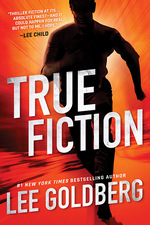
True Fiction by Lee Goldberg: A Writer on the Run

True FictionTrue Fiction

by Lee Goldberg
Series: Ian Ludlow Thrillers, #1

Kindle Edition, 248 pg.
Thomas & Mercer, 2018
Read: July 20 – 21, 2018

“Sorry I’m late,” Ian said. “I’ve been on the run all morning.”

It was a line worthy of Clint Straker and Ian knew it. He couldn’t stop being a writer, always thinking of the next line in one of his thrillers. But he was living a thriller now and it was no thrill at all.

This is one of those books that’s super easy to write about — if you like the premise of the book, you’ll like the book. It’s just that simple. The tricky part is finding someone who wouldn’t like this premise.

Ian Ludlow, television writer turned thriller novelist, can’t believe his eyes — a terrorist attack in Hawaii went exactly the way that he designed and he’s pretty sure that someone is trying to kill him. Ludlow was part of a group of writers (movie, TV, novelists) that came up with some scenarios for the CIA that terrorists might use, so the CIA could design counter-measures. This is a thing that actually happened (maybe still does) following 9/11, because writers have much better imaginations than government employees do. One of those scenarios is playing out in real life and Ludlow doesn’t know what to do. Clearly someone out there doesn’t want Ludlow spreading the word that he’s the source for this attack.

Before he realizes what’s happening, Ludlow is running for his life and has dragged Margo along with him. Margo’s a dog-sitter, house-sitter, aspiring musician, and occasionally drives authors visiting Seattle to their signings. That’s how this poor girl gets sucked into Ludlow’s mess — she saves his life (and then he returns the favor), dooming her to having to run with him.

Add in some over-the-top villains (I hope, see below), and Goldberg’s signature wit and solid writing, and you’ve got yourself a winner.

This is a fast fun ride featuring about the most unlikely of all thriller protagonists. Ian Ludlow isn’t really in any kind of shape; he has no skills with hand-to-hand combat, cars, or weapons — his people skills are suspect, really; all he has going for him is a pretty agile mind. Margo’s a little better off, but not much. They quickly run to the home of one of Ian’s friends who lives off of the grid and is paranoid enough he’ll believe their story. Which may not really be the strongest of qualifications, but they can’t afford to be choosy. The three of them will have to figure out a way to survive — and possibly stop whoever it was behind the attack.

Does anyone else remember Condorman? The Disney film about a comic book writer/artist who accidentally (very accidentally) becomes a super-spy? I was 7 or 8 when it came out and loved it. Anyway, I had a flash-back to that when Ludlow stumbles his way into taking out one of the many assassins that come after him — one of the many times I had an honest audible response to this book (not a book I recommend reading in an ICU ward, for what it’s worth, people tend not to like noises there).

Now, I called the villains over-the-top. I’m not really sure they are — they seem over the top, but there’s a little part of me wonders how hard it really would be for someone to pull off something like this. John Rogers, of Leverage, frequently talked about how some of their over-the-top bad guys were watered down versions of the real thing (because no one would believe the real thing). Take my word for it, I don’t have time to track him down saying it. Let’s put it this way — they’re perfect for this book, and like just about every thriller villain ever, it’s best that they stay inside the book.

While he’s telling a very fun story, Goldberg takes a little bit of time to satirize thrillers, thriller writings, and thriller heroes — I loved every bit of that. It helps that Goldberg writes and reads the same books he’s satirizing, so you know he does it with love and honesty. Some of the excerpts from Ludlow’s books are just awful, it must’ve been hard to write (but so much fun). Ditto for the TV shows that Ian’s friend Ronnie starred in, I really hope that those are things that Goldberg made up for this book (and fear they aren’t).

This feels like Goldberg and Evanovich’s Fox & O’Hare books, or maybe The Man with the Iron-On Badge (which features a protagonist only slightly more likely than Ian) — not his more serious work like King City. The story moves quickly, deftly and will leave you smiling — I can’t imagine Goldberg writing a disappointing book at this point, I just don’t think he can. Pick this up, you will be entertained.

—–

4 Stars

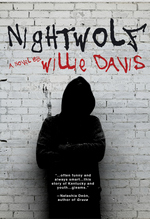
Nightwolf by Willie Davis: A beautifully written book about some horrible people

NightwolfNightwolf

by Willie Davis

Kindle Edition, 286 pg.
7.13 Books, 2018
Read: July 12 – 16, 2018

The police thought they collared Nightwolf. The newspapers kept cagey about it, saying the cops book a person of interest in a “prolonged vandalism case.” Prolonged vandalism–like the tagger had writers block and agonized for weeks, and then returned to the scene of the crime to erase a comma.

In the first three paragraphs, our narrator, Milo Byers sets the stage and the tone for what is to follow — a killer introductory section that is irreverent (at best, cynical, jaded, and — simultaneously — honestly optimistic.

We are then thrown into a giant mess surrounding the culture of runaways and poor teens in Lexington, KY. Dropouts, petty criminals, not-so-petty criminals with aspirations of greater crimes, drug dealers, addicts, users, the mentally ill, the ignored, the abused, and their friends create an interesting cultural web for Milo and his associates to move in. At this time, I’m not sure Milo actually has any friends (at least not to his knowledge), but he is constantly surrounded by people.

Milo’s not technically a runaway — he goes home to his mother frequently, but his mother’s dealing with dementia and other problems, so Milo’s practically orphaned. He had (has?) an older brother who left home a few years before, and no one’s heard from him since. Theoretically, that’s why Milo spends time with some of the criminal class — they knew his brother, and he’s sure that he’ll get a clue if he just hangs around enough.

Also running around the city is Nightwolf. He’s a graffiti artist who dabbles in vigilantism (and not wholly successfully) — a folk hero of sorts. For reasons I’ll let Milo explain, he’s got a theory that Nightwolf is his brother. Now he just needs to meet him to unmask him, hopefully finding his brother — and everything will make sense for him. Despite the book’s title, Nightwolf is a relatively minor character — but his presence (or lack thereof) hovers over just about everything we see Milo do.

Now, all this time — I don’t like Milo. He’s not got a lot going for him as a character, he’s a weasel, he lies to himself and everyone else in his life constantly (and frequently without reason) — it’s not that he’s a criminal, there’s at least something defining the character then. I just didn’t care about him, or about what happened to him. Honestly, he’s the best of the bunch — among this cast of characters he’s the most sympathetic, the most reliable, and the most tolerable. Frankly, I spent a lot of time wondering just what the point of this book was — I didn’t dislike the book, just everyone in it and just about everything they did.

(Small spoiler) Now, at 60% there’s a pretty big time jump. I was totally unprepared for that — and enjoyed someone saying, “Time moves too fast” two chapters later. I was initially annoyed because in many ways this jump ended things before I was ready for them to be ended. But it didn’t take me too long to figure out that pretty much everything before was setting the stage for Part Two. Yes, you could argue that sixty percent of a novel is too long to spend on the introduction — and typically you’d be right. But Davis makes it work. The characters have matured enough, have enough distance from the acts of the first part, and have seen what’s happened since then to those involved, etc. The last forty percent of the novel worked for me in ways that the first didn’t, but it wouldn’t have been able to without the foundation laid.

Whenever I’d brush up against “Southern” fiction in my lit classes in college — those stories/novels became my favorite in the course, and I’ve often intended on taking a year or so to do some sort of deep dive into that tradition — but I haven’t gotten around to it. I should see if there’s an iTunesU (or equivalent) covering that. Anyway, I’ve gotten distracted here. My point is that I can see a direct line from Faulkner and Flannery O’Connor to Willie Davis — particularly the latter. She’d be disappointed in Davis’ attitude toward religion, I think, but she’d note a kindred spirit, I think. That should give you a spirit of the flavor of the novel — agnostic, 21st century O’Connor-ish.

Better yet? Davis has the talent to pull that off. Even when I didn’t like the characters (and I mean “actively disliked” not “didn’t appreciate yet”) and wasn’t sure I wanted to know more about what was happening to them — I could not stop reading the writing. When I didn’t mind the characters and felt a certain apathy toward the plot, I couldn’t stop reading the writing. When I sorta kinda maybe liked one or two of the characters and was curious where things were going — I could not stop reading Davis’ writing. I think you get what I’m saying here. Davis’ writing is worth the hassle. I’m not going to try to explain it really — I don’t think I could. Just go with me on this. At the 9% mark, my notes read “horribly ugly world — beautiful prose.”

The book is funny (not really because of events, it’s largely in the narration), sad, thoughtful, mournful, provocative, visceral, offensive and strange (in the most positive sense of the word). It’s not one for a quick casual read, but will reward the effort. For most of the book — and maybe even now (I’m unconvinced) — I didn’t care what happened, ultimately, I just wanted to see what Davis would do with ideas and language (not that I wasn’t ultimately pulling for a few things to happen plot-wise). I’m not wholly satisfied with the novel — not that I can fully articulate why (beyond really not liking anyone or what they were doing for most of the book) but I have a nagging suspicion that the problems are within me, not the text. I will be keeping an eye out for Davis in the future, and suggest you do the same — but read Nightwolf first.

Disclaimer: I received a copy of this novel from the author in exchange for my honest opinion and this post.

—–

4 Stars

My Lady Jane (Audiobook) Cynthia Hand, Brodi Ashton, Jodi Meadows, Katherine Kellgren: This YA Romance/Alt-History/Fantasy is simply delightful

My Lady JaneMy Lady Jane

by Cynthia Hand, Brodi Ashton, Jodi Meadows, Katherine Kellgren (Narrator)
Series: The Lady Janies, #1

Unabridged Audiobook, 13 hrs., 47 min.
HarperAudio, 2016
Read: July 2 – 5, 2016

           You may think you know the story. It goes like this: once upon a time, there was a sixteen-year-old girl named Jane Grey, who was forced to marry a complete strange (Lord Guildford or Gilford or Gifford-something-or-other), and shortly thereafter found herself ruler of a country. She was queen for nine days. Then she quite literally lost her head.

Yes, it’s a tragedy, if you consider the disengagement of one’s head from one’s body tragic. (We are merely narrators, and would hate to make assumptions as to what the reader would find tragic.)

We have a different tale to tell.

Pay attention. We’ve tweaked minor details. We’ve completely rearranged major details. Some names have been changed to protect the innocent (or not-so-innocent, or simply because we thought a name was terrible and we liked another name better). And we’ve added a touch of magic to keep things interesting. So really anything could happen.

This is how we think Jane’s story should have gone.

So begins the Prologue to this wonderfully fun book. It’s that second paragraph — but specifically the parenthetical sentence — that locked in my appreciation for the book. Thankfully, it continued to be as good as that paragraph, but I was going to be a fan of anything that happened from that point on.

The advantage you have with historical figures that no one knows anything about, is historical novelists — particularly those who like to play with their history — can do pretty much what they want. Lady Jane Grey is probably the English monarch that people know the least about (if they know about her at all) making her perfect fodder for this story.

This is one of those books that I can’t figure out how to summarize, so I’m just going to steal the publisher’s blurb, as much as I hate doing that, but my attempts have a mess, and theirs worked:

           In My Lady Jane, coauthors Cynthia Hand, Brodi Ashton, and Jodi Meadows have created a one-of-a-kind YA fantasy in the tradition of The Princess Bride, featuring a reluctant king, an even more reluctant queen, a noble steed, and only a passing resemblance to actual history—because sometimes history needs a little help.

At sixteen, Lady Jane Grey is about to be married off to a stranger and caught up in a conspiracy to rob her cousin, King Edward, of his throne. But those trifling problems aren’t for Jane to worry about. Jane gets to be Queen of England.

Like that could go wrong.

The characters are wonderful — no one’s perfectly good, or perfectly evil (although there are a few that come close in both directions). The authors keep things moving well, never letting the story detract from the characters, or one part of the narrative take over (there’s plenty of action, romance, friendship, espionage for everyone). Yes there’s magic, yes there’s comedy, but there’s also a lot of heart — a lot of joyful storytelling. This has it all. I really can’t point to a favorite bit, or favorite theme or anything. This is just one of those books I enjoyed all of.

Inside this novel is a love letter to books — and Jane is the representative book lover par excellence (though she could like poetry and novels a bit more) — there’s a treasure trove of quotations about reading, books, and related topics in these pages. All of them delightful.

The novel is clearly clever, witty, with a lot of heart, etc., but what sealed the deal for me was Katherine Kelgren’s outstanding performance. I would’ve enjoyed the novel pretty much no matter who wrote it (I’m not sure Scott Brick or Dick Hill could’ve pulled if off, but you never know), but Kelgren absolutely sold it. Her accent work was outstanding, the life and verve she brought to the project just wowed me.

I’m blathering on, I realize — yet I’m not sure I’ve actually said anything. Bah — just grab the book or audiobook. I don’t care if you’re YA or just A, if you like romance or not, male or female — if you like a fun story that’s well told and never takes itself too seriously (but never makes a joke out of anything important), read it. You’ll have a blast.

—–

4 Stars2018 Library Love Challenge

Pub Day Repost: Kill the Farm Boy by Delilah S. Dawson and Kevin Hearne: A Comedic Fantasy Tells a Good Story While Playing with Too-Familiar Tropes

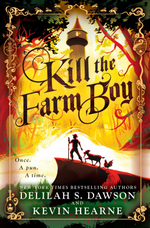
Kill the Farm BoyKill the Farm Boy

by Delilah S. Dawson and Kevin Hearne
Series: The Tales of Pell, Book #1
eARC, 384 pg.
Del Rey, 2018

Read: June 5 – 12, 2018
Ugh. I wish the eARC didn’t say I needed to hold off any quotations until I could compare it with the final copy — or maybe, I wish I had noticed that very tiny print before I got half a draft of this finished. On the other hand, I was having trouble narrowing down which of my lengthy options to use, because, if nothing else, this is one of the more quotable books I’ve read in the last couple of years.

Kill the Farm Boy is a comedic fantasy, a satirical look at fantasy and even a parody of the genre. But what makes it effective is that for all the comedy, there’s a decent story and some solid characters throughout. It’s be easy for it to be a collection of jokes, with no story; or a tale full of character types, not characters. But Dawson and Hearne avoid those pitfalls.

The titular farm boy, Worstley, is going about his typical day, full of drudgery when an inebriated pixie shows up to announce that he is a Chosen One — one who is destined to save, or at least change, the world. To demonstrate her power, the pixie gives one of his goats, Gustave, the power of speech. The goat isn’t too happy about being able to speak, but since he was destined to end up in a curry in a few days, decides to travel with the newly appointed Chosen One, his former Pooboy. The pixie, having Chosened Worstley, disappears. Worstley the Pooboy (hey, Taran, worse things to be called than Assistant Pig-Keeper, eh?) and Gustave head off on a quest for glory.

Despite the book’s title, we don’t spend that much time with Worstley — instead the focus shifts (for good reason) to a band of hero–well, a group of companions. There’s Fia — a fierce warrior from a distant land, who just wants to live a life of peace with some nice roses — and some armor that would actually protect her (not that there’s anyone who minds seeing here in her chain-mail bikini). Argabella, a struggling bard who is cursed to be covered in fur — she’s basically Fflewddur Fflam and Gurgi combined (last Prydian reference, probably). Every adventuring party needs a rogue/thief, this one has to settle for the klutzy and not necessarily bright, Poltro, and her guardian, the Dark Lord magician, Toby (though some would only consider him crepuscular), of dubious talents. I can’t forget Grinda the sand witch (no, really), Worstley’s aunt and a magic user of considerable talent.

There are no shortage of villains — and/or antagonists to this party. There are some pretty annoying elves; a hungry giant; Løcher, the King’s chamberlain and mortal enemy of Grinda; Staph, the pixie behind the Chosening; as well as several magical traps, Lastly, there’s Steve. We don’t meet him (I’m betting it’ll be in Book 3 when we do), but throughout these adventures we how much this world, and our heroes lives, have been turned upside down my the worst Steve since one (allegedly) unleashed the preposterous hypothesis that Jemaine was a large water-dwelling mammal. Steve . . .

The writing is just spot-on good. Dawson and Hearne have taken all these various and disparate themes, tropes, characters and surrounded them with a lot of laughs. There’s some pretty sophisticated humor, some stuff that’s pretty clever — but they also run the gamut to some pretty low-brow jokes as well. Really, these two are on a tight comedic budget, no joke is too cheap. The variation ensures there’s a little something for everyone — and that you can’t predict where the humor will come from. I will admit that early on I got annoyed with a few running jokes, but I eventually got to the point that I enjoyed them — not just in a “really? they’re trying it again?” sense, either.

For all the comedy — Kill the Farm Boy hits the emotional moments just right. There’s a depiction of grief towards the end (spoiler?) that I found incredibly affecting and effective. There are smaller moments — less extreme moments — too that are dealt with just right. Maybe even better than some of the bigger comedic moments. This is the reward of populating this book with fully-realized characters, not just joke vehicles.

I have a couple of quibbles, nothing major, but I’m not wholly over the moon with this (but I can probably hit sub-orbital status). There was a bit about a fairly articulate Troll being taken down by a female using (primarily) her wits that could’ve used a dollop or five of subtly. Clearly they weren’t going for subtle, or they’d have gotten a lot closer to it. But it bugged me a bit (while being funny and on point). Secondly, and this is going to be strange after the last 2 posts — but this seemed to be too long. Now, I can’t imagine cutting a single line, much less a scene or chapter from this, but it just felt a little long. I do worry that some of Poltro’s backstory is too tragic and upon reflection makes it in poor taste (at best) to laugh about her — which is a shame, because she was a pretty funny character until you learn about her.

This is probably the best comedic/parody/satire fantasy since Peter David’s Sir Apropos of Nothing — and this doesn’t have all the problematic passages. I’ve appreciated Dawson’s work in the past, and you have to spend 30 seconds here to know that I’m a huge Hearne fan, together they’ve created something unlike what they’ve done before. Well, except for their characteristic quality — that’s there. I cared about these characters — and they made me laugh, and giggle, and roll my eyes. This is the whole package, folks, you’ll be glad you gave it a chance.

Disclaimer: I received this eARC from Random House Publishing Group – Ballantine via NetGalley in exchange for this post — thanks to both for this.

—–

4 Stars

The Naming of the Dead by Ian Rankin: Rebus and Clarke find themselves in (well, next to) the middle of Global Politics.

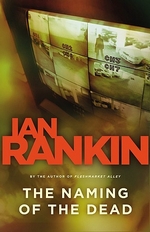
The Naming of the DeadThe Naming of the Dead

by Ian RankinSeries: John Rebus, #16

Hardcover, 464 pg.
Little, Brown and Company, 2006
Read: June 22 – 25, 2018

           “Know what I think? I think all of this is because there’s a bit of the anarchist in you. You’re on their side, and it annoys you that you’ve somehow ended up working for The Man.”

Rebus snorted a laugh. “Where did you get that from?”

She laughed with him. “I’m right though, aren’t I? You’ve always seen yourself as being on the outside–” She broke off as their coffees arrived, dug her spoon into her cappuccino and scooped foam into her mouth.

“I do my best work on the margins,” Rebus said thoughtfully.

Rebus is on the verge of retirement — really, he’s about to be forced out, he’s at the stage of his career where many detectives would be just coming into the office and doing nothing — if not outright retiring already. And, truth be told, that’s precisely what everyone in the force seems to want (except for a few allies/friends), particularly the top brass. None of which Rebus has an interest in. He’s going to have to be pulled out, kicking and screaming — probably with someone barring the door after he’s out.

So when the G8 comes to Edinburgh in 2005, the police have their hands full with security, protests, riot preparations, and whatnot. They’re importing help from all over Scotland and even England. Everyone has plenty of assignments to deal with, everyone but John Rebus, that is. So when a clue comes up that might turn into something interesting on months-old murder case, he’s ready and raring to go. That evidence seems to point at multiple victims, too — so Siobhan Clarke is put in charge of that investigation, just please keep it quiet until all the important people have gone home (and yes, everyone is fully aware of the insult of putting the DS in charge of the DI on this one). Thankfully, there’s a suspicious-looking suicide that’s related to the G8 for Rebus to focus on.

At least one of the victims in Clarke’s case has an obvious connection to Big Ger Cafferty, too. Because why not make this all interesting? Big Ger’s the target of a local politician who happens to be making a lot of waves thanks to being in all the right places during the G8 protests, sticking up for his constituents and the cause of civility in the face of civil unrest. Rebus and Cafferty do their usual thing — Cafferty wants information so he can get his form of justice taken out of the murderer, Rebus needs information from Cafferty so he can prevent that. But at the end of the day here, Siobhan spends more time with Cafferty, despite everything Rebus tries to do.

Which is the crux of this novel, really. Rebus is at his career’s end, he knows it. The closest thing he has to a legacy is DS Clarke — and he wants it to be a good legacy. He wants to keep her from Cafferty’s clutches, from the dirt that’s dogged him for years due to guilt-by-association — as well as his actual influence. At the same time, he wants her to maintain that “work on the margins” attitude, while staying in good graces with TPTB. He wants Clarke to be everything he is, just without all the bad that comes from it. (I think she wants that, too, actually). Bringing me back to the point that this novel features Rebus fighting all involved for Siobhan’s soul.

In an interesting parallel, Siobhan’s actual parents are in town to take part in the G8 protests. There’s a young woman hanging out with them, almost like a temporary daughter (which really gets under her skin). She’s determined to spend some time with them, to show herself that she can have some sort of personal life — a family — and still be a good cop. To not be Rebus. At the same time, she so wants her parents to see her as a capable detective, not just someone in the midst of a defiant reaction to her parent’s lifestyle and beliefs.

Eric Bains shows up in a light I don’t think anyone expected, and I’m hoping that things turn around for him soon. I like the guy. He’s not Brian Holmes, but he’s a nice character to have around. There’s a reporter, Marie Henderson, involved in all of this, too (that’s her opining in the opening quotation) — I really liked her, and hope we see her again. Rebus seems to actually enjoy her company and intelligence — at the same time, as the co-writer of Cafferty’s biography, she represents everything that Rebus fears for Clarke.

I’ve not spent a lot of time talking about the cases — which are interesting enough, and watching Rebus not be careful around Very Important People from all over the world is fun. But on the whole, the cases felt familiar. Like we’ve been down these roads before — not exactly, and both held plenty of surprises, but they seemed like familiar Rebus/Clarke investigations. I might have been tempted to give his a 3-Star rating and move on.

BUT, Rankin won’t let me — because putting all of this right smack in the middle of the G8 conference — and the hullabaloo surrounding it (protests, concerts, marches) — the Bush bicycling incident, the London bombings, and the announcement of the Olympics coming to London — added so much to the novel. It grounded it in reality, it presented so many obstacles to the investigations (as well as distractions from the investigations) — as well as unexpected sources of help (police officers from other jurisdictions that had just the right kind of information). Plus all the “keep Siobhan from becoming Rebus” elements of the novel just captivated me.

Another winner. What else is there to say?

—–

4 Stars2018 Library Love Challenge

Born to the Blade 1.11: All the Nations of the Sky by Michael Underwood: Season 1 Wraps Up in a Strong and Sufficient Manner — but will leave the audience wanting more

My post about 1.10 was supposed to run 6/22, but I apparently only saved it as “Draft,” so it went up late on 6/28 (so glad I pushed off sleep last week to get it done), and then my thoughts about episode 1.11 were delayed a couple of days by not being able to push off sleep, but assuming I clicked the right buttons you still will get to read them when they’re fairly fresh. In a day or two I’ll have some thoughts on Season 1 of Born to the Blade as a whole — which will include some interaction with comments Bookstooge left a couple of weeks ago. Anyway, on to All the Nations of the Sky, the season finale.

All the Nations of the SkyAll the Nations of the Sky

by Michael R. Underwood
Series: Born to the Blade, #1.11

Kindle Edition.
Serial Box, 2018
Read: June 28, 2018
I’m going to try to keep my thoughts to this episode, but I won’t promise that I’ll succeed.

Somewhere between episodes 10 and 11 Michiko made a pretty big decision. Okay, she made a huge decision — and we only get to see the result, not the thought process — this is annoying, but I can live with it, if I have to (and, by the by, we know she found something in the paperwork that her predecessor left of interest to the current goings-on, but we’re not told what, this also is annoying). Part of the story-telling style that Born to the Blade is employing leaves us open to this kind of thing, so it’s to be expected — I’m just not crazy about it. Still, while I’m excited for what this means for Michiko, her nation, and the narrative opportunities for Season 2, I do regret what it means for some of the character interaction I’ve been enjoying all along. That’s all I’ll say about that now.

Also, I couldn’t help but feel that some of the progress made between Kris and Adechike last week has been walked back a bit — some of which I understand, most of which I want explained before I can get on board wholly. But I don’t see that happening. Still, I liked (both as a fan and as someone who’s trying to look at the series through an armchair-critical eye) what both Adechike and Kris did throughout this episode.

We got a long-awaited duel in this episode (like last episode), it didn’t end the way my fan-boy impulses wanted it to, but did end the way it needed to. It’s the kind of thing I think I expected the series to be built on — and if a certain little war hadn’t happened, probably would have.

Every jot and tittle about Ojo in this episode was perfect, and I wouldn’t change a thing. I can’t say any more, but this was spot-on.

I’m not sure what else to say at this point without venturing into spoiler territory, so I guess I’ll wrap it up.

Now, it’s easy — very easy — to forget about one nation of the seven — Tsukisen, and their warder, Hii no Taro. Yes, it’s explained a few times — but anytime Tsukisen is mentioned, it only seems to underline how often they aren’t. This can be improved — Underwood had a great opportunity here to fix that, and he passed. Which is okay, he’s not the only one who had the opportunity, and I can only assume that this means that there’s a plan behind it. I do hope that’s rectified quickly in Season 2. And this point probably belongs more to the season-long wrap up post I’m trying to do, but I wanted to get it down before I forgot.

This has been dubbed as “Season 1” since the beginning, so we knew everything wasn’t going to wrap up nicely. In fact, there’s a lot that’s left hanging. But we got enough resolution to leave readers satisfied with where things left off. I do hope that Serial Box gives this team another shot to tell their story because I’m very curious about a few things and characters. But for now, we’re left with an optimistic, but not a rose-colored glasses, ending — true to the vision of the initial episodes, but with a darker undercurrent than one might have guessed from the first couple of installments. I’m not wholly sold on everything that happened this season, but I’ve come to accept and appreciate 96% of it — and I will probably come around on the rest eventually.

A good story, a good cap to the season and a good launching point for a potential Season 2. I’m just going to stop before I say “good” again — pick up season 1 now, if you haven’t yet.

—–

4 Stars

Born to the Blade 1.10: Shattered Blades by Marie Brennan: An exciting penultimate episode that’s sure to please

ACK! I apparently never took this off of draft mode! I thought this ran last Friday! Whoops!!

Shattered BladesShattered Blades

by Marie Brennan
Series: Born to the Blade, #1.10

Kindle Edition, 58 pg.
Serial Box, 2018
Read: June 21, 2018

           The Warders’ Circle was supposed to prevent this kind of thing. It gave the nations a way to settle their disputes without warfare, with the limited and ritualized violence of a duel. But that only worked if people believed in it. It was a game, and everyone had agreed to play by its rules.

Until they didn’t.

Sure, there were still warders on Twaa-Fei. Juniors thrust into the role of seniors, unwilling and unprepared and, worst of all, unsupported. Their nations had abandoned them to play out what remained of this farce, while behind that disintegrating cover of civility they prepared for and carried out war.

Nations on the brink of war (well, just on the wrong side of the brink), almost everyone’s favorite diplomat the target of assassins (favorite of readers and almost every other diplomat), relationships torn apart — the home of the Warders, Twaa-Fei itself, is being ripped apart by violence. The stakes really couldn’t be much higher.

But this episode isn’t about the stakes for the nations (not that those are uninvolved — it’s just not the focus): it’s about Michiko making some important choices and acting on them, in ways that will leave her life (and potentially the lives of the people she represents) changed forever; it’s about Takeshi finding what’s been missing (I hope); it’s about Kris and Adechike getting all their priorities straight; and about a few other things that I can’t talk about.

In the midst of all this character growth, character development and conflict — we get two knockout duels. Not the civilized, controlled, formal duels of Kris’ trials, either — we’re talking two people who unleash everything they have — magic and swordcraft alike — at each other. Brennan absolutely sold this part.

This episode was everything I wanted — great character moments, better action sequences — and every character (finally) not worrying so much about playing politics, but about doing the right thing (even if it’s the wrong thing for someone else). My notes have me writing twice “this is the high point of the series (so far),” and there’s at least one other candidate for that moment in these pages. I’m hoping that the season finale continues the uptick we’ve been on for the last couple of weeks.

—–

4 Stars

The Wrong Side Of Goodbye by Michael Connelly: Bosch takes on a new role, and gives the same solidly entertaining result.

The Wrong Side Of GoodbyeThe Wrong Side Of Goodbye

by Michael Connelly
Series: Harry Bosch, #19

Paperback, 386 pg.
Grand Central Publishing, 2017
Read: June 20, 2018
Not shockingly at all, retirement doesn’t sit well for Harry Bosch. As we saw in The Crossing, neither does working for defense attorneys. So what’s a guy like Harry Bosch — with that strong sense of mission driving him for decades — to do with himself when the LAPD forces him to retire?

Naturally, he’s going to get a PI license and do what he can with. But there’s going to be a dearth of clients that want him to investigate the kind of crimes he’s driven to investigate. Thankfully, the San Fernando Police Department is suffering a horrible budget crises and can utilize him as a reserve police officer looking at cold cases (this is an actual thing that happens, and was suggested by a member of the SFPD to Connelly as something for Bosch). This is work for free, true, but anyone who thinks that Bosch is driven by money in any real sense hasn’t talked to him for five minutes.

Bosch is hired by an elderly billionaire (at least), to hunt down a potential heir to his empire — his family “forced” him to abandon a lower-class woman after he impregnated her in the 50’s, and now looking at his mortality rushing to meet him, he wants to pass things on to his heir. He doesn’t have much to give Harry to start from — a name, an employer, and a time frame. That’s it. He needs Harry to keep this to himself — and has him sign a very tight non-disclosure agreement — because he doesn’t trust anyone in the company he’s the head of. He’s right not to trust anyone, as Harry quickly learns, but that’s a whole ‘nother story.

This case grabs Harry’s attention, particularly when he becomes convinced that he’s tracked down the heir — who served in Vietnam at the same time Harry did. In fact, Harry’s reasonably sure that they were briefly on the same ship at the same time. In addition to this being very interesting, watching Harry backtrack this man’s family — this focus on Vietnam gets Harry to reflect some on his time there, and even discuss a bit with Maddie. I think this is the most that Harry has talked about Vietnam since The Black Echo (feel free to correct me in the comments), and I appreciate reminding us where the character comes from.

As interesting as that is — both through the procedure Harry enacts, what’s revealed about the case and himself, plus the surprising amount of peril that beings to follow him — the other case that Harry’s looking into is more up his alley.

In the course of his duties as a reserve officer, he’s been looking through cases that haven’t been closed — the one he’s focused on now isn’t a murder (as you’d expect), but is a serial rapist. Between the way the cases were reported, the staffing problems SFPD has, some jurisdictional issues, and (most importantly) language barriers, it wasn’t until Harry started reading all the case files he could get his hands on that patterns started to emerge and a coherent picture of one criminal’s work became clear. The SFPD detective that Harry’s working with, Bella Lourdes, seems like a solid detective — probably not as obsessive as Harry, but a dedicated detective. She’s able to handle the interview side of things better than Harry, actually (see the language barrier, among other things). As things heat up with the other case, Harry can’t get away and Lourdes ends up carrying the water on vital aspects of this by herself. It’s one of the healthier partnerships Harry’s had, really. But don’t worry — at the end of the day, this is a Harry Bosch novel. Not a Harry and Bella. Harry’ll put all the pieces together — but not early enough to keep things from getting pretty harrowing for all involved.

MIckey Haller shows up briefly early on, and I thought “oh, that was a nice cameo.” But at some point, he becomes a strong supporting character — as important to the private client storyline as Lourdes was to the serial rapist. I appreciated the smooth way that Connelly merged Haller into this novel. But that’s not all — Harry spent a moment thinking about Jerry Edgar (is that the influence of the Amazon series, or just Harry getting retrospective?) and there was a completely unnecessary — but nice — little appearance by Det. Lucia Soto. Unnecessary to the plot, but it shows something about Harry, I think, that wouldn’t have described him a few books ago.

The mysteries themselves are a shade on the easy side for this series — but the fun in this comes from watching Bosch chip away, step by step, through the process. Sure, he cuts a corner or five, makes several lucky guesses — but we’re not looking for verisimilitude here, right?

That said, there were several moments in the latter third or so that I assumed I had everything worked out — and I was right as much as I was wrong. Connelly didn’t cheat, but he zagged a lot when I was sure he was going to zig. At this stage of the game, for Connelly to be able to fool me that often, that says plenty about his skill.*

A good ride for old fans — a decent (not excellent, but acceptable) place for a new reader to jump on — The Wrong Side of Goodbye capably demonstrates why Michael Connelly in general, and Harry Bosch in particular, has been at the top of the American Crime Fiction scene — and likely will stay there for quite some time.

*Sure, it could say something about me, and what kind of reader I am, but let’s give credit ot Connelly’s craft and not my gullibility, shall we?

—–

4 Stars

Page 50 of 88

Powered by WordPress & Theme by Anders Norén