Tag: 4 Stars Page 51 of 88

The Last Cleric by Layton Green: The Blackwood brothers are on their own in their new world and the danger is getting real

The Last ClericThe Last Cleric

by Layton Green
Series: The Blackwood Saga, #3

Kindle Edition, 374 pg.
Cloaked Traveler Press, 2018
Read: June 18 – 19, 2018

Urfe sometimes felt like a waking dream, the realization of both his wildest fantasies and darkest nightmares.

That’s fairly early in the book, too — I’m sure by the end of this, Will will be thinking less of his wildest fantasies, focusing on the nightmares instead. Which isn’t that surprising, it’s book three of a quintet — things aren’t supposed to be sunshine and rainbows (although things are going to get worse).

Will and some others are off on a quest to recover the Coffer of Devla — an Ark of the Covenant-esque religious relic and object of prophecy. The Revolution would profit greatly from taking it into battle with them — for psychological/propaganda’s sake, if nothing else. This quest takes Will, Yasmina, Mala, and a few others to the jungles of Mexico to find a mythic pyramid that may house the Coffer. We’re treated to an annoying amount of Will pining after Mala, Mala taking advantage of that a few times, and Will not learning anything. I do find his hangup over her annoying, but it’s about the only thing about Will’s character that is that flawed, so it’s good to stress his imperfection and naiveté, I guess. This storyline frequently felt like it escaped from a Rick Riordan Book (one scene in particular) — a series of tests, and narrow escapes leading to other tests. That said, when Percy or his friends fail and/or don’t succeed fast enough, the consequences aren’t as bad as they are for Will and his companions, which makes them far more entertaining to read than the most recent Riordans.

Caleb stays behind and fills his days with doing small acts around the city to help people, and his nights with getting as drunk as is humanly possible. He may not have had tremendous success on Earth, but he had his niche and he did okay with it. On Urfe, he didn’t even have that, so he turned to drink. Until the only person in two worlds who could possibly get him to stop — or at least consider moderation — shows up and does just that. Caleb soon goes on a mission to warn those living in the Blackwood Forrest about the danger coming from Lord Alistair and try to recruit them to the Revolution. On the whole, this story goes exactly like you expect it to — but it was probably the most effective of the three brothers’ arcs in this book. There were parts of this story you couldn’t see coming — at all — but once those events were introduced, it quickly became inevitable to see how those would flow into the overall storyline. Predictable isn’t bad — I’ve said it before, I’ll keep saying it — it really doesn’t matter how surprising or unexpected your story is, what matters is how you tell it. And Green tells this one just right.

Which leaves us with Val — things were looking pretty bad for him when we saw him last, and in the few days that have passed between then and this novel’s kick-off, things have continued in that vein. He does some pretty clever and daring things to try help his situation, and then finds an opportunity he can’t turn down. He essentially has to try to carry off a suicide mission for the Queen. If he succeeds, he’ll be set free. If not . . . well, the Queen or Congregation still won’t execute him, because he’ll be dead. He assembles a team — including faces you wouldn’t expect — and sets off. This storyline is the most inventive, least predictable and most harrowing of the three (which at times is saying something). Somehow, in the middle, it’s also the most dull. But never for long, I want to stress. The people that Val is surrounded by, their perspectives and what Val goes through are all shaping him — for the one who had the hardest time coming to terms with the world he found himself in, Val’s really taken to it in a way his brothers haven’t quite. Without noticing it, Val’s become a different person than he was when he first came to Urfe — and I’m not sure any Blackwood is going to be happy with the differences once they’re seen in light of day. I’m not saying he’s been seduced by the Dark Side or anything — bu he definitely approaches things from a different angle.

Meanwhile, Lord Alistair continues his bloodthirsty and power-hungry machinations at the top of the Congregation.

We meet a lot of new characters in each of the storylines (especially Will’s and Val’s) — there’s not a one of them that I wouldn’t want to spend more time with. Several of them we won’t see again, alas, but…the others? I hope we get a lot of. While I enjoyed it, I know that I came across as ambivalent towards Will’s quest — but the people he travels with are welcome additions to this cast and I didn’t get enough time with them for my taste. The other new characters were about as good, but I thought we got as much time and use from them as we needed.

The first book kept the brothers together — on the whole, there were times the group was split. In The Spirit Mage, Green split them up so we had Will and Caleb running around Urfe trying to stay out of trouble (and failing miserably); while Val took awhile to return and then was in a completely different kind of story. This time, Will and Caleb are split up so we get each brother doing something on his own. I get the desire for that move, and the narrative need — or usefulness, depending how you look at it — for that move, I really do. But man, I didn’t like it. I expected it was too much to ask to see the three Blackwoods reunited early in the novel, but (incredibly minor spoiler) now whenever they do reunite, I’m afraid what they’ve gone through will make it unlikely to be co-belligerents, much less allies. Again, I get why it was done, and will probably appreciate it by the end of the series — but in the moment, I don’t like it. it. The Brothers Three presented them as an interesting, if very flawed, team. Which was one of the things I appreciated most about the characters — keeping them from interacting takes a little of that away.

That said, Green did a great job balancing the various stories — watching each brother get a little closer to their goal, and then slipping in a reminder of what Alistair’s up to. Almost as if he’s saying, it really doesn’t matter how the Blackwoods do against these tasks, the Big Bad is out there waiting, and they’re not reading for him. There’s good character development, some good plot progression — and you can feel things going worse for the brothers, and that it’ll continue in that fashion for a while — until sometime in book 5, is my guess. Now it’s just a matter of hoping that the three of them — and as many of their friends as possible – make it through to the finale.

I had a blast reading this — there’s really little about this series that I don’t enjoy (and those aspects are all just matters of taste, really). Volume 4 is on the top of my “Waiting impatiently for” list — just under Jim Butcher and Patrick Rothfuss. It’s a great series and The Last Cleric just served as another piece of evidence for that. I really recommend all of them.

Disclaimer: I was provided with a copy of this novel by the author — which I greatly appreciate, even if it took me a few months to get to it. This gift did not influence my opinion beyond giving me something to have an opinion on.

—–

4 Stars

This Thing of Darkness by Harry Bingham: DC Fiona Griffiths solves a impossible crime or two in this compelling read

I didn’t do justice to my notes below — just took too many of them –but I’m hoping I did justice to the book. If there’s something you think needs expanding — well, that’s just one reason for the comment section…

This Thing of DarknessThis Thing of Darkness

by Harry Bingham
Series: Fiona Griffiths, #4

Kindle Edition, 576 pg.
Orion, 2015
Read: June 13 – 16, 2018

I think police rules matter and I’ll try to abide by them. But the dead matter more. Their rules are sacred and they last for ever.

For a change, Fiona Griffiths is making a serious, concerted effort to act the way that a Detective Constable is supposed to — crossing Ts, dotting Is, using warrants, court orders, rules of evidence, and so on — I’m not saying she’s successful at it, but she made an effort. Sure, she had to set the rules to the side in the beginning, and the had to put them in the dustbin towards the end — but during that middle part? She came awfully close to being a proper DC from Planet Normal.

So, Fiona is assigned to help out in Evidence Collection — going through all the gathered evidence, cataloging, tracking, documenting the chain of custody, etc. for a major sexual assault case. She has no use for the lead investigator — and the feeling is mutual — but she’s quite skilled at this sort of thing, so she has to stay on the case. Meanwhile, she’s also studying for the Detective Sergeant’s exam (or she’s supposed to be) — her superiors have very high expectations for her. Oh, and she’s been given a stack of cold cases to leaf through to keep her mind engaged. Two of this stack of cases catch her eye — and because she’s Fiona Griffiths, it turns out that her curiosity was piqued by cases that turn out to be more than anyone expected.

In one case, some very valuable art was stolen from the second floor of a home — all the security was located on the first floor, and there’s absolutely no indication that the first floor was accessed at all. Yet (with no obvious sign of break in), the second floor was picked pretty clean. There’s also an accidental death as the result of a fall from a rocky path near a cliff where a man who’d been drinking was walking at night. It’s not long before she’s able to demonstrate one solid explanation for the break-in, why it happened the way it did; she’s able to demonstrate that the accidental death wasn’t one, and is able to identify similar crimes. From there…well, things get complicated.

On the one hand, what Fiona and her colleagues uncovers is one of the most outlandish, hard to believe schemes I can remember in crime fiction. On the other hand, I just know that there are probably actual crimes that make this look pedestrian, and it wouldn’t surprise me if there are real life analogues to the crimes in this book. Also, when Fiona starts putting pieces together and explaining things to her superiors, it all makes sense in a way that you can’t believe you didn’t figure it out a dozen pages before her.

Naturally, this book puts Fiona in a couple of very difficult situations — and both make what she’s gone through before seem somewhat tame. Part of this takes place on a fishing boat in the Atlantic — I make no bones about it, I need to be on land. I cannot handle being on anything in the ocean for longer than…4 minutes. Reading those portions of this book were pure horror for me. I’m not going to slap a Trigger Warning on this or anything, but you might want to consider popping a Dramamine. Watching Fiona endure these extremes, while keeping her wits (mostly?) about her, planning her way out of them, and dealing with her mental health issues — it makes for great reading. Pure and simple.

Meanwhile, Fiona is making strides in her personal life, growing as a person — finding her relationships with her exes evolve and mature. Forging new relationships, realizing how to recognize attraction to someone, forging friendships, etc. She is getting closer to her goal (whether or not she’ll ever reach it, I don’t know, but she’s closer) of a “normal” life. Also, thanks to the mentorship and guidance (frequently firm) of her superiors, she’s advancing at work. Sure, she spends a lot of time stuck processing evidence — but that just adds fuel to her creative fire when she is investigating and coming up against brick walls. Also, the last chapter features some of the most overtly “fun” writing in the series — and that’s due to the relationships with her superiors developing the way they do.

It would’ve been very easy for Bingham to crank out a few books about the quirky and charmingly unbalanced Fiona acting like a maverick cop, investigating on her own and finding ways to justify everything for the brass. Instead, we see Fiona wrestling with her condition, making progress (and then regressing) with it — yet finding ways to integrate professionally and personally with others.

Not only that, but Fiona makes significant progress on the two ongoing investigations she’s been handling on her own since the first book — there’s been some incremental progress when it comes to tracing her personal history, and her campaign to learn more about those who were tied to the ringleader in Talking to the Dead in the last couple of books — but she makes strides greater than I really ever wondered if she would in this book — and I know she’s not done yet.

That reminds me — this novel revisits (in at least some small way) the victims and perpetrators of the cases in the firs three books in the series. Not many mysteries do that, but Bingham makes sure that Fiona can’t shake the ghosts of the cases she’s worked — no matter how they resolved.

There’s really very little that Bingham and Fiona don’t do well in this layered novel — whether we’re dealing with one of the many criminal investigations, her personal grown, or just understanding herself better, this book does a great job with everything. I am always forgetting how much I like these books, and just how good Bingham is — I’m not sure why it’s something I need reminding of. The balance of mystery, thriller, and character study is really outstanding. Obviously, if you watch Fiona’s growth from the get go, you will appreciate what happens in these pages better. But this would work as a jumping on point, too.
Definitely recommended.

—–

4 Stars

Born to the Blade 1.9: Assassination by Malka Ann Older: Many things happen — some even positive — in this very strong entry to the season.

AssassinationAssassination

by Malka Ann Older
Series: Born to the Blade, #1.9

Kindle Edition, 43 pg.
Serial Box, 2018
Read: June 14, 2018

I take it all back — every hesitation I’ve expressed over the last couple of weeks — this episode fixed everything.

Well, no, not really. But man, it’s close enough to justify a little hyperbole. This has none of the weaknesses or shortcomings of the last couple of episodes — there’s some good action, the plot moves forward, there’s some great character moments and the reader isn’t left wondering about what’s going on. There’s one character’s action that you can’t be positive about, and there’s something that happens in the closing paragraphs that you can’t know everything about — but you will soon into episode 10. But those are different from being aware that there’s a lot going on and you don’t get to see or know about it.

This takes place in the shadow of the events of last week’s episode, kicking off mere hours later, and carries you at a great pace through the next events.

Adechike and Ojo have a confrontation about their nation’s actions (and some of Ojo’s) and I found myself rooting for the junior warden — not something I’d have expected even a week ago. Michiko’s investigation bears some fantastic fruit. Takeshi learned more than he expected to — and possibly kicks off another sub-plot (who doesn’t want one so close to the end?). And the other wardens find themselves forced to react to the embryonic war.

This far into the series, it continues to be difficult to talk about the events without ruining things for people who have yet to start the series, so hopefully this was enough. This was a very strong entry — the strongest since episode 4 or 5, and one that bodes well for the end of this season.

—–

4 Stars

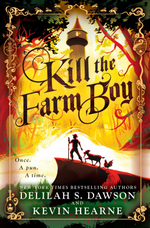
Kill the Farm Boy by Delilah S. Dawson and Kevin Hearne: A Comedic Fantasy Tells a Good Story While Playing with Too-Familiar Tropes

Kill the Farm BoyKill the Farm Boy

by Delilah S. Dawson and Kevin Hearne
Series: The Tales of Pell, Book #1

eARC, 384 pg.
Del Rey, 2018

Read: June 5 – 12, 2018
Ugh. I wish the eARC didn’t say I needed to hold off any quotations until I could compare it with the final copy — or maybe, I wish I had noticed that very tiny print before I got half a draft of this finished. On the other hand, I was having trouble narrowing down which of my lengthy options to use, because, if nothing else, this is one of the more quotable books I’ve read in the last couple of years.

Kill the Farm Boy is a comedic fantasy, a satirical look at fantasy and even a parody of the genre. But what makes it effective is that for all the comedy, there’s a decent story and some solid characters throughout. It’s be easy for it to be a collection of jokes, with no story; or a tale full of character types, not characters. But Dawson and Hearne avoid those pitfalls.

The titular farm boy, Worstley, is going about his typical day, full of drudgery when an inebriated pixie shows up to announce that he is a Chosen One — one who is destined to save, or at least change, the world. To demonstrate her power, the pixie gives one of his goats, Gustave, the power of speech. The goat isn’t too happy about being able to speak, but since he was destined to end up in a curry in a few days, decides to travel with the newly appointed Chosen One, his former Pooboy. The pixie, having Chosened Worstley, disappears. Worstley the Pooboy (hey, Taran, worse things to be called than Assistant Pig-Keeper, eh?) and Gustave head off on a quest for glory.

Despite the book’s title, we don’t spend that much time with Worstley — instead the focus shifts (for good reason) to a band of hero–well, a group of companions. There’s Fia — a fierce warrior from a distant land, who just wants to live a life of peace with some nice roses — and some armor that would actually protect her (not that there’s anyone who minds seeing here in her chain-mail bikini). Argabella, a struggling bard who is cursed to be covered in fur — she’s basically Fflewddur Fflam and Gurgi combined (last Prydian reference, probably). Every adventuring party needs a rogue/thief, this one has to settle for the klutzy and not necessarily bright, Poltro, and her guardian, the Dark Lord magician, Toby (though some would only consider him crepuscular), of dubious talents. I can’t forget Grinda the sand witch (no, really), Worstley’s aunt and a magic user of considerable talent.

There are no shortage of villains — and/or antagonists to this party. There are some pretty annoying elves; a hungry giant; Løcher, the King’s chamberlain and mortal enemy of Grinda; Staph, the pixie behind the Chosening; as well as several magical traps, Lastly, there’s Steve. We don’t meet him (I’m betting it’ll be in Book 3 when we do), but throughout these adventures we how much this world, and our heroes lives, have been turned upside down my the worst Steve since one (allegedly) unleashed the preposterous hypothesis that Jemaine was a large water-dwelling mammal. Steve . . .

The writing is just spot-on good. Dawson and Hearne have taken all these various and disparate themes, tropes, characters and surrounded them with a lot of laughs. There’s some pretty sophisticated humor, some stuff that’s pretty clever — but they also run the gamut to some pretty low-brow jokes as well. Really, these two are on a tight comedic budget, no joke is too cheap. The variation ensures there’s a little something for everyone — and that you can’t predict where the humor will come from. I will admit that early on I got annoyed with a few running jokes, but I eventually got to the point that I enjoyed them — not just in a “really? they’re trying it again?” sense, either.

For all the comedy — Kill the Farm Boy hits the emotional moments just right. There’s a depiction of grief towards the end (spoiler?) that I found incredibly affecting and effective. There are smaller moments — less extreme moments — too that are dealt with just right. Maybe even better than some of the bigger comedic moments. This is the reward of populating this book with fully-realized characters, not just joke vehicles.

I have a couple of quibbles, nothing major, but I’m not wholly over the moon with this (but I can probably hit sub-orbital status). There was a bit about a fairly articulate Troll being taken down by a female using (primarily) her wits that could’ve used a dollop or five of subtly. Clearly they weren’t going for subtle, or they’d have gotten a lot closer to it. But it bugged me a bit (while being funny and on point). Secondly, and this is going to be strange after the last 2 posts — but this seemed to be too long. Now, I can’t imagine cutting a single line, much less a scene or chapter from this, but it just felt a little long. I do worry that some of Poltro’s backstory is too tragic and upon reflection makes it in poor taste (at best) to laugh about her — which is a shame, because she was a pretty funny character until you learn about her.

This is probably the best comedic/parody/satire fantasy since Peter David’s Sir Apropos of Nothing — and this doesn’t have all the problematic passages. I’ve appreciated Dawson’s work in the past, and you have to spend 30 seconds here to know that I’m a huge Hearne fan, together they’ve created something unlike what they’ve done before. Well, except for their characteristic quality — that’s there. I cared about these characters — and they made me laugh, and giggle, and roll my eyes. This is the whole package, folks, you’ll be glad you gave it a chance.

Disclaimer: I received this eARC from Random House Publishing Group – Ballantine via NetGalley in exchange for this post — thanks to both for this.

—–

4 Stars

Rubicon by Ian Patrick: A thrill-ride that will stay with you long after the action ends.

RubiconRubicon

by Ian Patrick
Series: Sam Batford, #1

Kindle Edition, 232 pg.
Fahrenheit Press, 2017
Read: May 31 – June 2, 2018

. . . there’s no money in policing unless you cross the line.

But that doesn’t mean that Sam Batford isn’t going to try.

Batford is an undercover police officer who’s after a kingpin of some repute and his guns and drugs importing. DCI Klara Winter is a no-nonsense head of a task force going after the same kingpin, Big H, more directly — phone taps, applying pressure to associates, interrogations, etc. Batford is assigned to her task force to supplement their intelligence. Neither want this assignment, and work to undermine it immediately. They do actually help each other out — but it’s almost despite their best efforts. Their mutual dislike, distrust and antagonism is one of the more interesting dynamics that I’ve run across lately.

We see most of the novel through Batford’s eyes, with the occasional glimpse from Winter’s perspective. It doesn’t take much to get a strong sense of Winter’s personality and thought process. Just from the volume, the reader ends up seeing things Batford’s way — whether or not they should.

Batford infiltrates Big H’s organization — at least to a degree — for one job. A large one, no doubt, one that would secure Winter’s career (and would do his own some favors). Like most undercover officers (especially in fiction), he cuts many legal and ethical corners to do so. There’s some question — as there should be — whether or not Big H really trusts him, and the constant testing, evaluation and insecurity makes for great reading — it’s an atmosphere you can almost feel through the words.

So Batford is doing what he can to get enough information to take down Big H, to gain his trust (and therefore access), to disrupt the flow of drugs and guns — and mostly to stay alive. If he can find a way to make a little money while he’s at it . . . well, he might as well. Winter just wants enough evidence to make some arrests — and maybe some headlines — so she can get the budget to keep her team working.

This is not a book for the squeamish — there are a few scenes I know that would cause some of my friends and readers to throw the book down in disgust (the same scenes will cause other friends/readers to fist pump their excitement — I’m not sure which of these bothers me more). There’s one scene in particular that made me think of the dental scene from Marathon Man (I’ve never watched the movie just in case they nail that scene from the novel).

There were two . . . I don’t want to say problems for me, but things that kept me from going over the moon with Rubicon: Batford works his way into this assignment by worming his way in to the trust of one Big H’s associates while they’re in Bali. Do Metropolitan Police Undercover Officers really get to globe-trot the way that Batford does? Is that a bit of Artistic License? Is it a sign of just how far outside the lines that Batford colors? Does it tell us that he’s not just a Metropolitan Police Officer? It’s a minor point, I admit — and it’s really easy to accept as kosher (but that doesn’t mean I don’t wonder), because watching Batford’s machinations there is fascinating.

Secondly, Batford displays a very particular vocabulary — I’m not sure if it’s London slang, or Ian Patrick-slang. I could believe either. I will admit that there were periods that the slang got in the way of the story. That’s probably on me — and some of it is Shaw’s two countries separated by a common language phenomenon. With a little bit of work, and a small amount of guesswork (and a willingness to go back and revisit a passage later), it was all accessible enough and perspicuous.

There’s a lot about this book that I’m not sure about — I’ve been chewing on it for a couple of days, and it’s going to take a few more at least. Patrick’s characters take a little chewing, I think. It’d be easy to put Batford in the “murky anti-hero” category and move on — but I’m not sure he fits there; I’m even less sure where Winter fits — she’s not the straight-laced cop you’re at first tempted to label her, nor is she just the figure that makes life difficult for our anti-hero to do what he wants (although she functions pretty well that way). But even if/when I decide how to categorize these two — then I have to decide what I think of them as these characters — are they good people? No. That’s easy. Are they good fictional beings in their particular roles? My gut says yes, and my brain leans that way, but I’m still working on that.

Either way, I’m enjoying chewing on the novel and these ideas — and I’m definitely getting my money’s worth out of this book, just having to think about it this much.

There is part of this evaluation that’s easy — the writing? Gripping. The pacing? Once it gets going, it’s a runaway train that you’re just hoping you can hang on to long enough to get through to the end. The narrative voice is as strong as you could ask, and even when you’re thinking this cop might be more deserving of a being handcuffed on his way to a long incarceration than his targets, you’ll need to hear his singular perspective on the events around him.

Strong writing (some of my favorite sentences of the year are in this book), characters that demand thinking about, a plot that you can’t wrap up in a tidy bow — this isn’t your typical thriller. Whether it’s your cup of tea or not, it’s one that you won’t forget easily.

—–

4 Stars

How It Happened by Michael Koryta: A great thriller to kick off your summer (and/or a Russo novel gone awry)

How it HappenedHow It Happened

by Michael Koryta

Hardcover, 368 pg.
Little, Brown and Company, 2018
Read: May 29 – 30, 2018

The rain had tapered off overnight and given way to a gorgeous day, the sky and sea competing for the deepest blue, a light wind pushing off the water, temperature nearing eighty. The air was scented with ocean breezes and pines and held only the faintest trace of humidity. A quintessential Maine day, more suited to July than May.

If you weren’t looking for a drug addict and self-confessed murderer, it would be a day to treasure.

This is one of those that comes down to the set-up. Because it’s executed practically flawlessly, and if you’re in for a penny, you’re in for the whole pound — and it’s a heckuva ride. You won’t want to get off until the end, and then you’ll be able to breathe for the first time in seventy pages or so. If you’ve read Koryta before, you have an idea what things’ll be like — and you’ll be right. If you’ve not read him before, you probably will make arrangements to familiarize yourself with him soon after finishing this.

So, what is the setup? FBI Agent/expert on eliciting/evaluating confessions from criminal suspects, Rob Barrett returns to the small Maine community of his childhood summers to investigate a missing persons case/potential double homicide. After weeks of work, he finally gets a seemingly reliable confession from Kimberly Crepeaux to what happened to the missing young people. It’s a harrowing confession, I have to say — I’ve read novels with less tension than her recounting of what happened that night. Kimberly is a drug addict, jailhouse snitch, and all-around unreliable person — everyone in town knows this. But Rob believes her (and you will, too).

But there are a couple of problems. Problem one: Mathias Burke is the man that Kimberly says is the murderer. Mathias is a go-getter of a young man, and has been since he was a kid — the dictionary might as well feature his picture under “industrious.” No one in town can believe anything Kimberly says about the way he acted that night — even the non-criminal aspects of it. None of it is characteristic of him. Problem two: the bodies aren’t where she says they were. In fact, they’re found miles away and seemingly killed in a different fashion, with the fingerprints and DNA of someone not Mathias Burke present.

So much for Kimberly’s confession — and Rob’s career. He’s shipped out to a field office in Montana, probably for the rest of his career.

But Kimberly sticks to her story, and convinces the father of one of the victims, Howard Pelletier, to believe her (and fear for her safety from Burke). Howard’s wife died when his daughter, Jackie, was young. He became the most devoted single father in history, and in time, she reciprocated. The story of Jackie and Howard would be enough for a novel, were it not for the murder. Howard’s insistence that Rob pay attention to Kimberly again and his need for answers brings Rob back for one more try at finding out how it happened.

Pretty good hook, eh? And like I said, once it’s set, Koryta reels the reader in just like the seasoned pro he’s become.

A strange thought occurred to me this weekend: this could very easily have been a Richard Russo novel — I’m not sure who the protagonist would’ve been — maybe the cafe owner or something. But Rob, returning to his childhood stomping grounds (however temporarily), Howard and Jackie would’ve easily have been fixtures — ditto for Mathias Burke (and even Kimberly, come to think of it). Mathias would be a major player, really — not the protagonist, but a lead character for sure, his troubled youth, his Horatio Alger-ish work ethic/success story, the way that this silly FBI interloper messed up his life, etc. The tangled lines connecting all these people would be seen more clearly, and traced back a generation or two, making everything more complex. Actually, the more I think about this, the more I want to see Russo write his take on these elements. Anyhow, this isn’t a Richard Russo novel — this is a Michael Koryta novel. So, it won’t be anywhere near as funny, the psychology will be presented in starter light, the tension level will be much higher, and the sense of right and wrong will be much less murky.

A knockout of a read — a great thriller to kick off your summer with.

—–

4 Stars2018 Library Love Challenge

Trouble is a Friend of Mine (Audiobook) by Stephanie Tromly, Kathleen McInerney: The most enjoyable mystery I’ve come across in months!

Trouble is a Friend of MineTrouble is a Friend of Mine

by Stephanie Tromly, Kathleen McInerney (Narrator)
Series: Trouble, #1

Unabridged Audiobook, 8 hrs., 49 min.
Listening Library, 2015
Read: May 16 – 17, 2018

Preparing to survive a typical day of being Digby’s friend wasn’t that different from preparing to survive the apocalypse.

I don’t remember exactly what I was reading, but I came across a reference to this book filling the Veronica Mars dialogue hole for the writer (or something like that — I stupidly closed the tab and moved on so I can’t get the quotation right, or credit the source…). That sounded good enough to try, and boy, oh boy, am I glad I did. I doubted it’d come close to Veronica Mars, because none of the things I’ve read compared to it have ever come close (not that I haven’t enjoyed many of those things, even in their non-Mars-ness), but that was wrong of me — there’s a strong Mars-like vibe here.

Actually, that’ll work for a very reductionistic and not very accurate summary of this book: It’s Veronica Mars, gender-flipped, narrated by the Wallace figure.

I should’ve paid more attention to the piece I skimmed, I didn’t realize until I’d started that this was a YA mystery, but it works okay for older readers. There’s a soupçon of romance — and only that. I just want to throw that out before some of you decide to bow out of this one from the start.

So, post-bitter divorce, Zoe and her mother move to a small town from NYC. Mom’s an English professor at a community college and Zoe’s trying to fit in — temporarily. Her plan is to blow this popsicle-stand and move on to a Private School, make her mark there and step on to Princeton. She just needs to nail this semester.

Enter Digby. This odd boy who always wears a suit and refuses to fit in. First, ropes her into working on an insane independent study project (which he shows no signs of ever working on), showing up in the least convenient places, and leading her into all sorts of trouble — despite her best intentions.

Digby has a dark past, the events of which shape his every move (that’s obvious, I know — but he’s self-conscious about it) and the way that everyone in town sees his every move. It’d be very easy for this past to turn Digby into some sort of Bruce Wayne-y do-gooder crusader; or angry, rebellious young man — neither ends up being the case. He’s a brilliant kid with little regard for societal norms (not that he’s not very aware of them and how to use them for his own benefit). I’m doing a horrible job describing him — while there’s all that going on, Digby is observant, quick-witted, a creative thinker, resourceful, with a sharp-tongue, an odd-sense of humor and the teenaged-boyest teenage-boy appetite.

Zoe is strong-willed (except when it comes to Digby or her father), smart, careful, cautious, determined and focused. But she wants to be more — she wants to be adventurous, popular. I just don’t think she can admit that to herself. She’s a great character with a voice that makes you just like her.

Speaking of voice, I’ve gotta give kudos to Kathleen McInerney. She narrates this tale with life, verve, and humor. This is good material and she makes it live.

In addition to Zoe and Digby, we’ve got Henry — an old friend of Digby’s, the clean-cut quarterback — and many other mainstays of high school fiction (the meangirl, the computer geek, the bully athletes). Zoe’s mother is a better-than-average adult character for YA fiction, she’s not perfect, but she’s a committed and caring mother. Her father, on the other hand, is a little more typical — over-bearing and focused on his goals for his daughter (that’s typical for a character, not a father, I want to stress). The characters and the relationships between them feel grounded and believable — which makes it easy to want to see them succeed and to buy into the outlandish situations that Digby introduces Zoe and Henry to.

I’ve gone on a lot without talking about the plot — what kind of situations are there for Digby to involve his friends in? Let’s start with the cult with a headquarters across the street from Zoe’s house, and the very creepy guys who live there. There’s drug dealing, a missing high schooler, some dumpster arson, a gynecologist who definitely needs to review the Hippocratic oath, a case the police have given up on, and high school drama. It’s actually very difficult to say the plot is about X, because Digby has an agenda that he really doesn’t fill people in on until the last minute. And he seemingly hops around from caper to caper in an ADHD-manner. Minor spoiler: it’s not the case, he as some kind of a plan.

I’ve done a lousy job selling you on this book, some of that is because it’s such a quirky, oddball of a story — and the rest is due to a sloppy job on part, so let me sum up before I make things worse. The book moves swiftly and smoothly, making you smile frequently — impressed with Digby’s dogged determination and enjoying (even while rolling your eyes at his antics). The dialogue is snappy, the characters are likeable, you’ll find yourself invested in this crazy story — even if you’re a couple of decades past the target audience. Tromly has given us a great gift in Zoe and Digby, give this a shot, you’ll have a great time.

—–

4 Stars

2018 Library Love Challenge

Fleshmarket Alley by Ian Rankin: Rebus finds himself in his most tangled case yet

Fleshmarket AlleyFleshmarket Alley / Fleshmarket Close

by Ian RankinSeries: John Rebus, #15

Hardcover, 420 pg.
Little, Brown and Company, 2005
Read: May 18 – 23, 2018

           Rebus had never seen children in a mortuary before, and the sight of« fended him. This was a place for professionals, for adults, for the widowed. It was a place for unwelcome truths about the human body. It was the antithesis of childhood.

Then again, what was childhood to the Yurgii children but confusion and desperation?

Which didn’t stop Rebus pinning one of the guards to the wall. physically, of course, not using his hands. But by dint of placing himself: an intimidating proximity to the man and then inching forward, until the guard had his back to the wall of the waiting area.

“You brought kids here?” Rebus spat.

This — even by Rebus’ standards — is a dark book, but we keep finding Rebus pushing back against it. It actually almost seems against his character — the cynicism and pessimism that is so definitive of him seems frequently absent. That’s not a bad thing — it’s just a little strange when you stop and think about it. Of course, there’s an easy line to draw between idealism and cynicism, and Rebus has always been an absolutist about justice — and doesn’t let much stand in his way to pursue it. This time there’s a lot more injustice that he seems to be targeting. Something about this murder that has gotten under his skin.

Maybe it’s because he knows it could be one of the last cases he’s involved in — St. Leonard’s has been reorganized and no longer has a CID, so the detectives have been reassigned throughout the city. He and Clarke were sent somewhere that reminds them on a regular basis that they’re not welcome — Rebus doesn’t even get a desk. The message is clear: he should retire. Fat chance of that happening while he can say anything about it.

Which leads to Rebus jumping in to help some old friends investigate the what appears to be a race-based murder, which ends up opening up a tangled web of crimes in so many circles it’s difficult to summarize (I deleted a couple of attempts to do that because they ended up undreadable) while staying spoiler-free. Just know that pretty much everywhere Rebus goes, he’s going to find something else that’s very, very wrong. The more Rebus learns about the victim — and his life — the less likely the fact that he’s Kurdish seems to play in his killing, but it’s inescapable — the press, other police, and every one he talks to about the case won’t stop bringing it up. It’s easier for everyone when first impressions are right, but when you can’t make the facts fit the narrative, you’d better have a detective like John Rebus around to actually get somewhere.

Siobhan meanwhile, gets involved in a couple of things that aren’t really cases but end up dragging her into one. First, she starts doing a favor for a couple she knew years ago when their daughter was raped and later committed suicide. Now their younger daughter has gone missing and they fear the worst. Also, there’s a couple of skeletons uncovered in Fleshmarket Alley that have an interesting story to tell. One thing leads to another and Siobhan becomes involved in a murder investigation that while not connected to Rebus’ keeps the two of them brushing into one another at interesting points.

We also get to see Big Ger for a few minutes, and isn’t that always fun?

There’s some odd tension between Rebus and Siobhan in these pages — something that feels natural, organic. They’re not as static as Spenser and Hawk (for one bad example), with differing goals, aspirations, etc. It’s good to see this dimension to their relationship, really. It makes be believe in them more.

Dark, tangled, well-paced, oddly timely for something written over a decade ago, and so wonderfully constructed that you really can’t believe it when all the pieces start to fall in place. Fleshmarket Alley/Close is just one more bit of evidence that Ian Rankin is a master of his craft.

—–

4 Stars
2018 Library Love Challenge

The TV Detective by Simon Hall: A Murder. A Reporter. A Police Detective. Maybe the beginning of a beautiful friendship

The TV DetectiveThe TV Detective

by Simon Hall
Series: The TV Detective, #1Kindle Edition, 290 pg.
Fahrenheit Press, 2018
Read: May 16 – 17, 2018

The first interview with a witness.

Or, as Breen had put it, ‘Initially a witness, anyway.’

‘Meaning?’ Dan asked, as they walked down the stairs from the MIR.

‘It’s remarkable how quickly a witness can become a suspect in this business.’

All it needed was a musical sting to emphasise the drama of the detective’s words. Dan was beginning to suspect his new colleague was a frustrated actor. He certainly enjoyed a little theatre.

Dan deposited the thought safely in his mental bank. It might just be useful.

Carter Ross, I. M. Fletcher, Annie Seymour, and Jack McEvoy are my favorite reporters who happen to find themselves in the middle of criminal investigations (“find themselves” is typically code for throw themselves into, slip past the all the blockades surrounding, etc.) — I think Dan Groves has added himself to the list. But I’m getting ahead of myself.

Dan Groves is a TV Reporter for Wessex Tonight, covering environmental news. With the Christmas holiday rapidly approaching, he’s forced to help cover the latest in a string of attacks on prostitutes. He and his cameraman/friend Nigel are found taking a less-than by-the-book approach to getting a colleague of the latest victim on camera (really, Nigel didn’t do anything — but he didn’t stop Dan, either). The story they aired was good, but their tactics were reported — between his editor’s need, his skill, and his editor’s fresh material for leverage — Dan’s taken off the Environment beat and made the program’s new crime reporter.

The problem is, he knows nothing about reporting on Crimes. And demonstrates it with a facepalm-worthy performance at his first crime scene (a murder, of course) after getting this assignment. So he pitches this idea to his editor, who in turn runs it by the local police. The police haven’t been looking good to the (and in the) press lately, Dan needs a crash course in detective work — so why doesn’t he shadow the investigation, giving the police some good coverage and PR while he learns on the job from the best around. DCI Breen — and (the underused) DS Suzanne Stewart — aren’t crazy about this idea, but they aren’t really in a position to argue with the brass, so they bring him on. Tolerating his presence largely at the beginning, but gradually finding ways to use him.

This is one of those cases that the police would probably be okay with not solving — at least most of the police. Edward Bray was in Real Estate — he owned many buildings, treated his tenants horribly and evicted them when he could find a way to make more money off of the land/building. He was heartless, notorious, and had an enemies list worthy of a, well, an unscrupulous land-owner. Yet, he also gave generously to a local hospice — so generously that many people had a reflexive notion to commend him while they suffered cognitive dissonance between his perceived nature as a shark, and his obvious and selfless good work with the hospice center. The list of suspects is long — former tenants, an employee, competitors he profited from and ruined, his own father — and the head of the hospice center who chafed under his authoritative hand.

So there’s the setup — a pretty good hook, I have to say. It’s an interesting pairing — Castle-ish, but not as goofy. I could totally buy this without suspending a whole lot of disbelief. The reactions of the other police officers help ground this. So who are the investigators?

First is Dan Groves — he seems to be a decent reporter, we’re told repeatedly that he has a history of looking out for the little guy in his news stories. He’s into the outdoors, hiking and whatnot. He’s very single and has been for some time — there’s a hint of something significant in his past that put him there, but we don’t get into that in this book. I’ve never read about a reporter not wanting the crime beat — it’s the most interesting, right? I just didn’t get his rationale for quite a while. But by the time we’ve heard about a few of his past stories, I guess I could see it (and have to admit that Environmental News sounds pretty dull, but wouldn’t have to be in the right hands). Lastly, Dan has a German Shepherd named Rutherford, who seems like a great dog. This speaks volumes for him.

DCI Adam Breen is your typical driven detective — stern, unbending (at first, anyway), not that crazy about the unusual staffing on his inquiry. He has a flair for the dramatic (as noted above — but it’s worse), seems to spend more time and money on clothing than most (somewhere, Jerry Edgar is fist pumping the idea that he’s not alone). We eventually get to know a little about him outside the job — and it seems to go well with the character we’ve met. He seems like the kind of detective most police departments could use more of. Breen will warm to Groves (and vice versa) and will find ways to use his strengths, as Groves finds ways to flex them.

DS Suzanne Stewart, on the other hand, is little more than a name and a presence. Hall needs to find a way to use her character in the future or drop her. This character is the biggest problem with the book. Not an insurmountable one, or one that greatly detracts from the book, but still. I get that Hall’s priority was establishing the relationship between Groves and Breen — and he nailed that. But he could’ve given us more of Stewart along the way. We could also use a little more development with Nigel and Dan’s editor, Lizzie — but I honestly didn’t notice how underused they were. Stewart stuck out to me.

Hall does a really good job of balancing the murder inquiry and dealing with the characters outside of the case — Breen off-duty, Dan’s blossoming personal life, another story or two that Dan works on. The suspects are well-developed and interesting — and there are times that you could totally buy all of them (well, maybe all but one) as the actual perpetrator. That’s really hard to pull off, many writers will start off with a long list of suspects and really only have one or two that you can believe being the killer after one conversation. They all have similar but individualized reasons to want Bray dead. Most of them also have strong alibis, because you don’t want this to be easy. The solution to the case is clever — and better yet, the way that Groves and Breen have to work together to get the solution proven is well executed.

Hall’s writing is confident and well-paced. He knows how to use characters and plot to strengthen each other. There are occasional turns of phrase that will really make the day of readers. I have a lot of “oh, that’s nice” notes throughout the book. This is a solid start to a series — the kind that makes me want to read more. I’m looking forward to finding out a little more about Dan’s history as well as seeing the relationship between he and DCI Breen grow and change (and be challenged, I assume). Good stuff.

—–

4 Stars

How to Be a Perfect Christian by The Babylon Bee: Winning Satire with a Point

How to Be a Perfect ChristianHow to Be a Perfect Christian: Your Comprehensive Guide to Flawless Spiritual Living

by The Babylon Bee

eARC, 208 pg.
Multnomah, 2018
Read: May 13, 2018

I’m pretty sure my introduction to the concept of satire came from the works of “Jovial” Bob Stine (this was before he discovered you could make a bazillion dollars selling horror books to kids) — The Sick Of Being Sick Book, The Cool Kids’ Guide to Summer Camp, Don’t Stand in the Soup, and How to be Funny. I hadn’t thought of him for years. Until I read How to Be a Perfect Christian, that is.

I’m not trying to suggest that this book is the equivalent of satirical children’s books from the early 80’s and late 70’s. But it’s exactly what someone who grew up reading that kind of thing should read. Also, I’m glad I got to spend a few moments remembering Jovial Bob Stine, and I wonder if I still have those books somewhere (and how un-funny would my own kids think they are).

If you’ve ever read anything from The Babylon Bee, you know what to expect from these guys. If you haven’t — you either should, or maybe this isn’t the book for you.

Styling itself as a guide to sanctification — there’s even a handy ruler at the end of each chapter helping the reader to note their progress — How to Be a Perfect Christian is a hands-on guide to making progress in Cultural Evangelicalism. There’s a chapter on picking the right Church (what can they do for me?), what things to volunteer for at church (minimum of work, maximum of exposure/attention), how to use social media (if your Quiet Time doesn’t result in an Instagram post, was there a point?). There’s a wide variety in the types of jokes here: there are dumb and obvious jokes, some subtle, some clever — all pointed. Which is the idea, they’re pointed so they can deflate contemporary American Evangelicalism — its cultural (sociopolitical/cultural) manifestations, anyway.

Yes, sometimes the prose contradicts itself — because the target or punchline on page 70 is different than the target or punchline on page 47. But that’s okay for two reasons — 1. the jokes land on both pages 70 and 47 (these numbers are made up, by the way), and 2. this books isn’t really trying to make a coherent, consistent argument. At least not for the first 98%, anyway. But the jokes are funny — not all of them laugh out loud funny, but they’ll elicit a chuckle or a grin. Some might just leave you with a general sense of amusement. Most will find a way to strike home (and there are a few duds — but everyone will have their own list of duds, I don’t think there’s one in the book that everyone will dislike).

More importantly, everyone will find themselves at the receiving end of the serrated edge of the satire more often than they’d like. But not in a guilt-inducing way, but in a — “hmm, I should probably work on that” kind of way. Which, I trust, is the point.

The last two percent (for those clever enough to do the math) that I pointed at earlier? Yeah, that’s what the whole book driving toward — the lampooning is for fun but there is an overall point under-girding everything. A point, that’s both well earned, and very needed, by cultural Christians, sincere and thoroughgoing Christians, and a waiting world.

Solid satire — laughs with an edge — directed toward a deserving target. The conclusion was equally on-point and earned. I honestly expected less from this book — yes, I knew there’s be good laughs along the way and that the necessary sacred cows would be shot at — I just wasn’t sure if The Babylon Bee could pull off a piece this long, and count the whole thing as a pleasant surprise.

Disclaimer: I received this eARC from WaterBrook & Multnomah via NetGalley in exchange for this post — thanks to both for this.

—–

4 Stars

Page 51 of 88

Powered by WordPress & Theme by Anders Norén