Tag: Non-Fiction Page 8 of 31

REPOSTING JUST CUZ: Beyond Authority and Submission by Rachel Green Miller: Starting-Point for a Discussion the Conservative Church Should’ve Already Had

originally posted 10/27/19
I feel compelled to repeat the disclaimer I threw on a book last week—and I should probably throw this on a lot of theologically-oriented works. This is another one of those works that I feel really unqualified to discuss. So, know that this is from the perspective of an opinionated and semi-(formally)educated reader and occasional armchair theologian. Not the reflections of an ordained minister or professional theologian.

Beyond Authority and Submission

Beyond Authority and Submission: Women and Men in Marriage, Church, and Society

by Rachel Green Miller

Paperback, 259 pg.
P&R Publishing, 2019

Read: September 22-29, 2019

Contrary to what popular culture states, women and men are not from different planets. We’re complementarymore alike than different. Without denying the differences, we need to stop defining women as the polar opposite of men and vice versa. Such divisive definitions create and encourage unnecessary conflict and set up unrealistic and unbiblical expectations for how women and men should behave.

Paul frequently refers to fellow believersboth men and womenas co-laborers. The word he uses, sunergos, means “a companion in work.” As we will see in the next sections, co-laborer captures the sense of what we were created to be and what we are called to be in Christ.

I can’t get where this is controversialI’m definitely not the kind of guy to say “in this day and age” when it comes to this kind of thing, so please don’t hear me saying that. In any day and age where someone’s thinking is shaped more by the Bible than it is by the surrounding culture (either of the moment or by some version of a historical point of view). I don’t get where this is controversial. Sadly, it is. But as long as that’s Rachel Green Miller’s controlling thought (and I firmly believe it is), I’m on board with this book.

So I should say at the outset, I’ve appreciated Miller’s writing for years now and am very sympathetic to Miller’s general perspective on the issues she tackles in the book. I came into it expecting a useful and beneficial book for those wading through issues relating to the relation of the sexes to each other from a Christian worldviewand I got it. I didn’t expect a book to settle arguments, or a panacea to problems churches/ministries/individuals are having on this frontwhich is good, because she doesn’t try.

After setting the stage for what she wants to discuss in the book, Miller goes on a brief historical survey of views of men and women in the Greco-Roman World and Victorian Era (which she posits have more of an influence on conservative Christianity than we realize), and then she looks at First, Second and Third-Wave Feminism and how the Church has reacted to each. I think her book would be better served if this section were expanded and depended less on secondary sourcesbut given space limitations, I can live with it. From there she explores Biblical teaching on the Nature of Men and Women, how the two should relate in marriage, the Church, and society. In these chapters, she tries to show how current understandings are (too) frequently largely molded by a reaction to a political movement or values imported from a historical context (that needed Biblical reform). Each section here could be a book unto itselfand maybe should bebut Miller’s treatment is a good starting point for discussion.

If you see the book as thata starting point for conversation, with a lot of very helpful things to bear in mind, this is a very commendable and worthwhile read. If you’re thinking of it as definitive in any sense of the word (and I think Miller would warn against that herself), the book will not come close to living up to expectations.

Miller critiques both the foundation of the worldviews she disagrees withancient pagan cultures or recent/contemporary naturalistic views. Latter feminism, as well as godless patriarchal views, are her targetsas are the ways those presuppositions or their expressions are imported into the Church.

Where I think this book stumbles is in the positive case for what she believes. Miller is very clear on what she’s not trying to say (though many aren’t paying attention to this), she’s also clear on what she disagrees with (no one would deny this)but she’s too unclear about what she’d like people to think. I think I just did the same thing hereso I’m going to resort to metaphor. Most of what I talk about here is fiction, so I’m going to employ that for a minute. If Andy Carpenter, Eddie Flynn and Mickey Haller (various fictional defense attorneys) have taught me anything, it’s that while it’s all well and good for a defense attorney to poke holes in a prosecution’s case, what will really turn a jury around is a good alternative suspect, someone to blame, to hold accountable for whatever crime is in question. Miller’s done a great job in showing problems with the prosecution’s case, and we know she doesn’t want us to find her client guiltybut I don’t have anyone else to hold accountable/punish for the crime.

Now, the problems with that metaphor are plain enough, but I think my point is clear (clearer than I could’ve made it earlier). For what it’s worth, I think she’s dead to rights on what she’s not wanting to say, and by and large, she’s right on what she’s critiquing. I just wish I had a clearer notion of what she wants readers to think in a positive sense. Also, while I agree that we need to do more than talk about the relationship between the sexes in terms other than “authority” and “submission” we still need to have clear ideas about how those roles should function (if we’re going to understand the Bible), and Miller should have addressed that.

This book has, regrettablyyet not at all unsurprisinglykicked up a hornet’s nest of controversy. Sadly, it seems that most of the reviewers have dug into two hard-and-fast camps: the “this is a load of drivel that Miller and P&R should be ashamed about” camp on the one hand, and the “this is the greatest thing since the Institutes” camp on the other. Neither is even close to right. This is a good book (with clear flaws) and deserves to have its good points, flaws, and pushes to conversation discussed without vitriol. Sadly, I can’t see that happening, which is probably why books like this are needed.

Honestly, if we can’t deal charitably with each other on this kind of thing, how can we expect a lost and dying world to listen to us at all?

I know that more than a few reviewers have taken issue with the way that Miller treats some of the sources she’s citing and critiquingand there were a couple of times I wondered if she and I had read the same article/chapter/book, because I didn’t come away from it with the same ideas she did. At timesand more often than should be acceptableshe comes across as saying that “Writer X is problematic on these issues and therefore everything they’ve ever said about them is wrong.” I don’t think that’s her intention, but I do think that she gives that impression. But on the whole, I think there’s a lot of straining at gnats by her critics when it comes to her treatment of sources.

I think I’ve lost the thread a bit here. Such is the nature of the tempest in the conservative Christian teapot, that I can’t really think about the content of the book without thinking about the reaction to it. I wish I’d found/made the time to write about this book before I read about it. That’s on me.

Let me try to get back on track. I liked this book. It made me re-examine a lotand will probably continue to do so as I mull on what she has to say (and I’ll probably find a lot to disagree with ultimately, and a lot to agree withas it ought to be). How much of what I think about how women and men should interact with each other (in the home, Church and society) comes from Scripture and how much from the culture? How much of what I think it means to be a man or what it means to be a woman has more to do with Ancient Greek culture or the Victorians? (more than it should). The core of the message should be heard and weighed, and hopefully, after the hubbub has died down a bit, we can start to deal with it.

The Bible testifies to our unity. We don’t have one Bible for men and a different one for women. The armor of God isn’t just for men, and the fruit of the spirit doesn’t apply only to women. No, we have one Bible for us all, and most of the Bible’s commands apply to all of usmale or female, old or young, rich or poor, servant or master.

It’s important to emphasize that when God made humanity in His image, He did so by making a man and a woman. Women are as much made in the image of God as men are. Men don’t have more of God’s image because of their masculinity. We are equal in worth, but we’re not the same. We are different, but we are also interdependent. We were created to complement each other, and we need each other.

Tolle Lege.


4 Stars

A Few Quick Questions With…Tony Ganzer

Earlier today, I posted my two cents about Ganzer’s book, Kneading Journalism, and now I have the opportunity to share this Q&A with the author. The note at the beginning was just something I included for him, but I enjoyed his response enough that I thought I’d throw it in.

There’s an intimidation factor I hadn’t anticipated in asking questions to 1. a journalist and 2. a journalist about a book on journalism. Hopefully this is worth your time 🙂
I really appreciate you taking the time to read these essays and wanting to engage in dialogue. Hopefully the feelings of intimidation and hunger subside with some bread and good chatting!

Could you take a moment or two to introduce yourself to my readers? What set you on the path to writing this book, describe your path to publication, and so on?
For most of my career I have been a public media broadcaster, working for NPR stations in the US, and was previously a correspondent for an English-language service of the Swiss Broadcasting Corporation. I’ve been fortunate to have covered everything from tracing the Ricola production cycle from Alpine herb farm to cough drop, to the realities of Swiss gun culture. From the earliest experiences of “real world” journalism, though, I’ve been confronted with the juxtaposition of reality versus ideal. I wanted to tell sound-rich, character-filled stories all the time, but modern journalism is still very much a “feed the beast” apparatus all too often chasing minutiae and scandal. So more than 15 years ago I started writing short essays on my craft, and posting them on my website. I’d reflect on whether Glenn Beck being interviewed by Anderson Cooper on Glenn Beck’s show about Glenn Beck’s book was appropriate. Or I’d reflect on whether journalism as a craft is being practiced by other industries as a kind of “outsourcing” of journalism. These essays were part journal, part industry critique, and part lodestar to anchor me in my beliefs about what is good or bad about the industry. Journalists tend to be—and I’m speaking anecdotally and personally—a fairly cynical bunch, and in recent years I haven’t seen enough to salve that cynicism. The COVID period was strange on its own, but it goes well beyond that. Amid ever nastier political rhetoric about “the media,” amid disinformation campaigns, amid the continued deterioration of the journalism labor market, and amid personal and professional soul-searching, I looked for a way to more deeply preserve that “lodestar.” Given how important bread baking had become in my life—for food and mental health—I thought I had a unique enough idea, and after being hit by a car in March 2020 (a story for another Q&A!) I was even more determined to see it all the way to the end. I thought about the traditional publishing route, but decided to remain an independent publisher to make exactly the kind of essay collection I wanted, and to build publishing skills. I hired a talented illustrator, Nicole Falatic, and a newspaper editor friend, Brian Beesley, to keep me sharp. It just so happened that this project was wrapping up at the same time I decided to step away from daily news. I finished my MBA and found a job outside of journalism, and began a detox from push alerts. The book acts as a kind of a love letter to the brand of journalism I wanted to practice and I think we need especially now.

I think I missed your time at the UI’s Argonaut by a semester or two, but I enjoyed knowing there was a common-bond there. Something I’ve often wondered—does working on a student newspaper prepare you in any way for “real world” journalism?
To a degree, yes, if you have a well-structured program, and good advisers (which the UI does). The student newspaper, radio, and television could be seen as journalism with training wheels. You need to learn how to talk to people and to listen. You face ethical questions of what to report and how to frame stories. And something else people may not think about is how often nowadays student media are a first line of accountability and challenge to university administrations. Information can travel quickly on campus, and student reporters may be clued into big and small stories before they break into non-student press. One of my beats (areas of focus) while at the student paper was administration, which might sound boring, but it gave me a chance to build sources and explore budget issues. And sometimes big stories break on campus, even at the UI, requiring students to mature in their practice of the craft. After the FBI descended on campus, a colleague and I explored whether students’ rights were violated by interrogations. My experience in student media positioned me to be able to help tell that story then, and build experience that I applied once in the “real world.”

I thought the idea behind the “combination of baking and thoughts on the craft of journalism” was a stroke of brilliance—did that idea come to you fully-formed, or did you have to work your way to it?
Thank you for that—I know it’s definitely a niche combination! I had been tossing around the idea of combining my bread baking with my journalism for a while, but I didn’t know what it could be. I had been an assistant baker at a food co-op for a few months after college, but didn’t begin re-upping my bread skills seriously until 2018 as a stress reliever, and I thought maybe I could do a vlog following my progress. Being a radio guy, I’ve always felt weaker in video production and I like to learn through doing. So a vlog could help me improve in video (and early episodes show I needed practice!) while improving with bread as well. Now this is a bit of a random turn, but I had a chance online encounter with members of a passionate fandom for Korean megagroup BTS, which led to literally thousands of social media messages to me explaining the culture, philanthropy, and support network of their fandom. Long story short: for a time, I became a go-to resource for some people’s questions about journalism and the framing of stories. Usually this came after a writer was seen as misinterpreting the motivations or beliefs of this fandom. I asked whether some of these people would like me to try to demystify journalism and maybe throw in some bread baking, and there seemed to be some interest. So I began making vlogs showing my very amateur bread skills while I tried to explain something about journalism. Looking back at those breads…well, not all of them are pretty, but the project was more about personal progress (even through failure) and dialogue—if it’s not fully formed yet, well that’s part of it. Over time my breads improved, and I further refined my thinking about journalism. Eventually, I got to a point where I thought I could really elevate the concept with research and memoir, and the book was born.

You’ve traveled a lot as journalist—how would you say that journalists/journalism is regarded in other parts of the world? Either the work of foreign journalists or their fellow-citizens?
This is a tough question because I don’t want to generalize. There are nuances in every country to the relationship with the press. Most of my experience has been in the “West,” namely Europe and the US, in which there is more or less the understanding that quality journalism is valuable and that journalists should be serving the public. I say “more or less” because recent years have seen our common language and perceptions about journalism splinter into an unrecognizable battleground of semantic and ad hominem attacks. Even when speaking with people who are hostile toward “the media” I tended to be able to find space to dialogue with them on a person-to-person level. The desire to be heard and understood is the same in rural Ohio or Idaho as it was in a tea bar in Zurich with members of the Palestinian diaspora. But here are two observations: I will say that Germans, in my experience, were much better about news literacy than the US—that’s to say Germans typically knew about the top stories, and had read enough to form a fairly nuanced opinion about a range of issues. When living in Berlin I would often be on a morning train next to workers just getting off the night shift. These working-class guys would be drinking a beer at 7 or 8 in the morning, looking through the paper and having a great conversation on fiscal policy or foreign affairs. Maybe it was just my train, but that image stuck with me. Germany has faced populism and tabloid frenzies as other countries have, but I still considered their general news literacy very high. Second observation: it seems no matter where you are, people with power are generally accommodating to the press so long as they are not the target of a report. If a story can be used to further their goals—either noble or self-serving—they’ll be very helpful. It makes sense that someone would want their narrative to get the widest amplification possible, but when they actively obscure information, manipulate facts, or just lie, then the end product is at best incomplete and at worst propaganda. Even with journalists no longer playing the role of “gatekeepers” of information as in the past, the skills they should have are meant to help filter and counteract such manipulation…assuming they are truly independent of political favor or ideology.

You talk about the effect of having public officials calling the press an “enemy of the people.” Have things improved in the last year or two, or do you think it’s continuing?
Have things truly improved? No, I don’t think so. What’s happened—and this is just my opinion, of course—is we’ve entered a kind of ideological Cold War with our media. For the most part, the country has gone beyond just media echo chambers which reinforce perspectives or preconceptions. Increasingly we are living in parallel societies based on political, religious, cultural, or social identities in which we mostly hear information as being from “friend” or “foe.” These ideological ecosystems then work to defend the “friends” and defame the “foes,” reality be darned. Occasionally there are skirmishes and proxy wars fought on individual issues, or judicial or government nominees, or federal debt limits, but these events are just grist for the ideological mill working to perpetuate divisions. There are “neutral” players in the ecosystem. For news outlets, these may be the straight shooters just trying to document our times (a wire service like Reuters, for example) but they are often only paid attention to when they can fit the “friend” or “foe” role. The COVID pandemic showed the extent of the divisions, not just in discussions about state and federal response and economic aid (and potential misuse and/or fraud) but also in vaccines and medical advice. Many people died, it wasn’t clear how long the worst of the pandemic would last, and we needed an adult conversation about what we should do to protect ourselves and our posterity. Instead, the parallel societies did what they did best: partitioned reality and perception to accept information that was seen as coming from “friends” or “foes.”

To extend the Cold War analogy, what happens in the end? The opposing sides remain existential threats to a healthy democracy so long as dialogue is seen as a dirty word. It’s not about friends or foes, it’s about fellow citizens with their own perspectives which would add to a nuanced conversation. Is it easy? No. It is necessary? Yes. I try very hard to make personal connections with people when I speak to them for an interview or just in life. I’m not an idealogue, I’m not pushing a narrative—I’m just a guy investing time and energy in this interaction. Think of it as creating the Cold War “red phone” hotline to deescalate tensions. At the other end of the line wasn’t an ideology, it was a person.

Would you say you’re fairly optimistic or pessimistic about the next, say, 50 years of American journalism?
Wow, 50 years!? You think back 50 years from now, and we’re in the midst of the Watergate scandal, which many people see as the dawn of a new era for modern journalism. In the ultimate check on power at the highest levels, journalists proved their worth. A generation or two of journalists looked to emulate that check on power, even as the economics and tools of the trade vastly transformed journalism. Projecting 50 years beyond this point, I think there are a few things that are likely to happen:

  1. The ideological separations of our media will continue. The democratization of technology has allowed bloggers, podcasters, activists, malcontents, and everyone else to flood the world with niche perspectives, just as corporate and political media operations continue to further the “friend” and “foe” partitioning. We’re coming full circle to the partisan beginnings of the American press, and I don’t think it’s a good thing.
  2. Meanwhile, what we understand as “modern journalism”—well reported, nuanced, ethical—will continue to face financial pressures. Philanthropy will fund some operations for a time, as will corporations, but the net effect will be a smaller and smaller field of professionalized journalists. Work may be found behind subscriptions or paywalls or media bundles, meaning there will be further proliferation of free media of varying quality and perspectives, while the best stuff will be consumed by a shrinking number of citizens willing to pay for it.
  3. Because AI is all the rage right now, I do want to mention the potential for further evolution of robot writers. AI been used for years to create journalistic work, notably with financial news. If quarterly results stories are formatted the same way, every time, except for the numbers, then journalists can be freed up while the computers fill in news story mad libs, right? Further, AI could continue to scrape sentences and media from other websites to create for every user a personalized news report, with increasingly complex multimedia elements which may or may not be credible. I think AI-generated content will likely increase in an assistive capacity, for data crawling, visualizations, and perhaps even some basic writing. I think this technology has the potential to flood the mediascape with more and more questionable material, making it harder and harder for people to sniff out quality information. I’ve already pulled way back on my social media use (save for posting bread pictures) as a way to protect myself from “fake news.” This struggle will continue.

I hope we’ll see a renaissance of journalism, but the craft is on the backfoot.

We have to talk bread a bit—and frankly, as hungry as the book made me, I think I could go on for a while. Did you have to cut any recipients for space (or because you couldn’t think of an essay to pair them with)? What kind of feedback are you getting on including them? What’s your favorite to eat? Bake? (whether it’s in the book or not)
There’s a recipe for Swiss braided Zopf bread I came across years ago and I would’ve loved to include that because it’s an impressive bread (looks like a Challah) that makes a good gift. I also have a recipe for hot dog buns that I made into pull-apart dinner rolls that can be baked with Camembert. This may be controversial, but: bread recipes are pretty ubiquitous. The ingredients themselves have been more or less the same through the course of all bread history, so it’s the description and execution of the process which adds a personalized flavor. Those are two breads I left out because I didn’t want to force the concept too much—am I writing an essay because I think it should be written, or just because I have another bread to include? I also wanted the breads to be as accessible as possible. I’m not a bread sommelier, just a guy sharing what I’ve learned so far!

I think most of the response I’ve gotten so far has been about the bread, and not the essays! And that’s fine by me, because it means people took some time to at least try something new. But this concept of mixing bread and journalism has generally been well-received. It’s unusual, but taken seriously. And I do feel like I’ve been able to build a small community of bakers both new and experienced.

It’s tough to decide on a favorite bread. I think I like the Rosemary Asiago bread because it’s hard to screw up—cheese tends to be very forgiving on bread! I sometimes will make this bread into rose buns (sometimes called flower buns) which is a nice treat for the kids.

I’ve also just started exploring pain d’épices, which is just honey-based spice bread. I’ve not tweaked the recipe enough to consider it enough of my own, but it’s a good addition to the dessert arsenal alongside my Irish Gingerbread.

There’s a game we play around here, called “Online Bookstore Algorithm”. What are 3-5 books whose readers may like Kneading Journalism?
Oh—what a challenge!

Maybe Outliers by Malcolm Gladwell, since I take a unique track into the topic!

A Cook’s Tour: Global Adventures in Extreme Cuisines by Anthony Bourdain, even though it’s a different vibe, maybe someone would like a less-than-conventional take on food and stories.

And a recent book: maybe The Best Strangers in the World: Stories from a Life Spent Listening by Ari Shapiro. This memoir by NPR host Shapiro is a different kind of book, but still uses the lens of journalism to explore the world, as I tried to do.

What’s next for Anthony Ganzer, author? Do you have other books in you?
I would like to think I do. I’m not sure it will be the same kind of book (Kneading More Journalism? Kneading Journalism Harder?!) I’ve traveled so much in my life, and have talked to so many kinds of people, I feel like there is something to be said about lessons I’ve learned about myself through sometimes very personal moments with interviewees. I have a podcast where I use narrative journalism to explore issues of faith, and I thought they might eventually weave themselves into a book-appropriate format. Journalism tends to be a fairly non-religious industry, or at least that’s how it seems, so it could be a powerful lens to examine my reporting and my personal faith journey. It’s an idea at least!

Thanks for your time—and thanks for Kneading Journalism. I really enjoyed it, and hope it finds an audience.



Kneading Journalism by Tony Ganzer: Thoughts on Bread and the Press

Be sure to come back later this morning for a Q&A with the author!


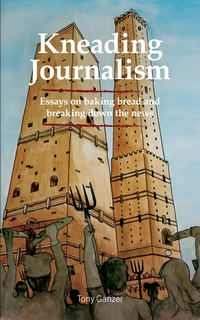
Kneading JournalismKneading Journalism:
Essays on baking bread and
breaking down the news

by Tony Ganzer

DETAILS:
Publisher: Cherry Mountain Media
Publication Date: March 17, 2023
Format: eBook
Length: 166 pg.
Read Date: April 14-29, 2023


What’s Kneading Journalism About?

This book is centered on the idea of the kitchen table—a (perhaps mythological) place where people can sit down, have a meal, and discuss a wide range of issues with respect and frankness. What can be found in every culture on the globe on those tables as a staple—particularly when enjoying the company of someone outside your household? Bread.

Ganzer used to work in a bakery and has recently gotten serious about his breadmaking again. He brings bread into this collection in two important ways. First, he includes a recipe for a different kind of bread to accompany every essay. Secondly, he incorporates something about the enjoyment, projection, and/or history of a bread into the essay about journalism (this sounds like it’d take some stretching or forcing of the issue—but it doesn’t. Or Ganzer’s just so good that he can force it without it feeling that way).

Beyond that—the essays themselves are about the state of journalism/news media in the U.S. and in other countries around the world (not exhaustively, just where Ganzer has some experience), along with personal reflections on his career in journalism. Some of the topics he covers are: journalism education (and how it can help “consumers” as well as “producers”); Machiavelli and his relation to the media as well as contemporary equivalents; The Daily Show and similar “journalism cosplay”; and being a reporter in the middle of the Egyptian revolution.

Bread

I want to start by saying how much I love this way of organizing the essays and the motif of the bread.

I’m no expert, but the recipes (advertised as for any level of baker) do look easy enough and pretty tasty. I need to get around to trying them someday.

But more importantly, the way that Ganzer weaves the various breads and factoids about it (wow, Germans seem to love the stuff) into these essays is really commendable and helps hook the reader into the rest.

Journalism

Ganzer is an advocate for and believer in a certain type of journalism—one that cares more about informing citizens for the public good, not one that’s about reinforcing our own bias.

To say that he takes a dim view of most cable news would be an understatement. He’s also not crazy about the way that public figures are calling the press the enemy of the American people—and going out of their way to erode trust in the press. Since Watergate, American esteem of reporters has shifted, and over the last few years that shifting has sped up.

What Ganzer wants to reinvigorate is a respect for constructive journalism. Reminding the reader that reporters can—and should—serve a vital function in society. Particularly in a democracy.

He compares and contrasts, for example, the way the press has been viewed and used throughout history, as well as in other parts of the world—like Egypt and Germany.

I’m going to cut myself off here before I say too much about Ganzer’s arguments—he’ll do a much better job of it, and I don’t want to muddy the waters.

So, what did I think about Kneading Journalism?

This is a great read—challenging, but in a friendly, welcoming way. Thoughtful and thought-provoking without being combative or overly critical. Ganzer has a point of view—and makes no claim about lack of bias here—but isn’t pushing a partisan outlook, just a pro-responsible press outlook. Brief, but not insubstantial.

I enjoyed reading these essays and appreciated the insight and opinions. But I couldn’t stop with just reading—I spent time afterward thinking about the individual essays as well as the book as a whole. Both in terms of the content of the essays as well as in how to apply and evaluate what I read/watch.

I’m afraid this isn’t going to find the readership it deserves—but I hope it does find readers that the message resonates with and that they can at least spread the ideas and carry them into their own lives and media consumption. It’s something all Americans need to think about before it’s too late.

I encourage you to read and think about this. I’d grab a new book by Ganzer without much thought and would hope that there are other books like it out there for me to read, too.

Disclaimer: I received a copy of this book from the author in exchange for this post and my honest opinion.


4 Stars

This post contains an affiliate link. If you purchase from it, I will get a small commission at no additional cost to you. As always, the opinions expressed are my own.

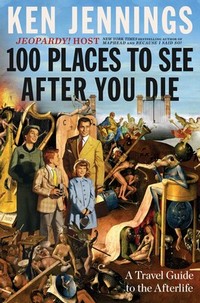
100 Places to See After You Die by Ken Jennings: The Tour Guide No One Wants, But Everyone Needs

100 Places to See After You Die100 Places to See After You Die:
A Travel Guide to the Afterlife

by Ken Jennings

DETAILS:
Publisher: Scribner Book Company
Publication Date: June 13, 2023
Format: eARC
Length: 304 pg.
Read Date: May 24-26, 2023


What’s 100 Places to See After You Die About?

Ken Jennings provides a handy tour guide through one hundred visions of the afterlife for the modern reader. Complete with tips on places to see, areas to avoid, local lingo, bits of trivia, dining tips, and so on, it’s just the kind of thing you’re going to want to peruse before you shuffle off this mortal coil, so you know where to go.

The book is broken down into: Mythology, Religion, Books, Movies, Music and Theater, and Miscellaneous. Then (alphabetically) Jennings looks at a variety of afterlife locales in each category.

For example, the Books section covers:

Aslan’s Country • The Bridge • The Cemetery • The Empyrean • The Five Lessons • Half-Life • The Inbetween • Inferno • The Kingdom • King’s Cross • Mansoul • The Null • Pandemonium • Paradiso • The Parish • Purgatorio • Riverworld • The Third Sphere • The Time Bubble • The Undying Lands • The Valley of the Shadow of Life*

* From Lewis’ The Chronicles of Narnia and The Great Divorce; O’Connor’s story “Revelation”; Saunders’ Lincoln in the Bardo; Milton’s Paradise Lost; Albom’s The Five People You Meet in Heaven; Dick’s Ubik; Sebold’s The Lovely Bones; Dante’s The Divine Comedy; Twain’s “Captain Stormfield’s Visit to Heaven”; Rowling’s Harry Potter; Moore’s Jerusalem; King’s Revival; O’Brien/O’Nolan’s The Third Policeman; Farmer’s Riverworld; Matheson’s What Dreams May Come; Oliver’s The Time Bubble; and Tolkien’s The Lord of the Rings.

Jennings describes each place with wit, humor, Dad Jokes, puns, irreverence, and plenty of facts.

Dancing Through a Minefield

It’s one thing to talk about places like Valhalla, Hades, The Bad Place, Bill & Ted’s Bogus destination, or Futurama‘s Robot Hell in a light-hearted or flippant fashion. It’s an entirely different can of worms to discuss the LDS Three Kingdoms of Glory, Jannah, Jahannam, Ariel Toll Houses/Telonia, and so on—in the same tone.

I will not say that Jennings was able to fully succeed in discussing the afterlives described in some major religions in an unoffensive manner. Primarily because I’m not an adherent of any of the religions he discussed, so my tolerance for that is really high. Had he tackled something I believe in, I very well could’ve been at risk of insult.

That said, I think he did okay. Yes, he walks close to irreverent. But he maintains a decent degree of respect. The humor largely comes from the way he describes the beliefs not at the expense of an article of faith.

Still, some people might want to skip over a chapter or two if they’re worried about getting their toes stepped on. (but those people probably aren’t going to be reading this book in the first place)

A Few Highlights

Ohhh, there are just so many.

The Books section was my favorite—followed closely by Movies and Television—this is the kind of thing I blog about, think about, and so on, so it makes sense that those sections resonated with me most. The Books section, in particular, discussed portions of those works in ways I could really sink my teeth into.

But there were multiple highlights in each section—I learned a lot about D&D, I couldn’t help singing “Ghost Riders in the Sky” during that chapter, I think he pointed out a good plot hole in It’s a Wonderful Life (I don’t know, maybe he’s not the first), I loved the discussion of Bosch’s paintings, and so on.

The chapter on The Good Life was fantastic—a great systematization of the series’ take on the afterlife (and several characters). The chapter on Nirvana was sublime.

Books, movies, mythologies, songs, etc. that I’ve never heard of, much less, read/watched/listened to/studied were described in enough detail that I could appreciate those chapters and maybe even develop an interest in following up on.

Problems/Quibbles/Things That Didn’t Work for Me

Um. Hold on, I’ll think of something.

oh! Here’s a problem: the eARC came with the typical “don’t quote from this version until verified by the published edition” warning—but it was more pronounced than usual. I really want to use samples throughout this post, but I can’t. (and I wouldn’t have even without this warning, because I know things get tweaked in the final stages).

Actually, I do have a legitimate gripe. There are no footnotes—or even endnotes*—for anything that Jennings says. Most of what the book contains could fall into the category of “General Knowledge” (at least for people who know anything about The Good Place, Dante, or the religion of the Maori). But I wouldn’t have minded a point in the right direction to learn some more details, context, or background on many, many, many things Jennings wrote about.

* It’s been decades since I haven’t asked why a book uses endnotes when footnotes exist, and yet I’d have liked to have them in this book more than the nothing we got. That’s how much this bothers me.

I Can’t Help Pondering…

Given the argument of Planet Funny: How Comedy Took Over Our Culture by Ken Jennings, I wonder about his approach to the subject of the afterlife. Sure, even Planet Funny was frequently funny as it critiqued the overuse of humor in our culture, but for his next book to take this tone, seems to undercut the work.

Or maybe it just shows that even as he can look with clear eyes at some of the weaknesses of our culture, he’s part of it and is subject to the influences. It’s almost like he’s human.

So, what did I think about 100 Places to See After You Die?

This section is going to be shorter than usual because I think I’ve pretty much answered the question already.

From the “throwaway lines” to the big ideas, this was a delight from start to finish. I thoroughly enjoyed this approach to the subjects—quick hits that tell you the essentials and make you smile while telling them.

Jennings’ style is one I aspire to, and can’t say enough good things about.

I can’t think of a reason not to give this 5 Stars, but my gut tells me not to. So I’ll knock it down to 4 1/2 (which isn’t a big deal since Goodreads, NetGalley, etc. won’t let me use 1/2 stars, I’ll round up). It’s educational, it’s entertaining, and it’s thought-provoking. You can’t go wrong with this.

Disclaimer: I received this eARC from Scribner via NetGalley in exchange for this post and my honest opinion—thanks to both for this.


4 1/2 Stars

This post contains an affiliate link. If you purchase from it, I will get a small commission at no additional cost to you. As always, the opinions expressed are my own.

Douglas Adams’ London by Yvette Keller: The Map of London I Never Knew I Needed

Douglas Adams’ London Douglas Adams’ London

by Yvette Keller

DETAILS:
Publisher: Herb Lester Associates
Publication Date: April 15, 2023
Length: 2 pgs.
Read Date: May 6, 2023


What’s Douglas Adams’ London?

This is a map of important locations (42 of them, of course) in London for Douglas Adams, the Dirk Gently series, and/or the Hitchhiker’s Guide series.

The reverse side explains why the locations were selected and gives some biographical information about Adams’ relation to each spot. I loved learning something about Hotblack Desiato, Fenchurch’s apartment, the pizza place Dirk Gently talked about, and so on.

The Design/Art

The map itself has some nice little bits of art scattered throughout—cartoonish little sketches of things like a dolphin, a sperm whale, and a certain depressed android. Just fantastic illustrations that made an already interesting map into something you want to come back to time and again.

The people at Herb Lester Associates who put this together did a simply wonderful job.

So, what did I think about Douglas Adams’ London?

I’ve already given up on my dream of wandering around London—but, boy, howdy, this makes me want to go even more.

Keller is described as “the planet earth authority on Douglas Adams literary tourism,” and will soon publish a travel guide to London. Who better to put something like this together?

Douglas Adams’ London is a gem—even if you never get the chance to put this information into action, it’s great to have.

This post contains an affiliate link. If you purchase from it, I will get a small commission at no additional cost to you. As always, the opinions expressed are my own.

Catch-Up Quick Takes: Some Overdue Audiobook Takes

This is a post I’d hoped to get up the first week of February, making it…very late. But here we go…

As always, I want to say that the point of these quick takes posts is to catch up on my “To Write About” stack—emphasizing pithiness, not thoroughness.


Destructive ReasoningDestructive Reasoning

by Scott Meyer, Luke Daniels (Narrator)

DETAILS:
Series: The Authorities, #2
Publication Date: November 16, 2022
Format: Unabridged Audiobook
Length: 9 hrs., 21 min.
Read Date: January 5-10, 2023

(the official blurb)
This sequel starts off with a sequence as silly, but slightly less cringe-worthy, as the first book before shifting to the major storyline. This one takes the team to Los Angeles to investigate a series of killings. The common thread amongst the victims is that they were playing a version of Dr. John Watson in a movie/TV series.

Not only have there been some killings, but there are three actors in the area who are currently playing Watson (or a Watson-figure), and the team has to investigate and keep them alive.

We get some mocking of the Entertainment Industry, general silliness when it comes to the team, and even a little more backstory on a couple of characters.

Overall, I didn’t like this quite as much, it felt like Meyer was trying too hard to be funny rather than tell a story in his signature way. Still, it was enjoyable enough to finish and want to see more.

Luke Daniels did his typical bang-up job. Ending the audiobook with bloopers was a fun bonus.

3 Stars

Ms. DemeanorMs. Demeanor

by Elinor Lipman, Piper Goodeve (Narrator)

DETAILS:
Publisher: HarperAudio
Publication Date: December 27, 2022
Format: Unabridged Audiobook
Length: 7 hrs., 27 min.
Read Date: January 17-18, 2023

(the official blurb)
I saw this a few times on my Libby app and decided I wasn’t that interested as cute as it sounded, but at some point, I saw a cover blurb from Richard Russo. So, why not?

Jane Morgan is under house arrest and newly unemployed thanks due to a minor crime, a nosy neighbor, and a judge wanting to make an example of her. She’s forced to try to do things to help the time bearable—including making the acquaintance of someone else in her building also under house arrest.

There’s some romantic comedy here, some self-discovery, and just some warm-hearted fun. It’s not fantastic, but it’s a good way to spend some time. It’ll keep you engaged and entertained.

3 Stars

The Wizard’s ButlerThe Wizard’s Butler

by Nathan Lowell, Tom Taylorson (Narrator)

DETAILS:
Series: The Wizard's Butler, #1
Publisher: Podium Audio
Publication Date: April 20, 2021
Format: Unabridged Audiobook
Length: 12 hrs., 10 min.
Read Date: January 25-27, 2023

(the official blurb)
I feel like I should have a lot to say about this one, but I don’t (which kind of bugs me). It’s the story of a man being hired to be a butler/caretaker of an older man for a year. After that year, the unscrupulous relatives that hired him will pay Roger a disgusting amount of money and will ship Joseph Perry Shackleford off to a retirement home and take control of his money and property.

What is going to make this easier is that Mr. Shackleford forward thinks he’s a wizard. Roger could use the money and likes Mr. Shackleford, so he doesn’t care what the old man thinks he is. Roger wants to help him—and he’s pretty sure that his new bosses are up to no good, maybe he can cause them some trouble.

It turns out, however, that the old man actually is a wizard. Roger gets introduced to a world he couldn’t have imagined was real if he tried.

This book was charming as all get out. I really enjoyed the story, the world, the magic system, the characters (I really enjoyed the characters), and the way that Lowell put this together—Taylorson’s narration was effective and engaging, too.

This is the slowest-paced Urban Fantasy I’ve ever read—with stakes that are so far smaller than we’re used to, which doesn’t stop it from being something that holds your attention. It could probably be safely described as Cozy UF—Fred, the Vampire Accountant books have more violence, and it’s typically tame 90% of the time. And I’m more than ready for more of this kind of story.

3 Stars

Really Good, ActuallyReally Good, Actually

by Monica Heisey, Julia Whelan (Narrator)

DETAILS:
Publisher: HarperAudio
Publication Date: January 17,2023
Format: Unabridged Audiobook
Length: 10 hrs., 13 min.
Read Date: January 20-25, 2023

(the official blurb)
This is a look at the ups and downs—and further downs, and deeper downs–of a young woman in the year after her divorce. It’s about grieving her relationship, friendship, dating (we’ll be generous/prudish and call it that), and accepting yourself–and accepting help.

I thought the prose and inventiveness in certain scenes were spot-on. There’s a lot of cleverness displayed throughout. But while there are some great moments, but I just didn’t think the journey was worth the destination—and I’m not that crazy about the journey, either.

It’s an utterly fine book.

3 Stars

How to AstronautHow to Astronaut:
An Insider’s Guide to
Leaving Planet Earth

by Terry Virts

DETAILS:
Publisher: Workman Publishing Company
Publication Date: July 15, 2022
Format: Unabridged Audiobook
Length: 11 hrs., 23 min.
Read Date: January 27-31, 2023

(the official blurb)
This is exactly what you want in an astronaut memoir—he talks about his interest in the program and why he wanted to become an astronaut, his training–both for the Space Shuttle and ISS—actual service on both—(obviously spending more time on the ISS because he spent more time on it and there was more to talk about), as well as what it’s like after returning to Earth. It’s not glowing about NASA or any space program—he’s frank and honest about problems, his own errors, and difficulties as well as what a fantastic opportunity it was for him.

He’s witty, thoughtful, and reflective throughout (in both the writing and his audio narration). I thoroughly enjoyed it and can see myself returning to this one in the future.

3 Stars

This post contains affiliate links. If you purchase from any of them, I will get a small commission at no additional cost to you. As always, my opinions are my own.

Semicolon (Audiobook) by Cecelia Watson, Pam Ward: No, Really—I Assure You, It’s Interesting

SemicolonSemicolon:
The Past, Present, and Future
of a Misunderstood Mark

by Cecelia Watson, Pam Ward (Narrator)

DETAILS:
Publisher:HarperAudio
Publication Date: July 30, 2019
Format: Unabridged Audiobook
Length: 3 hrs., 47 min.
Read Date: March 13, 2023

Grammar, in our mythical narrative, is part of the good old days. People used to know grammar properly, we think, the same way they used to walk three miles to school uphill in the snow, and everyone was polite, and better looking and thin, and well dressed.*

* I want to stress that the above represents my guesswork on punctuation, Watson’s is probably superior)

What’s Semicolon About?

I’m going to go the lazy route and just lift from the Publisher’s Website:

A page-turning, existential romp through the life and times of the world’s most polarizing punctuation mark
The semicolon. Stephen King, Hemingway, Vonnegut, and Orwell detest it. Herman Melville, Henry James, and Rebecca Solnit love it. But why? When is it effective? Have we been misusing it? Should we even care?

In Semicolon, Cecelia Watson charts the rise and fall of this infamous punctuation mark, which for years was the trendiest one in the world of letters. But in the nineteenth century, as grammar books became all the rage, the rules of how we use language became both stricter and more confusing, with the semicolon a prime victim. Taking us on a breezy journey through a range of examples—from Milton’s manuscripts to Martin Luther King Jr.’s “Letters from Birmingham Jail” to Raymond Chandler’s The Big Sleep—Watson reveals how traditional grammar rules make us less successful at communicating with each other than we’d think. Even the most die-hard grammar fanatics would be better served by tossing the rule books and learning a better way to engage with language.

Through her rollicking biography of the semicolon, Watson writes a guide to grammar that explains why we don’t need guides at all, and refocuses our attention on the deepest, most primary value of language: true communication.

Pam Ward’s Narration

Wow…just wow. Ward throws more emotion, dynamic changes, dramatic changes, and overall oomph! into this narration than several novels I can name. It was so striking, so entertaining, and engaging that most of what I liked and noticed about this book can be attributed to her.

Seriously, immediately before this, I’d listened to a book with multiple murders, other violent crimes, and a natural disaster threatening homes and livelihoods—Ward filled a book about a punctuation mark with more pathos and excitement than that.

At least half the stars down there belong to her.

So, what did I think about Semicolon?

A grammar attack is, quite simply, an ad hominem attack that looks more legitimate becuase it’s dressed up in a cap and gown.

The fact that this ends up being about more than the semicolon is both a strength and a weakness.

It’s a strength because Watson simply doesn’t have enough material to just talk about the semicolon for 200 pages (in the hardcover). The material was so wanting that she really had to spend a lot of time on the case about sales of alcohol in early 20th century Boson than it was worth.

I thought her material on Raymond Chandler and Martin Luther King, Jr. was fantastic. The origins of the semicolon and the ups and downs of its usage pre-grammar textbooks were fascinating.

But when she went off on grammar rules, how they get in the way of communication, can help shut down discourse, etc. The book suffered. Now, she was insightful, helpful, and persuasive on these points (and I say this as someone who reflexively comes down on the “prescriptivist” side in grammar debates). But when she did that, she walked away from “The Past, Present, and Future of a Misunderstood Mark,” and it bugged me. If Watson was going to write something like Emmy J. Favilla’s A World Without “Whom” or Gretchen McCulloch Because Internet, I’d be there in a heartbeat. (also, if she wanted to tackle punctuation beyond the semicolon like Shady Characters by Keith Houston, I’d be all for that) But for this book, she went too far afield for this reader’s taste and lost a lot.

At the end of the day—if you want a rousing celebration and examination of the winking half of an emoticon—or the mark’s more illustrious use and history, this is the book to grab. I almost never recommend a particular format of a book, but you need to listen to at least a sample of Ward’s narration.

This post contains an affiliate link. If you purchase from it, I will get a small commission at no additional cost to you. As always, the opinions expressed are my own.

BOOK SPOTLIGHT: Crimes of Famous & Infamous Criminals by Mitzi Szereto

I’m very pleased today to Spotlight Mitzi Szereto’s upcoming release, The Best New True Crime Stories: Crimes of Famous & Infamous Criminals. It comes out on February 14th—just what your Valentine wants. Assuming your Valentine is into true crime, that is. (I’m not being snarky, I know quite a few people who’d do well to pick this up in lieu of chocolates. Or at least in addition to chocolates).

Anyway, before I make this more awkward, let’s move on to looking at the book.

Book Details:

Title: The Best New True Crime Stories: Crimes of Famous & Infamous Criminals
Author: Mitzi Szereto
Genre: True Crime
Publisher: Mange
Release date: February 14, 2023
Format: Paperback/Ebook
Length: 252 pages
Crimes of Famous & Infamous Criminals

About the Book:

Infamous Figures Caught in the Act
People from all walks of life commit crimes. But the ones featured in this anthology aren’t your typical neighbors or subway passengers. Actors, musicians, TV personalities—they aren’t always who they appear to be. You might be surprised at just how many household names and Hollywood stars have led nefarious double lives. And after committing their crimes, the world may have kept on turning, but their infamous legacies remain. Get the stories behind these public figures, both contemporary and historical, who turned to lives of crime. The Best New True Crime Stories: Crimes of Famous & Infamous Criminals offers a fascinating assortment of cases from around the world and from various time frames. Like previous entries in this series, this volume contains all new and original nonfiction accounts penned by international writers from across the literary spectrum, including true crime, crime fiction, and journalism, all expertly arranged by editor Mitzi Szereto. Inside, you’ll find cases that would thrill even the most seasoned true crime addict; stories of Hollywood stars and famous criminals who went down the wrong path; encounters featuring the cases of infamous celebrities like Robert Blake, Jimmy Savile, Fatty Arbuckle, and more.

Book Trailer:

Purchase Links:

Amazon US ~ Barnes & Noble ~ Books-a-Million ~ Amazon UK ~ Blackwells ~ Amazon Canada ~ Chapters/Indigo ~ Angus & Robertson Australia ~ Booktopia

About the Author:

Mitzi Szereto Mitzi Szereto (mitziszereto.com) is an American-British author, anthology editor, and short story writer whose work spans multiple genres. Her widely acclaimed series The Best New True Crime Stories features the volumes Crimes of Famous & Infamous Criminals; Unsolved Crimes & Mysteries; Partners in Crime; Crimes of Passion, Obsession & Revenge; Well-Mannered Crooks, Rogues & Criminals; Small Towns; and Serial Killers. Aside from her many popular books, she has the added distinction of being the editor of the first anthology of erotic fiction to include a Fellow of the Royal Society of Literature. Mitzi has appeared internationally on radio and television and at literature festivals, and taught creative writing around the world. She produced and presented the London-based web TV channel Mitzi TV and portrays herself in the pseudo-documentary British film, Lint: The Movie. Follow her on Twitter, Instagram, TikTok, and Facebook @mitziszereto.

Author Links:

Website ~ Twitter ~ Facebook ~ Instagram ~ Youtube ~ TikTok ~ Goodreads


One more time, it’s out on Feb. 14th—get your preorder in now.

E.B. White on Dogs edited by Martha White: A Great Collection of Short Pieces

E.B. White on DogsE. B. White on Dogs

edited by Martha White

DETAILS:
Publisher: Tilbury House Publishers
Publication Date: March 7, 2016
Format: Paperback
Length: 177 pg.
Read Date: December 28-31, 2022
Support Independent Bookstores - Visit IndieBound.org

Next year, when Dog Show time comes round, we would like to see a wholly new brand of showmanship introduced into the Garden… A dog should be made to work for his ribbon, each breed in his own wise. Pointers should have to point, Shepherds should be required to herd a band of sheep from the east goal to the west goal. Poodles should be required to jump through a paper hoop, not just follow Mrs. Sherman Hoyt around the ring. English bull terriers should be made to count up to ten, retrievers retrieve rubber ducks, Scotties chew up old shoes. Greyhounds should be put over the high hurdles. St. Bernards carry brandy to anyone in the audience who feels weak, preferably us. Beagles would jolly well have to bealge, or shut up. How about it, dogs—are you dogs or mice?

What’s E. B. White on Dogs About?

This is a collection of essays, articles, letters, and other brief notes written by E.B. White about dogs. In other words, it’s what the title says. Most of the entries are very short—1-2 pages, some are a paragraph long—but (especially toward the end), we get some longer letters and essays.

Most are about White’s dogs—particularly Fred, a beloved dachshund. But there are pieces about dog shows and other dogs, too.

A Few Highlights

This is going to be tough, there are just too many options. Something about Dog Shows brought out the best and/or snarkiest in White, and are possibly my favorite moments.

There’s a point where he describes how a dachshund climbs up and down stairs and the optimum height for said stairs. I don’t know about the height, but he described perfectly how our pug uses the stairs and it’s something I’m going to borrow. He had, over the course of his life, multiple dachshunds and his affection for the breed is evident. But you can tell that Fred had a big impact on White—both during and after his death. The piece White wrote after his death is possibly the highlight of the book.

There’s a long (for this book, anyway) piece about taking a dog on its first coon hunting trip—it’s just wonderful. It’s tonally different from most of the book, which probably helps it stand out—but it didn’t need much help.

Some Non-Dog Moments

Not everything in this book is focused on dogs but involves them tangentially. The best of these pieces are about contemporary politics—I knew some of the names, but not all of them, but that didn’t change things really.

There’s an essay from The New Yorker that I’d probably have paid half the purchase price of the book for—it’s called “Khrushchev and I (A Study in Similarities).” Some newspaper published a feature on the Soviet premier, and from what I can tell, it was the puffiest puff piece around. White takes some parts of that feature to show how much he and Khrushchev are alike—they’re devoted to their families, like walking in the woods, and so on. The last paragraph points out some important differences, too—size, amount of hair left on their heads, the fact that White has never threatened to bury America…the usual differences. And just as he has you chuckling in a different way than he has for a few pages, the last line or two are somber and sober. Fantastic stuff.

So, what did I think about E. B. White on Dogs?

Overall, this was a great collection. It does feel like Martha White hit “Ctrl-F” on an electronic version of everything her grandfather had written and pasted the entire contents of that search into this book. Some of the letters contain one sentence about a dog—not always that cleverly written or interesting—and I had to wonder why she bothered, outside of a drive for thoroughness.

I don’t recommend reading too much of this at once—but maybe that’s just me, my attention waned after too many entries. But if you’re familiar with White’s non-children’s writing, or have the desire to be, and enjoy reading about dogs (and a couple of cats, and a squirrel or two)—you’ll enjoy this.

Speaking of his non-children’s writing—in her note to the reader describing the impetus for the book, and their approach to editing, keeping the pieces “largely as they appeared originally, not attempting to mesh the inconsistencies.” (including some phrasing I don’t think you’d get away with today). Martha White says,

The letters…are more casual in style and my Tillbury House editor was surprised to find that the co-author of The Elements of Style did not always get his that and which correct, especially in the early years. Our hands-off policy nearly killed her.

I feel for that editor and can’t help but chuckle about E.B. White’s divergence from his own book.

All in all, this book delivers what the title promises, and if that’s up your alley, you’ll enjoy it. I sure did.


4 Stars
This post contains an affiliate link. If you purchase from it, I will get a small commission at no additional cost to you. As always, the opinions expressed are my own.

My Favorite Audiobooks of 2022

My Favorite Audiobooks of 2022
Last year I kicked off my Year-End Retrospective with a look at my favorite audiobooks, I might as well repeat that this year. How do I keep this from being just a rehash of my other year-end lists? By focusing on the audiobook experience over the content. What was it like to listen to it? How engaging was it, how did the narrator do? Was it a good match in terms of tone, content, and performance? All of these books are/were good—but the audiobooks are a bit better because of the narrator and the rest of the people involved in the production.

(in alphabetical order by author)

The LawThe Law

by Jim Butcher

My original post
Sure, I love Harry Dresden—so it’s almost a given that this novella is going to show up somewhere on my end-of-year lists. The fact that Jim Butcher did the narration himself makes this something special (thankfully, he’s still fully intending on having James Marsters do the series). Butcher’s good at this, he’s not great, but he’s good. Hearing his idea about what the characters that we know and love sound like was a lot of fun. Also, after all the epic and emotional moments that Butcher’s put his fans through lately, having something non-epic or world-changing like this is such a nice breather.

4 Stars

Black Nerd ProblemsBlack Nerd Problems:
Essays

by William Evans & Omar Holmon

My original post
Funny, insightful, thoughtful, thought-provoking, passionate (about things both important and trivial). This collection of essays about pop culture, race, and the intersection of those two things was a surprise to me—I thought I’d have a good time with it, I didn’t know I’d have a great time and be moved, too. The authors narrated this themselves—both have backgrounds in poetry jams, and the panache from that shines through. I have quoted this and referred more people to various essays in this than probably anything else this year.

4 Stars

On Eden StreetOn Eden Street

by Peter Grainger, Gildart Jackson (Narrator)

My original post
This one makes the list due to the nature of the book and how well Jackson handled it. The previous book served as a transition point from the DC Smith Mysteries to the Kings Lake series—but this is the one that’s truly different. We have a bunch of new characters to deal with in addition to serving those we’ve grown accustomed to. The nature of the central character and his new boss underlines how different this is from the previous incarnation, but it’s the same books at their core. And Jackson gets both through to the listener. It’s all there in Grainger’s text, no doubt—but it’s the narration that solidifies it for the listener.

4 1/2 Stars

A Wizard's Guide to Defensive BakingA Wizard’s Guide to Defensive Baking

by T. Kingfisher, Patricia Santomasso (Narrator)

My original post
I don’t know if I can put my finger on why this made the list, but as I was looking over the list of audiobooks I read in ’22, as soon as I saw this one, I knew it had to make the list.

Between Kingfisher’s text and Santomasso’s narration, this was just a great experience. The story is fun, the characters (particularly as embodied, or emvoiced?, by Santomasso) were endearing—as a whole, it was an immersive and pleasant time—just what you want in an audiobook.

3.5 Stars

The World Record Book of Racist StoriesThe World Record Book
of Racist Stories

by Amber Ruffin & Lacey Lamar

My original post
My wife assures me that the paper version of this is well-worth reading, but I can’t imagine having the opportunity to listen to Ruffin and Lamar reading this and passing it up—the goofy voices they employ and little tunes they sing in addition to the reading adds a nice little layer to the book that you’re not going to get with the print edition.

This is a more serious, more somber, book than its predecessor was—by design. But because of that, it feels like they dialed the silliness up to help alleviate things. It can’t be an easy balancing act—discussing the horrors of everyday racism in a way that is entertaining enough that it can educate those that need it the most. Ruffin and Lamar hit that balance in both print and in audio.

4 Stars

How to Be PerfectHow to Be Perfect:
The Correct Answer to
Every Moral Question

by Michael Schur (Writer, Narrator)
with: Michael Schur, Kristen Bell, D’Arcy Carden, Ted Danson, William Jackson Harper, Manny Jacinto, Marc Evan Jackson, Jameela Jamil, and Todd May

My original post
Yeah, that’s a huge cast—but 95+% of the work is done by Schur. The contributions of the rest shouldn’t be overlooked, but when you think about the narration, you’re going to be thinking about the author, Mike Schur. My appreciation for Schur’s writing goes back before I knew who he was on a baseball blog that I really enjoyed. After that, I got on board with this TV writing and became a huge fan. What puts this audiobook on this list is the way that Schur is able (thanks to his own writing) to make this introduction to ethics and philosophy so accessible. It doesn’t feel dry, or head-in-the-clouds at all. Yes, I have significant issues with a lot of the thinking in this book (he rules out theism or morality given to us by a deity from the get -go), but that doesn’t mean I can’t learn from it—I can’t gain an appreciation of the thinking through ethical dilemmas.

I had fun, and I think I learned something. You can’t ask for more.

4 Stars

Movies (And Other Things)Movies (And Other Things)

by Shea Serrano, Mario Toscano (Narrator)

My original post
There’s a little bit of the seriousness of Black Nerd Problems in this collection of essays about Movies (and things like it), but Serrano doesn’t spend that much time with it. Serrano’s approach to movies is a wonderful hybrid of fanboy and educated critic that can appeal to people all over that spectrum. This results in a book that’s a great combination of movie knowledge/insight, social commentary, and humor mixed throughout each of these. Even when it came to movies I’ve never seen, have no interest in seeing, or saw ages ago and don’t remember well, Serrano kept me pretty engaged and entertained. Toscano’s narration is so good, so convincing that you have to remind yourself that he’s reading Serrano’s words and isn’t speaking from the heart.

3.5 Stars

We Are Legion (We Are Bob)We Are Legion (We Are Bob)

by Dennis E. Taylor, Ray Porter (Narrator)

My original post
Stumbling across this series is one of the highlights of 2022 for me. Ray Porter doing the narration is what pushed me to give this story a shot, and I’d be happy I did if only for his narration. I can think of a handful of narrators that could’ve got this gig (based on their other work, etc.) and I’m not sure how many of them would’ve got me to come back so quickly—nothing against Taylor’s text, but it’s Porter’s skill and warmth that elevates this book (and the rest of the series) into something I can see myself revisiting often.

It’s not all about Porter, I should make clear—Taylor has a gift for SF comedy. Throw in Bob’s snark and optimism and the great premise that pretty much opens the door for Taylor to do just about anything he wants in the series for as long as he wants to, and you’ve got yourself a real winner.
3 Stars

The HobbitThe Hobbit, or
There and Back Again

by J.R.R. Tolkien, Andy Serkis (Narrator)

My original post
As soon as I read that Serkis was doing audiobook versions of The Hobbit and The Lord of the Rings, I knew I had to listen to them—what could be better? I mean, for the scene between Bilbo and Gollum alone, you know that The Hobbit is going to be worth the time and expense. And it was.

The rest of the book is great, too, make no mistake. Serkis knows what he’s doing with his voice—because of the nature of a lot of his acting jobs, his voice has to carry the performance that his (own and natural) face can’t. It’s a great skill that he brings to bear on an audiobook’s narration. This is just a joy to listen to.

5 Stars

Free BillyFree Billy

by Don Winslow, Ed Harris (Narrator)

My original post
Speaking of actors who can do a lot with their voice, here’s Ed Harris. There’s something so natural about his delivery of this short story that I have to wonder why he hasn’t been making audiobooks for years. It’s like Winslow’s words were written solely for him (I’ve heard three of these Audible Originals from this pair and could listen to another 20 this year). This book is a sequel to The Dawn Patrol—one of my All-Time Desert Island books. You get Ed Harris to do the narration on that, and you know I’m going to love it. People who aren’t me are likely going to enjoy it a lot, too.

(sure, there’s part of me that wishes Ray Porter had been used—his work on the audiobook for The Dawn Patrol was stellar, but why be greedy?)

5 Stars

Page 8 of 31

Powered by WordPress & Theme by Anders Norén