Author: HCNewton Page 210 of 623

Marshall Karp Appreciation Day

This was all supposed to go up last Tuesday, but Life Happened. Then it was supposed to be Thursday—and more Life. Then I realized that today was Publication Day for Karp’s new novel, NYPD Red 7: The Murder Sorority, so why not do this today? I’ve already posted my Pub Day Repost about that book, so this introduction is going up out of order, but…oh, well.

Marshall Karp
I’ve mentioned before that there was a time in my life when I didn’t let myself read a lot of fiction—I had my goals set on other things. Marshall Karp is one of those authors I discovered around the time I refocused things and started reading fiction The Rabbit Factoryagain. His book, The Rabbit Factory, jumped off the New Release shelf at the local library and worked for me on so many levels—I was absolutely hooked by it and I’m not really sure how many times I’ve read it—a minimum of four times.

That Lomax and Biggs series has gone the way of all things and Karp has moved on to other things—notably co-authoring a stand-alone novel and a series with that up-and-comer, James Patterson (really hope things work out for him). 2022 has brought us his first solo novel in years, Snowstorm in August, and, as of today, the first in the NYPD Red series without Patterson’s involvement.

This past summer, I got an email out of the blue from Karp asking if I’d be interested in reading Snowstorm in August. And I went all fan-boy in my response. The level of fan-boy where I misspelled the name of the Lomax and Biggs series and didn’t notice it until I received his reply. Thankfully, Karp was still interested in sending me the book and participating in a Q&A with me—he also sent me today’s release.

I’ve exchanged emails/DMs/tweets, etc. with quite a few authors since I started this here blog—but my Karp fandom predates it, so our exchange hits me in a different spot, you know? Thankfully, his correspondence is as entertaining for me as his novels are (just in a different way). It has been a blast for me to work with him.

So I wanted to take a little extra time to thank him for his gracious emails, his time these last couple of months, and the books he mailed me. That box included a signed hardcover of The Rabbit Factory, which I assure you is in a very prominent place in my library.

And now, I urge you to track down his books. The Lomax and Biggs series, NYPD Red (especially NYPD Red 7: The Murder Sorority as I discuss here), and Snowstorm in August. I’ll be posting my take on the latter in a little bit, and my Q&A with Karp will be coming up a little bit later (read it if only to be inspired to contribute to his great charity).

PUB DAY REPOST: NYPD Red 7: The Murder Sorority by Marshall Karp: Is This Elite Squad Ready for Their Latest Challenge?

NYPD Red 7: The Murder SororityNYPD Red 7: The Murder Sorority

by Marshall Karp

DETAILS:
Series: NYPD Red, #7
Publisher: Blackstone Publishing
Publication Date: November 21, 2022
Format: ARC
Length: 352 pgs.
Read Date: November 8-9, 2022
Support Independent Bookstores - Visit IndieBound.org

What’s NYPD Red 7: The Murder Sorority About?

Part of this feels like too much to say, but it’s right there in the title (also, the publisher’s description), so…

Practically simultaneously, two wealthy and well-known producers are killed. One was shot by a sniper pulling off an incredibly difficult shot. The other was killed by a knife attack in broad daylight with no witnesses. These two were brothers, and each had given some people clear motives to kill them. But both at the same time? It’s difficult to tie them together. The NYPD Red squad—with Kylie MacDonald and Zach Jordan in the lead—is assigned to these cases and they want to consider that there’s one person behind the killings—with two accomplices doing the killing. But can they actually establish a link?

During their investigation, a theory begins to surface about a team of assassins operating under the name of a sorority—Kappa Omega Delta. KOD—Killers On Demand. It sounds farfetched to the partners (and their captain), but they keep running into the idea. And soon, they might start to find some actual evidence pointing to it.

Meanwhile, in a probably unrelated incident, Kylie’s boyfriend is shot. Officially barred from investigating (and she is front-and-center on a case the media and City Hall are focused on), Kylie is mostly watching this from the sidelines—but manages to help the detectives on the case while worried about his recovery.

The KOD Story

I’m both annoyed and glad that the description of the book tipped its hand so much about the assassins. I prefer to discover that kind of thing in my mystery novels—don’t tell me what the characters are going to figure out, let me do it with them. But knowing it was coming did make it easier to buy into.

Up to the point that Zach and Kylie really start to take the notion seriously this novel had the feel of a pretty by-the-book procedural. They were being methodical, beating the bushes, checking off the things they needed to—and that’s the kind of thing I really appreciate seeing in detective novels. I’ve said it before, I’ll keep saying it, too.

Then there’s a shift in the way the novel worked once we get to that point, though, and it takes on a heightened reality*-sense as the detectives try to work out the details of the KOD group—how they operate**, who they are, and how to track them down. The shift isn’t a qualitative one, really, it’s more subjective—it’s a different feel to the book. One that is probably more in line with the rest of the series. The transition jarred me a bit, but not so much that it took me out of the book—but it reminded me what kind of book I was reading.

* I really need to find or develop a synonymous phrase for that, because I use it too often in this post. Sorry about that.

** I fought off the temptation to really dig into this part here, you should read it for yourself.

Looking back over this whole thing, I’m really impressed with it—at several points Karp plays against what you believe is happening. I don’t think he ever pulls the rug out from beneath the reader—but he gives it a good, strong tug, and makes you stumble a bit. It may not be as flashy as a huge twist but can leave the reader just as discombobulated and unprepared for what’s next.

The Personal Subplots

I thought these were handled pretty well. There were elements of Zach’s story that seemed like pretty large coincidences, but if a reader isn’t willing to accept a convenient coincidence here and there, it might be time for a new hobby. I do think that story was handled pretty well.

The same goes for the plot about Kylie’s boyfriend and the shooting (and what that suggests about the ongoing story about her now-missing husband). I think this shooting, the investigation, and the resolution was actually the strongest storyline in the novel and Karp developed it well. Especially in the heightened reality of this series, this came across as pretty grounded.

I’d have to go and look at my posts about the first two books in this series to see if I say anything about it—but I don’t want to. I’m pretty sure that at the time I thought the books spent too much time on the personal lives of these two detectives. To an extent, it made sense while establishing the characters, but I still thought the balance was off. Perhaps it’s because this is a later book in the series, perhaps it’s the shift in authors, maybe it’s just the way things worked out here in NYPD Red 7—I’m not sure I care—but that problem is gone. I even paused to note a couple of times how compared favorably to my memories of the first two books.

So, what did I think about NYPD Red 7: The Murder Sorority?

I went into this book with apprehensions—I dropped this series after two books and while I don’t remember being opposed to coming back, I sure wasn’t in a hurry to. But when someone mails me an ARC, I tend to read it. And I’m really glad I did—it won me over pretty easily, I got invested and caught up in the story, and generally had fun reading the book.

The best thing I can compare this to is an episode of Castle—but with two Detective Becketts and no novelist. Detectives—and their friends, lovers, contacts—who are impossibly attractive and extraordinarily bright on the trail of implausibly effective and skilled killers. And it’s just as entertaining as that series was at its best.

The heightened reality of this series works well in the cases these detectives are involved with—Entertainment personalities and the super-rich. I’ve always liked the idea of a squad like NYPD Red (see also, The Closer‘s Priority Homicide), and halfway assume something like this actually exists. Given media scrutiny and politics, it makes sense for cases of this profile to be handled differently (as long as no one’s ignoring other cases per Bosch’s maxim). I enjoy seeing detectives work in this world as much as I do seeing them in more “everyday” settings belonging to the middle and lower class.

There’s part of me that wants to harp on the implausibility of KOD. But I don’t know why I would—it’s a fun idea and works well in this novel. Karp’s version of this thing that we’ve seen and read about in other books/shows/movies/comics is as successfully conceived and executed as I’ve seen it. And as I said before, if you accept the world of this series, the outlandish nature of the KOD works well. So, I don’t know why I feel like I have to make excuses for it or justify it, but I do feel that way. The KOD is a good challenge for Kylie and Zach and the way they confront it is entertaining. Which is what this book is about. He’s not attempting to tell a gritty story like Winslow’s The Badge (which has parts that are just as implausible)—this is an action-adventure story.

This is a fun read—I raced through it because Karp’s writing and pacing wouldn’t let me put it down until I had to. I thought the novel was stronger than the first two in the series and I’m tempted to go back and see where the series started improving. I’m definitely interested in NYPD Red 8, assuming that Karp gets to do another one and I hope the sales without Patterson’s name on the cover allow it.

Even if you’ve never read this series (maybe particularly), pick this up if you’re in the mood for an adventurous Police Detective novel, I think you’ll be glad you did.


4 Stars

Disclaimer: I received this ARC from the author unexpectedly in conjunction with another, this had no bearing on the opinions offered above.
This post contains an affiliate link. If you purchase from it, I will get a small commission at no additional cost to you. As always, the opinions expressed are my own.

A Few Quick Questions with…James Brayken

Earlier today, I posted about James Brayken’s debut, The Veiled Edge of Contact (please give it a look if you haven’t seen it yet). Now I get to ask the author a few questions. I really appreciated his answers and time. Hope you enjoy this!


Why don’t we start off with you telling us a little about yourself, what got you into writing/your path to publication, and so on.
Ever since I was a teenager I wanted to write novels, but for a long time I didn’t seriously pursue that goal because whenever I sat down to write, I found I didn’t really know how to effectively express the ideas in my head. So, I would stop before giving my ideas much of a chance. Not until I took up drawing as a hobby did I fully appreciate that you need to work through the initial difficulty when you first put pencil to paper and what comes out isn’t what you intended. Rather than stop in disappointment, I realized I needed to keep drawing and redrawing, and the improvement was visually obvious. They say that writing is mostly rewriting, and once I fully digested that, everything changed.

How much of James Brayken is there in Okon (or another character from the book)?
Ha, hopefully Okon and I don’t share too many characteristics. But admittedly, I would imagine there is a bit of me in all of the book’s characters. Some of these shared characteristics I’m aware of and some, I’m sure, I’m completely oblivious to. That said, I think who we are is many-sided and fluctuating, i.e., I think we all have the capacity to be a bit Okon-like from time to time.

Clearly (well, it seems clear to me), the stories told here aren’t something you arrive at all at once, can you describe the genesis of the idea?
In the early stages, I naturally turned to the things that were of interest to me. In fact, I have a rule that I only write about what I’m personally interested in rather than what I think others might like. I’ve always been fascinated by the existence of uncontacted tribes (although they are growing fewer in number, there are still at least a hundred uncontacted tribes out there according to estimates), and I’ve always been captivated by the idea of extraterrestrial contact and what the outcome of this might be. I think the genesis point came when I began exploring how different levels and types of “first contact” might be overlaid in the same story, and this theme formed the foundation of the narrative for The Veiled Edge of Contact.

All authors have more ideas running around in their head than they can possibly develop—what was it about this idea that made you commit to it?
I do recall being acutely aware that I could forever flit between entirely different ideas and never develop any of them to any substantial degree. And so, I made another rule (I like giving myself rules) that I would stick with my uncontacted tribe/alien contact premise because I was personally excited by the potential scenarios that might unfold. I kept playing with that premise until (after many many iterations of ideas and drafts) I had a fully fledged story that I was happy with.

Not to pick a fight here, but you’ve described the book as “genre-breaking.” I’m not sure that I buy that. In your mind, what do you mean by that phrase and how does your novel do that?
I use the term “genre-breaking” as shorthand communication to potential readers that this science fiction novel breaks a number of first contact sci fi conventions. It’s tricky to be too specific about this without giving spoilers, but I want readers to know up front that this book is going to be different from what they might typically expect of a first contact story, and feedback from readers seems to agree that this book is “different”, “surprising”, “unusual”, “refreshing”, etc.

Just to add, I have no issue with conventions. I love them, in fact. They are integral to how we communicate through narrative, and The Veiled Edge of Contact certainly contains conventions including those that place the book firmly within the genre of sci fi (advanced tech, extraterrestrials, etc.). But the story also contains a number of atypical elements and atypical turns. This is what I want potential readers to be aware of so they can make an informed decision as to whether the book is something they might like.

It’s hard to pick just one or two things to focus on to ask about that don’t involve spoiling the whole book…but I want to talk about Ratu for a minute. I don’t know precisely what to ask—just tell the reader something you want to know about him.
I really enjoyed developing the character of Ratu and in particular his interactions with Okon. I have a theory that “outsiders” tend to be drawn to each other, perhaps sometimes by necessity, even if they have nothing in common except the fact that they don’t fit in very well elsewhere. That in itself can be a bond. I view Okon and Ratu in this way. They squabble like siblings but are initially bonded by their outsider-like status. Another reason I enjoyed developing Ratu’s character is that he annoys the other characters and through doing so we get to learn more about not just Ratu but also those he has annoyed—usually Okon. Not that Ratu is the only tribe member to rub others the wrong way. Far from it. I was very keen for the Wuchumbu to be a living, breathing collection of individuals, each with their own set of idiosyncrasies and opinions. And the result is they bicker a lot.

What was the harder thing to develop and write about—the SF future tech and culture or the culture and practices of the Wuchumbu?
I’d say I found the culture of the Wuchumbu to be less difficult to develop and write about than the SF future tech. Perhaps I felt this way simply because I so much enjoyed bringing the Wuchumbu to life—establishing their values and cultural practices, defining what it is that unites them and makes them Wuchumbu and what it is that separates them from their fellow tribe members. In my view, the tribe are the lifeblood of the novel, and, ultimately, it’s the characters that cause us to invest in a story, right? Well, for me that’s the case.

Who are some of your major influences? (whether or not you think those influences can be seen in your work—you know they’re there)
If we are talking about artists, writers, and filmmakers then my thoughts initially turn to the cyberpunk genre. Although The Veiled Edge of Contact isn’t cyberpunk, I am a big fan of the genre and I’m sure it has influenced me and will continue to do so. The classics of cyberpunk (including proto-cyberpunk) have probably influenced me most, such as Neuromancer (William Gibson), Do Androids Dream of Electric Sheep? (Philip K. Dick), both Blade Runner movies (Ridley Scott and Denis Villeneuve), and the original Ghost in the Shell manga (Masamune Shirow). I imagine the cyberpunk influence will become more apparent the more work I produce. I’m also a fan of horror and so there will be some influences creeping in from there too.

I wouldn’t have guessed cyberpunk to be in that spot (there’s a reason I say “you know they’re there”), but I have to say after reading that answer that I can see that in the background of the novel (deep background, maybe—it’s in the DNA).
Let’s play “Online Bookstore Algorithm.” What are 3-5 books whose readers may like The Veiled Edge of Contact?
Okay. I promise I won’t cheat by looking at the Goodreads “Readers Also Enjoyed” section. So, I think if you like sci fi stories (or any story really) that involve unusual scenarios with some humor and darkness thrown in the mix, then you may well like The Veiled Edge of Contact. With that in mind, I’ll include Annihilation by Jeff VanderMeer in my answer for its unusual scenario and darkness. Annihilation is a very different type of book than mine, but there are some similarities in subject. I’d also include Oryx and Crake by Margaret Atwood for its eccentricity and humor. And finally, The Gone World by Tom Sweterlitsch for its dark tone—a tone that sometimes surfaces in The Veiled Edge of Contact.

Disclaimer: I find it difficult to predict what people will like. It seems to me that taste is a complex beast.

What’s next for James Brayken, author?
I’m presently developing the idea for my second novel, which will also be science fiction, and I intend to publish it some time in the second half of 2023. Well, actually, I’m developing two ideas concurrently as I’ve been unable to decide which one to go with next. Hopefully I’ll be able make that decision soon. I’ll probably need to make another rule for myself!

Thanks for your time—and thanks for The Veiled Edge of Contact, I was swept up in it and I hope you have plenty of success with it.
Thank you, H.C. Newton. It’s been a pleasure.


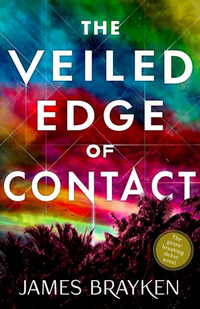
The Veiled Edge of Contact by James Brayken: Apotheosis Through Union

I’ve got a a Q&A with the author coming up in an hour or so. I haven’t read his A’s yet (so I didn’t have to rethink anything I wrote below), but I’m betting they’re worth your time. Come back and give them a read, will you?


The Veiled Edge of ContactThe Veiled Edge of Contact

by James Brayken

DETAILS:
Publisher: Oh Gentle Night
Publication Date: May 10, 2022
Format: eBook
Length: 384 pg.
Read Date: October 26 - November 1, 2022

…right now, I’m not discounting anything— time travel included— just because it sounds unbelievable. Unbelievable is the new norm.

What to Say? What to Say? What to Say?

This is one of those books that I have a lot of things that I want to talk about. There is so much worthy of discussion. But if I talked about it all—in the ways that I’m tempted to—you’d finish reading this post and say, “Yeah, H.C., this book sounds like it’s full of interesting ideas, but now I don’t need to read the book.” Then I’d have to admit you were right, and I’d feel bad and the tens of you that read this wouldn’t buy Brayken’s book. So then I’d feel guilty, because he seems like a real nice guy, so then I’d buy multiple copies of it to make up for the copies you don’t buy. Then Mrs. Irresponsible Reader would see what I spent and a fi—ahem—an intense discussion would ensue. Annnd….

Well, let’s just say that’s just too much drama. So I’m going to have choose what I discuss carefully.

What’s The Veiled Edge of Contact About?

Okon is no one’s idea of an SF hero—including his own. A former chef of some notoriety, he hasn’t worked in some time, instead, he’s lived a life of comfort. His wife, Efawi, is an engineer-entrepreneur who is very politically active. Okon isn’t sure that he shares her politics—he definitely doesn’t want her as active as she is (particularly as it puts her under the unfriendly gaze of the government). A few years back, she’d become hugely successful and he’d quit working, and mostly sat around all day playing video games and watching movies (or a futuristic equivalent).

It’s been seventy or so years since a large war of some sort in Africa (and, possibly, other places, it’s not made specific). They live in a country near the largest jungle—but the specifics (again) aren’t given. The couple has little in common beyond a shared history and commitment to each other. As all marriages do, they’ve had their ups and downs—they’re currently in the middle of a prolonged down—but Okon is sure (fairly sure), they’ll turn it around.

But before they can, Efawi’s political activity puts her on the outs with the government, she’s accused of some serious crimes and goes missing. Several days later, Okon finds messages for him to come after her and meet her—she’s on the verge of a discovery that will change everything. Assuming she can finish it without being arrested. She wants her husband with her and has left him directions and equipment—including an armored exosuit—to follow.

Weeks after she’d gone missing, Okon follows her into the jungle. Something about the jungle (and he assumes what she came looking for) interferes with almost all of his tech—particularly the communication portions. So he’s relying on data drops Efawi left behind giving directions to the next one, and the next, and both are starting to despair about how long it’s taking him to catch up.

Okon then stumbles upon a group that call themselves Wuchumbu. They’re possibly the last people group on Earth unfamiliar with and untainted by technology, “modern” culture, etc. They want nothing to do with anyone not in their group and set to attacking him. Stuff happens, and he ends up living with the Wuchumbu and looking for his wife. He’s certain that there’s something about the Wuchumbu, their practices, their location…something that is tied to the tech issues. And therefore, this is where he’ll be able to find Efawi.

And then a whollllle bunch of other stuff ensues.

The Tone of the Novel

This doesn’t read like an SF novel (not that there’s a monolithic tone/voice for SF, but not many come across this way). It might feel like a Mike Chen SF novel, if it was set in an African jungle. But that’s as close as you’re going to find.*

* If I wasn’t late getting this up in the first place, I might spend 3-4 paragraphs on this point. Part of me wants to restart the whole post and say “Pretend Mike Chen wrote a book that’s set…” The more I think about this comparison, the more apt it feels.

The whole novel is rather dark and dystopic but is written in such a way that you can easily forget that. Okon is a likable fellow and his voice (it’s a first-person narration), is pretty much what you’d expect from an adult male who spends his life watching movies and playing video games while his wife revolutionizes science and tries to shake up her country’s government. That same, laid-back attitude crosses time and culture, apparently.

When you wipe everything away, this is the story about a man looking for his wife, increasingly concerned that he can’t find her—but who habitually (and through force of will) is optimistic in the face of increasing challenges. Making this ultimately a sweet—and potentially sad—story. Largely because of Okon’s outlook, his voice, and his devotion to Efawi. Those challenges—mostly those things we just wiped away—take the form of the Wuchumbu, the government Efawi is fleeing from, Okon’s tech issues, and a mess of other obstacles.

A Question of Genre

The descriptions for this book describe it as “genre breaking.” I’m not sure about that. I don’t know that it’s wrong, but I fear that it might mislead some readers (I went into it with skewed assumptions, for example). I’ve got a Q&A with Brayken coming along later today, and he might convince me otherwise—I haven’t read his responses yet, so I don’t know.

What I would say is that The Veiled Edge of Contact is a great example of the wideness of Science Fiction, the range of ideas and settings that it’s capable of, the diversity of characters, and more. I’m not saying that Brayken has done things I haven’t seen in SF before, but the way he combined most of the aspects of this book is pretty rare. (I’d say it’s unique, but as soon as I do that, someone’s going to point out something similar out there, so let’s stick with rare).

The fact that he mixes so many ideas together successfully, with wit and polish not usual for a first novel makes this stand out.

So, what did I think about The Veiled Edge of Contact?

I want to go home—to the one made from bricks. I crave my room. I crave walls and ceilings. I’ve never felt so strongly about carpet.

I felt a little lost at the beginning—there’s a pretty big disconnect between the Prologue and Chapter 1. But I pushed on through and Brayken quickly won me over and I forgot about everything that I got hung up on in the Prologue and the disconnect I felt. Literally forgot—so much so that when that material became relevant again, I had to work to remember it. Which is a compliment, Brayken got me so sucked into to Okon and the Wuchumbu and everything that was immediately going on that it consumed all my attention.

I wanted to see what was around the corner, what was going to befall our (mostly) hapless protagonist next. But I also just wanted to live in the moment and spend more time with him and that moment to go on—because whatever befell him next was going to push the narrative to an end and I’d have to say goodbye. We’ve all been there before with novels, you know that sensation. I got a major dose of it from this book.

I don’t know what more to say about the book than that. Brayken plays with SF concepts, tropes, and mainstays, and does things with them that are familiar and are strikingly unfamiliar. Mostly at the same time. But on the whole, while he’s doing that you don’t care—you just want to see what’s coming next. All the thoughts about what he’s doing and why and how it changes the story come after you’re done—or when you step away for a while for work or whatever.

I would love to sit down and pick his brain some time over a meal and dig down into his thinking and some of the choices he made. I’m not crazy about all of them—but they were absolutely the right choices, and I’m glad he made them (maybe especially the ones I’m not crazy about). Brayken immersed me in another world and I really didn’t want to leave. There’s not a whole lot more I can say that’s more complimentary than that.

Now, I’ve behaved and haven’t said too much. It’s your turn to keep the other end of the bargain. Go and do the right thing and buy this book, will you?


4 Stars

Disclaimer: I received a copy of this book from the author in exchange for this post and my honest opinion.

Creeds, Confessions, and Catechisms: A Reader’s Edition edited by Chad Van Dixhoorn

Creeds, Confessions, and CatechismsCreeds, Confessions, and Catechisms: A Reader’s Edition

edited by Chad Van Dixhoorn

DETAILS:
Publisher: Crossway
Publication Date: June 21, 2022
Format: Clothbound
Length: 434 pg.
Support Independent Bookstores - Visit IndieBound.org

What’s Creeds, Confessions, and Catechisms: A Reader’s Edition?

This is a collection of Ecumenical Creeds and some of the most-used Protestant Confessions and Catechisms. These are:
bullet The Apostles’ Creed
bullet The Nicene Creed
bullet The Athanasian Creed
bullet The Chalcedonian Definition
bullet The Augsburg Confession
bullet The Belgic Confession
bullet The Thirty-Nine Articles of Religion
bullet The Canons of Dort
bullet The Westminster Confession of Faith
bullet The London Baptist Confession
bullet The Heidelberg Catechism
bullet The Westminster Larger Catechism
bullet The Westminster Shorter Catechism

Each document is given a 1-2 page introduction by the editor describing “its origins and significance” to the church (as the Publisher puts it).

As I’m not foolhardy enough to give pluses and minuses (or whatever) when it comes to the matieral, so this isn’t going to be my typical kind of post.

Questions I Had

While reading through this collection, I had a few questions about why Van Dixhoorn selected certain Confessions (no offense, Lutherans and Baptists) or why he picked particular translations of some of them. And I’d intended to spend a little time discussing them and speculating about the answers. But then I read on Crossway’s site that this book was “Adapted from ESV BIble with Creeds and Confessions,” so I guess that edition of the ESV probably did the selecting in the first place and Van Dixhoorn stuck with that.

Why Should You Buy Creeds, Confessions, and Catechisms: A Reader’s Edition?

bullet It’s very attractive—the cover design is top-notch. The interior layout is pleasing to the eye and easy to read. The paper is nice and thick. It looks good on your shelf or in your hands. On the one hand, this is a minor point—but it’s a big selling point for a reference work.
bullet Along those lines, the binding and everything makes me think this is going to last a long time—and through repeated readings.
bullet The way it’s typeset and laid out would make it easier as a copy to read through some or all of the contents. I’ve got multiple copies of most of these documents, and a lot of them aren’t easy to read—they’re more things you consult briefly. This is one I could sit down with regularly and just read.
bullet That’s what it’s designed for—to read. It’s right there in the title. This isn’t an edition for people who are doing scholarship or research. You’ve got Schaff for that—or James Dennison’s set.
bullet Especially if you’re looking for an introduction to the Protestant standards, this is a handy edition and guide to the essentials.
bullet Van Dixhoorn’s introductions are user-friendly and helpful to orient the reader to the origin, concerns, and highlightings of each document.

This post contains an affiliate link. If you purchase from it, I will get a small commission at no additional cost to you. As always, the opinions expressed are my own.

Saturday Miscellany—11/19/22

It’s been a quiet week on the blog, I know. I’m going through one of those spells where I just have no energy and fall asleep at my keyboard while writing. I managed to get 1/3 of my planned posts for the week up. So now I have no energy and a paralyzing anxiety about things that pretty much only I care about. It’s a fun combination, I highly recommend avoiding it🙂 I trust that I’ll shake it off (I always have before), but in the meantime, expect things to be slim around here.

Meanwhile, I’m hoping that the people who keep Twitter going are able to stabilize that ship, because despite all the helpful posts about going to Mastadon, I just don’t feel smart enough to figure it out (and yes, I’m this close to hiring one of my kids to do set it up for me…I can’t believe I’m at the age where I’m relying on my kids to do this for me). I hope I don’t lose track of all of you in the seemingly-immanent collapse.

But for now, here’s a quick miscellany to wrap up the week!

Odds ‘n ends about books and reading that caught my eye this week. You’ve probably seen some/most/all of them, but just in case:
bullet 125 Most Borrowed Books—In honor of its 125th Anniversary, the Brooklyn Public Library posted a list of its 125 most-borrowed books. It’s a fun list and one that gives a pretty clear view of their primary borrowing demographic.
bullet Author Sarah Maclean shared a handy-dandy thread on how to keep up with favorite authors in a post-Twitter world
bullet Behind the Blue Wall: How my time in the LAPD Academy helped Shape My Series—Aaron Philip Clark gives some background for his series
bullet Damppebbles’s annual recommendation-fest, #R3COMM3ND3D keeps chugging along and the hits keep coming—some great-looking reads this week (as per usual).
bullet …with #BookBlogger Carol
bullet …with #BookBlogger HC Newton (what does he know, anyway? Guy can’t even handle social media platforms)
bullet …with #Author Joy Kluver
bullet …with #BookBlogger J – LoveBooksReadBooks
bullet …with #Bookstagrammer Zoebeesbooks
bullet …with #Bookstagrammer Lynda Checkley
bullet …with #BookBlogger Namrata Ganti
bullet ’Tis the Season to Buy Books … for Other People—a guide to giving books as gifts. Not just for the upcoming season, these suggestions apply year-round.
bullet Christmas gift ideas for book lovers – edition 2022-2023—even for those of us not big on certain seasonal observances, I enjoy looking at this kind of posts (and really like #3)
bullet The Six Stages of Having Too Many Books—I can relate to this—also, I think it’s amusing enough to justify putting up with The New Yorker trying to sell a subscription.
bullet Is listening to an audiobook, reading?—Are we all fed up with this question yet? Delany makes his position clear early on.
bullet In Defence of Nasty Reviews—preach it! That line from Joanna Russ is one I’m going to employ at every opportunity.

A Book-ish Related Podcast episode (or two) you might want to give a listen to:
bullet Page Break with Brian McClellan Ep 55 – Nicholas Eames – Epic Fantasy Author—a fun chat, and a little glimpse at the next book in the trilogy

This Week’s New Releases that I’m Excited About and/or You’ll Probably See Here Soon:
bullet title by Cherie Priest—everyone’s favorite Travel Agent/rookie psychic is back in this strong follow-up. I opined about it a couple of weeks ago (back when I seemed to be able to write things).
bullet Have I Told You This Already?: Stories I Don’t Want to Forget to Remember by Lauren Graham—I find Graham’s writing as least as charming as her acting, so I can’t wait to dive into this jog down memory lane. (Also, it’ll check off one of the last book challenge items I have this year.)
bullet The Twist of a Knife by Anthony Horowitz—Horowitz himself (well, the fictional one) is the prime suspect in this book’s murder—will Hawthorne be able to help him? More importantly, will he want to?
bullet Welcome to the Game by Craig Henderson—I can’t resist a good high-speed car scene in print or in film, this one looks like it should have a few (and probably some other gripping material).
bullet How to Survive Everything by Ewan Morrison—An estranged father kidnaps his teenaged children to help them survive an impending pandemic that he’s certain is around the corner (even if no one else is).

Lastly, I’d like to say hi and extend a warm welcome to yvonnembee, who followed the blog this week. I hope you enjoy the content and keep coming back.

The Ballad of Bonaduke—Episode 9: The Hand that Feeds by R. T. Slaywood: Things Get Weird…er, Weirder

The Ballad of BonadukeThe Ballad of Bonaduke—
Episode 9: The Hand that Feeds

by R.T. Slaywood

DETAILS:
Series: The Ballad of Bonaduke, #9
Format: Kindle Vella Story
Read Date: November 10, 2022

Letting out a breath I repressed a laugh then pinched the bridge of my nose, where it had been broken several times. I know that I’ve never done well with people, but even this was beyond my normal social dysfunction.

I can do better

The Story So Far…

A drunken Michael Bonaduke decides to use a grift (with maybe some sort of magic/magic-like “help”) to win on a scratch-off lottery ticket so he has money to buy more to drink. He pulls off whatever he did, gets his money and some booze and stumbles off into the darkness to drink himself into oblivion so he can start again the next day. He’s hit by dark memories (probably what’s driving him to the drinking) of fire, pleading, and screaming. There’s going to be a price to pay for his grift, and he’s trying to be ready.

Before then, he gets himself drunk and we get some of his tragic backstory. As he ponders this, he decides to use some of his ill-gotten-gains to buy more booze and walks into a liquor store robbery. He foils it in some sort of magical fashion, gets some more to drink, and heads off to the park to drink until he’s arrested (probably for the failed robbery). At least that’s his plan, but it gets interrupted by being hit by a car. He wakes up on some sort of short, metal bed and is unsure what’s going on. It turns out that some group is subjecting him to a test—if he passes, everything will be explained to him (and hopefully the reader, too).

What’s The Hand that Feeds About?

Michael’s two captors? Examiners? Guides? Take him to an apartment in another part of the city—after everything he’s been through in the last day or so, he collapses into an exhausted sleep. When he wakes one of the pair is still with him—Om. Om either subjects him to more tests or starts the day off with strange tasks for him. Neither the reader nor Bonaduke knows for sure.

So, what did I think about The Hand that Feeds?

I think I like the path that we’re on…I really do, but it’s too soon to know for sure. I had fun with this, though.


3.5 Stars

The Friday 56 for 11/18/22: Theft of Swords by Michael J. Sullivan

The Friday 56This is a weekly bloghop hosted by Freda’s Voice.

RULES:
The Friday 56 Grab a book, any book.

The Friday 56 Turn to Page 56 or 56% on your ereader. If you have to improvise, that is okay.
The Friday 56 Find a snippet, short and sweet.
The Friday 56 Post it.

from Page 56 of:
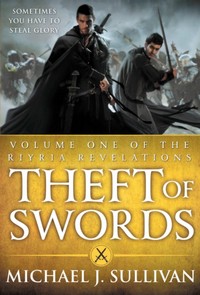
Theft of Swords

Theft of Swords by Michael J. Sullivan

The room was unused.

Hadrian remained silent near the window as Royce moved across the room to the door. He watched as the thief’s feet tested the surface of the floor before committing his weight. Royce mentioned once how he had been in an attic on a job when he hit a weak board and fell through the bedroom ceiling. This floor was stone, but even stones sometimes had loose mortar or contained hidden traps or alarms. Royce made it to the door, where he crouched and paused to listen. He motioned a sign for walking with his hand and then began counting on his fingers for Hadrian to see. There was a pause, and then he repeated the signal. Hadrian crossed the room to join his friend and the two sat waiting for several minutes in silence.

Eventually Royce lifted the latch with gloved hands but did not open the door. Outside they could hear the heavy footfalls of hard boots on stone, first one set, and then a second. As the steps faded, Royce opened the door slightly and peered out. The hall was empty.

NYPD Red 7: The Murder Sorority by Marshall Karp: Is This Elite Squad Ready for Their Latest Challenge?

This was originally intended on being one of three or four Marshall Karp-centric posts today. But I could only get one finished on time—you’ll be seeing more about this author soon.

NYPD Red 7: The Murder SororityNYPD Red 7: The Murder Sorority

by Marshall Karp

DETAILS:
Series: NYPD Red, #7
Publisher: Blackstone Publishing
Publication Date: November 21, 2022
Format: ARC
Length: 352 pgs.
Read Date: November 8-9, 2022
Support Independent Bookstores - Visit IndieBound.org

What’s NYPD Red 7: The Murder Sorority About?

Part of this feels like too much to say, but it’s right there in the title (also, the publisher’s description), so…

Practically simultaneously, two wealthy and well-known producers are killed. One was shot by a sniper pulling off an incredibly difficult shot. The other was killed by a knife attack in broad daylight with no witnesses. These two were brothers, and each had given some people clear motives to kill them. But both at the same time? It’s difficult to tie them together. The NYPD Red squad—with Kylie MacDonald and Zach Jordan in the lead—is assigned to these cases and they want to consider that there’s one person behind the killings—with two accomplices doing the killing. But can they actually establish a link?

During their investigation, a theory begins to surface about a team of assassins operating under the name of a sorority—Kappa Omega Delta. KOD—Killers On Demand. It sounds farfetched to the partners (and their captain), but they keep running into the idea. And soon, they might start to find some actual evidence pointing to it.

Meanwhile, in a probably unrelated incident, Kylie’s boyfriend is shot. Officially barred from investigating (and she is front-and-center on a case the media and City Hall are focused on), Kylie is mostly watching this from the sidelines—but manages to help the detectives on the case while worried about his recovery.

The KOD Story

I’m both annoyed and glad that the description of the book tipped its hand so much about the assassins. I prefer to discover that kind of thing in my mystery novels—don’t tell me what the characters are going to figure out, let me do it with them. But knowing it was coming did make it easier to buy into.

Up to the point that Zach and Kylie really start to take the notion seriously this novel had the feel of a pretty by-the-book procedural. They were being methodical, beating the bushes, checking off the things they needed to—and that’s the kind of thing I really appreciate seeing in detective novels. I’ve said it before, I’ll keep saying it, too.

Then there’s a shift in the way the novel worked once we get to that point, though, and it takes on a heightened reality*-sense as the detectives try to work out the details of the KOD group—how they operate**, who they are, and how to track them down. The shift isn’t a qualitative one, really, it’s more subjective—it’s a different feel to the book. One that is probably more in line with the rest of the series. The transition jarred me a bit, but not so much that it took me out of the book—but it reminded me what kind of book I was reading.

* I really need to find or develop a synonymous phrase for that, because I use it too often in this post. Sorry about that.

** I fought off the temptation to really dig into this part here, you should read it for yourself.

Looking back over this whole thing, I’m really impressed with it—at several points Karp plays against what you believe is happening. I don’t think he ever pulls the rug out from beneath the reader—but he gives it a good, strong tug, and makes you stumble a bit. It may not be as flashy as a huge twist but can leave the reader just as discombobulated and unprepared for what’s next.

The Personal Subplots

I thought these were handled pretty well. There were elements of Zach’s story that seemed like pretty large coincidences, but if a reader isn’t willing to accept a convenient coincidence here and there, it might be time for a new hobby. I do think that story was handled pretty well.

The same goes for the plot about Kylie’s boyfriend and the shooting (and what that suggests about the ongoing story about her now-missing husband). I think this shooting, the investigation, and the resolution was actually the strongest storyline in the novel and Karp developed it well. Especially in the heightened reality of this series, this came across as pretty grounded.

I’d have to go and look at my posts about the first two books in this series to see if I say anything about it—but I don’t want to. I’m pretty sure that at the time I thought the books spent too much time on the personal lives of these two detectives. To an extent, it made sense while establishing the characters, but I still thought the balance was off. Perhaps it’s because this is a later book in the series, perhaps it’s the shift in authors, maybe it’s just the way things worked out here in NYPD Red 7—I’m not sure I care—but that problem is gone. I even paused to note a couple of times how compared favorably to my memories of the first two books.

So, what did I think about NYPD Red 7: The Murder Sorority?

I went into this book with apprehensions—I dropped this series after two books and while I don’t remember being opposed to coming back, I sure wasn’t in a hurry to. But when someone mails me an ARC, I tend to read it. And I’m really glad I did—it won me over pretty easily, I got invested and caught up in the story, and generally had fun reading the book.
The best thing I can compare this to is an episode of Castle—but with two Detective Becketts and no novelist. Detectives—and their friends, lovers, contacts—who are impossibly attractive and extraordinarily bright on the trail of implausibly effective and skilled killers. And it’s just as entertaining as that series was at its best.

The heightened reality of this series works well in the cases these detectives are involved with—Entertainment personalities and the super-rich. I’ve always liked the idea of a squad like NYPD Red (see also, The Closer‘s Priority Homicide), and halfway assume something like this actually exists. Given media scrutiny and politics, it makes sense for cases of this profile to be handled differently (as long as no one’s ignoring other cases per Bosch’s maxim). I enjoy seeing detectives work in this world as much as I do seeing them in more “everyday” settings belonging to the middle and lower class.

There’s part of me that wants to harp on the implausibility of KOD. But I don’t know why I would—it’s a fun idea and works well in this novel. Karp’s version of this thing that we’ve seen and read about in other books/shows/movies/comics is as successfully conceived and executed as I’ve seen it. And as I said before, if you accept the world of this series, the outlandish nature of the KOD works well. So, I don’t know why I feel like I have to make excuses for it or justify it, but I do feel that way. The KOD is a good challenge for Kylie and Zach and the way they confront it is entertaining. Which is what this book is about. He’s not attempting to tell a gritty story like Winslow’s The Badge (which has parts that are just as implausible)—this is an action-adventure story.

This is a fun read—I raced through it because Karp’s writing and pacing wouldn’t let me put it down until I had to. I thought the novel was stronger than the first two in the series and I’m tempted to go back and see where the series started improving. I’m definitely interested in NYPD Red 8, assuming that Karp gets to do another one and I hope the sales without Patterson’s name on the cover allow it.

Even if you’ve never read this series (maybe particularly), pick this up if you’re in the mood for an adventurous Police Detective novel, I think you’ll be glad you did.


4 Stars

Disclaimer: I received this ARC from the author unexpectedly in conjunction with another, this had no bearing on the opinions offered above.
This post contains an affiliate link. If you purchase from it, I will get a small commission at no additional cost to you. As always, the opinions expressed are my own.
Book Blogger Hop: Are You a Voracious Reader or a Book Nerd?

Book Blogger Hop


This prompt was submitted by Billy @ Coffee Addicted Writer:

Which do you prefer to be known as: a voracious reader or a book nerd?

If I’m going to limit myself to those choices, I guess I’d probably go with “voracious reader”. I like the term book nerd, though, and would answer to it unthinkingly. But voracious seems to fit me better (although it also feels like an understatement…from my first reading to today, I saw myself in Scout Finch’s “Until I feared I would lose it, I never loved to read. One does not love breathing.”).

However, if I’m not limiting myself to those options, I have a few other ideas:
bullet The ubiquitous Book Wyrm/Book Dragon label
bullet A Book Shark (à la “I always read. You know how sharks have to keep swimming or they die? I’m like that. If I stop reading, I die.” as Patrick Rothfuss has said)
bullet An Irresponsible Reader (see this comic, and, well…the banner above)
bullet A Bookish Weirdo (thanks, Fahrenheit Press merch!)
bullet But I think my favorite description is something I stumbled onto via a Kevin Hearne tweet: “ink drinker” (buveur d’encre) (see this post from bluesyemre for other nifty international terms).

How do you self-identify as readers?

Page 210 of 623

Powered by WordPress & Theme by Anders Norén